When you lay out the chain of events that have led to Mark Vientos playing first base for the New York Mets every day, it becomes less surprising that the Mets have been one of the worst teams in baseball this season. During the winter, the organization made the decision, which will likely seem pretty smart in the long term but was highly unpopular in the moment, to let another team pay full price for Pete Alonso's next five seasons. To replace the franchise's all-time home run leader, the Mets signed Jorge Polanco, with an eye on moving him to first base. Vientos, along with fellow not-quite-busted corner infield prospect Brett Baty, was surely a trade candidate during the offseason, but wound up on the Opening Day roster as depth and a platoon-specific option at designated hitter.
That those three have not recreated Alonso's (middling to poor) early production with the Orioles in the aggregate is not surprising, really. Polanco has been more of a designated hitter than a second baseman in recent seasons, and hurt more often than healthy for much of his career; he had never previously been a first baseman and will turn 33 in July. Baty is by far the superior fielder at first, and has looked competent with the glove wherever the team has asked him to stand, but could most politely be described as an enigmatic offensive contributor; Vientos is the most capable of hitting the ball over the fence. That Polanco could miss a bunch of games was always a possibility, and that is happening now: After a slow start, he was placed on the IL in mid-April with a bruised wrist and a debilitating and stubborn case of Achilles bursitis that has shown every indication of becoming a classic Mysterious Lingering Mets Ailment. Though he was cleared for baseball activities earlier this week, Polanco by all accounts cannot really do any of those baseball activities right now. "We need to get asymptomatic with the ankle and with the bursitis," Mets President of Baseball Operations David Stearns said on Tuesday. "We're not there yet."
Where the Mets are instead is "extremely in last place," and with the second-fewest wins in the sport. More specifically, it has meant that Vientos, who would ordinarily not start for any first-place division team and would ideally not be asked to play defense at all, is holding down first base while Baty plays third; Bo Bichette, also signed to play a new position, has moved from third back to shortstop while Francisco Lindor continues what seems likely to be a prolonged recovery from another ominously vague lower-body injury.
Leaving aside the fact that all of the aforementioned have spent the season being late on low-90s fastballs and hitting dorky little pop-ups, you can see why this would not work out well. The raw bulk and odd mysteriousness of this by no means complete catalog of injuries is Not What You Want, but more than that there is the way that all these contingencies—a series of bets that seemed plausibly clever or just plausible in the offseason—have failed in ways so dispiriting and total that they feel inevitable in retrospect. There was always the chance that the Mets would, if a few aging or injury-prone or aging and injury-prone players got unlucky, find themselves with both a record-high payroll and a lineup featuring four or more players who would not start for most MLB teams. In theory and in practice, this sort of thing could happen to any team; due to both something inherent and terrible about the Mets and the specific roster-building failures of Stearns in this case, it is all happening to the Mets right now.
From one game to the next, this has mostly been boring. There were some searingly bleak moments during the team's 12-game losing streak, but mostly those losses were dispiriting, dispirited, clock-punching affairs—a starting pitcher left in a little bit too long, a low-energy cuddle puddle of soft contact and seven nightly groundouts to second base and the grim presence of a 37-year-old Craig Kimbrel, now ponytailed and looking jarringly like a craft mixologist, warming up in the bullpen in medium-high leverage situations. Bad baseball teams are only rarely broken in interesting ways and mostly are just dull, and it was the rote dullness and absolute flatlined funlessness of every game more than anything that brought home that the Mets actually were this bad.
But credit where it is due: The Mets have won two straight against the Detroit Tigers, a surgelet that has kept them even with the Colorado Rockies in the win column and featured some promising performances from young outfielders Carson Benge and A.J. Ewing. (In the Mets game happening as I write this, both Baty and Vientos have homered; I look forward to an endless future of being owned by this team.) More strikingly, they elicited an undeniably memorable defensive performance from Vientos on Wednesday night. Before you watch it, please remember that "memorable" is a value-neutral descriptor. For instance, I have a very vivid memory of the time I spilled 22 ounces of water into the USB-C port of my laptop. Here's Mark!
How is this possible?
— Roger Cormier (@themetsnewsletter.com) 2026-05-14T00:53:18.333Z
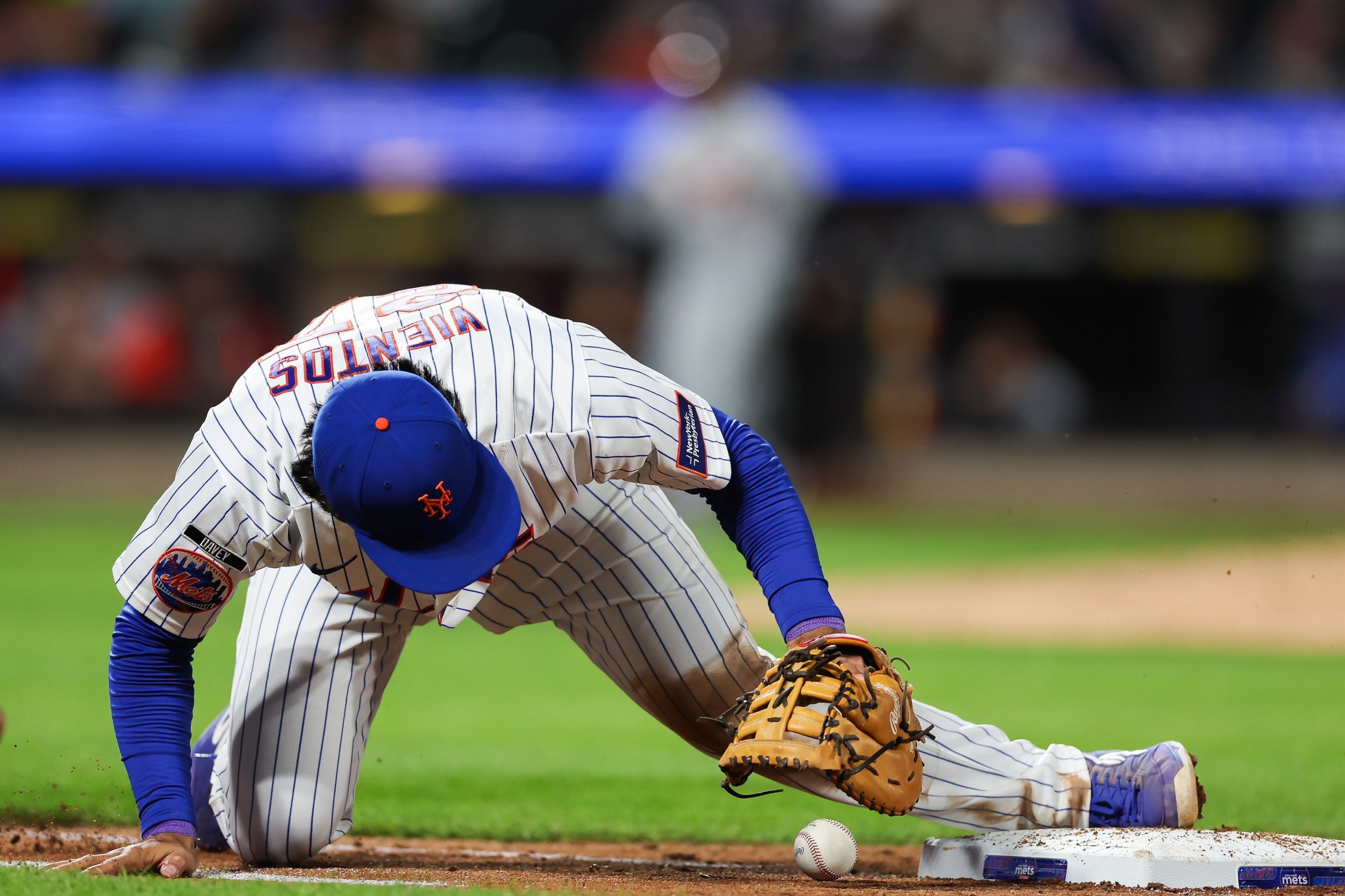
What we have here is Vientos fielding, then somehow un-fielding, then gently kicking, and finally falling on top of an extremely slow-moving chopper off the bat of Tigers infielder Zach McKinstry. For a fuller examination of the play, which includes the grounder that Vientos lost this particular slap fight against, the Mets' failed attempt to get the safe call overturned, and some extremely bemused commentary from Mets broadcasters Gary Cohen and Ron Darling, you can review this equally memorable footage:
Mark Vientos might need this footage deleted from the archive pic.twitter.com/D1WnNi7i1f
— Jomboy Media (@JomboyMedia) May 14, 2026
McKinstry was subsequently picked off of first base, and the Mets went on to win the game in 10 innings by the score of 3-2. It is the 14th of May.