
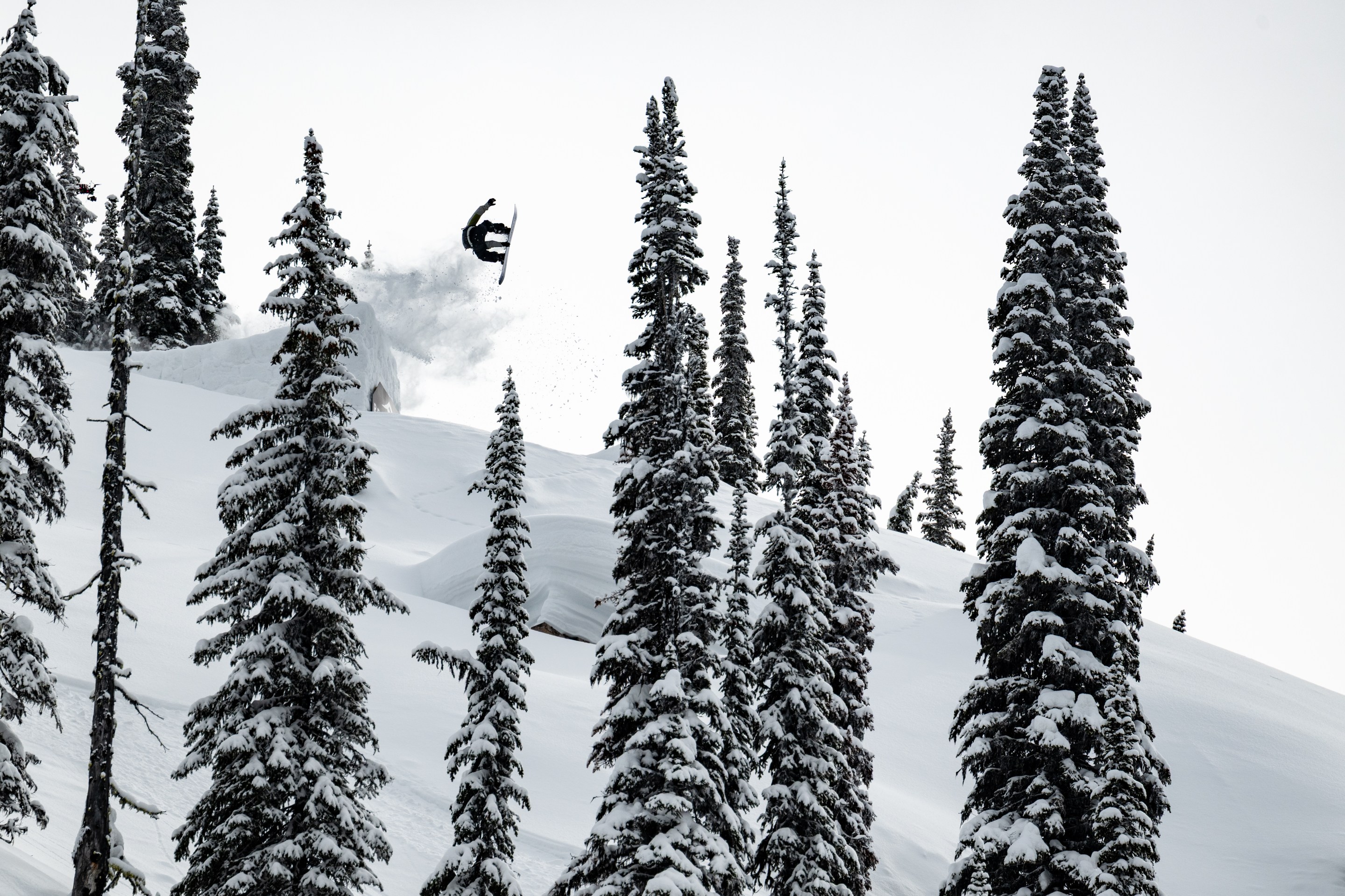
BRITISH COLUMBIA — Staring up from the base at the high walls of the Montana Bowl, a backcountry ski zone in Revelstoke, British Columbia, feels like gazing upon a deadly cathedral. My eyes naturally gravitate to the dangerous bits, but I realize they're pinballing around wildly, because it's almost all dangerous bits. Front and center is a zone they call Bar Fight, a series of increasingly terrifying cliffs and choke points. The terrain to the west is more inviting, but it's riddled with huge man-made jumps, some of which require a perfect landing in order to avoid becoming mush on a tree. There are two fresh debris fields, evidence of small, naturally occurring avalanches.
My overwhelming thought is that I can't believe they're about to hold a snowboarding contest on that stunning monstrosity.
The Natural Selection Tour is the brainchild of Travis Rice, one of the world's most prominent snowboarders and one of the major pioneers in the discipline known as Big Mountain Freestyle. There are two main types of snowboarding: Freeride and Freestyle. Freeride takes place off-piste (in natural, un-groomed terrain), often in the backcountry, usually in steep, cliffy, rugged faces. There's often an element of alpinism mixed in, as the majority of freeriders have to summit peaks under their own power, and wayfinding while riding down is extremely important to prevent getting hung up over an unmakeable cliff. There's an annual Freeride World Tour that's been going on in various forms since the mid-'90s. Freestyle, on the other hand, is what you see at the X Games and Olympics. It's much more famous, and it takes place within ski resorts, on carefully manicured runs. It includes events like Big Air, the Halfpipe, Park, and, of course, Slopestyle.
Big Mountain Freestyle is the unholy union between the two disciplines. You might think of it as backcountry slopestyle, where riders must navigate top to bottom with speed and fluidity, hucking the biggest, most technically sound tricks they can off of cliffs and other natural features, landing in ungroomed snow (which is far less predictable), linking moves together until they get to the finish line. Natural Selection ups the ante by building some huge jumps and platforms, augmenting the natural course, giving the riders ample opportunities to trick or get wrecked on their way down.
This isn't a normal season, though. The 2025–26 winter has been strange and tragic. Unusual weather patterns have created unstable layers within the snowpack virtually everywhere, and that means avalanches. In January, California saw its deadliest avalanche on record when 13 people were buried on a backcountry hut trip outside of Lake Tahoe. Nine of them didn't survive. In the European Alps, at least 119 people have died by avalanche this season, well above average, and the Freeride World Tour canceled two events there because the snowpack was so dangerous organizers felt a big slide was inevitable. And yes, British Columbia, where this event was about to go down, had seen five avalanche deaths, too.
Extreme snowsports are inherently dangerous. I witnessed the first death at the X Games, and was personally swept up in a small avalanche last season. This event felt more ominous than most, though, given the recent spate of avalanches. I was afraid that calling this event Natural Selection would end up being a cruel joke.
So, feeling like a dweeb among jocks, I started asking why they thought they could do it safely, or as safely as possible when risk is explicitly cited as a core component of the judging criteria: CREDO (Creativity, Risk, Execution, Difficulty, and Overall Impression). In a year when other competitions were being canceled outright, what gave them—the organizers and the athletes—the confidence to go?
"One of our biggest challenges is the type of riding that we're showcasing," Travis Rice told me at the competition's media day. "When people tune in and see athletes riding these unsupported slopes in insane conditions, and just full-confidence charging … the risk profile of the events that we run appears from the outside to be stacked heavily against us. But the steps that we take to ensure the safety of the venues that we hold our events on are substantial."
Rice was alluding to the fact that from the moment Revelstoke Mountain Resort opens for the season, its ski patrol is out there monitoring and managing Montana Bowl. While technically out of bounds, it's easily accessible to the mountain safety team as well as to the public, which is a critical component. If you have a persistent weak layer or an interface of concern in the snowpack and you don't have access to it, and then that layer gets buried, that's when things get dangerous. Those weak layers act like a low-friction slide, and if a large layer of snow gets added to the top (especially if it's heavier now), that can lead to huge slabs breaking loose and careening down the mountain.
The trick is getting in there early and often, and breaking up those layers before they solidify or get covered up. "Our forecaster that's in charge of that venue, Josh Morris, is out there all the time," Dustin Christian, Revelstoke’s Mountain Safety Manager, told me over coffee, "monitoring, ski-cutting [skiing tracks into the snow to prevent a smooth, planar surface the new snow might slide right off], and doing explosives work if necessary.
"We leave that venue open until about a month before the competition, so we just let the public have at it. That's awesome for the public, and while they don't typically go as big as the competitors, they ski it in and compact those layers, break things down, and it's a huge help. Then, once we close the venue, it's the same thing. Watch the storms and balance the work we do. Do we put too many tracks in and risk not having a storm to fill it in? It's a bit of an art for sure, but it's definitely a full-season project from the time we start until the comp is done."
There's plenty of science involved, too. I sat down with Liam Griffin, Natural Selection's Chief Operating Officer and co-founder, who is basically in charge of executing the event. He noted that ski resorts by and large take a heavy-handed approach to mitigating risks (via bombing, gas explosions, or aggressive ski-cutting), because their focus is getting the terrain open safely, not whether it will ride well. Natural Selection has the added challenge of making sure the terrain looks pristine on TV and rides exquisitely, and has developed some techniques over the years of running these competitions that, to Griffin's knowledge, haven't been used elsewhere.
Take the problem of surface hoar, for instance. Surface hoar tends to develop on cold, clear nights. The dry air triggers a moisture transfer, pulling water out of the snowpack and up to the surface, where it growks into these long, feathery, leaf-like structures that reach skyward. "It's beautiful but terrifying," Griffin said. "Because basically what it builds is a house of cards. And then if you get new snow on top of that … you've got this layer that's basically just air that's being held up by these tiny little crystals, and when that layer collapses everything on top of it is going to move."
Twice now—once in 2013 at the Baldface event, and then at last year's Revelstoke event—they observed a significant surface hoar layer building up and new snow was in the forecast. It was too close to the contest to bomb it or ski cut without ruining the snowpack. What they really needed was a wind event, which can easily collapse those delicate crystals, but none was in the forecast. "So, we brought in the helicopter and we made our own wind event," Griffin said.
In just 20 minutes of low-altitude hovering, they managed to rotor-wash the entire venue. At Revelstoke, they have created nearby test slopes at the same elevation and same pitch. That allowed them to do some A/B testing. After cleaning the venue, they rotor-washed one of the test slopes, too, while leaving the other one untouched. After the predicted eight to 12 inches of fresh snow came in, they went in and skied the test slope they had rotor-washed, and it held perfectly. Then they skied the unwashed test slope and the whole face ripped. That gave them confidence that the venue would be safe for the competition.
And then there's the Teton Tickler, which was first used before an event in Jackson Hole (hence the Tetons) when organizers found that even though they were ski-cutting, they weren't seeing enough surface interruption. They needed to extend the range of the ski cut uphill and downhill from where the patroller could reach. Using 10-meter-long carbon fiber rods, they were able to whack away and give everything a little "tickle" while ski cutting, putting some texture in the snow. It wasn't as severe as the ski cut, but it was just enough surface texture to create a non-planar layer for the next storm to interface with, so new snow that falls can slot in like a Tetris piece.
And that's how you use a Teton Tickler.
On the morning of the competition's first day, roughly 20 inches had fallen on the venue over the previous five days, including three to five inches the night before. In the athletes' lounge (a GMC-branded geodesic igloo at the base of the course) the vibes were good. The competitors had just taken a snowcat up to the top and ridden down one of the adjacent test slopes to check snow quality. Some said it was feeling good, others said it was a bit variable. All of them were visibly giddy, but there was tension in the air, too. Even in the best of circumstances, what they were about to do is extremely dangerous, and nobody has won this event by playing it safe.
"The stuff I'm used to, riding Slope Style and Big Air, where you kind of know the features and you get feedback straight away, so you're kind of just risking those tricks," 25-year-old New Zealander Zoi Sadowski-Synnott told me. "But within Natural Selection, because you're dealing with different snow conditions it's kind of hard to know what you're going to do and how much to risk. But I think all of us riders just want to try and do something we're stoked on and would want to watch again, so that's what I try to do. And I think, Dustin [Craven] said it, but if you're not scared, you probably shouldn't be doing it, you know?"
"The highest risk is hitting a tree," 31-year-old Vermont native Nils Mindnich told me. "So that’s my focus: To not hit a tree." It's good to have goals.
Mindnich also talked about the importance of sluff management, noting that while he generally trusts that the deeper layers have been made stable, the light stuff on top may still slide, as happened with Mark McMorris in the 2024 event. Mindnich said he plots his runs from the bottom up, starting with clean exits, then working backward, linking features in reverse, sort of like working a maze from the end back to the start.
35-year-old Czech rider Sarka Pancochova told me that a big factor in feeling comfortable out there is riding as much powder as you can and getting used to landing jumps in fresh snow. "Once you come to the contest, it's very much mental, more than physical. There's a lot of visualization," she said, noting that riders get a lot of video in the days leading up to the contest, but there are no practice runs. "It's quite stressful, but it's so pure. It's so cool that you just don't get to ride it at all, and then you just have to pull it together, and when it works it's just such an awesome feeling."
Fans, who trekked an hour from the nearest operational chairlift in sub-freezing temps, filled up bleachers made of snow, some carrying signs or home-made cutouts of their favorite riders. Thankfully, Day 1 went off without a hitch, though some of the athletes may have left with a hitch in their gait, as slams were abundant. There were some isolated pockets of sluff (typically light snow sliding on the surface) that would temporarily blind riders, but nothing that swept anybody off their feet.
Some big names, like Olympians Sadowski-Synnott and Mark McMorris, made it through the first heats of the day to move straight on to round two. Other heavy hitters, like former NST champions Ståle Sandbech, Elena Hight, Spencer O’Brien, and Travis Rice himself didn't make it through this time. The highlights are mind-boggling.
There were double backflips, 900s, and huge cliff drops landed in thick blankets of powder, but skip to 3:34 in the video above and you'll see why I could never fully relax and enjoy watching. The scariest moment of the day (starting at 4:01 in that video) was when local favorite Dustin Craven uncharacteristically caught an edge while going off a series of cliffs. He bounced off one, only to tumble backward off another and splat at the bottom. I was sure I'd just seen a broken back, but he was back on his feet and made his way down under his own power. If just one rock had been in the wrong place, it could have been a true disaster.
After Day 1, the contest went back on hold as a significant late-season dump was forecast for later in the week. Most years, they hold Day 1 on the west side of the bowl, then hold Day 2 on the east side, but the storm's timing meant they could use the whole venue for the first day, (hopefully) get a full reset from the new snowfall, and have the full venue for Day 2 as well.
Before the storm came in, patroller Morris went in and skied some tracks that didn't get ridden during the first day of the competition, just so there were tracks everywhere. With that, virtually every face had been ski-cut. Then the 12-inch storm arrived, Tetris'd in perfectly, and just wiped everything clean. The team tested the snowpack on a run just beside Montana Bowl called Holy Cow, skiing and digging pits, and everything was looking unbelievably good. In fact, the snow on the venue was looking better than it ever had on a final day.
The two standouts throughout the competition ended up winning gold, too. Sadowski-Synnott took the women’s title with just an absurd amount of speed and flow, though her 93.3 in the semis was even better. Watching her throw gigantic 720s, drop cliffs between tight trees, and fly farther than the men did was worth losing all the feeling in my toes. A few days prior, I'd asked her what her plan was for sluff management, and she said, "I just try to ride fast so I don't have to think about it," and that's exactly what she did.
The men's division was taken out by Mindnich. An engineer by trade, he always seemed to find the right gear. His highlight run probably came in the semis when he needed a big score and ended up with a 95.0 for a run that had just about everything you could want from a big mountain freestyle contest, but his 60-foot method air transfer over a gap in the finals earned him an 82.0 and belongs in a museum.
I'd be doing you a disservice if I didn't highlight the best runs from second-place finishers Brin Alexander (93.0) and Sarka Pancochova (80.3), and third-place Torstein Horgmo (90.0) and Billy Pelchat (78.3). Unreal.
There were some hard falls that hurt just to watch, but a whole winter's worth of work put in by the snow safety team held the competition together. The thrill of an event like the Natural Selection Tour is in watching the competitors create something beautiful out of the danger of the environment they've been put in. That can't happen without the hard work and dedication of the ski patrol and event organizers who are willing to do anything, even blast a mountain with a helicopter, in order to keep disaster at bay.
"There are many unique layers to NST and one of the unique layers is that we're essentially able to replicate the dream backcountry course," Mindnich told me. "And if there weren't all of the resources put into place by ski patrol to treat it like a ski resort run—to bomb the face, ski cut it, and try to manage the bad snow layers—it would be really scary. But as a rider, knowing that there's been a lot of work put into it, and that odds are my experience on that face would be the same as my experience inbounds at a ski resort as far as stability is concerned, that inspires a bunch of confidence."
I'm just glad he didn't hit a tree.