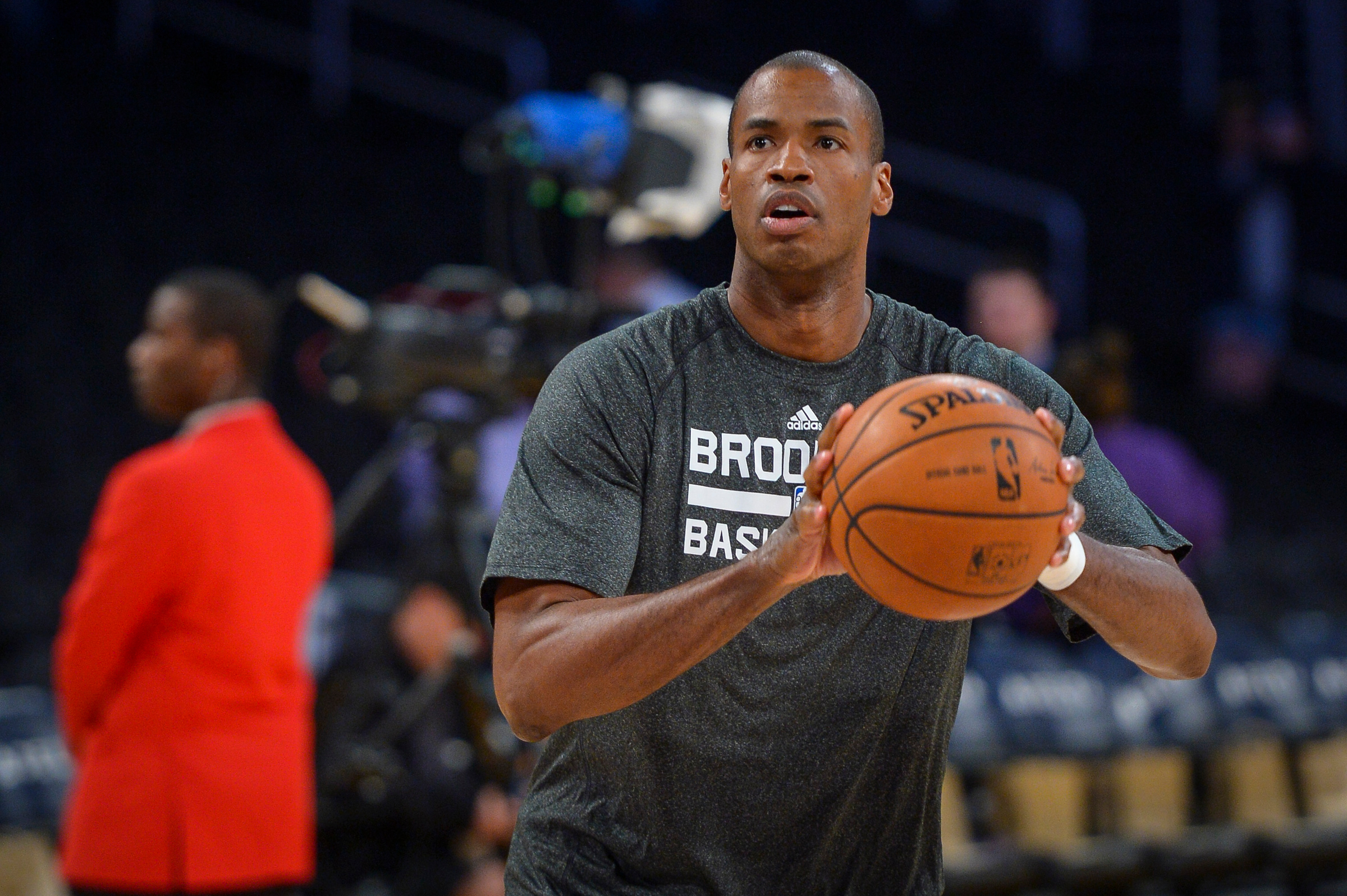
Jason Collins, the first openly gay player in the NBA, has died of brain cancer, his family announced on Tuesday. He was 47. Last year, Collins was diagnosed with a brain tumor and later revealed that it was Stage 4 glioblastoma, a particularly deadly form.
As Collins told ESPN's Ramona Shelburne in an article published this past December, he went to Singapore for experimental treatment to try and extend his life. "The goal is to keep fighting the progress of the tumors long enough for a personalized immunotherapy to be made for me, and to keep me healthy enough to receive that immunotherapy once it's ready," he said. The treatment allowed him to return to the United States and make some public appearances, but the cancer returned and worsened. He died at his home in Los Angeles.
Collins played for 13 seasons in the NBA, a successful career by any standards, but became better known for what he did toward the end of his professional basketball run. In 2013, after the end of the regular season, he came out in an article published by Sports Illustrated, and became the first openly gay active athlete in one of the four major American men's pro sports leagues. He was unsigned during the 2013–14 season until the Brooklyn Nets offered him a 10-day contract, and he entered his first game since his announcement on Feb. 23, 2014. He finished out the season with the Nets, then retired in November of that year.
When looking at the current state of the culture wars, it's tempting to think of Collins coming out during a more welcoming period in sports. "I'm glad I'm coming out in 2013 rather than 2003," he said in his Sports Illustrated essay. "The climate has shifted; public opinion has shifted. And yet we still have so much farther to go. Everyone is terrified of the unknown, but most of us don't want to return to a time when minorities were openly discriminated against." Collins said at the time that he wore No. 98 on the Boston Celtics and Washington Wizards as a reference to 1998, the year that Matthew Shepard, a gay student, was tortured and murdered by two men in Wyoming.
"Woke" wasn't yet a well-worn dog whistle in 2013; instead, it was still "politically correct." Then-President Barack Obama called Collins after his announcement and told him he had done a meaningful thing. Many NBA figures vocally supported him. There were still those who didn't, instead leaning on religious purity tests because Collins stated in his SI article that he took "the teachings of Jesus seriously, particularly the ones that touch on tolerance and understanding." Chris Broussard, then a commentator for ESPN, said on live television that homosexuality was a sin.
It's easy to forget the ignorance of that era because of the limited forms in which it could be delivered. Tweets disappear; sports radio jackasses fade away. Search engines get worse. The Westboro Baptist Church, a hate group famous for bringing "God Hates Fags" signs to basically anywhere that would give them publicity, said in the days after Collins's announcement that it would demonstrate at a couple of NBA playoff games. The year after Collins came out, college football player Michael Sam did the same, and became the first openly gay player drafted into the NFL. He faced ignorance as well, including from Don Jones, a Miami Dolphins player who was fined for tweeting "Horrible" after Sam was picked by the St. Louis Rams. "We’ve become so politically correct in this country that the country is going to hell, we can't do anything anymore—people are afraid to talk," said Donald Trump during a 2014 Fox & Friends segment about Jones's fine. "They're afraid to express their own thoughts."
These are the parts of the news cycle that are gradually forgotten. Remembering them serves as a reminder that the hatred was still prevalent then; it was just given less validity by institutions. The Westboro Baptist Church is basically defunct now, but its values and approach live on in many other forms, including numerous tiers of the media and federal government. If Collins had come out today, there'd be more bigots with significant platforms. What he did then was brave and noble, and it would be in any year.
"One thing I've always prided myself on is having the right people in my life," Collins told ESPN last year. "When I came out publicly as the first active gay basketball player in 2013, I told a lot of the people closest to me before I did so. I wasn't worried it would leak before the story came out, because I trusted the people I told. And guess what? Nothing leaked. I got to tell my own story, the way I wanted to. And now I can honestly say, the past 12 years since have been the best of my life. Your life is so much better when you just show up as your true self, unafraid to be your true self, in public or private. This is me. This is what I'm dealing with."