
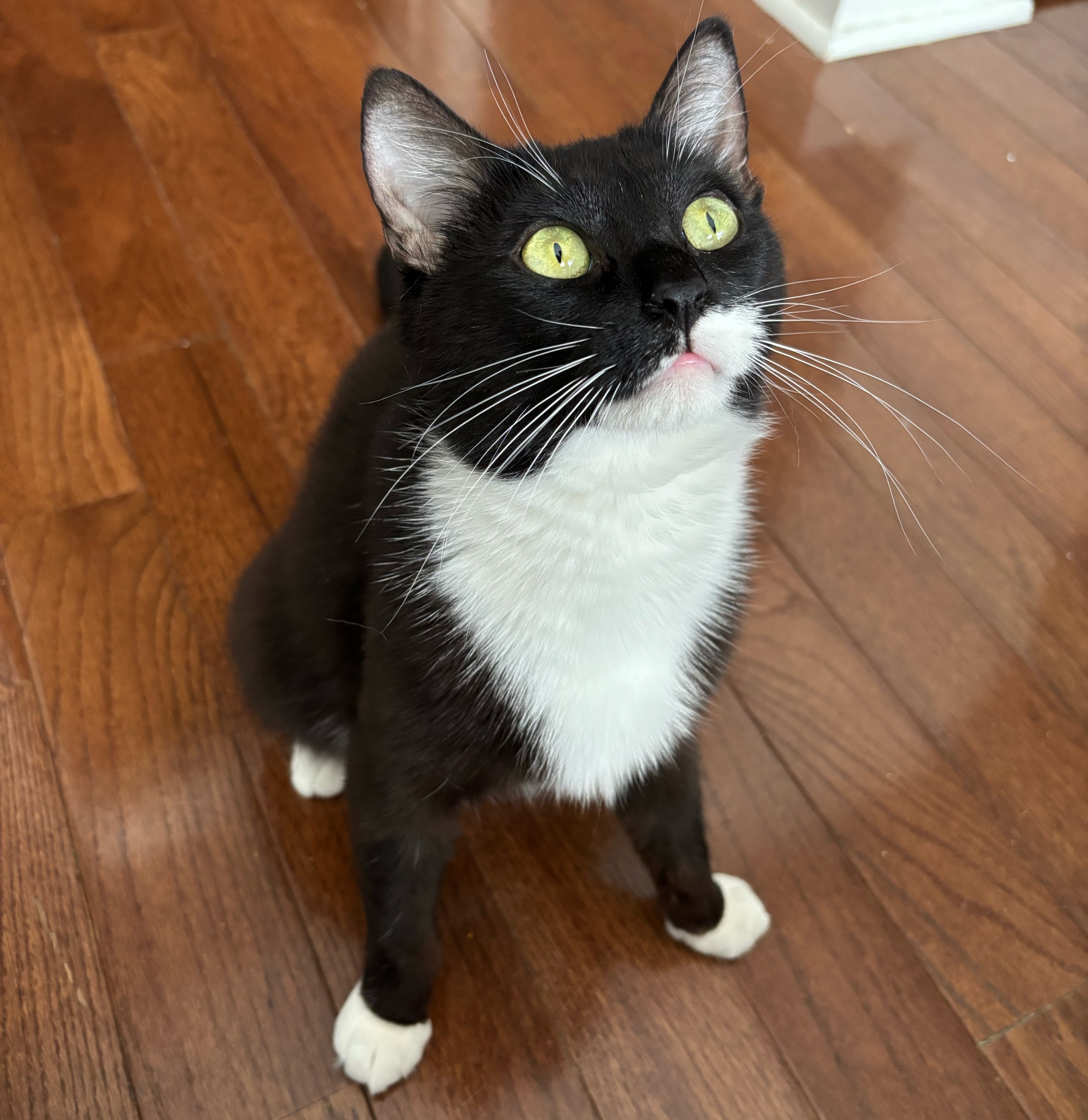
At the start of this year, a seismic shift occurred in my life: The number of cats I saw regularly went from zero to three. First, my friend who lives three doors down from me adopted a sweet little menace off the streets of Rochester, N.Y. Her name is Clementine; she is a tuxedo cat, approximately 8.5 pounds and 1 year old. Second, I made new friends who have two cats of their own: A tortico former mother named Guagua (or 瓜瓜, a cute way of saying "melon" or "gourd" in Chinese), who is perhaps the most perfect and angelic cat I have ever met, and a weird little man named Sesame. Our three protagonists are pictured below.
While I met Clementine first, my self-employment as cat tutor only started when I met Guagua and Sesame, and my friends told me that Guagua knew tricks. I had never before met a cat in real life who knew tricks. The trick-knowing cats I saw on various internet platforms appeared to me like unusually dignified and intelligent creatures, sometimes upsettingly purebred, and now Guagua—a normal cat from the streets of Philadelphia who does not have teeth—had proved herself part of that circle. She demonstrated her suite of tricks: sit, spin, paw, other paw, high-five, other high-five, down, and going wherever she was pointed. She was, it was clear to me, a genius, and also extremely food-motivated, which in animals tends to be related.
My friend said that she was also trying to teach Sesame some tricks, but that he had not yet progressed past the simplest command of "sit." He "just didn't have the attention span"; in his defense, he is literally a baby. During the Super Bowl, I bore witness to Sesame's delinquency. Whilst the extraordinarily dull fourth quarter dragged on, my friend decided to try to teach Sesame how to spin. She first gestured above his head before dragging the treat around him so he would follow it. (Guagua, who was not a part of this conversation, was off to the side, fruitlessly spinning to try to earn a treat for herself.) Many treats later, Sesame had not learned anything. Haha, I thought. Dumb little baby boy.
A couple of weeks later, my friends told me that Sesame now knew how to spin! They had held some more training sessions, and he'd finally picked up on it.
Despite my personal relationship with Clementine—I would consider her, in many ways, to be my niece—I never considered the possibility of trying to teach her anything, even after meeting Guagua. To be clear, Clementine has many positive attributes. She is teeny tiny, outgoing, and still has a lot of kitten-ish energy. She sets boundaries effectively, but she's also very sweet and a cuddler. I would kill for her. However, she has never once been described as "very smart." Her signature moves are chasing her own tail and sprinting out of the room for no reason. She is pretty shockingly unathletic, which leads to curious pathing choices (rather than jumping, say, two feet to the windowsill, she clambers up my friend's headboard like a submariner climbing a ladder). She is possibly near-sighted. She has an at-times frightening lack of object permanence and attention span.
Guagua, as previously established, is a certified genius with distinctive poise. No one is expecting other cats to live up to Guagua's high standards. But Sesame? An odd, unwieldy, pampered little man who, despite living a comfortable life since kittenhood and being huge, is scared of most things and people, unless they are actively holding a treat and/or preparing his food, in which case, oh, actually, he's decided that he's not in any danger at all? Sesame? If Sesame could learn tricks, surely Clementine could too.
My mentality shifted. I developed a strong investment in my niece's education. One session in, I came to a realization: It's not that hard. I have zero experience in training animals, much less training cats. Once again, I would not have described Clementine as being particularly intelligent. And yet she picked up on "sit" shockingly quickly, taking perhaps one session to learn how to do so. I simply raised the treat above her head, said sit when she parked her butt on the rug to look at the treat, clicked a clicker, and then gave her the treat. My niece was so smart. Dare I say genius? (Spin was still very much a work in progress.)
Both Clementine and I suffered some unforeseen consequences of our operant conditioning. First, it turned out that Clementine's little cat brain deciphered that "sitting = treats" without fully grasping the importance of the "sit" command. As a result, whenever I was in her apartment, she would come up to me, sit down, and then stare expectantly. (When my friends first taught Guagua how to spin, a similar phenomenon occurred; as they were prepping her meals, she would spin repeatedly at their feet.) Second, Clementine got into the habit of going to town on the treats in a way that made her throw them up basically intact. The enterprise was temporarily placed on hold until we realized that she would also perform for her normal dry food.
Something also happened to me during this time period: My favorite hobby became teaching Clementine tricks. No longer was my calling in life "blogging" or "writing," but to get paid thousands of dollars by a rich person in the Hamptons to train their cats. I would take practice footage of Clementine's progress, and watch it back, to look for ways to improve both of our performances. I relentlessly showed my training videos to friends, whose responses ranged from I didn't know cats could do that! to What's the point? Uh, the point is that it's super cute and fun!
Clementine learned "paw" during this stretch, but she is often too enthusiastic to properly demonstrate it. She instinctively grabs for the hand holding the treat, irrespective of whether it was requested. For similar zeal-related reasons, I have recently discontinued trying to teach her how to do "up," after my fingers have gotten bitten a few times.
Then we tried "spin," and hit our first major roadblock. As I tried to drag the treat around Clementine in a circle, she simply did not seem capable of tracking it all the way around. She would follow it halfway, either get distracted by something in the background or otherwise lose it, and then meow as if the treat had vanished from the Earth. I would have to wave it in front of her nose to get her to follow it the rest of the way.
Progress was slow. My friend reassured me that at the start, Sesame had had similar stumbles, but I began to worry that my niece had a genuine learning disability. "Clementine, let's eat tape together," I said, attempting to show her the practice footage to see if that would help with her development (it didn't).
But! Repetition, as always, proved the key. We got our reps in:
Eventually she only needed a partial cue:
And now she is capable of spinning when prompted!
Now all the cats in my life understand how to spin. Guagua does it when requested. Sometimes Sesame will spin even if you request "paw" instead. Clementine will often start spinning if you hold the treat above her without doing anything else. That's a Pavloved beast right there. If you have your own cat, or at least regular access to one, I highly recommend you teach that cat how to spin. There's no experience like it.
Come July, Clementine and I will be moving in together (also Clementine's owner). Hopefully, by then she will know how to ride a unicycle and have released her own translation of The Odyssey.