

Darren Aronofsky's AI production studio Primordial Soup was announced in May of 2025 during Google's annual developer conference. The launch was meant to burnish the pioneering reputations of both entities simultaneously: Google released a new version of its text-to-video model Veo and an AI video tool called Flow, while Aronofsky, like a worrying number of other filmmakers, sought to forge a new and daring path into unknown technological territory by partnering with one of the world's biggest tech companies. In a classically hyperbolic statement crediting the dawn of a new artform with hardware rather than human creativity, Aronofsky said, "Filmmaking has always been driven by technology. After the Lumiere Brothers and Edison's ground-breaking invention, filmmakers unleashed the hidden storytelling power of cameras."
The first Primordial Soup project was a short film called Ancestra, directed by Eliza McNitt, which used a combination of AI-generated images, live-action photography, and computer-generated animation to make, in essence, a stupid, eight-minute version of Terrence Malick’s The Tree of Life. Ponderous, whispery voiceover narration from a mother to her unborn child plays over vignettes of macro photography showing cells, microorganisms, fish, and nature. Drop into the film without context and you would be forgiven for thinking you were watching a drug commercial.
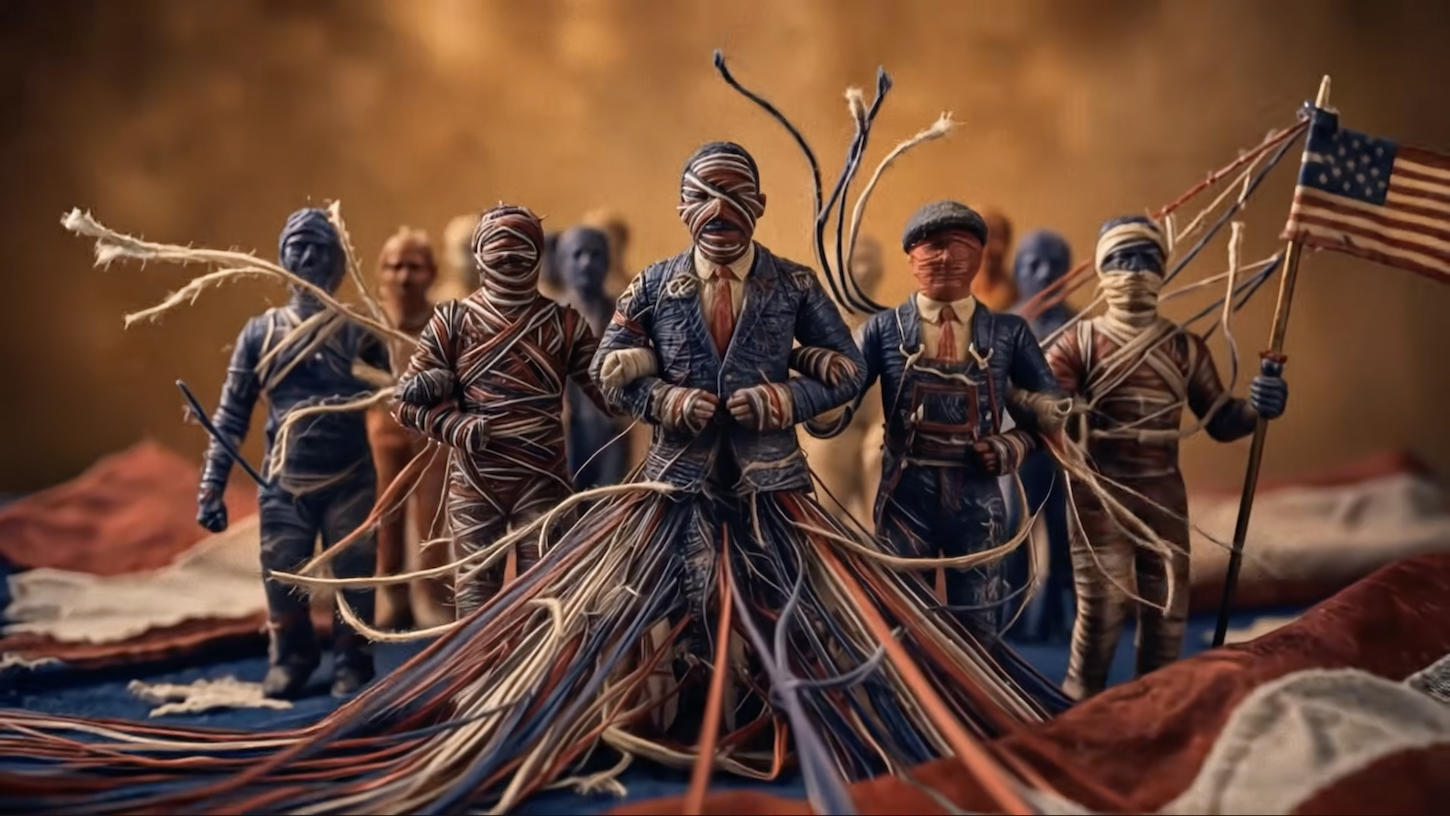
It seemed like Primordial Soup, its name so brazen in Aronofsky's already infamous pretensions, laid low for the rest of 2025. In January of this year, it announced a series of videos exploring the founding of the United States, tied to the 250th anniversary, in collaboration with the most relevant and cutting-edge news organization in the country, Time magazine. The series is called On This Day … 1776 and has steadily been making waves online, mostly in the YouTube comments. "Wow this is freaking EPIC if you like dogshit!!!" reads one representative entry. "It’s like poop from a butt" is a little repetitive, but "This is the most beautiful thing ive ever seen since i spilled acid in my eyes after i drank all that mercury" communicates a vivid encapsulation of the experience of watching such pointless dreck.
Credit where it's due: Using AI to celebrate the founding of a country teeming with credulous dupes, who would rather ask Grok to summarize a Wikipedia page about the Declaration of Independence than skim it, is funny. But it's a better joke on paper than in practice. Perhaps the most confounding aspect of most AI-generated videos that strive for professionalism and legitimacy is the impulse toward photorealism. One supposes this is because the people who want to legitimize AI as a filmmaking and creative tool believe the only way to impress skeptics is to fool them with something that looks like it isn't AI at all. One problem, among others, is that motion is not an area in which AI excels for any length of time longer than a minute, and even then, visual hallucinations are rampant: the flouting of the laws of physics (objects merging, floating, glitching) or the accidental addition of appendages to bodies. This is true no matter which program anybody uses. The fact that Primordial Soup's (and, more recently, A24's) partnership with Google entails its use of Google DeepMind, culprit for the increasing ubiquity of Gemini, doesn’t remedy this.
The very first On This Day video, "January 1: The Flag," begins with a speech by King George III, whose voice leaps way too loudly from the mouth of a character model with lips that aren't moving at the right speed. Anxious to prove that their studio is doing AI the right way, Primordial Soup announced that real actors would provide the voice work in the video series, thereby unintentionally acknowledging that the main reason for this exercise in ugliness, besides fulfilling contractual obligations, is to undercut the labor and expense of actually filming a historical documentary.
Most AI videos of the kind Primordial Soup seems interested in making function well if you look at a paused frame. Pores, individual hairs, irises, dirt and grit, garments, and wrinkles are rendered with the convincing detail most people expect from digital cameras. It's only when you let the video run that all the by-now recognizable artifacts of AI-generated clips rush into view: elements in the foreground and background that shift from hyper-detailed fidelity to soft fuzziness; very short shots with little continuity between them; dead eyes; a sudden morph from one facial expression to another; and that uncanny lag in body movement, where a character looks as if they're loading.
None of this touches on the fact that these videos, which barely scratch five minutes at their longest, feature freeze-frame stingers introducing major figures like George Washington and John Adams, seemingly royalty-free Renaissance Fair music, and absolutely no cohesive visual style. Extreme close-ups, slow-motion, gonzo simulated camera moves, and uniformly orange lighting contribute to what are very boring pieces of content, uncanny spectacles in which whatever information is being conveyed is secondary. It's telling that, after the first few installments, whoever was in charge of uploading the On This Day videos to Time's YouTube channel abandoned the calendar date concept and tried to go for poor SEO-farming: "Britain's Plan to END America in One Campaign," "How Ordinary Men Were Forced Into the King's War," "John Adams Had To Turn Drunk Arguments Into a Revolution."
Whether intentionally or not, the vision of colonial America illustrated through these videos is both incredibly idyllic and frightening in its homogeneity. The Thomas Kinkade quality of the natural landscapes clashes against the repetition of the same expressions on faces that have been generated to look like those of modern-day actors rather than plausibly weathered historical figures. The tone of these videos is meant to be melodramatic and humorous, but whatever narrative they’re meant to tell is slapdash and convoluted. To say nothing of the fact that each video seeks to portray America as having been forged through the bravery and defiance of the colonial settlers, a parade of squinting white men fighting against British tyranny, while the Indigenous, African, and Indian counterparts to this history are sprinkled in the background like extras. Of course, this is an old and familiar kind of marginalization, but it's interesting to see it recapitulated in such a bizarre, supposedly authorless format.
In a Financial Times interview with Aronofsky and Demis Hassabis, the CEO of Google DeepMind, Hassabis does what every AI evangelist eventually does when touting the potential of their pet technology: He hedges. Emphasis mine:
"Currently, these tools are not capable of making up new starts. They're more extrapolations of what's already known. Can these systems actually come up with new conjectures, not just solve an existing one? The answer right now is no. So there's clearly still something missing from these systems, out-of-the box thinking or true invention, that the great creatives, whether they're scientists or artists like Einstein or Picasso, can do."
This kind of thinking obliterates anything interesting or beautiful about human creativity in favor of a mindset that only sees inputs and outputs. The marriage of the tech bro and the artist, in this case Hassabis and Aronofsky, is meant to illustrate two halves of a whole and thus an implicit dependence of one on the other.
Except no one needs garbage like On This Day… 1776, or anything else Primordial Soup ends up producing. At another point in the FT interview, Aronofsky compares AI to hip-hop sampling, a clearly nonsensical example given that sampling is the product of human curation, an artist deliberately choosing which samples to use and how. AI has no perspective or taste. It has no instincts or intuition. In that sense, it reflects the personalities of the people who so enthusiastically use it.
Making fun of AI now offers fewer and fewer moments of levity. This shit is coming at us from all sides, not just on our devices or in ads or emails. Even ultimately unpopular and frivolous projects like On This Day—the 40-second trailer for which still holds the series' highest view count at under 250,000—deserve to be seen as insidious. It's not that such an exercise in patronizing mythology was ever going to be good. But if it was destined to be bad, I'd rather see what kind of bad a human being could come up with.