The Super Bowl halftime show is a giant, overstuffed program that is about celebrating its own overstuffedness. It's a maximalist entertainment spectacle set in the middle of the most maximalist entertainment spectacle in sports, where football is stretched out over five hours in order to show people commercials where society's most famous people hawk society's worst products. Thus it makes sense that halftime performance duties are usually bestowed upon the biggest pop stars of the moment, though assigning that title has become more difficult in our fractured and fractious culture. What made Sunday's event so interesting is that, for the first time in a couple of years, there actually was no doubt that the Super Bowl halftime show was performed by the biggest pop star in the world.
Bad Bunny, the Puerto Rican rapper, singer, and all-around superstar, has become the biggest artist in a global cultural zeitgeist no longer dominated exclusively by English-language music. He is extremely popular all over the world, including right here in the U.S., a country traditionally dismissive of artists that don't conform to a straitjacketed idea of "Americanness." The strain of all these tensions was evident the moment Bad Bunny was first announced as this year's performer. The usual suspects in the culture war pounced on the choice, accusing the NFL of the capital crime of felony wokeness, robbing these true patriots of the chance to celebrate "real America." This reaction was best encapsulated in two things: firstly, Republican House Speaker Mike Johnson wondering aloud why the NFL couldn't have settled instead on a performer like Lee Greenwood, the octogenarian singer best known for 1984's "God Bless the USA"; and secondly, the decision by Turning Point USA, the right-wing dumbass debate club, to program an alternative halftime show headlined led by spiritually octogenarian rapper-turned-country-artist-turned-MAGA-mascot Kid Rock. Not exactly finger-on-the-pulse stuff. Meanwhile the NFL was itself stuck in its own cycle of nostalgia, opening Super Bowl 60 with multiple renditions of the national anthem and a Green Day performance of "American Idiot," to remind us, even in protest, that we are trapped in the Bush era redux.
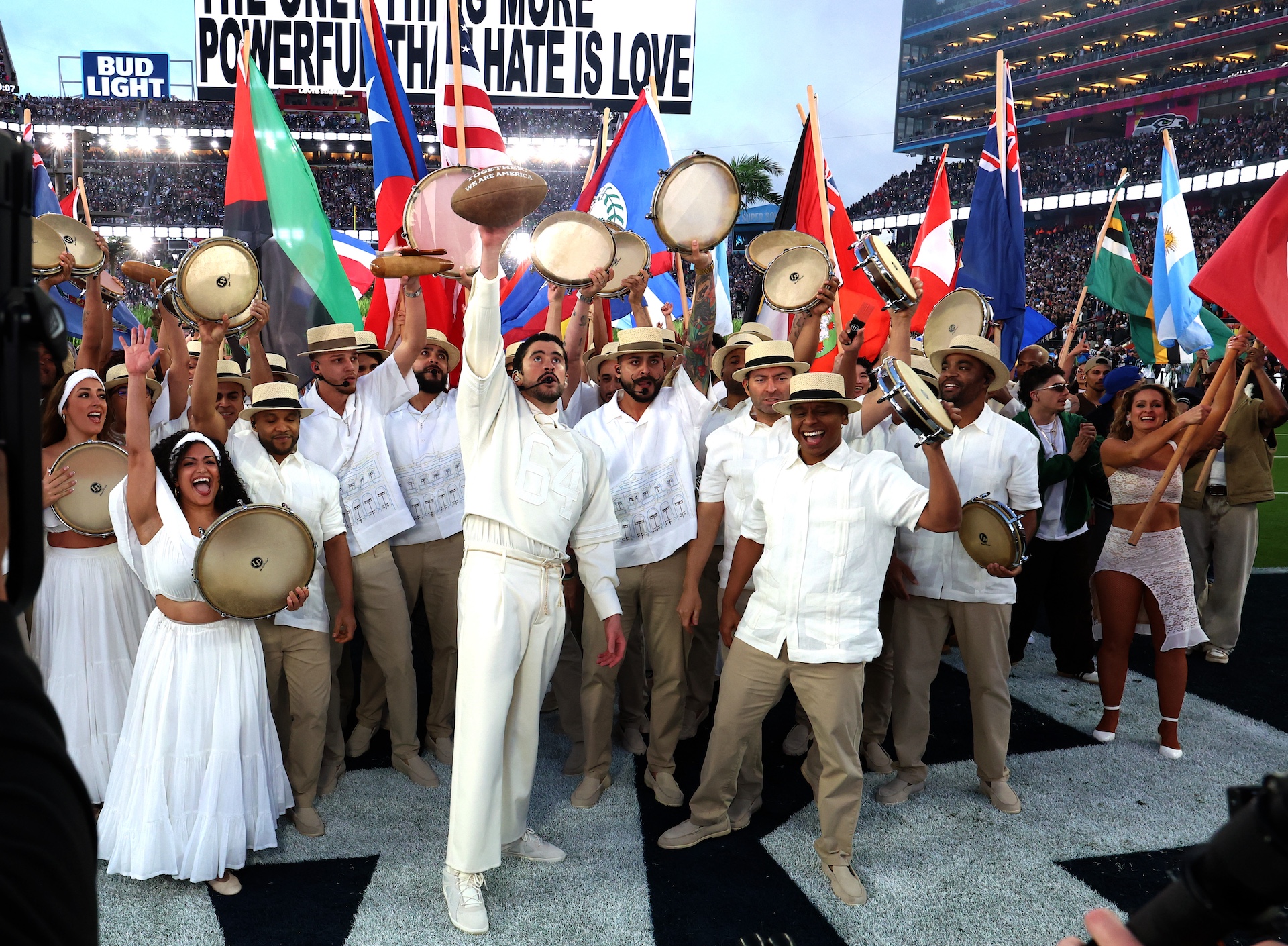
But for all the contrived controversy over the presumed America-bashing act of singing in Spanish, Bad Bunny's night was one of celebration. It was a culmination of his ascendence as the biggest star of his generation. He turned the 49ers' field, previously the site of what had been an almost unwatchably bad half of football, into a fantasia of Puerto Rican and Caribbean culture, traversing between sugar cane fields, storefronts based on real businesses like LA's Villa's Tacos and NYC's Caribbean Social Club, men playing dominos and women at nail salons. Through elaborate stage design and intense choreography, the performance presented a people's history of the Caribbean, with both intellectual rigor and visceral, joyful exuberance.
There were references to Daddy Yankee's "Gasolina," Lady Gaga made an appearance to perform a salsa rendition of "Die with a Smile," and Ricky Martin, a trailblazing Latino crossover superstar, stopped by to sing Bad Bunny's "Lo Que Le Pasó a Hawaii," a song that uses the fraught history of the 50th state to advocate for Puerto Rican independence. Cardi B was there too, as were Pedro Pascal, Karol G, and many other little cameos to be spotted by those of the culture. There was a party at the casita, dancing atop the Latin grocery, a Puerto Rican wedding, and the flags of all the countries of North and South America together, with Bad Bunny as the welcoming maestro of it all.
Bad Bunny came into Super Bowl week fresh off winning album of the year at the Grammys for Debí Tirar Más Fotos, a record that celebrates Puerto Rico and anti-colonialism. It's not for nothing that many speculated that the child he handed his Grammy to in the middle of Sunday's halftime show might have been Liam Ramos, the five-year-old boy who went viral after ICE abducted and tried to deport him. It wasn't actually him, but this boy's inclusion couldn't help but be a stand-in for the many children threatened by U.S. immigration policies, which were reprehensible long before Donald Trump came into office and made them even worse. That was part of the performance's magic: It represented so much, so effortlessly.
It has been funny watching the press decide that Bad Bunny's show stayed away from politics, surely due to non-Spanish speakers who didn't bother to look up the lyrics to his songs, like "Yo Perreo Sola," a club banger about women's right to dance without being sexually harassed or "Baile Inolvidable," a tribute to Puerto Rican heritage. Along with his gift for infusing cultural and political commentary into fun records, Bad Bunny is our foremost defender of "bad bitch" behavior, from his personal swaggering style and visibly incredible grooming regimen—he was resplendent on Sunday in a cream suit that would make David Byrne proud—to his attention to detail, filling the stage with dancers of all body types, genders, and sexual orientations in a way that never insisted upon itself. By the time we got to the triumphant performance of "DTMF" to close the show, Bad Bunny had already advocated for a more capacious conception of America, standing in stark contrast to the increasingly narrow vision of old glory days that only existed for a few if it existed at all.
Now, it's worth pointing out that I am not a believer in treating the halftime show of the Super Bowl as some kind of venue for radical politics or cultural critique. The halftime show, like the event it occurs in and the league it celebrates, is first and foremost a business. Bad Bunny's show was good business for all involved: He was able to present himself on entertainment's biggest stage and make his case for why he truly is the most vital musical artist of the day, while the NFL was able to burnish its halftime stage as the cultural stage, along the way basking in Bad Bunny's refracted brilliance, cultural relevance, and progressiveness, something that all the controversy only heightens, especially before the eyes of the Latino audience the league desperately covets.
I find it way too sentimental to think that symbolism in a halftime performance means much beyond a wink to an intended audience, the musical equivalent to a Marvel end-credits scene. I believed that last year when Kendrick Lamar made his own statement on American life, and I feel the same about Bad Bunny's ode to all the Americas that live within this country's borders and beyond. But what I will give him, is that in the midst of revanchist immigration policy, open white supremacy, hyper-violence by ICE and CBP, concentration-camp internment, and nihilistic trolling from the sociopaths in charge, there is something about an artist putting on a good show that dares to say this is what America is, extending to both north and south, together, making for one world that is welcoming, diverse, and joyous. And who wouldn't rather live in the joy right about now?