I started reading James Baldwin in college, as a politically curious renegade-in-training. What appealed to me was his deeply philosophical outlook on race in America, the beauty of his prose, and how he brought it all to bear in his writing about the pop culture of his day. Like so many young critics over the generations, I was greatly inspired by the way he wrote about movies, books, and music, assaying their aesthetic merits as well as their political weight.
If there was one thing I bumped my head against with Baldwin back then, it was of his analysis of this "moral question" of America: Basically, why did this country invent something called "the nigger"—the other—and how long would it decide to hold onto the idea at the expense of the nation's very soul and therefore its prospects of survival? How long could it hold this moral rot within itself?
It is entirely up to the American people whether or not they are going to face and deal with and embrace this stranger who they have maligned so long. What white people have to do is try and find out in their own hearts why it was necessary to have a “nigger” in the first place, because I’m not a nigger, I’m a man. But if you think I’m a nigger, it means you need him. ... If I’m not the nigger here and you invented him, you the white people invented him, then you’ve got to find out why. And the future of the country depends on that, whether or not it is able to ask that question.
The question intrigued me, though I couldn't quite follow the logic. I was reading all of this at a time when the country was damn near breaking its arm to pat itself on the back for finally "solving racism" by electing the first black president, and at the same time was fomenting a grassroots movement of people enraged by the election of that black president, seeing in it the first sign of the impending death of whiteness as a culture. The corroded soul part, I got. But where exactly was the evidence that any of it threatened the survival of a country that—let's face it—had done pretty damn well for itself with a soul that was corrupted from the very beginning? This country does harm, profits off it, and champions that success so much so that we all choose to participate on some level. Baldwin's argument seemed too immaterial, too "Christian" in a way. Even though I had grown up in church, I wanted something more direct, more abrasive. Today, I think I might've felt the same way if not for what's been happening in Minneapolis over the past few weeks.
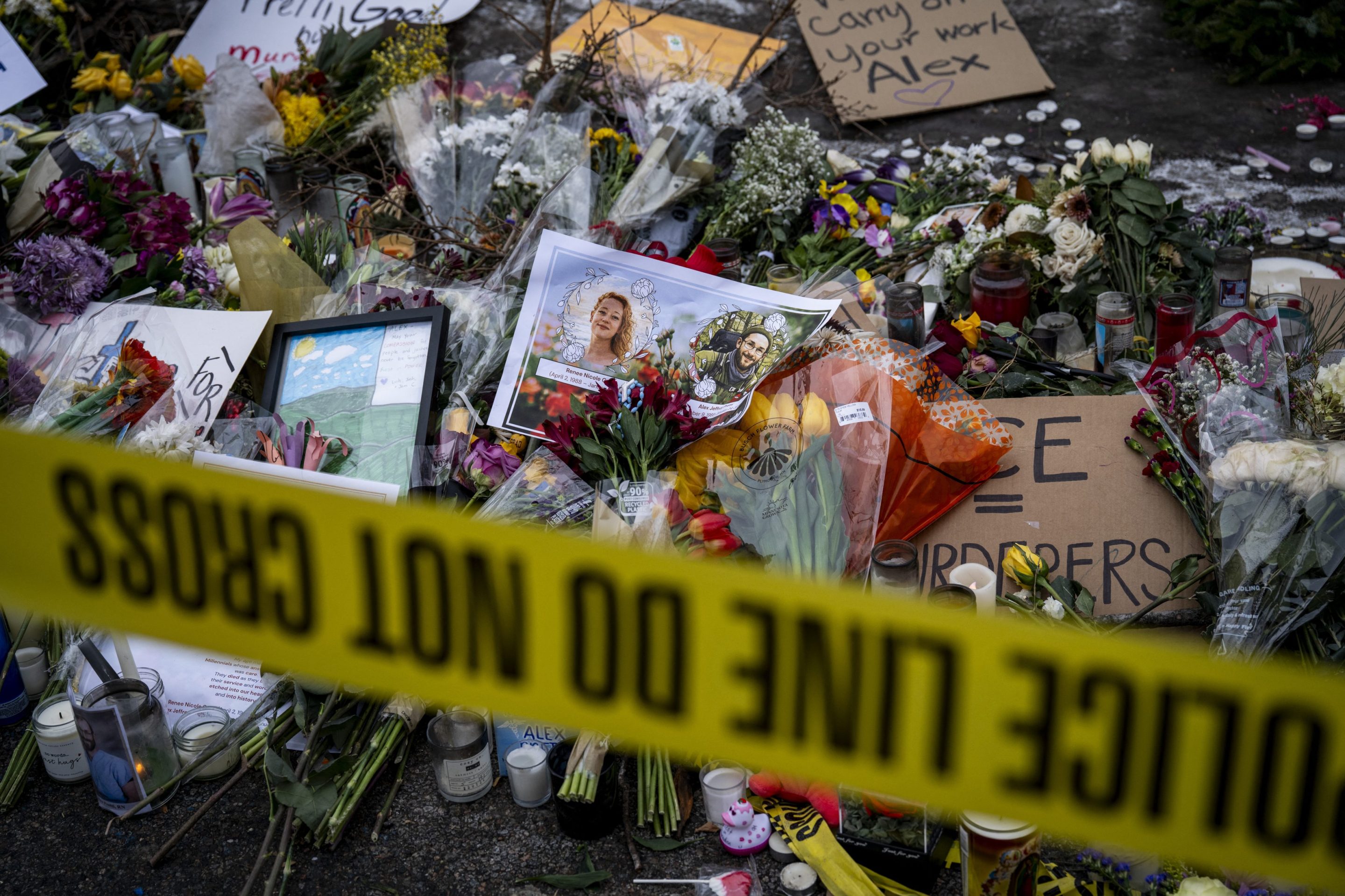
Alex Pretti was killed by masked Customs and Border Protection agents while he attempted to help up a woman whom those same agents had shoved to the ground. On his person was a licensed firearm, which the officers had already stripped from him before shooting him nearly a dozen times while he was pinned down. But the gun wasn't the most dangerous weapon he had on him. That would be the phone in his hand, which he was using to record the interaction.
Throughout the occupation of Minneapolis and Minnesota, and really all over America, ICE and its fellow fashy agencies have declared war on anyone who has shown the audacity to record them, follow them, find out the identities behind those masks, and alert others to their presence. Pretti was the second high-profile murder of a nonviolent observer in less than two weeks, following the killing of Renee Good. In both cases, the Trump regime immediately went into PR mode, telling obvious lies about things everyone could clearly see on video, in its efforts to discredit the victims. Good, despite being a concerned citizen and mother doing her part to help her community against invading forces, fit neatly into the caricature the Trump folks have long tried to blame for much of the country's ills: a "disloyal" queer white woman who did not accept her rightful place either in the kitchen or in a Mar-a-Lago spa. In the case of Pretti, an outdoorsy, gun-owning American white man, painting him as the enemy for Trump's particular caucus wasn't so simple. Minneapolis is not the first city tormented by occupation, nor is it even the only city currently being occupied by our shadow police, just as Pretti and Good are not the first victims. But if nothing else, Minneapolis represents a boiling point for what has happened to a country obsessed with race and racial violence, seemingly to the point of its own collapse.
When Baldwin would talk about the soul of the country, and this need for an other to place blame onto, he could not have invented a better example than Donald Trump, a silver-spooner who used his daddy's money, his own shamelessness, and lots of bad real estate deals to fashion for himself a reputation as a larger-than-life business mogul. That his self-authored origin story was made of lies didn't matter. Trump has always understood that, in America, money is all you really need. No one cares how you got it. As long as you've got it, you will never run out of people eager to suck up to you, willing to buy whatever it is you're selling.
Trump's entire persona is built on that fact. And yet, despite this, or maybe even because of it, there is a deep insecurity that lives within him. Money may justify him in the eyes of his legions of sycophants, but it has never satisfied his need for recognition, both from the people he considers below him and those who really are who he pretends to be. It is not enough to buy a building and put his name on it; people must also praise him for it. It is not enough to be talked about on TV often; he must be the only thing anyone ever talks about on there, and he must appear on it himself. If there's an award, prize, or medal to be given out, he must be the one who receives it. Whenever Trump is not on screen, all the other characters should be asking, "Where's Trump?" No one seemed to have triggered his insecurity and desperation for recognition more than Barack Obama.
Racism and right-wing politics weren't anything new for Trump, but like many personalities who make for good television, people were happy to ignore it for the sake of the show. When Obama became president, and an angry alliance of embittered conservatives called the Tea Party decided a black guy with a scary-sounding name was a bridge too far, Trump found the perfect parade of dipshits to step in front of and lead. Trump put a charismatic spin on the politics of grievance. He became a champion for the segment of the population that felt denied their rightful place in the upper echelons of American society, due, in their minds, not to their own personal shortcomings, but rather to a bunch of uppity women, minorities, and immigrants who had rewritten the rulebook in favor of themselves.
Though Obama is often considered the first president of the internet era, Trump was the first president created in the internet's image: the worst, most venomous parts of the online world coalesced into an actionable political ideology. Conspiracy theorists, once coded as left-wing for their anti-government bent, now stand side by side with MRAs and NRA activists. Proud Boys stand alongside Zionists and Christians. TERFs stand with techies, oligarchs with lonely podcast bros. All are united around a common cause: grievance, and the desire for retribution against an infinitely amorphous "they."
What does a politics of grievance actually entail? Not much beyond catharsis for mankind's worst emotions and impulses, it turns out. The internet is full of cynicism and nihilism, so it's no surprise that the ideology that best represents the internet would be so devoid of anything affirmative. According to this worldview, people are at heart unchanging animals, and any change that does occur is just further devolution away from some idealized past. Anyone who does believe in progress is an idiot, a liar, or a "virtue-signaler" out to overturn the natural social hierarchy to put their own kind on top, where the straight whites are meant to be. Under this prism, anything that doesn't adhere to this imagined state of nature must be reversed or destroyed in the process, be it science, education, finance, or our own government. But most especially, popular culture.
The appeal of grievance is that by inventing the other, you can make it real. From day one of Trump 2.0, the administration has, in an increasingly literal sense, dispatched troops into battle, hoping to incite a reaction that would then prove its conceit that a war has been raging all along, at which point they could position themselves as the good guys fighting on the side of truth, tradition, and order against the forces of anarchy and perversion. In their ideal world, the faces under the boot heels would be black and brown ones, but they thought they could go right on ahead with their script by casting Good and Pretti as emblems of the other anyway.
But reality hasn't proven quite as malleable as they hoped. Instead, at every turn, the immigration crackdown has exposed to even the most normie of citizens the dangers of a militarized secret police and the repulsiveness of unprovoked murder. According to the latest polls, the majority of the country now supports the idea that ICE should be abolished, a remarkable feat in light of how much this country loves its trigger-happy police. Whatever belligerent fantasy the openly white-nationalist administration had of maintaining the moral high ground, or even of just getting the country to quietly acquiesce to domestic militarized occupation, has not proven so.
Part of the issue is that the Trumpist vision has always been deeply unpopular. Despite the glee with which the mainstream media seemed to pronounce a death to wokeness, Trump's electoral victory wasn't the sign of some cultural turnaround that they might've hoped. It did provide cover for corporations to do away with HR regulations around diversity and sexual harassment, which they had always resented being dragooned into in the first place, and also to accelerate their plans to replace workers with AI. It also wrangled a bunch of dumb comedians and streamers whose entire political outlook was based on getting yelled at for saying the F-word 10 years ago. But in reality, Trump's election had more to do with the inability or disinterest of the greater political class to provide any material solutions to the country's structural failures, instead playing out another referendum of "The status quo everyone hates is good, actually" vs. "Let's make it literally illegal to look or think like those people we hate." In a world where the only thing everyone can agree on is that everything sucks, it stands to reason that voters might list between the two poles from election to election, even if no one is particularly enthused by either side, even if one side is actively evil. Once you get past people in power growing angry when that power is questioned, most of America was not clamoring to "end woke" or whatever. And while Trump certainly made inroads by humping the immigration and crime boogeymen, this strategy of kidnapping people outside of schools and churches and sending them to concentration camps remains a hard sell to all but the most addled of brains.
So much of this unnecessary violence comes down to the simple truth that, as America becomes more truly multicultural and whiteness becomes one of a plurality of experiences instead of the sole dominant one, those who feel their cultural significance waning have lashed out. And if they lack the power to recover what they believe they've lost, well, they will settle for exercising the power to burn down everything that remains. Elon Musk's eugenics tweeting, elite universities expelling students who have the temerity to protest genocide, Peter Thiel's talk of ushering in the Antichrist, the Trump administration's attempt to redraw the political landscape in its own image and imprison anyone who dares question him—in all of it, you can see America's supposed saviors mustering their resources to tear democracy apart. It fits that America's soul has grown so corroded that it can no longer be disguised, being physically manifested in the decrepit, faltering, unnaturally colored husk of its president, a Dorian Gray who at last looks like his picture.
It is my belief that Trumpism will lose again in three years, not because of some profound moral awakening, but rather for the very boring reasons that most admins lose: The economy is bad, people are mad, and they will blame it on the ones they deem in charge. Despite the promises that attacks on immigrants will somehow make this country better, things are still bad and are only getting worse. And the only people who stand to gain are those who are already rich or who figure out ways to get rich selling this poisonous ideology.
People across the nation are angry today because two people were killed for no good reason, by the kind of forces that used to sound like the wet dreams of the most ardent conspiracy theorist or militia guy in the woods. But this is what fascism does: creating senseless violence in an effort to maintain a status quo that benefits a small group of the most powerful who refuse to accept that people with less than them should also get a say. Good and Pretti weren't the first killed by the immigration system, and they surely won't be the last. But those murders, the cowardly acts that created their conditions, and the brave responses they exemplified did lay bare what exactly the stakes are for the entire country to see. America now has to decide how long this stain on its soul can linger on before we finally cut out the cancer.