
The following is excerpted from Every Time a Bell Rings, a book of essays about It's A Wonderful Life by Lauren Theisen and Emily St. James. It is available for purchase now.
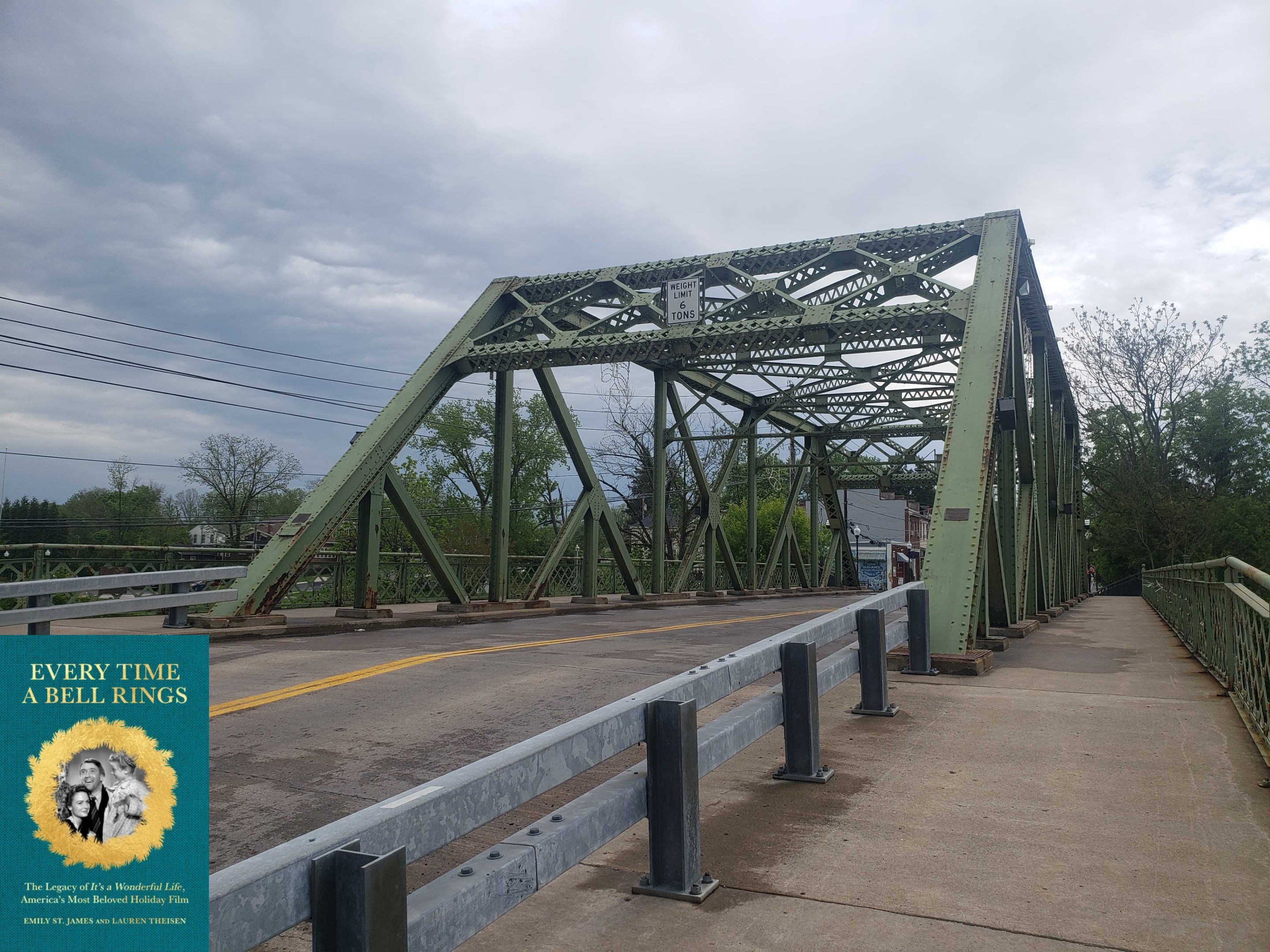
The bridge in Seneca Falls really does look just like the one that George and Clarence find themselves underneath in It’s a Wonderful Life. It’s short, accessible to pedestrians, made of steel beams that join together to form triangles, and stands just a little bit detached from the town’s main street. I knew when I started writing this book that Seneca Falls claimed to be the real-life inspiration for Bedford Falls, that this New York village with a famous feminist history hosted a festival for the movie every year, and as I started my work, I looked forward, specifically, to standing on that bridge. I knew, of course, that it wasn’t the real bridge, that any kind of location shooting was cost-prohibitive, and that the movie was filmed in California. But I was wondering if I might channel a little of George Bailey in myself, looking out onto the water, reenacting a great American moment of hope rediscovered.
When I actually went to Seneca Falls and stood on that bridge, however, I found myself less interested in fiction and more attracted, instead, to a plaque that’s hung there for over a century, which commemorates a very real story.
Maybe it was just because the sun was shining on a gorgeous morning, or maybe it was the stark contrast from my home in busy Brooklyn, but Seneca Falls clicked for me the moment I laid eyes on it.
Unlike the Bedford Falls of the twentieth century, there’s no train that’ll get you right into the town. Instead, I’d taken an Amtrak to Rochester on a Friday in May, spent a pleasant evening there, and then rented a car in the morning to drive forty-five miles down the freeway and then a bit longer down more isolated country roads. Arriving from State Street, I saw the small downtown backed up against the river like something straight out of a ceramic village set. After I parked and started walking, I glimpsed the bridge from a distance, its light green contrasting with the blue, blue sky. Instantly, I felt like I had come to the right place. This was exactly the kind of village that the Baileys could call home.
Someone much more important than me had this reaction back in 2002, helping build momentum for the It’s a Wonderful Life celebrations that the town would go on to host. Karolyn Grimes, who played Zuzu, first visited Seneca Falls in 2002. She didn’t come on a gorgeous May morning, but when it was snowing. Upon arrival, she got out of her car, saw the bridge, and she said, “I’m home. This is as close to Bedford Falls as you’re going to get.”
That’s what Anwei Law told me when I visited her at the It’s a Wonderful Life Museum in downtown Seneca Falls. She coincidentally moved to this place in the very same year that Grimes visited, drawn by the human rights history of Seneca Falls that includes former resident Elizabeth Cady Stanton and the 1848 convention that stoked the women’s rights movement. Anwei Law went on to play a critical part in the creation and ongoing work of the museum—“Cofounder, probably the director. We don’t care too much about titles,” she said, laughing when I asked about her official role.
Law was sitting at a small welcome desk, greeting visitors in between my questions. I’d asked about how much Seneca Falls acknowledged the connection to It’s a Wonderful Life when she’d first started living there. She said that the town might have a screening over Christmas alongside a canned food drive, and that people talked about the overlap with Bedford Falls, but it was Zuzu’s appearance that really started the momentum. Grimes brought back other folks associated with the film—her fellow grown-up child actors and descendants of Donna Reed and Frank Capra—and thus began an expansion of Seneca Falls’s identity, which now includes a packed annual multiday It’s a Wonderful Life Festival, featuring special guests, presentations, performances, activities, meals, and of course, a community screening.
The museum itself opened in December 2010, and it did so in a significant location. While I visited at a temporary spot down the street while the usual building underwent renovation, the true home of the museum is at the site of what used to be the Seneca Theatre. Opened by Charles Fornesi in 1913, it was both the first movie house in Seneca Falls and, per Law, the entrepreneurial work of the village’s first Italian American, who was partially responsible for other Italians joining the community.
I was at least a tad concerned, before I visited, that the museum would turn out to be a cynical tourist trap, but it was anything but. Admission, true to the spirit of the film, was a suggested five dollars that you could toss in a basket. The
gift shop next door, which was manned by Law’s husband, Henry, didn’t accept credit cards because he didn’t know how to work the machine. If you wanted to buy an ornament, pin, or postcard without cash, you had to go outside and take it back to Anwei. To me, it was not a place that valued money, efficiency, or flash. It did, however, draw enough people to quickly fill the limited space in its first hour of operation on Saturday morning. Moving past the exhibited items, I navigated a variety of locations and encountered folks from all generations—one child told Anwei they called their grandmother “Zuzu.” Anwei makes a point of asking every visitor where they’re coming from, and over the previous summer, she’d logged travelers from all fifty states.
I found the museum cozy and personal, with a kind of rambling storytelling nature that endeared itself to me with its quirky style. It basically had an entrance area, a big exhibit space, a narrower hallway packed with items, and a smaller exhibit space, all laid out with the unofficial care of somebody’s living room. There are only a few known props from the movie still in existence, and the only one on display at the museum was a pair of Violet’s earrings. But instead, the museum was filled with tributes, connections, and digressions through the themes of the movie and the lives of the people who brought it into the world.
According to Anwei, the museum opened with just one case featuring items from Grimes’s collection and has expanded, thanks to donations from those with ties to the film or just hardcore fans. You can find autographs, a cigar lighter like the one in Mr. Gower’s store, Lego and ceramic recreations of Bedford Falls, copies of personal essays about the movie, a Christmas tree, a “George lassos the moon” drawing resting on a piano, and much more. Rather than tell a definitive and complete story, curators took what they had and turned it into an absorbing experience—one that perhaps takes whatever emotions and memories of the film you bring into Seneca Falls and draws them a little closer to the surface.
“There’s a lot of men who talk about how much it means to them, because they feel like they’ve been George Bailey at some point in their life,” Anwei said. “We get people in here who cry and just—they just remember.”
When it comes to Frank Capra’s Bedford Falls and the real Seneca Falls, I feel an urge to channel a famous line from another Jimmy Stewart film, The Man Who Shot Liberty Valance: “When the legend becomes fact, print the legend.” The official line of the museum is a modest claim. One of their signs reads, “While there are many similarities to Seneca Falls, we do not believe that Frank Capra wanted Bedford Falls to be one specific place. Bedford Falls evokes fond memories of small towns everywhere. As one visitor to our museum said: ‘Bedford Falls is in your heart.’ ” That said, the village clearly revels in the connection. The repair shop right near downtown is “Bedford Falls Garage.” The sandwich place where I ate my lunch sold a variety of It’s a Wonderful Life paninis—I got the “Bedford Falls.” There’s a public space decorated with several large bells dedicated to a man named Menzo D. Case, whose plaque calls him “a modern-day George Bailey.” And the postcard I took home with me from the museum, a wintery scene that highlights the bridge, is bold enough to read, “Seneca Falls ... The Real Bedford Falls.”
While there’s no strong documented connection between Frank Capra and Seneca Falls, the circumstantial evidence is both fun and fascinating. I learned more about it when I walked over to the Seneca Falls Historical Society and met with its executive director, Jonathan Monfiletto. The Society is headquartered in a reddish-brown mansion north of downtown, right next to the library, and dates back to the 1800s. I talked with Jonathan upstairs in an office packed with books and papers. He was pretty new on the job and clearly very excited to be there. We chatted for a bit about the history of Seneca Falls, and then, when I asked about Capra, he showed me a newspaper article from December 1996 that shed some light on the start of the Seneca/Bedford Falls momentum.
That article, published in Rochester’s Democrat and Chronicle, said the fiftieth anniversary of the movie brought renewed media interest in Seneca Falls as the inspiration for its setting. The problem: There was no evidence that Frank Capra had ever been there. The closest the museum can definitively place him around the time of preproduction is New York City, some 250 miles away, and from there, it’s only conjecture that he maybe visited family in Auburn, a former home of Harriet Tubman that lies just to the east of Seneca Falls.
That’s where Seneca Falls’s Tommy Bellissima, then seventy-four years old, came in. The local barber, raised in Sicily, told reporters in 1996 that some fifty years earlier, he had cut Frank Capra’s hair. According to Bellissima, he wasn’t familiar with Capra when he walked into the shop because he didn’t know much about American films, but the name stuck in his head. The filmmaker, he says, complimented Bellissima on his surname, which means “very beautiful” in Italian. The barber did not return the nicety, however, because “Capra” means “goat.” Sometime later, though, he saw Capra’s name and picture in a movie advertisement and remembered his Italian customer.
“I’m positive that was the guy,” Bellissima said.
You can scoff at this, and some do. An AP article about Bellissima also includes an opposition quote from film historian Jeanine Basinger, who says about Seneca Falls, “Let them have their fantasy.” On a professional level, I can see her point. Certainly, there’s not any evidence available that would allow a journalist to print “Bedford Falls came from Seneca Falls” as a fact. Think about it too much, especially from a distance, and it all might start to sound like idle speculation.
But then there’s that bridge, impossible to miss and just as hard to forget.
“The Greatest Gift,” the short story on which It’s a Wonderful Life is based, bears little meaningful resemblance to the masterpiece it would eventually help spawn. But the artists behind the film took a perfunctory piece of writing and exploded it into something with so much heart, depth, and big ideas about America that it achieved immortality. And one of their many improvements—a small choice in the grand scheme of the film, but one with a massive intangible impact, I think—was to change the introduction of the Clarence character. In the Philip Van Doren Stern story, the mysterious stranger just appears next to a depressed George Pratt on the bridge, saying, “I wouldn’t do that if I were you.” In the movie, of course, Clarence falls out of the sky before George Bailey can jump off the bridge, then flails around in the water because he bets that George’s deeply ingrained selflessness will override his surface-level stress and depression.
If you choose to believe that Capra came to Seneca Falls in late 1945, then this change in the story is unmistakably connected to the bridge in that village. That’s because this structure just off downtown, where you can walk over the Cayuga–Seneca Canal, has a plaque from 1917 dedicated to Antonio Varacalli, who, it reads, “Gave his life to save another.”
Varacalli is one of the heroes of this village, and Jonathan told me a lot of what’s known (or partially known) about him. He was twenty-one in 1917, but he might have been a teenager who lied about his age to get work. He’d come to Seneca Falls with his father to earn money while the rest of his family stayed behind in Italy, working either on the canal itself or at one of its factories.
On the morning of April 12, 1917, Varacalli was at work on the canal with several other men, according to contemporaneous articles in the Syracuse Herald and the Rochester Democrat and Chronicle. Around 11:00 a.m., a teenager named Ruth Dunham came to the now-famous bridge. Per the Herald, “The young woman stood on the east walk of the bridge for some time, and then, in the plain sight of a score of people jumped over the railing.” Varacalli, without removing any of his work clothing except his hat, plunged in to rescue her. He succeeded in pushing her close enough to shore that the other men could get her out of the water, but he himself was unable to swim to safety. A couple of hours later, men used drag hooks to bring his body back to the surface.
Ruth Dunham, the Democrat and Chronicle reported, stayed unconscious for several hours after she was returned to her home on Bridge Street but survived. The paper attributed her suicide attempt to a nervous collapse. “For the past six months, Mrs. Nettie Dunham, the young woman’s mother, has been confined to her bed and the girl has cared for her mother nights while working days as a stenographer,” it said.
For the true believers in the Capra connection, this echo of Clarence and George cinches it. You have It’s a Wonderful Life’s placement in the general Upstate New York area, in a town with the name “Falls” in it, with visual and economic similarities. And then you have the change from the original short story so distinct that you can picture exactly how it happened. Capra, one day, walks through Seneca/Bedford Falls, crosses the bridge, sees the plaque honoring a fellow Italian American, learns a little more about the story, and decides that this real-life sacrifice is also something that he’d like George Bailey to emulate.
Something I haven’t mentioned yet is that It’s a Wonderful Life is explicitly a very Christian film, to the point that it was no surprise when Pope Leo XIV named it one of his very favorites. My love for the movie doesn’t come from a religious place, but when I myself finally stood on the bridge in Seneca Falls, I had what felt like a spiritual experience. Alone, in blue-gray post-rain weather, I was drawn to a plaque on the fence separating me from the canal. “Here, April 12, 1917, Antonio Varacalli gave his life to save another. He honored the community. The community honors him.” Surrounding the plaque were as many as one hundred bells tied to the webbing of the barricade.
From that spot, you can picture the past. About 108 years ago, a young woman had jumped into this water, and a man had jumped in to save her. One of them made it out alive. Thanks at least in part to the visual supplied by the movie, the image in my head was especially evocative. The Seneca Falls bridge asks you to take stock of your own selflessness, your own courage. It’s a monument to an extraordinary challenge and a reminder that at any moment, we might be called upon to act in a situation that has life-or-death stakes.
Said Jonathan in his office, “I was talking to someone recently and was like, ‘Man, what would I do in that position?’ I would hope I would jump in. But would I just be paralyzed by fear?”
Antonio Varacalli’s life ended on that day in 1917, but Ruth Dunham lived on. Per Ancestry.com, her ailing mother died two years later in 1919. Just a few months after that, Ruth married Charles Winslow, and she lived with him in the Washington, DC, area for the next few decades. Charles died in 1958, and Ruth lived until 1980, when she died at the age of eighty-three. An obituary from The Washington Post lists Charles as being survived by a daughter, “Mrs. Arthur J. Williamson,” and three grandchildren. That’s basically it. That’s what I’ve got. In
searching through newspaper archives for months after visiting Seneca Falls (with help from Jonathan too), I was not able to find any obituary for Ruth (Dunham) Winslow or anything that might have illuminated what her life was like in the years between her rescue in Seneca Falls and her death sixty-three years later.
I was hoping to find tales of Ruth helping people, spreading love, or just doing something fascinating with all those years that Antonio had given to her. I wanted the domino effect to be clear and obvious, something like George Bailey saving the lives of all those men on the transport because he’d saved his war-hero-to-be brother, Harry, all those years before. I wanted proof that Ruth had been special, that she had lived this great big wonderful life filled with tons of grandchildren and time spent pursuing passions that touched the lives of so many.
For whatever reason, Ruth didn’t seem to get the kind of lasting obituary that functions as proof of a life well spent. But I was motivated to fill the void in this story, to find some way that Ruth had changed the world for the better. And lucky for me, a few folks actually beat me to it a few years earlier.
After a long time searching for traces of Ruth in older newspaper archives, I stumbled upon a 2022 article published in Auburn, New York’s The Citizen. It’s by Buffalo News columnist Sean Kirst, who wrote that he’d experienced the same frustrating dead ends that I had trying to follow up on the Ruth-Antonio aftermath. But he called upon a genealogist named Megan Smolenyak, who tracked down two important women to the mission. One was Elizabeth “Lill” Kress, the granddaughter of Antonio’s sister, Elisabetta, who came to America along with other family members thanks to a fundraising effort by the Seneca Falls community after Antonio’s death. The other was Kathy Williamson, the granddaughter of Ruth—who, to her knowledge, never spoke about her suicide attempt or passed down the story of her rescue for posterity. Kress and Williamson went on to meet face-to-face in Seneca Falls only because that act still inspires so much interest from fans of the movie. Both of them took careers that embodied the kind of help-the-community idealism that It’s a Wonderful
Life promotes: Kress was a nurse practitioner in Upstate New York, and Williamson was a special education teacher in St. Louis. And after they connected, they both could understand a bit more about why they had the lives they did.
“If Antonio hadn’t saved Ruth, I wouldn’t be here and Kathy wouldn’t be here,” Kress said.
Strange, isn’t it? How each person’s life touches so many others? Part of me can’t help but be terrified by the enormity of that choice and even frustrated by the unfairness of it all. But another part—one that badly wishes to keep feeling some idea of faith—wants to celebrate the sacrifices that some humans make for others and to revel in all the ways we’re able to make an impact with the great gift that is our lives. The village of Seneca Falls is a love letter to this incomprehensible power, one that we all possess from the second we’re born.
© 2026 by Emily St. James and Lauren Theisen, used with permission from Hanover Square Press, an imprint of HarperCollins