
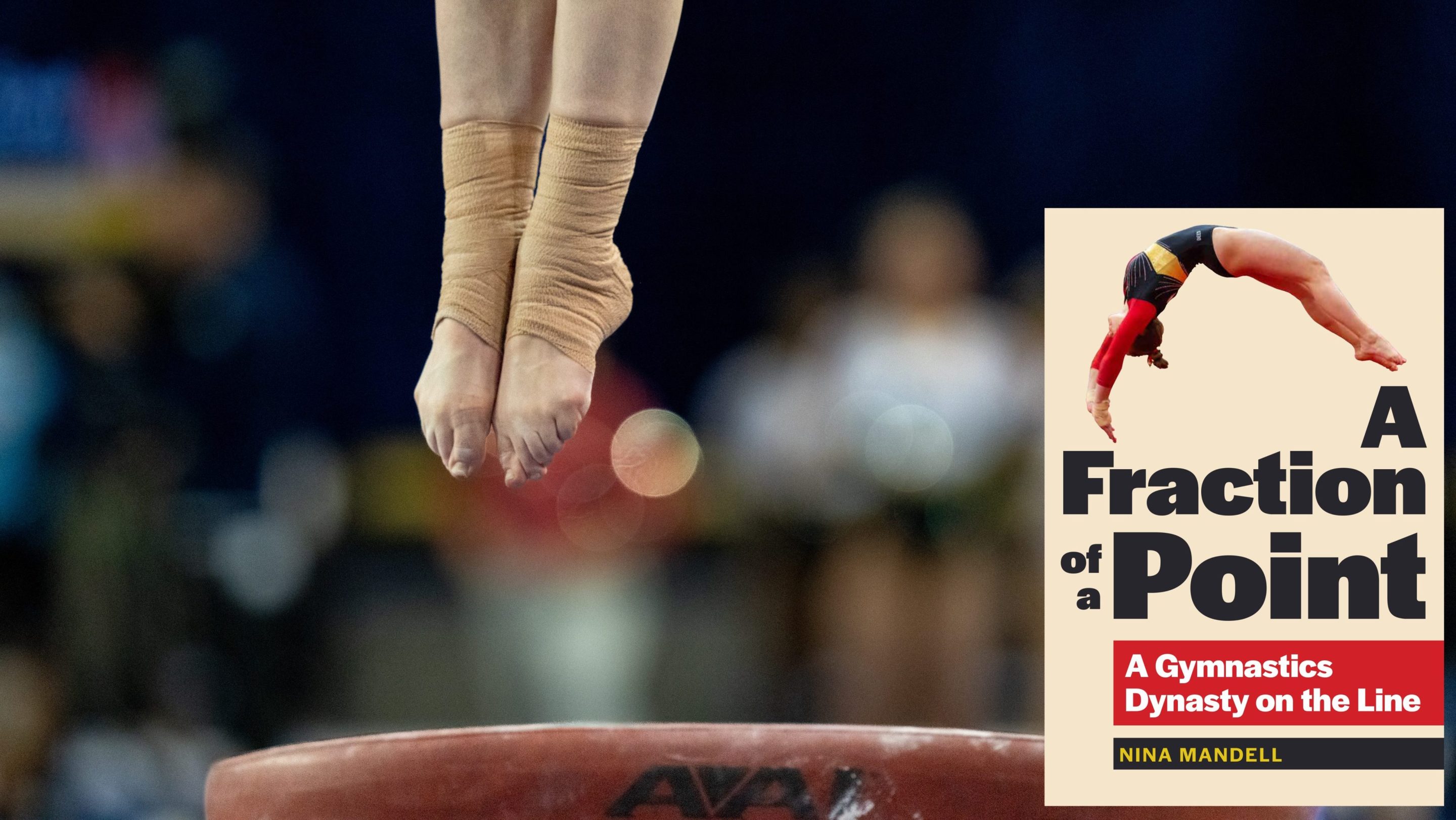
The following is excerpted from A Fraction of a Point: A Gymnastics Dynasty on the Line, by Nina Mandell. Published by Kent State University Press. Reproduced with permission. The book is available for purchase now.
With the Brecksville-Broadview Heights High School gymnastics team’s state win streak at five years old, Andrea Kinzer stood over her teammate Diana Moock, watching her as she sat on the ground calculating the scores from other teams across the meet. Diana, a numbers whiz with the nickname "the human calculator," was furiously computing the scores of the competition that the team had gathered through their intel sources. Brecksville had an advantage: The order of events was randomly decided and in their draw that year, they went after Magnificat. But there was bad news: After completing her quick math, Diana looked at the team. "We need to upgrade our skills," she said.
The gymnasts for Brecksville—even in 2008—had a range of skills that they performed for club meets (the harder skills), and they often watered them down for Ohio high school meets. With the coaches, the gymnasts would craft routines for the high school competitions that were more reliable than the ones they competed with at club meets. But in 2008, the safe routines it seemed, weren't going to get the score they needed. So they came up with plan B on the fly.
Andrea had fractured her right ankle earlier that year and had surgery on her left knee the year before after being injured doing a Yurchenko layout full vault. She changed her vault into an easier one and had planned on competing that at the state meet. But, looking at Diana's scores, she knew it was Yurchenko layout full or bust.
And she wasn't the only one who had to make a last-minute change.
"I remember giving the pep talk in the back and [saying] “Everyone is upgrading their vaults,’” Andrea said. "Everyone is doing everything. If we don't do that, we are going to lose."
"And we knew that. We knew if not every single person in that lineup upgraded their vault, we were going to lose."
Mission agreed upon, the gymnasts got into a line and started their walk out. Team coach Ron Ganim grabbed Andrea's shoulder and looked at her with a stern expression. "There is a chance that we may not win this meet today, " he told her.
She looked back. "I know," she said.
"Keep your head up high, keep the team focused, keep them going,” he responded.
Andrea nodded. She knew. As she led her team out, the thought echoed in her head. "We could lose right now."
A few months earlier, Andrea had decided she was going to quit gymnastics. She had suffered through so many injuries. She was tired of spending 40 hours a week in the gym, and she had just had enough. "I was done. I was tired. I didn't wanna go to college for it anymore. I was fried, I was exhausted," she remembered.
She told her mom.
"Okay, you are coming home today," her mom told her. "You're not going to practice." And I said, "Okay, I'm not going to practice."
Andrea went home and was sitting at her kitchen table. She watched through the window as a familiar car pulled up, a black SUV. "I was like 'Oh shit,’” she said. Ron, in his signature shorts and polo shirt, came walking up to her door.
"And my mom said, 'Come on in, Mr. G. And I was just like, no, no, no, no, no, don't let him in, don't let him know I'm here. And my mom's like, 'Oh, you're here?’ My parents were very close with Mr. G too. And he just sat there and looked at me and I just started crying. I don't want to do it anymore."
Ron sat and listened. "He talked me through it and tried to figure out what was best for me. And at that point I was so over it that he told me, 'Okay, how can we make this better? How can we get you to come back to the gym and find a love for gymnastics again?'"
Andrea didn't know. So they came to an agreement. She came into Gym World for a week just by herself and on her terms, and worked on what she wanted. It worked. "That helped me get to a place of loving the sport," she remembered.
She eventually resumed her full schedule of training. And as she walked into that gym in 2008, her senior year, the high school team was depending on her. Magnificat finished with a 147.050. Brecksville trailed by more than 37 points going into the last event, meaning four gymnasts had to average a 9.25 score.
Andrea was the last vaulter up and the team needed a 9.7 or above. She walked up to the start of the vault runway. AJ Ganim, one of Ron’s children and a then-Brecksville assistant, stood to the right of the vault, ready to catch her if it went awry, but it wasn't necessary. She landed the first for a 9.7. She heard some taunting in the crowd from other teams. Then she went for her second attempt—and nailed a 9.85. Her teammates rushed in to congratulate her. There's a video of the moment she'd seen many times since then—one of her favorite moments in it was a shot of Ron Ganim, sitting off to the side of the event. All of a sudden, his hands went up. "And he's all pumping his fist into the air, all that stuff," Andrea said.
Andrea went on to work in an emergency room at a hospital as a nurse. She credited her time on the team with giving her a lot of similar skills as it took to handle her current job. "I'm very good under pressure, I've always been very good under pressure," she said. Even in 2008, when she graduated and the streak was only at five consecutive state titles, she remembered the pressure to win being intense. At the time, busloads of her peers came down to watch the state meet too. "You have not only your parents, you have your coaches, you have your team, and then they also take all these students down on this bus that goes all the way down to Columbus," she said. "And you have your friends and you have the people you're dating and all those people and you just want to do well. And you're young, you're in high school and you're just thinking, oh my God, everyone's eyes are on this team right now. It's easy to crumble, it's easy to hiccup a little bit."
At the time Andrea competed, many of the team's traditions were similar to the 2022-23 team, though the pregame dinners were limited to spaghetti dinners and the post-state meet toilet papering was mostly targeted at the football and hockey team. She loved her relationships with her teammates. "Everyone was very close. And when we were in high school, I don't think we had any other friends besides each other because we're training four hours a day, five days a week. Saturday mornings after going out, after football games, we'd all be there at 6 a.m. or 7 a.m. Some days, they'd be functioning as a group on five or six hours of sleep each. It was rough.
"That was my second family. I spent more time at the gym than I did at home. I was at school all day and then I'd go to the gym for four hours at night and then I'd get home at eight o'clock, do homework, go to bed. So that was my life. And the Ganims, I always said, well, they're... they're my second family. They were always there when I needed it."
She also credited Ron Ganim for being a protector in a sport where—unbeknownst to Andrea and her teammates—when she competed, abuse scandals were festering at the highest levels of gymnastics, and the sport was in a crisis that wasn't being openly talked about yet. She remembered going to club meets and camps and being shocked at what she saw.
"I saw these coaches screaming at their gymnast," Andrea remembered. "Mr. Ganim never yelled at me. I would literally laugh if Mr. Ganim yelled at me. He never raised his voice at me. He talked to me like I was an equal." The memories of the other coaches still stuck with her. "I saw [one coach] scream at a girl and call her all sorts of names because she fell on a floor routine. And then seeing a couple others [from other gyms] cursing at their gymnasts on the vault."
She remembered Ron calmly guiding them away from scenes like that. "We're going over here," he would tell them. "We're not a part of this.”