The following is excerpted from The Long Game by Leander Schaerlaeckens, to be published on May 12, 2026 by Viking. It is available for purchase now.
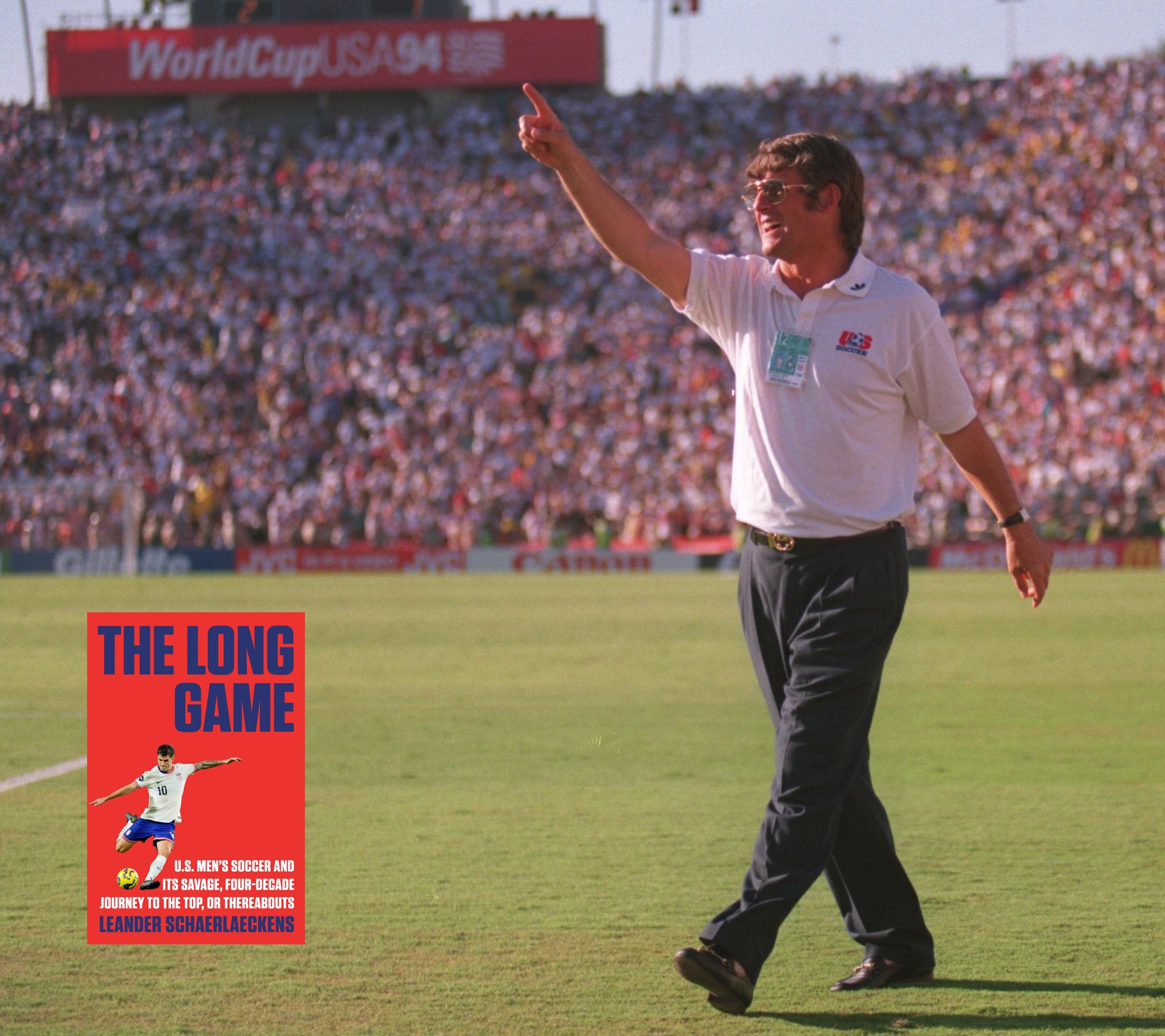
Velibor Milutinović, or Bora to both friend and foe, was born in Yugoslavia and orphaned by World War II. After a childhood spent kicking an inflated pig’s bladder around in the streets, he and his two brothers made the national team. He signed with clubs in Switzerland and France before winding up in Mexico. He became a successful coach there and then managed the Mexican national team. With an unconventional approach, he brought a moribund team to an improbable quarterfinal on its home soil at the 1986 World Cup, making him a Mexican hero. He was hired by Costa Rica just two months before the 1990 World Cup, dumped half a dozen of the team’s stars, and made it the first Central American nation to reach the World Cup’s second round. He was a certified miracle worker.
He was also, somehow, available to U.S. Soccer at a salary in the very low six figures—which was to be paid to an offshore company that then “loaned” the federation Milutinović’s services, according to then-federation president Alan Rothenberg—a fraction of what the other candidates commanded. Milutinović had other job offers. Certainly more traditional ones than this strange gig sculpting a respectable national team out of players most of whom had no club team. But he thought of his life as an adventure. Milutinović wanted to live in Southern California and believed there was untapped potential in the team’s young core. Their mentality appealed to him. They would shut up and do whatever they were told.
In March 1991, Milutinović and his signature mop of early-Beatles-style hair signed on to coach the American men through the 1994 World Cup. “It was an incredibly good challenge to do something special in a special country,” he remembered. Milutinović was famous in Mexico, but stateside he was, as he put it to The New York Times, known only to the cooks and the gardeners—“This is enough.” Rothenberg hoped that Milutinović’s star status would help the national team make inroads with the country’s swelling Hispanic population: “He was God in that community,” Rothenberg said.
It didn’t take long for one of Milutinović’s myriad quirks to reveal itself: his use of language as a weapon. When Hank Steinbrecher, the federation’s secretary general, met with Milutinović in Mexico City, he was told the coach spoke no English. Since Steinbrecher had no command of Spanish, Milutinović brought his personal translator. “I had a distinct feeling that Bora knew absolutely everything I was saying,” Steinbrecher remembered. So he decided to lay a trap. After Milutinović was hired, he came to the federation’s then- headquarters in Colorado Springs and, this time, Steinbrecher made sure to supply the translator himself. Then Steinbrecher instructed the latter not to translate what he said simultaneously, but to wait until he finished talking. In English, Steinbrecher welcomed Milutinović and then, with a straight face, announced that he and not Milutinović would be the one to set the lineups for the team—an unthinkable incursion on the coach’s authority. “Before the translator could open his mouth,” Steinbrecher recalled, “Bora goes, ‘No, no, no, no, no, señor!’ Gotcha.”
Milutinović, for his part, maintained decades later that he really was heedless of the language. “What was my problem was I don’t speak English, only Spanish,” he said, in English.
Rothenberg wanted Milutinović to at least speak English when he addressed English- language media. Milutinović did his entire introductory press conference in Spanish. Years later, when Milutinović had taken a job with a different federation, Rothenberg couldn’t help but note that the coach gave his first press conference in English.
Ask his former players about Milutinović and they’ll wonder out loud how they could possibly begin to describe a man so enigmatic yet so charming.
Alexi Lalas, a young and obscure defender who would grow into one of Milutinović’s stars, still couldn’t quite define his old mentor three decades after last working together. “Bora is a strange mix of Yogi Berra, Yoda, and Yogi Bear,” Lalas said. “He speaks five languages and none of them well. He is the most frustrating coach and person that I’ve ever met, and also the most illuminating. In strange way, he’s the best coach I ever had.”
“He was a mystical, magical character,” said Steinbrecher. “A genius. Don’t ask Bora why he did something tactically; you don’t ask Picasso why he had a flick of the wrist. Bora was not a scientific coach, he was an artistic one who felt the game, breathed and lived the game. Our players needed that.”
At Milutinović’s first camp he informed the stunned players that they would not be stretching before the day’s practice. At first, he wouldn’t let his players drink water during breaks from his grueling workouts either, in the belief that it would toughen them up—a team doctor had to intervene. The American player, Milutinović thought, was coddled by his cushy circumstances. There was no desperation in their game because success wasn’t a condition for their survival. “This is the problem with these people: They don’t have a problem,” Milutinović told journalist Simon Kuper in his book Soccer Against the Enemy. Then again, Milutinović admitted that he liked working in the U.S. because he got to live in Southern California and there was virtually no pressure on him.
Milutinović rarely explained anything and barely talked to anyone but the team’s few Spanish speakers. Instead, he paced the field and demonstrated. When he did speak, it was hard to make sense of his message, which was typically delivered in fragments of several different languages. Sometimes Milutinović’s pregame instructions were so bewildering that the team worked out its own tactics. “The players would get together and say, ‘Bora’s lost his mind. Let’s just play,’” striker Bruce Murray remembered. “So we’d play and do the complete opposite of what he’d asked us and he’d be like, ‘This is the perfect game.’”
No detail was too small to escape Milutinović’s attention. He once substituted Eric Wynalda out of a game right after scoring a goal because the coach felt that the striker should have shot the ball with his left foot rather than his right. Shooting pool was banned because Milutinović worried the players might hurt their hamstrings leaning over the table. He told them how to tie shoes, shifting the knot of their laces off to the side of their cleats in order to create a flatter surface to strike the ball with. Lapper’s cleats had a long tongue, which concerned the coach. “So he literally bent down and cut the guy’s shoes,” goalkeeper Tony Meola said. “And we’re like, ‘This guy’s a maniac. What’s wrong with him? He’s like a mad scientist.’” He even told the players how to eat their spaghetti. They were to twirl up their pasta with a spoon, rather than on their plates. “He had a lot of lessons,” defender Marcelo Balboa said. “I’m not sure if he was doing it to fuck with us, but you always learned something from Bora.”
Beneath all the eccentricity, Milutinović was a sound coach who filled the many gaps in his players’ techniques, and an astute tactician who did his best work at halftime of games, recalibrating his team to the rhythm of the match. Milutinović got the players to believe. Within months of his hiring, he had led the U.S. to victory at the Gold Cup, the first significant trophy in the program’s history. The Americans beat Mexico 2–0 in the semifinal, their first competitive victory over their neighbors since the 1934 World Cup play-in game. “He seemed at times to be a scatterbrain,” Lalas said. “But there was absolutely a method to his madness. When you’re in it, it was very difficult to see.”
When the team wasn’t on the road playing games, Milutinović ran two training sessions a day in the team’s 18-month, live-in training camp in Mission Viejo, California to prepare them for the 1994 World Cup. But that wasn’t all. There were hours-long lectures on tactics and endless games of soccer tennis; during their lunch break on days with UEFA Champions League action, the players were expected to join Milutinović at a local restaurant to watch the games. The whiteboard tactical sessions were vexing. Milutinović would draw up a problem, quiz everyone in the room, and then give the one answer nobody had come up with. “I think, for Bora, the two-a-days were more of a mental thing than him thinking we needed to train twice a day—just to see who would hold up,” said Meola.
Practice sessions were monotonous and included stretches of the dreaded “one player, one ball” drill that could run as long as half an hour. Milutinović would give no instruction other than for each player to grab a ball. From there, they were on their own. “It was one of the most mundane, unproductive exercises I’ve encountered as a professional soccer player,” defender Dominic Kinnear said. “I think he thought, technically, we were not that great and so the more touches we got on the ball, the better we would be. Some people would shoot the ball over the goal on purpose just to kind of skip the exercise for a good fifteen to twenty seconds.”
“Many times, they tell you, ‘Hey, we don’t train nothing,’” Milutinović said decades later. “But at the same time, we’re training everything.”
Milutinović’s methods were hard to parse. He would announce that a scrimmage would last five more minutes but not blow his whistle to end it for another twenty- five. When he refereed during practice, he made bad calls on purpose, just to see how his players would react. “It made you pull your hair out,” said Lalas. “It made you question everything that you had known about soccer. And some players, honestly, ultimately it was their demise.”
One day, Renato Capobianco, the team administrator, went up to Lalas and informed him that Milutinović wanted him to cut his long red hair. After protesting vigorously, Lalas got a haircut. The next day, Milutinović walked in, glanced at Lalas, nodded, and said nothing. From that day, Lalas grew his hair out longer and wilder than before, adding in a bushy goatee for good measure—the iconic look that would make him famous at the World Cup. Milutinović never bothered him about his hair again; Lalas had passed his test.
The players who spoke no Spanish had a hard time communicating with their coach. Yet Milutinović had other ways of making himself understood. One day, some players got into one of the team vans and waited for Milutinović. With some time to kill, they got onto one of their favorite subjects, complaining about their coach. “We’re waiting and we’re waiting and next thing you know, Bora pops out from underneath the backseat,” Balboa recalled. “‘Everywhere you go,’ I remember him telling us one day, ‘just remember, if you think you can get away with something, you won’t. Remember, I am Bora. I know the people that work here. I know the cooks, the cleaning lady, the people behind the front desk. They will tell me if they see you leaving the hotel. They will tell me if you’re ordering food at 11 o’clock at night. They will tell me.’”
When the 1994 World Cup finally neared, Milutinović’s work was essentially done. His eighteen-month indoctrination camp had turned out a team that had grown close and developed tactical coherence. They’d traveled the world over several times and experienced just about anything a World Cup game could throw at them. If his methods were maddening, Milutinović also seemed to have delivered on his mandate. The Americans were competitive.
Copyright © 2026 by Leander Schaerlaeckens.