It started, as all diarrhea outbreaks do, with rumblings of discontent. At first it was funny; "explosive diarrhea parasite" forms a laughably horrid trifecta, an anti–"cellar door," the butt of a bad joke, a fate you'd wish on your worst enemy, especially an ailing one. But then the threat crept closer to home. Someone I knew posted a series of Instagram stories detailing his harrowing personal experience with Cyclospora cayetanensis, the parasite in question, with a haunted gravity unbecoming of an Instagram story. As the number of cases continued ticking upward in states far and near, I began looking at my bundle of herbs with suspicion.
This cyclospora outbreak has already become the largest in U.S. history, with thousands of cases counted by individual states. It's hard to say for certain how many cases there are right now, in part because there is a six-week lag between the time the illness begins and it is reported to federal health authorities. Michigan has seen the most cases, with 2,640 reported as of July 13, followed by New York and Ohio. For context, Michigan generally reports around 50 cases of cyclospora each year, per the New York Times. And these numbers only represent the people brave or anguished enough to seek medical treatment and an official diagnosis of cyclosporiasis. The real number of cases is almost certainly higher. "Most people with a few days of watery diarrhea ride it out at home rather than see a doctor," Katelyn Jetelina sagely noted in her newsletter, Your Local Epidemiologist.
If all this talk of explosive diarrhea parasites has left you with questions, such as if "explosive" is a sensationalist media description or a medical term, allow me to do my best to answer them.
What kind of parasite is cyclospora? Is it a worm or an amoeba or something?
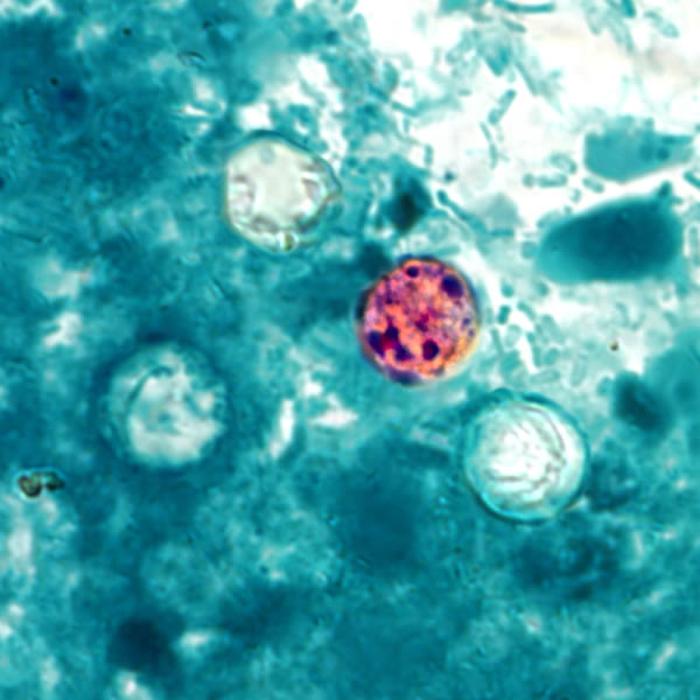
Unfortunately for RFK Jr., cyclospora is not a worm. It is a type of single-celled parasite called a coccidian. Like other coccidia, cyclospora lives and reproduces inside the cells of animals. The most famous coccidia might be Toxoplasma gondii, which can infect all warm-blooded animals but can only sexually reproduce inside cats. Once inside the cell, cyclospora resembles microscopic, globular spores. Other cyclospora species have been found in baboons, vipers, moles, rodents, and even myriapods, the group that includes millipedes and centipedes. But Cyclospora cayetanensis only infects humans.
The first known cases of cyclospora appeared in the 1970s, but it took decades for the parasite to be fully described, according to a 2010 paper in Clinical Microbiology Reviews. In the 1980s, cyclospora spores were frequently misdiagnosed as another single-celled parasite called Cryptosporidium, which also causes watery diarrhea, was frequently identified in patients whose immune systems had been compromised by AIDS. Cyclospora was formally identified in the mid-'90s—a long overdue introduction to a ghastly sort of debutante.
How do you get cyclospora?
Cyclospora is spread through human feces. People get the parasite via two routes: eating contaminated food or drinking contaminated water. Once you swallow cyclospora's oocytes, which are basically its eggs, they take over your gut. They become male and female and then proceed to reproduce inside of you. Their eggs burrow into the wall of your intestines, and you shed them when you poop. Cyclospora is not directly contagious from person to person. After the parasite is shed (read: pooped) it needs a few weeks to produce more spores and become infectious.
The food most likely to contain the parasite is fresh, hard-to-wash produce, like knobbly berries and delicate herbs. Foods associated with outbreaks in the U.S. include raspberries, basil, cilantro, snow peas, and mesclun lettuce, per the FDA. But cyclospora is hard to track down because symptoms can appear anywhere from two days to two weeks after a person encounters contamination. And I'd wager that the only people who remember, in exact detail, everything they ate over the last week are these guys.
The CDC, which is currently investigating the cause of the outbreak, has shared no leads. Michigan health officials have tentatively identified "lettuce or salad greens" as a potential source, although the officials cautioned this lead was not definitive. They did not share any particular grower or supplier and said that the cyclospora may be coming from other foods as well. So as far as leads go, it is hard to say how helpful this one is.
OK, so how should I be washing my beautiful fresh lettuces and salad greens?
If you heat them to 158 degrees Fahrenheit, you'll kill all the cyclospora.
That's obviously not how I want to eat my salad.
Sorry! I wish I had a better option. You should be rinsing your produce under warm water, as Penn State food safety expert Martin Bucknavage told NPR. But this strategy is not foolproof, especially with more fragile foods that are harder to scrub down. Washing does not get rid of the parasite; it only reduces its numbers.
The Michigan health officials advised against buying bagged or pre-mixed salad kits. Instead, they recommend buying a whole head of lettuce, throwing away the first few layers of leaves, and then thoroughly rinsing the leaves underneath. With other kinds of produce, the officials recommend peeling it.
How will I know if I have cyclospora, or if I am simply beset by unrelated diarrhea? What does "explosive" diarrhea really mean?
A cyclospora infection causes a number of symptoms, including nausea, fatigue, bloating, and "explosive, watery diarrhea." Anyone who has had diarrhea before might wonder, as I have, about the use of adjectives here. Isn't all diarrhea, by dint of its sudden onset and dilute, spattering consistency, a kind of explosion? Is "explosive" just sensationalist framing by a failing news industry greedy for clicks? I regret to inform you that cyclospora diarrhea truly does live up to its name. The clinical description of its symptoms include "frequent and sometimes 'explosive' bowel movements."
Most stomach bugs that cause watery diarrhea last around two or three days, as Omer Awan, a clinician at the University of Maryland School of Medicine, told PBS. But cyclospora-caused diarrhea can last for weeks, even longer than a month. With cyclosporiasis, you're typically having diarrhea multiple times per day and feeling bloated, full, and uncomfortable, Rebecca Schein, an infectious disease expert at Michigan State University Health Care, told CNN. Or, as beleaguered Denver local Reba Pousma told CBS News, "I'm on day five now of going to the bathroom over 40 times a day, and nothing has been solid."
So if your diarrhea has lasted longer than a few days, it is in everyone's best interest that you go ahead and get tested.
But I don't want to have diarrhea for weeks! Is there treatment?
Yes! A cyclospora infection can generally be treated by a 10-day course of antibiotics, and most people's symptoms resolve within a week.
Cyclosporiasis is not life-threatening for most people. But diarrhea is dangerously dehydrating, and can cause severe illness in younger or older people, as well as people with weakened immune systems. If you get diarrhea, explosive or not, it's important to rehydrate with electrolytes.
How much of this should be blamed on RFK Jr.?
While RFK Jr. did not engineer the cyclospora parasite in a lab—that we know of!—he helped lay the groundwork for its rapid, alarming spread. Last year, RFK Jr. announced plans to lay off 10,000 employees from the Department of Health and Human Services, impairing the agency's ability to, well, serve the health of humans. Many of these cuts directly affected the CDC, including employees who would ordinarily be in charge of tracking this outbreak. Also, last year the CDC scaled back its main food surveillance system, the Foodborne Diseases Active Surveillance Network, eliminating mandatory federal surveillance of cyclospora and five other pathogens, including campylobacter, listeria, shigella, vibrio, and Yersinia. Now, tracking these pathogens is voluntary for individual states. (The only pathogens that remain mandatory to track are salmonella and Shiga toxin-producing E. coli.) Food safety experts worried that these cuts would make it easier for foodborne illnesses to spread undetected. And would you believe that they were right?
This is why the CDC has such poor coverage of the cyclospora outbreak right now. This why Michigan has reported more than 2,000 cases of cyclosporiasis while the CDC has reported less than a thousand. It's likely that whenever this season of cyclosporiasis dies down, giving America's toilets a breather, we will have little understanding of the full extent of the outbreak. Cyclospora is not included in the test most doctors give patients with a stomach bug, meaning that many patients who go in with symptoms might not be counted among the official reported cases.
But as long as the explosive diarrhea outbreak rages on, no one can blame you for not eating your vegetables.