Is there a story writers love to tell more than the one about how we became ourselves? Give me all of them: your Künstlerromans, your campus novels, your NYCs, your MFAs. I didn’t go to Iowa, but I’ve read so many recollections of the program that sometimes I think I might have. The pleasures of the genre arise in part from how its entrants play with certain tropes: the struggle to find one’s voice, the anxiety of influence, the labor of constructing an identity, the implicit resolution promised by the book the reader holds in their hands.
A key figure in this artistic coming-of-age is the charismatic teacher. The writing teacher is both a vision of a possible future and that future’s arbiter; maybe the first authority to give—or withhold—permission for the student to keep going. The stakes of their pleasure or displeasure are high. This can make it easy to confuse the aim of the class—to write good sentences—with the teacher’s gratification. A good teacher, writes Amia Srinivasan in The Right to Sex, will get out in front of this confusion, seizing a student’s desire and rerouting it toward its proper object: their education. You could fill a bookshelf with examples where that redirection fails, and the ensuing lessons confer an aesthetic and moral education of an entirely different kind.
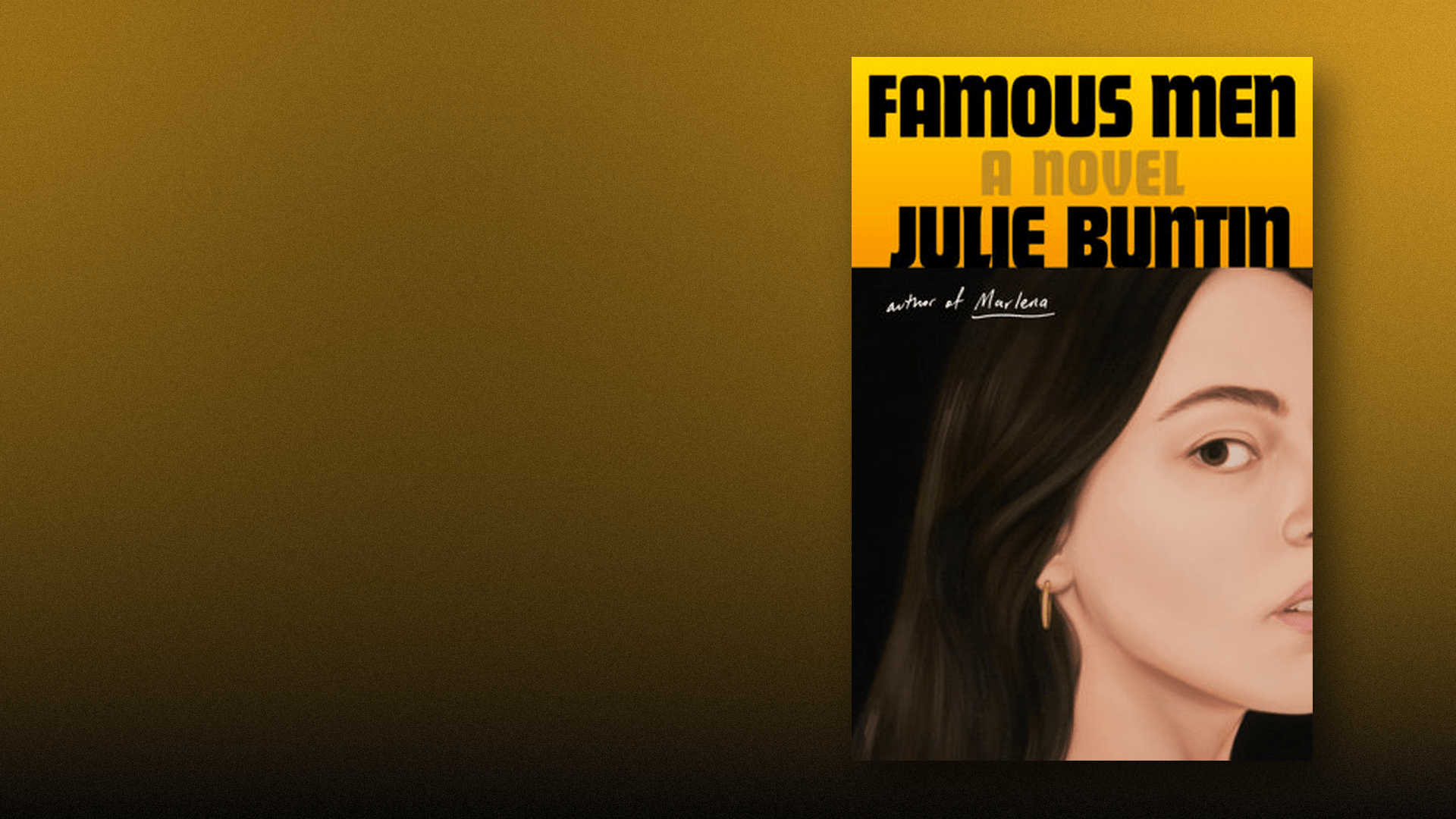
Julie Buntin’s sophomore novel, Famous Men, is an audacious entry into this canon. The narrator is Wilhelmina (Will) Miles, a budding writer from Greening, a fictional town in Northern Michigan. Greening’s best-known export is the “great American writer” Nathaniel Fellow, who teaches at a prestigious MFA program in New York. When Will discovers his poetry at 14, it dilates her sense of what life and art might look like. In Greening of the early aughts, a world of snow and skinned deer, of “raw-eyed fathers and their identical boys,” she feels constrained—by tensions with her mother; her mother’s predatory boyfriend; a high-school rumor that dogs her after a party; her longing for proximity to art. Her hunger to escape takes Nathaniel as its object—not just his work, but the chance that he might be the father whose identity her mother has never revealed. By the time she finally makes it to his doorstep in her early 20s, his influence and her artistic formation have been intertwined for a substantial portion of her life.
The two have a glancing meeting at a poetry reading. But their first real conversation, in Nathaniel’s office, is rendered with the kinky tautness of Clarice Starling’s initial interview with Hannibal Lecter. They circle one another, feeling for the limits, trading power back and forth. Will—who has not yet confronted him about the possible daddy thing—works Nathaniel, charms him. Her actions, like her narration, operate by forthright, almost desperate assertions of agency; a reminder that she is never as much in control as she likes to think. Of her own accord, she winds up under Nathaniel’s desk to tie his shoes, turning her subjugation into a power play. Will is enrolled at a different college in the city, but her plan is to pitch herself as Nathaniel’s “literary assistant”—a proxy for dazzling him with the poems she’d included as an email attachment and thereby securing an invitation to his MFA workshop. Nathaniel gives her the job and permission to audit—“You’ll be my first exception,” he says, like he’s never said those words before—but only later does she realize that not once, during the meeting, did he mention her writing.
Nathaniel Fellow is a formidable entry into the ledger of men who bend the rules and call it good pedagogy. By the time Will meets him, he is 62 and his best work is behind him. But he is still a literary star and a force in the classroom, where his passionate monologuing, devastating judgment, and flirtatious favor recall notorious teacher-editor Gordon Lish. He is charismatic, fussy, mercurial. He is known for being a generous mentor, who might slip a protégé’s book to an editor at dinner. But he’s also known for being a creep. Will hears his students gossiping outside the seminar room. His bad behavior is “part of his lore, something to be accommodated, like a therapy dog.” It is a testament to Buntin’s skill that despite these familiar hallmarks, the dynamic between Will and Nathaniel feels original and consistently electric.
This charge comes from the ways Famous Men sets up, and then subverts, our expectations of the artistic coming-of-age narrative. Chief among these subversions: Nathaniel has not chosen Will for her talent, or chosen her at all. He never takes her under his wing the way he does his students. He takes her onto his payroll, into his home, his bed. But really, she has chosen him, bending her life to put herself in his path in hopes of gaining access to his world. Early in the novel, she wonders at the source of talent—whether one is born with it, or learns it, or discovers it. She settles on a formulation that undergirds the novel’s provocations: “What if talent was, simply, a path one chose?”
Will is single-minded in her pursuit of that path. She is determined to exact literary mentorship from Nathaniel, even when he seems reluctant to give it. His feedback on her work, at first painfully dismissive, is part of what she sees as their “arrangement.” Even as the boundaries between them warp and erode, she does not waver in her conviction that this man knows her better than anyone else, and that he must hold the key to her future self. Nathaniel clocks this doggedness in her, even encoding it with a nickname: Wilhelmet. It is a semi-literalization of Wilhelmina’s etymology: desire and blunt force, a hard head. Coming from Nathaniel, it feels like both insult and endearment, but also proof of Will’s hunch that all along, he has been the one capable of truly seeing her. For all her hard-headedness, Will also feels the ambivalent erotic thrill of this attention. She enters their exchange confident that she holds the power. That power slips away partly at Nathaniel’s hand, but also out of Will’s own curiosity about who she might become if she lets it happen.
She is so beguiled by his influence that there seem to be few limits on what she’ll do to keep it. Right before they sleep together for the first time, Will wonders about confessing that old hope—mostly dispelled by that point, but not yet entirely—that he might be her father. But she stops herself because it would almost certainly kill the vibe, halting “the events [she’d] set into motion. It would have to.” An unbearable pause, then … “Wouldn’t it?” How badly do you want to be a writer? Would you fuck your own dad? The setup recalls Harold Bloom’s “anxiety of influence,” in which the (male) writer, in trying to articulate his own poetic voice, is enacting a version of Freud’s oedipal drama—except instead of a son wanting to murder his father, we have a daughter who’s willing to sleep with him. In this light, a hint of incest is less a transgression than a stage of—or a commitment to—artistic development; perhaps the purest possible form of “prais[ing] famous men, and our fathers that begat us.”
Despite her tenacious belief in her own agency, Will is, of course, tremendously vulnerable. She is a new transplant to New York: a broke student renting an abominable room, with a too-friendly roommate and a heart condition that occasions regular and costly emergencies. She relies on Nathaniel for far more than a paycheck and feedback on her drafts. Her precarity adds another twist to her complicity—she isn’t doing this solely out of fandom or ambition, but because she has few other options. Nathaniel may be grooming her, and Will may be exploiting him, but the two of them are also deeply lonely people who cultivate a genuine intimacy that hovers—compellingly, unsettlingly—between the familial, the sexual, and the intellectual. When you don’t come from privilege, a mentor can also be a tool for accessing spaces that would otherwise have shut you out. This is the case for Will, whose gambit eventually pays off when she becomes a published writer. But the influence and access Nathaniel provides are not inexhaustible resources. She can only outsource her development for so long before the bill comes due.
In this case, a #MeToo reckoning, many years into the novel’s expansive timeline, forces Will to confront the personal and social fallout of her loyalty to Nathaniel. It can still feel jarring to encounter the movement in fiction, because its impulse to diagnose, even litigate, is at odds with the emotional complications that novels thrive on—especially this novel. But the inflection point feels naturalistic in this case, because it becomes part of the context rather than the engine of the novel’s emotional or political logic. 2017 spurs questions Will would have had to face anyway, about the cost of getting what she wanted.
Some critics will take a book that engages with power dynamics and reflexively apply the label “#MeToo novel” as shorthand for bad man, as if the hashtag were a literary movement, or novels about male misbehavior originated after 2017. Famous Men has already attracted the descriptor at least once, though Buntin has said that she would not characterize the book as such. I agree: The book feels more like a case for abolishing the label altogether.
Famous Men draws its power from how committedly it dwells in the spaces where agency and blame cannot be easily apportioned. The reader can be horrified by Nathaniel’s manipulations or by Will’s will, but shine the harsh light of condemnation on them and an essential truth disappears: This quality of influence can be seductive, even—or especially—when it is transgressive. Maybe that’s even why it works. This is the volatile promise of the charismatic teacher, the great literary daddy—maybe you can use him to get exactly what you want. If the reader gives themself over to this possibility in the same way Will does, then they, like her, will leave the novel changed.