One dreary weekend this past December, I decided to fight back the winter gray with the color and vibrancy of musical theater. I routed myself not to Times Square but to the closest AMC, which was screening the recorded live performance of the 2023 revival of Merrily We Roll Along.
If you just shuddered in horror at the thought of seeing a recorded play or musical as a movie, wait, hear me out. Before I had ever seen one for myself, I assumed that a live theater performance put to film would offer the worst of both forms. As a bonafide theater-lover, I was skeptical of film’s ability to capture the magic of a live performance, and thought a static screen would flatten the energy and dimensionality of the stage.
But then I saw one. It was 2017 in Montreal. Together with a friend, I had shuffled through the downtown slush of snow to my local movie theater to see the 2016 revival of Falsettos, an incredibly spare show that included just seven cast members and a set of gray, modularly designed stage furniture that the cast manipulated to form settings like a kitchen counter, a chess table, or a shrink's couch. The effect was stunning, even for a movie theater audience. We could see how the show’s scenes scaled to hold pomp or intimacy, or how the smallness of an actor juxtaposed at times with the largeness of the stage. The camera, with its powers to zoom in and out, could frame each setting in a way that heightened the viewer’s sense of immersion while staying faithful to the spirit of the show. I entered the movie theater a skeptic, but I left a believer.
I’m not alone. In the years since my first experience, recorded theater has really taken off. A performance of Hamilton released on Disney+ in 2020 and had a theatrical release in 2021. AppleTV+ released a recording of 2017’s Come From Away, also in 2021, and a recording of the Waitress musical came to theaters in early 2025. PBS has a growing collection of theater recordings, as does the little-known streaming platform BroadwayHD. The Brits are all over this, too.
I’ve seen most of these, and many I’d recommend wholeheartedly. So when Merrily was announced in theaters, I was thrilled. I had missed its original run and was excited for a chance to see it—and its illustrious cast—in theaters. But what I witnessed was not at all what I expected. It was shockingly bad, both ill-conceived and poorly executed. It was so bad, in fact, that it forced me to really consider a question I had taken for granted: Who or what is the recorded theater performance for?
Let’s dissect the case at hand. Merrily opens with a very tight close-up of Frank Shepard, a composer-turned-Hollywood producer played by Broadway royalty Jonathan Groff, as he looks pensively out at the night sky. The camera lingers in a way I found uncomfortable—though perhaps that’s part of the point—with Groff’s face dominating the frame for far too long. The shot stays there, even as Groff starts to slowly move across the stage.
Interesting to start on a close-up, and such a tight one, I thought, especially considering that this is a stage show, where ordinarily no audience member can see so much close detail. I would soon learn that this recording is little else but close-ups.
Soon, additional cast members begin to fill the stage for the opening number as the scene shifts to depict Shepard’s fabulous Los Angeles home. Initially, you know these characters are on stage only because of the quick successive close-ups that flit from face to face with every new line. And you know the scene has changed only because of the few wide shots mercifully punctuating the sequence of faces every so often. All of these shots are on actors whose characters haven’t quite been established. Since you get so acquainted with all their faces so quickly, one might assume all these characters are important (they’re not!). Some of these characters are captured in close-up while simultaneously singing and moving across the stage, creating an uncanny TikTok-ian effect. There’s a cut every few seconds, with every frame about 10 to 20 percent too tight for comfort.
All this would be a problem for any show, but for this one in particular it’s disastrous.
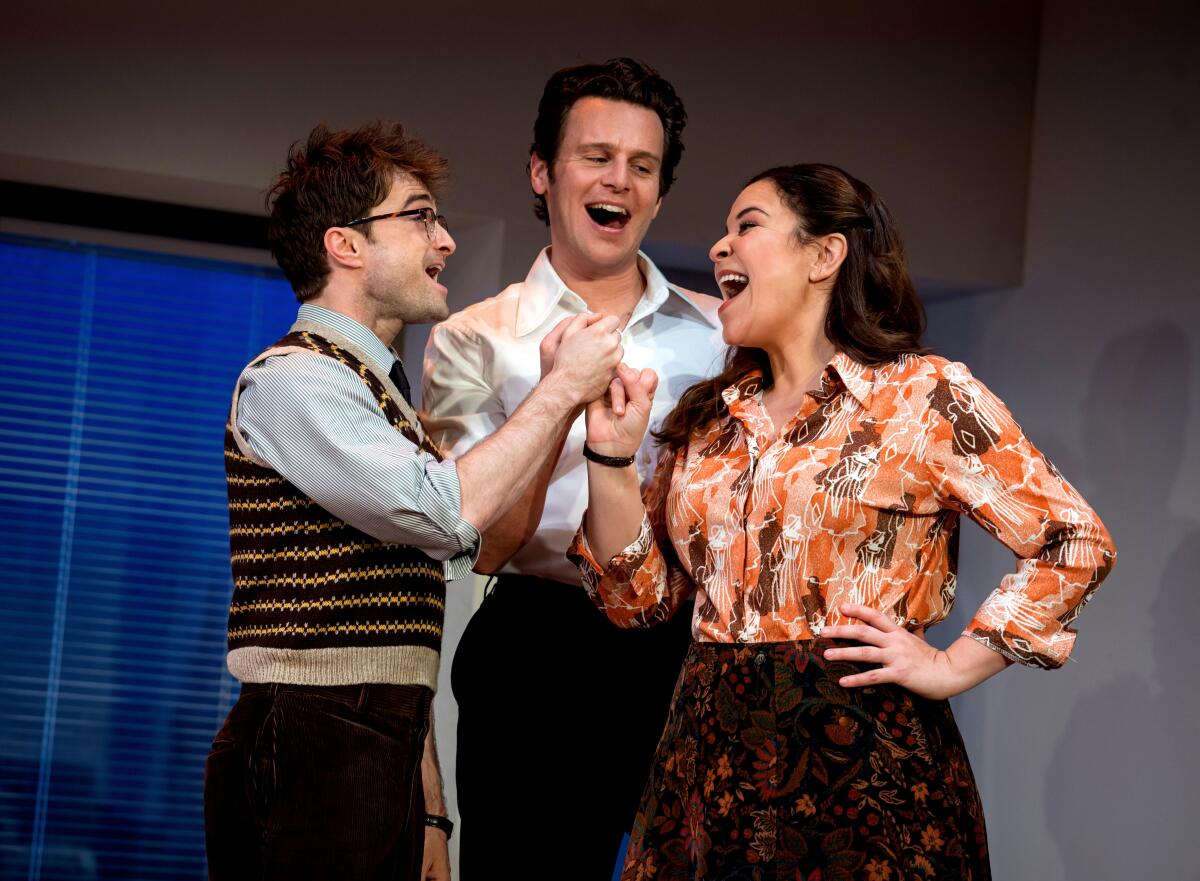
Merrily We Roll Along is a story made up of many different scenes that move backward through time. We follow the central trio of characters—Shepard, playwright Charley Kringas (Daniel Radcliffe), and theater critic Mary Flynn (Lindsay Mendez)—as we rewind, seeing the complex dissolution and origin of the friendships between them. This reverse chronology is exactly what makes context so key: The story is pieced together in the working memory of the audience who see consequences of characters’ actions only in hindsight. The critical information is not how each individual character is feeling or reacting in one moment, but how interactions between characters thread together into a greater narrative of friendship and interpersonal responsibility.
The excessive close-ups hit viewers with a triple whammy: First, since theatrical productions don’t typically use extras, but instead have actors in the ensemble play multiple roles, excessive close-ups cause confusion. Is the show implying that this actor is the same character in this scene as the last? I wondered. (I’m still not totally clear.)
Second, staying too zoomed in keeps the movie-goer in limbo. Despite all of theater's strengths in immersing us in a scene, and the considerable work involved in designing and building the world on stage, the viewer is jarringly unmoored when forced too close. They’re unable to comprehend how people are moving on stage or how the stage is changing to communicate time or place. With each new close-up I found myself thinking, Oh, another person’s on stage now? and Where on the stage even are we? One forgets there even is a stage.
Third, since the audience isn’t trusted to know where to look (and forbidden the chance to try), viewers are robbed of wider context. When a character sarcastically ribs another character, I want the opportunity to see how the joke lands. In a party scene where some characters are making a scene, I want to know if the partygoers are horrified or titillated. Don’t get me wrong, I appreciated being able to see the exact quality of Lindsay Mendez’s eyes as she gazes across the stage. It’s just that I’d prefer to also see the object of her attention, how they are or aren’t affected by it, what the air between them feels like.
In theater, the stage is already a viewfinder, the frame in which directors balance out compositions of character. Excessive zoom-ins disrespect that intentionality. When, two thirds into the show, the song “Bobby and Jackie and Jack” finished without a single close-up, I nearly cheered.
Maybe the people behind the recorded version of Merrily figured that having a movie star in the cast gave them license to make a movie. But this is precisely the wrong choice. Theatrical performances, even when put on a movie screen, are not really movies. So what should they be instead?
To answer this, I think we need to first ask who filmed theater is for. On that count, the answer to me has always been a bit obvious. After all, the medium’s great strength is its ability to broaden accessibility to people who either can’t travel to see the original show or who cannot afford exorbitant box-office prices (the average ticket during the entirety of Merrily’s Broadway run was about $200). Many theater-lovers will only ever be able to see Hamilton on Disney+, and it’s those fans who have kept the show at the top of the platform’s streaming charts.
For those people who love, or are at least interested in, theater, filmed shows are their proxy for a theater-going experience. Speaking for myself, when I see a recording of a show I never got to see live, I want the opportunity to take in the costumes, the choreography, how the show wrestles with the physical constraints of its stage—all of it. And I want to leave feeling like I got all the same information as those who saw it live.
Now, if the one and only goal of the recorded performance was to achieve exactly a theater-going experience, producers would be content to plunk a camera down somewhere in the middle orchestra and film with the whole stage in view for the duration of the show. They of course don’t do this, and thank goodness!
With the power of the camera, producers of these filmed shows know that a recorded performance is the opportunity for an audience to have not just the best seat in the house, but the best seat for any particular scene. Since the camera need not be confined to a seat, there’s an opportunity to capture a scene from its optimal angle, see the twitch of an actor’s eye, or walk with a character across stage.
But taken to an extreme, giddiness to inject theater with “movie magic” can neuter all the spark of live acting. In the Hamilton recording, there are moments when the camera dances on stage with the actors, even moving between them. Some people love these moments, hailing them as “immersive.” But to me, these moments taint the spirit of theater. Why? Because those “immersive” dance sequences were recorded without an audience present.
The promise of theater is that you, collectively alongside the rest of the audience, will witness a performance that can never be achieved exactly the same way again. And the presence of an audience bearing witness to this ephemeral performance creates a bit of tension, adds stakes to the performance of the actors who do not have second takes available to them. Even when watching a recorded performance, I want to know that I am watching someone sticking their landing.
On one hand, I’m glad that people are tinkering with ways that technology might augment the experience of filmed theater. There’s potential here for recorded theater to become its own hybrid genre, with a production language all of its own and potential for new experimentation. On the other, I think the ultimate goal of recording these performances should be to widen their audiences—to make sure some kid in Iowa can experience the magic of Broadway, or to bring shows to those who wouldn’t otherwise have access, but to also introduce them to those who are curious or skeptical about theater, who would only be inclined to click on a show from the comfort of their couch. The best way to do that is to make these recordings stay true to the spirit and feeling of live theater. That doesn’t mean we should never zoom in to see the sweat of an actor’s brow, just that we can’t lose sight of the forest for the sweat-glistened trees.
Unfortunately, that’s exactly what Merrily We Roll Along did. I left the theater feeling like I still hadn’t seen the show. I’d love the chance to someday.