
Rich Paul, CEO of Klutch Sports and active NBA agent, has drawn some ire this season for things he said on his new podcast called Game Over, which he cohosts with Max Kellerman. Anonymous members of the Lakers staff were reportedly mad at him for fake-trading Austin Reaves for Jaren Jackson Jr. Lakers fans are mad at him for causing the "disconnect" in the Lakers’ locker room. Stephen A. Smith was mad at him for not understanding that people see him as LeBron James’s mouthpiece. All of these reasons, I fear, are misguided. The only good reason to be mad at him is that he has leveraged the unlimited resources and power of Klutch Sports, CAA, Spotify, and The Ringer to make a daytime SportsCenter simulacrum without the catchphrases.
Paul and Kellerman’s FanDuel-sponsored podcast is bad. It's bad in the sort of banal way that most podcasts are bad: The hosts don’t say much of substance, they are stricken with red light syndrome, and their riffs are obtuse and unimaginative. Paul started a recent episode with the line, "Can’t put a watch on without the time being right." This reads like some kind of adage, but Paul was literally just talking about his watch.
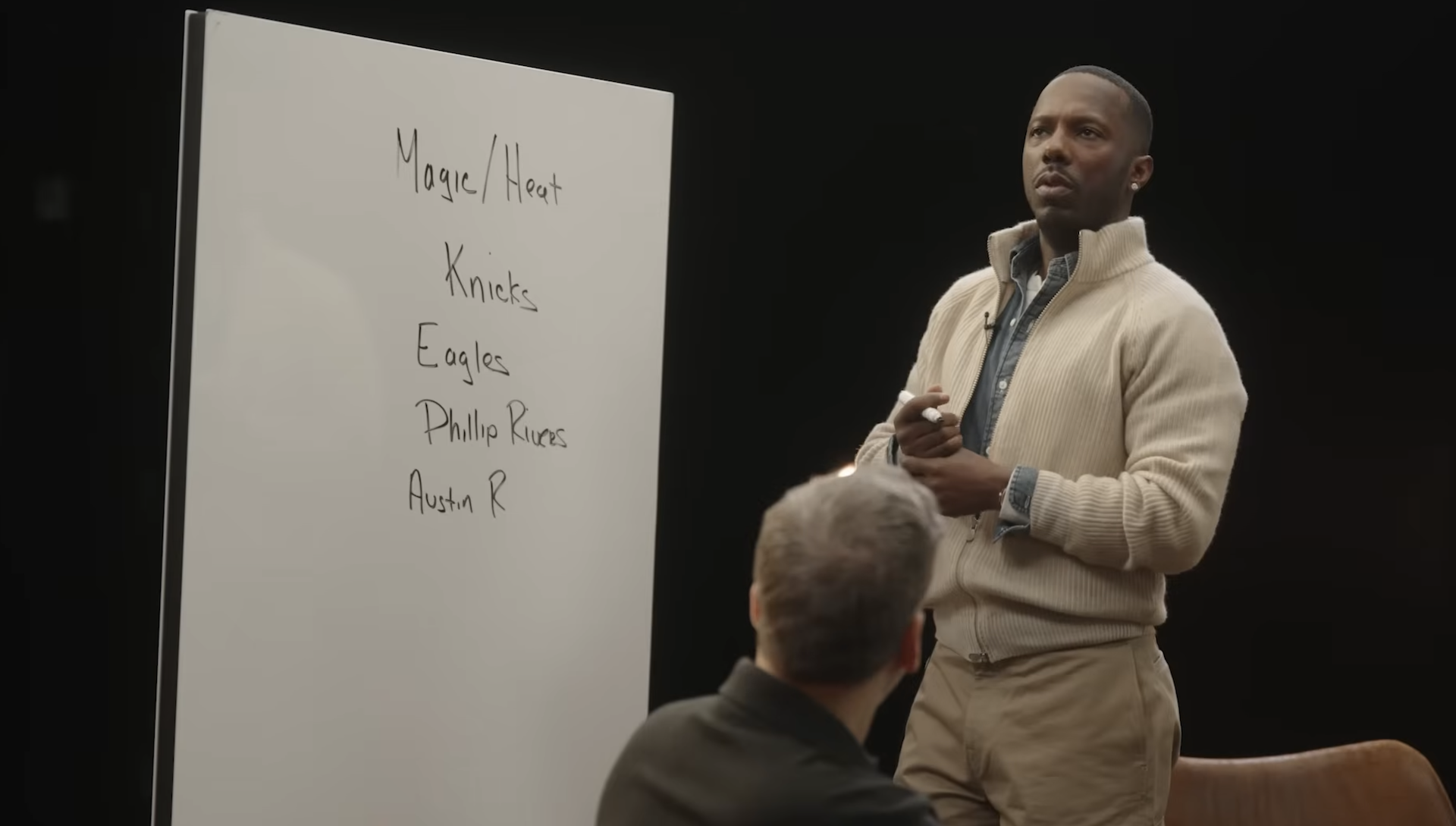
The opening minutes of the first episode of Game Over are telling. They featured Kellerman and Paul in a sparse, HBO-meets-Airspace set with brown chairs and a brown table. In the room was a whiteboard that Paul was writing on. The intended effect was unsubtle: We’re so committed to taking you behind the scenes of the world of sports that we’re gonna take you behind the scenes of how we make the dang show!
Hilariously, the planning involved Paul writing the word “Chiefs” and then “Lakers” on the board. Kellerman quipped, “You know what you're going to be accused of,” before convincing Paul that the second slot should belong to “Bills.” The whiteboard, the forced understatedness, Kellerman’s winking toward what the perception of the show may be: It's all presented in the same tone as an influencer posting "my realistic non-aesthetic trip to the Maldivian Alps"—a cynical performance of non-performance. They think we are stupid.
Paul has an odd tic of spending his time on Game Over talking about future episodes of Game Over. On a recent episode, breaking down the NBA All-Star Game (saying with a straight face, "the whole weekend was great"), Paul sketched out a hypothetical future episode where listeners could generate episode topics in a live chat format. This is both a bad idea and one that exists already. It's clear even to Paul that the show does not know what it is.
What makes this early sputtering interesting is that this show could work. The pitch of the show has a rare ability to make advertisers and sports fans' mouths water. An agent giving us a look into what's really going on? A murky para-celebrity stepping out from the shadows to show you how he specifically grips the levers of power? Do you think Paul could get LeBron to come on? Dumber premises have worked.
The low-wattage controversy the show has created is a red herring, and says much more about bad-faith clip aggregation than Paul’s candor. Ironically, when you listen carefully to Paul’s fake Austin Reaves trade, it’s clear he hasn’t actually thought about the trade at all. That’s the problem! A podcast hosted by an active NBA agent inherently promises more, but Game Over has so far demonstrated that it need not deliver on that promise in order to get attention, which is both a creative and strategic failure. If I’m not getting inside info, I can go elsewhere for riffs. If Paul were doing the podcast right, he’d be in trouble for something new every week.
As it currently exists, Game Over is stretched profoundly thin. The three-episodes-per-week cadence leaves too much space to be filled with any of the actually interesting insights Kellerman and Paul are equipped to provide, and so the show regularly devolves into Jordan vs. LeBron-style debating, Paul addressing his various mostly imagined microcontroversies, and analysis that doesn’t get much deeper than Josh Allen can really sling it.
In the astronomically saturated market of two people talking about sports, few gimmicks can stand out. Right now, the only stuff that is guaranteed to work is if you are very famous, very racist, or worked in digital media between 2008 and 2014. Paul is none of these things. The other type of show that works is one that leans in to what it is. Jeff Teague’s Club 520 show works because of Teague’s natural charisma and willingness to make fun of himself. The Athletic's Sports Gossip Show works because they found a lane nobody else saw. A show like The Rights To Ricky Sanchez works because its slim aperture allows depth and world-building that most podcasts can't create. Game Over, rather than attempting to be 1,000 people's favorite podcast, is going for a losing strategy of being 50 million people's fifth-favorite podcast.
It’s worth considering the larger trend of splashy-name podcasts. We are very clearly in the midst of a second pivot to video, but we are also in the more insidious pivot from homegrown talent to third-party celebrities. Take The Ringer: In the company's early days, it had a track record of fostering talent and launching careers. More recently, they have turned to outsourcing shows hosted by celebrities like Amy Poehler, one-man bands like Todd McShay, NBA players like Austin Rivers, and writers for other publications like Derek Thompson.
Game Over’s choppiness is a product of the incentive structure of this system. The show being profoundly undercooked is a feature, not a bug. Big celebrity deals mean that instead of a team coming together to make a show, two weary parties claw to see who can extract more out of the other party. Paul doesn’t say anything of substance about his clients on the podcast because the checks clear either way. The Ringer released Episode 1 before the hosts had any real chemistry because they don’t get paid until they can sell ads against Paul and Kellerman publicly yapping. The show being good or fun to listen to is almost incidental to the show simply existing.
It's possible the show could turn into something really good. There are glimpses, occasionally, of what it can deliver. In one episode, Paul offhandedly remarked he’s in a group chat with Tyrese Maxey and Darius Garland’s moms, and that they all texted each other during a Cavs-Sixers game. I’m skeptical, though, because the good version of this show can only exist if Paul is willing to sacrifice some privileged information at the altar of insight, or at least mine his own experiences with his clients for interesting stories. Here is where the celebrity-driven podcast truly fails: Paul has no reason to take any risks in order to turn Game Over into something surprising, because it’s not his day job. He has no stakes in this game, other than to satisfy sponsorship obligations and his own vanity. At this point, I’d take open attempts at Paul manufacturing Broncent over the unrealized half-podcast they’re doing now.
Also, I gotta say, Paul’s fashion sense on the show is unmatched. He looks great.