Remoras evolved to be clingy. The suction cup on their foreheads allows them to attach to larger animals like fridge magnets. Remoras hitch free rides on creatures of their choosing: sharks, rays, whales, dugongs, turtles, even parrotfish. But it has been traditionally assumed that the remora's approach to such symbiosis was mutually beneficial to both parties: The fish eat parasites off their hosts and slough off their dead skin, reducing the host's risk of disease, while all the remora requests is shelter under the enormous shield of their body and free transport to faraway ocean realms. And the fish feeds itself, scrounging on scraps from their host's meals and slurping up its feces. Sure, a hitchhiking remora or two makes a manta ray a little less aerodynamic. But the remora is so vanishingly small, and the manta ray so grandiosely big. Is this really such a big ask?
Now, however, the tides are turning against the notion of the remora as a helpful, or even merely benign, fish, according to Emily Yeager, a PhD student at the University of Miami. "The narrative is shifting," Yeager said, and then proceeded to share an incriminating list of the remora's recent offenses. One 2025 paper found that sea turtles carrying one to three remoras grazed less. And in all their observations, the researchers only found a single example of a remora giving back and cleaning a turtle's shell. The strong suction of the fish's forehead can harm a host, and some remoras have been glimpsed entering their host's bodies. One 2023 paper collected observations of remoras wriggling inside the mouths, gill slits, and even the cloacae of whale sharks (cloacae being the preferred plural of cloaca, some animals' all-purpose holes for peeing, pooping, and birthing).
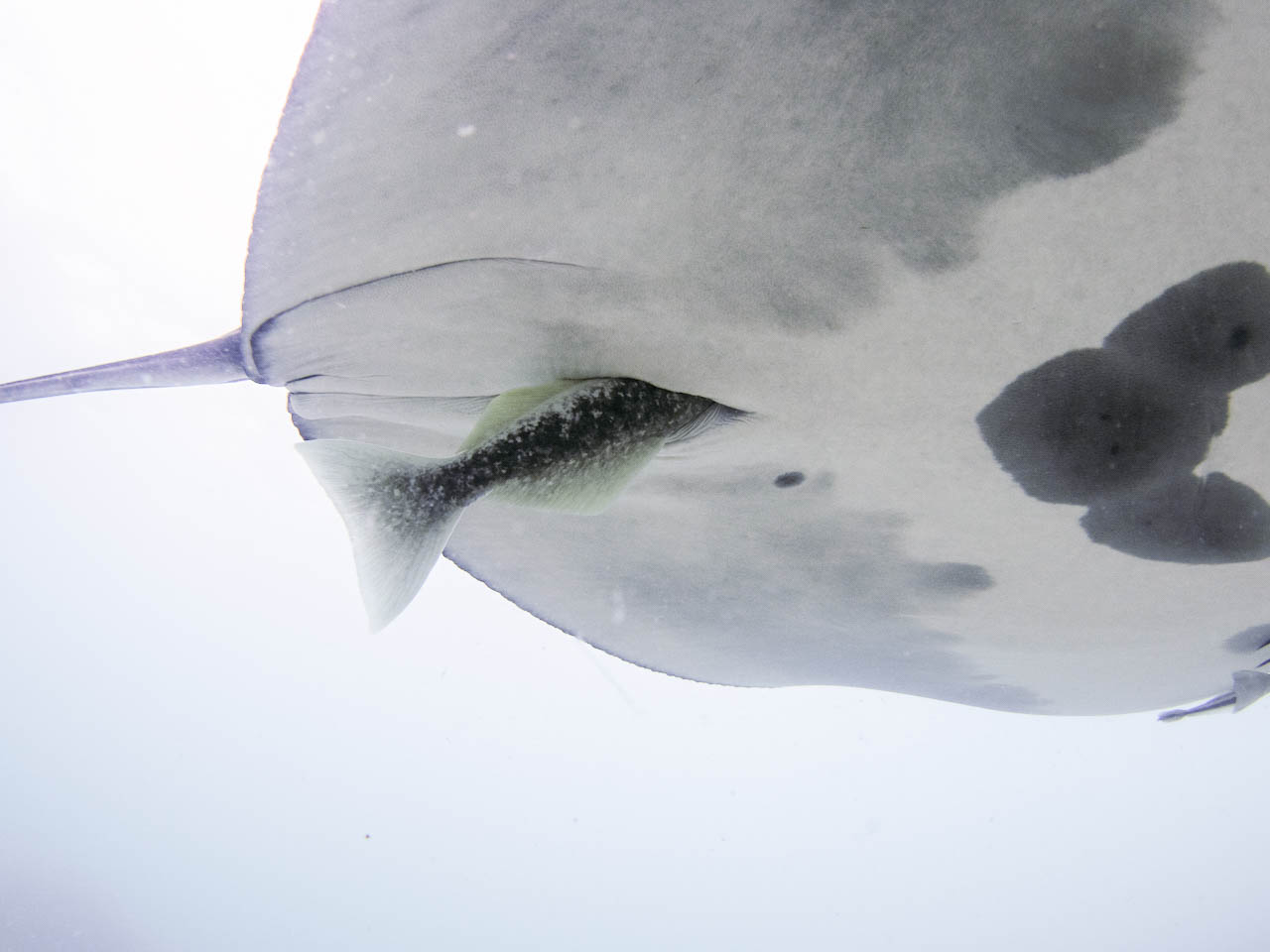
Yeager is the author of a new paper that presents the strongest case yet for the remora as a pest. Yeager and colleagues have gathered evidence of remoras swimming inside the cloacae of manta rays, sometimes squeezing half their body inside a helpless ray's cloaca. The researchers have dubbed this behavior "cloacal diving," perhaps a more elegant term than the act deserves. The paper, published recently in Ecology and Evolution, tips the scales towards understanding remoras as potentially parasitic, and is one of the strongest arguments I've ever seen for the life-changing power of hands.
Remoras are hard to study on their own, as the fish are small and difficult to tag. "Most of what we know about remoras are from these weird, one-off observations," Yeager said. Scientists did not even know how long remoras stayed with their hosts. But these relationships actually persist longer than previously thought. One 2025 paper found a single remora called a sharksucker attached to a yellowtail parrotfish over a 283-day time period, an observation made possible by a livestream called Coral City Camera. "They're not just swimming together," Yeager said. "They're having these more complex interactions."
For more than a decade, nonprofits called the Marine Megafauna Foundation and the Manta Trust have carried out long-term surveys of manta rays. Jessica Pate, a research scientist at the foundation and an author on the paper, tipped Yeager off about these strange and occasional observations. "Maybe once every two or three years, they just happened to see a tail sticking out of the cloacal opening," Yeager said. Pate and Catherine Macdonald, the director of the University of Miami's Shark Research and Conservation Program and another author on the new paper, debated whether these observations could be published. Yeager volunteered to try.
She sifted through 15 years of footage taken from waters around Florida, the Maldives, and Mozambique, and gathered seven examples of cloacal diving, as well as observations of remoras inside manta ray gills. Almost all of the footage showed a manta ray gliding by with a remora already stuffed inside their cloaca. But one observation, taken by a free-diver in 2023, showed cloacal diving in action. The video captures a medium-sized remora inserting itself into the manta ray's cloaca after it was seemingly startled by the diver. At the moment of insertion, the manta ray visibly shudders before swimming away. Frankly, I shuddered, too.
Yeager was shocked by the footage and photos. She'd known that remoras have been observed entering the cloacae of whale sharks. "But whale sharks are really, really big, and so having those fish go in there, it doesn't seem to bother them," Yeager said. Some of the remoras inserting themselves into manta rays, however, appeared to be about the same width as the ray's cloaca. In one of the photos in the study, the remora is not even able to stuff its whole body inside the opening. "It's a pretty tight fit for most of these guys," Yeager said. How does the remora get out? Can the remora even get out? No one has seen a remora extricate itself from such a pickle, Yeager said, but she imagines they can. "Otherwise, I'm guessing we would see a lot more tails coming out," she said.
What might a remora gain from burying half of its body inside a cloaca? The most obvious benefit is shelter. Yeager points out that the remora in the video may have been prompted to dive into the cloaca because it noticed the freediver, suggesting the behavior could be a startle response. But even with such ironclad protection, a cloaca does not seem to be a suitable longterm home. Remoras have to pass water over their gills to breathe, and yet some of the recorded remoras appeared so girthy that it was unclear how they might be breathing inside a cloaca.
What might a manta ray gain from such an encounter? Absolutely nothing, it appears. If the remoras are suctioning themselves within the cloaca, "they could cause some serious damage," Yeager said. The remora's suction cups are made of modified dorsal fins, and their intense sucking power is known to cause permanent damage on shark skin, which is itself incredibly tough. As such, Yeager speculates the damage that the fish could cause even more damage inside the manta ray's more sensitive internal cavity. Manta rays can breech like whales, catapulting themselves out of the water to rid themselves of remoras and other parasites, and also dislodge their unwanted buddies by rubbing themselves against rocks. But a ray has little recourse to remove a cloacally minded trespasser. "Obviously manta rays don't have hands like we do," Yeager said.
As these observations were all one-offs, the researchers do not know how long a remora might stay buried inside a cloaca. Given that the cloaca is a brilliantly multipurpose opening, I asked Yeager about how the fish might interrupt the ray's other bodily functions. "You have to assume that there's some issue pooping," Yeager said, adding that a remora in the cloaca could also interfere with mating and giving birth. Remoras are known to feed on their host's feces, so I asked Yeager if it was possible that the fish could be eating the manta ray's poop from inside the cloaca, similar to how I once saw a corgi eat another corgi's poop right out of the butt before it even touched the ground. "It could be," Yeager offered.
Since the paper was published earlier this week, Yeager and her colleagues have heard from three other researchers who have observed similar behavior in other oceans. Yeager has more unpublished data from her dissertation showing remoras going into other orifices and cavities of sharks and other organisms. She hopes that within the next decade, technological advances will give scientists more insight into what, exactly, the remoras are doing in there and why they are doing it. But for now, the new paper illuminates some of the complexity of the relationships between remoras and rays, which likely span the spectrum of mutualistic and parasitic. "When we talk about nature and relationships, we like to put them into really distinct boxes," Yeager said. A more accurate framing, she suggests, would be to treat these ecological relationships like we would the relationships we have with people in our lives. "Sometimes you get along great, sometimes you might be having arguments," she said. Such is the complexity of living with roommates; sometimes you eat your host's freeloaders, and sometimes you find yourself dangling ass-out from their cloaca.