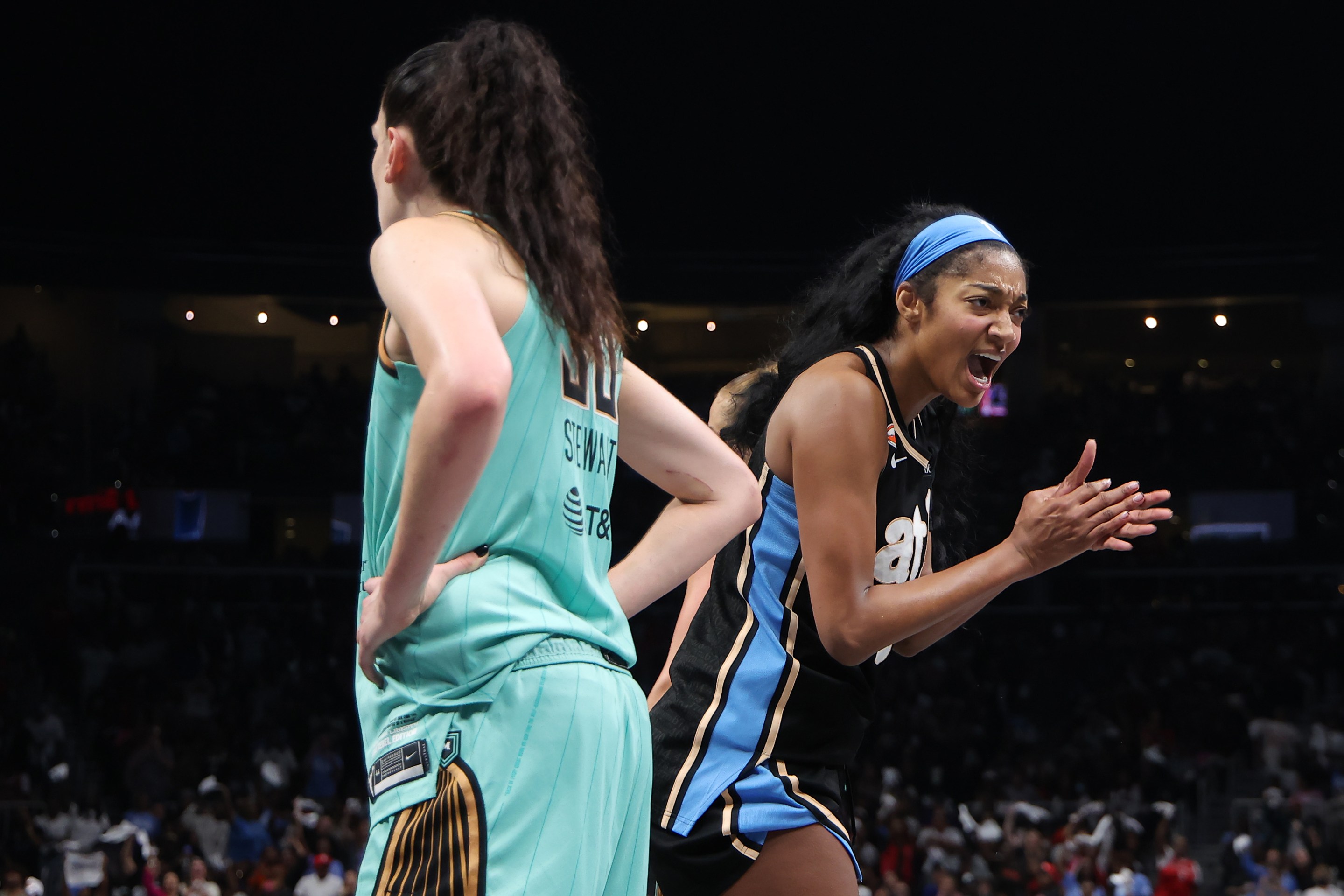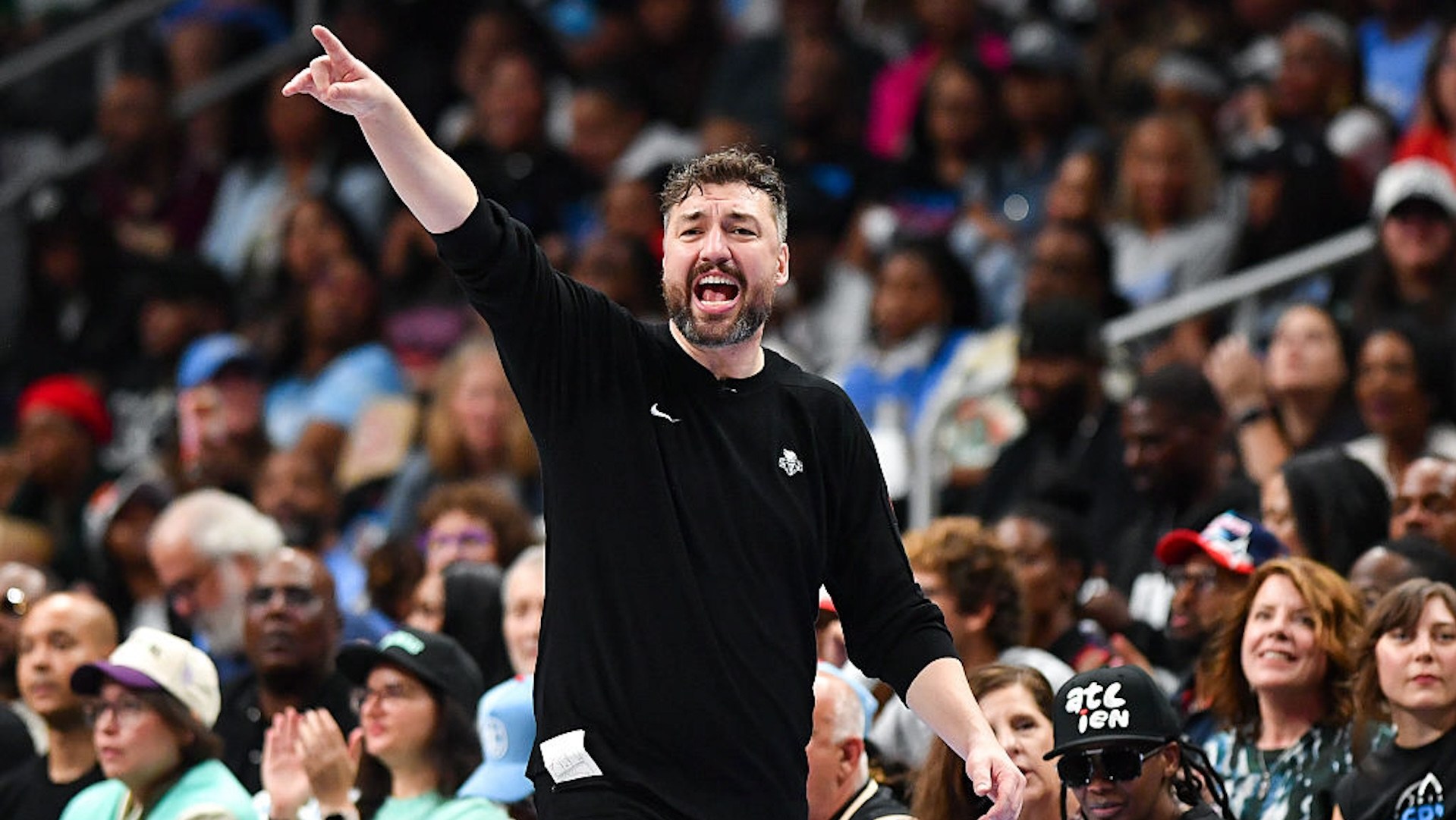



What is the point of Unrivaled? Or rather, how seriously should it be taken? It’s easy to understand what the players get out of it: Napheesa Collier and Breanna Stewart founded the startup basketball league in 2023 as an offseason option for a few dozen WNBA players, offering them equity and competitive salaries to play 3x3 games on a Miami soundstage. For them it’s a convenient way to get paid, stay in shape, and remain in the U.S. during the winter months, when their earning opportunities have historically been overseas.
As a media member, I still don’t exactly know how to value Unrivaled as the league begins its second season. The 3x3 game differs so much from WNBA basketball that Unrivaled’s utility as a gauge for player development is dubious. Last year, stars who had dismal Unrivaled seasons—Stewart, Aliyah Boston, Satou Sabally—went on to have their typically excellent WNBA seasons. It's certainly an appealing opportunity for media members to go to Miami in the winter: Last February, I watched games at the Unrivaled facility and found myself genuinely taken by the atmosphere and in-person product. But I also felt kind of silly attending press conferences afterward and asking players questions about a game that still did not feel totally “real.” From the practices I observed—practices of wildly varying rigor—I get the sense that some players take Unrivaled more seriously than others. It won’t shock any women’s basketball fans to know that Collier’s team, the Lunar Owls, practiced the hardest.
This is why, despite some whispers during the WNBA’s ongoing CBA negotiations with players, I’m skeptical that Unrivaled’s ambitions are to challenge the WNBA for control of American women’s basketball. Same goes for the shadowy “Project B,” a forthcoming global 5-on-5 offseason league modeled after Formula 1, with commitments from players such as Nneka Ogwumike and Alyssa Thomas.
Take it from the co-founder of Unrivaled herself: “The WNBA is something that everyone has looked up to and has grown up watching, and it’s obviously the height of women’s basketball,” Collier told ESPN’s Katie Barnes in an interview published Thursday night. “No one is trying to get rid of the WNBA. We all want this to work. We just want to be valued in the work that we’re doing. We want to reach that pinnacle together. So that’s all we’re asking for. No one is trying to replace the WNBA or anything like that.” It wouldn’t surprise me if the founders’ vision for “success” for Unrivaled is that WNBA salaries increase enough that it no longer needs to exist. A recent Front Office Sports story from Annie Costabile asks whether this might not just end in a formal partnership or acquisition.
Cathy Engelbert, the leader on the other side, has also been inclined to talk about the WNBA and Unrivaled as complements rather than substitutes, if she has been slightly huffy when doing so. At her press conference before the WNBA draft last spring, she sounded a little annoyed by the volume of questions about Unrivaled. She was “so really proud” of Collier and Stewart, but added, “Of course we'll have—by the time we get done with 16 teams—over 190 players we need to take care of. I know it’s a lot easier to do 30 in one spot. We obviously travel the world and the U.S. and have a big platform.” (She would take this extremely amusing passive-aggressive tack again when answering a question about what ideas the WNBA might borrow from Unrivaled: “Obviously, it’s a very small fan base, 800 or so that go to their games. Obviously, we’ll have 17, 15, 18—20,000 at our games. So it’s a different scale from a fan perspective. But again, I think it’s great that—again, growing women's basketball in a different way.”) Engelbert’s visit to Unrivaled in February, and conversations she had with Collier there, inspired Collier’s eventual denunciation of WNBA leadership.
To me, as a women’s basketball consumer, the relationship between the WNBA and Unrivaled is less one of direct competition and more like the one between the straight man in a comedy act and the funny one. You have to have some sense of the world’s norms and rules to appreciate when those norms and rules are subverted. WNBA teams are assembled in a particular way, by particular systems that yield a particular distribution of stars and young players and veterans. But Unrivaled shakes all that up. It’s entertaining for the same reason the National Geographic show Unlikely Animal Friends is entertaining. It’s a cat and a pig! Together! Being friends! You don’t see that so often!
Last year, before they were upset in the playoffs, the Lunar Owls ran Unrivaled. They were Lynx South. Collier was paired up with her Minnesota teammate Courtney Williams in a preseason trade that sent Jackie Young to the Laces to play with fellow Aces Tiffany Hayes and Kate Martin—the equivalent of that annoying thing All-Star Game captains do where they just draft their teammates. The Lunar Owls, Laces, and their stifling commitment to normalcy are no more: Collier is sitting out the 2026 Unrivaled season while she recovers from surgery on both ankles, and Williams and Martin were re-drafted to new teams.
This year, the novelty Unrivaled can offer WNBA fans is a superteam of super youths: the Breeze BC, one of two new teams the league added to accommodate more players. At 27, Aari McDonald is the oldest Breeze player. Her teammates? Just Paige Bueckers, Cameron Brink, Dominique Malonga, Martin, and Rickea Jackson, none of whom is older than 25. On account of their being from different countries, on rookie contracts with different franchises, and playing the same position, it’s unlikely Malonga and Brink would otherwise ever suit up for the same team. But in the upside-down world of Unrivaled, the two coolest and most freakishly athletic young bigs in the sport can simply be on one team together—with Paige Bueckers! While we wait for real basketball to begin, that's a fantasy team I do want to hear about.
Correction (3:04 p.m. ET): The original version of this article stated that Tiffany Hayes was not part of Unrivaled this season. She is actually an injury replacement for the Phantom.