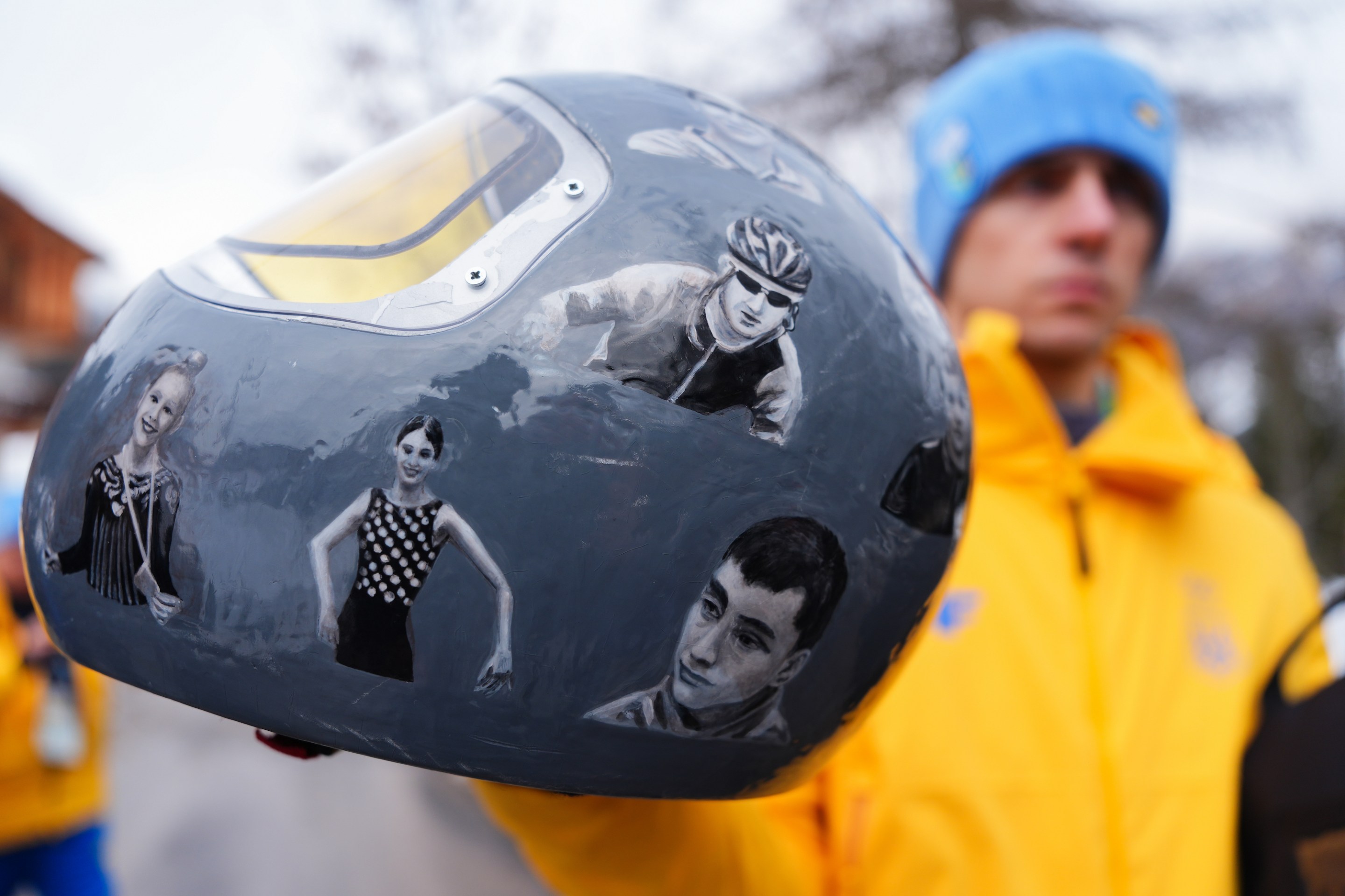
One hour before the start of the men's skeleton event, Ukrainian slider Vladyslav Heraskevych was disqualified from participating, after insisting on wearing a helmet with illustrations of Ukrainian athletes and coaches who were killed in the war following Russia's 2022 invasion of Ukraine. The helmet was banned days ago under Rule 50.2 of the Olympic Charter, which reads, "No kind of demonstration or political, religious or racial propaganda is permitted in any Olympic sites, venues or other areas."
Heraskevych, Ukraine's sole participant in the skeleton event, continued to wear the helmet during official training sessions and stated his intention to wear it in competition. Before Thursday's competition kicked off, IOC President Kirsty Coventry met with Heraskevych and attempted to reach a last-minute compromise over wearing the helmet on the "field of play." Coventry instead suggested that Heraskevych could wear a black armband during the competition and display the helmet afterward.
The nature of skeleton as a sport played a role in the discussion: Skeleton athletes go headfirst, but traveling as fast as 75 miles per hour, at which speed it would not be possible to see the designs on Heraskevych's helmet. After Heraskevych's run was over, the faces would be more clearly seen. Coventry and Heraskevych reportedly agreed on this point, which highlights the fundamentally arbitrary distinctions in IOC rules on expression. From Coventry's perspective, there is no point to wearing the helmet if it is indistinguishable during competition. On the other hand, if the helmet is indistinct, then shouldn't it be irrelevant whether or not it is worn?
The IOC's primary concern was with enforcing the rules as written. "Sport without rules cannot function," IOC spokesman Mark Adams stated.
"No one, no one—especially me—is disagreeing with the messaging. The messaging is a powerful message," Coventry said. The "tears roll[ing] down" her face while speaking to the media after Heraskevych's disqualification were noted by the press. "In Ukraine now we also have a lot of tears," Heraskevych noted.
"I never wanted a scandal with IOC. I did not create it," Heraskevych said on Facebook. "It was created by IOC with its special interpretation of the law, which many people consider discriminatory."
Heraskevych's assertion that the IOC created this mess is true. Banning Heraskevych from wearing his helmet gave him the opportunity to make a stronger statement than the helmet would have on its own; it also, by the nature of these things, has resulted in far more controversy than if the IOC had permitted him to wear it. Heraskevych has stated that he will appeal his ban to the Court of Arbitration for Sport, but it'll be too late for him to race. And anyway, the refusal to change his helmet has already been an unequivocal success as an act of civil disobedience.