

KANSAS CITY, Mo. — As celebrity restaurant mascots, athletes offer a tidy sense of vertical integration: Why not supply the very calories they need to expend on the field? I’m surprised there are so few successful models. We have all mostly forgotten (or agreed not to talk about) George Brett’s restaurant in Kansas City, Brett Favre’s Wisconsin steakhouse, or those 31 Papa John’s franchises Peyton Manning coincidentally shed two days before the NFL dropped the pizza chain as a sponsor.
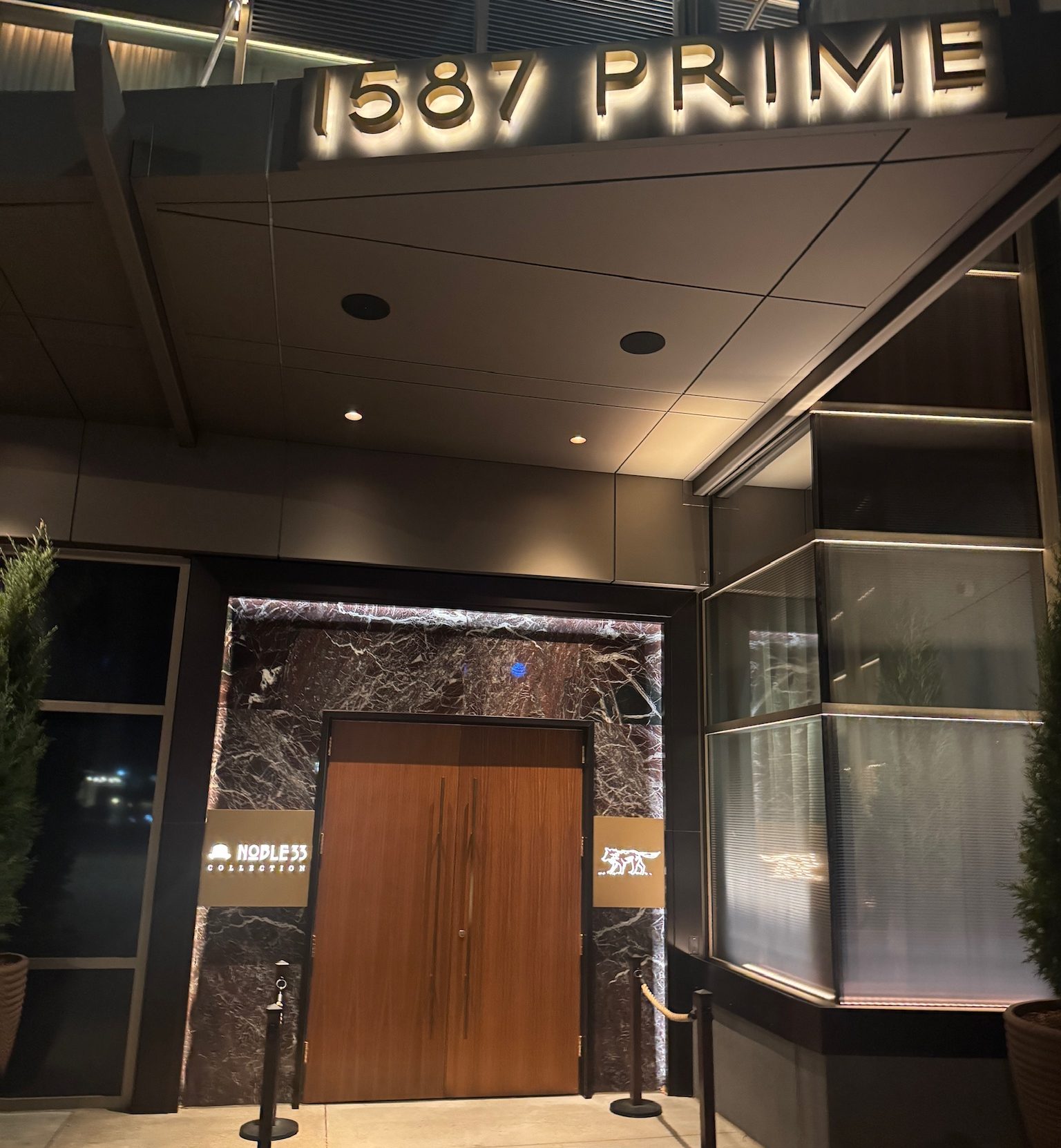
Still, tables have been reliably booked at 1587 Prime—a mashup of Patrick Mahomes’s and Travis Kelce’s jersey numbers, along with a word that vaguely connotes “beef”—since it opened in Kansas City in August. I left an eight-year gig as a KC restaurant critic in 2023, but the mania surrounding the opening was enough to summon me out of retirement. Like a washed-up former detective, I couldn’t resist stumbling half-drunk into my old precinct for one last job.
In some respects, a flashy celebrity steakhouse means the same thing everywhere. But it means something else in Kansas City, a cowtown whose economic engine was its stockyards, once the second-largest in the country, and which has struggled for years to cultivate a high-end dining scene. We have some great restaurants, but fundamentally, we’re a city that loathes to dress for dinner. (I felt a swell of civic pride when I learned Travis proposed to Taylor Swift in shorts.) I wondered how Noble 33—the Miami-based fine-dining restaurant group tasked with executing 15 and 87’s vision—would fare here.
In a pure business sense, they seem to be faring just fine. On a recent visit, a server told me that a group of Taylor Swift fans had waited six hours for bar seats, hoping they might catch a glimpse of the singer housing a truffle grilled cheese. Taylor didn’t show. I wish the restaurant had something else to offer them.
If nothing else, 1587 Prime looks nice. The 238-seat, two-story restaurant inside the Loews Kansas City Hotel is riddled with luxury tropes. Everything is bathed in a charmed, golden light. The stairs are marble, the tables are marble, and the servers all wear smart white coats and black ties. The leather-backed menus are enormous—perilous. Manipulating them at a small table covered with expensive glassware made me feel like a horse on roller skates.
Music is ostensibly a theme. Every night, local musicians perform short sets of Motown, jazz, and soul hits, and the performers are universally talented. They’re also chastely miked. The live backing band is never loud enough to compete with diners’ conversation, and while the singers roam around the dining room, they seem trained in the art of extremely brief eye contact that asks nothing of you in return.
The same can’t be said of the patrons. Every time I looked around the room, diners looked back with the defiant stares of people who are used to being watched. The restaurant seems to be drawing in its target clients: people who fly private. On my first visit, our server—a very friendly woman named Debbie—told us she had two tables that had flown in just for dinner.
“There’s this thing I learned about,” she said. “Did you know they have an Uber Jet?”
I did not. I sensed that Debbie and I had both learned this against our will.
To be fair, one of the reasons I kept looking around the room was that everyone’s drinks were on fire. This was, I learned, The Alchemy ($22), a cocktail the restaurant created for Taylor Swift, a woman who has never had to use Uber Jet.
I ordered one, too, and a dedicated server brought out a martini glass with some steel wool tangled around the stem. (Something else to know about 1587 Prime: there are at least two employees whose main job appears to be setting things on fire.)
“How many tables order this every night?” I asked.
“Almost all of them,” she said, with just a hint of resignation.
She lit the drink. The steel wool pulsed with a warm, luxurious shimmer before almost immediately fizzling into a cold pile (yes, this is a metaphor). “The stem might be a little hot,” she warned, pawing the nest away from the glass. The drink tasted like a Cosmo someone had strained through a French Vanilla Yankee Candle.
The Alchemy is in a section of cocktails titled “The Players,” named for the steakhouse’s famous guests. For Mahomes fans, there’s the “Showtime” ($19), a rum and coconut cocktail made with a “Coors Light syrup” that I tragically could not taste. I preferred Kelce’s “Big Yeti” ($24), a nocino-enhanced old fashioned with bitter chocolate notes.
There is a fourth cocktail in the section, named after Brittany Mahomes. I will not be tricked into commenting on it.
The drinks were designed by beverage director Juan Carlos Santana, who’s led menu design at other Noble 33 haunts. This is the only way I can explain why a steakhouse cocktail menu features a “Noble Margarita” ($18), or why the house martini ($23) is laced with fino sherry and fennel-infused Italicus (a sweet, sunny bergamot liqueur). It’s a lovely, nuanced cocktail, and it seems to have been designed in a lab to piss off martini drinkers.
If you’re after a more traditional martini—say, gin and vermouth—you can order the martini “your way” for an extra $10.
“Isn’t this a service most bars offer for free?” my husband asked.
Sure. But most bars don’t come with a “Martini Cart Experience.” The first part of the Experience is using a checklist and a golf pencil to select your ideal spirits, vermouths, and enhancements, whether that’s truffle brine (an additional $5), caviar-stuffed olives (an extra $12) or an accompanying “caviar bump” ($21).
The second part of the Experience is waiting for the cart. The restaurant only has space for one cart per floor, which can create backlogs when multiple tables order martinis. On my first visit, my table waited a modest 12 minutes before the cart became available.
The Experience concluded with a bartender scanning my checklist, building the martini, shaking it (you read that correctly), and straining it into a glass that had been chilled by a light-up contraption resembling a Simon. With the upcharge for the truffle brine, the martini was $38.
Much of the menu at 1587 Prime reads like magnetic poetry for people with expense accounts. If you’d like, you can order a black truffle grilled cheese ($27), truffle fettuccine ($39), tuna tartare with a truffle ponzu ($29), fried chicken with truffle honey ($25). You could not bring a truffle pig within a mile of this place; it would die instantly from a seizure.
Wagyu? You got it. There’s wagyu pastrami ($42), a wagyu cheesesteak ($65), a bowl of wagyu meatballs and spaghetti for two ($68). There’s a wagyu carpaccio ($33) that also has black truffle sliced thickly over the top, like very expensive bagel chips.
Even dishes without any obvious high-end flourishes are given a luxury veneer. I liked the homey roast chicken ($37), which had crisp skin and a simple, savory pan sauce. For some reason, the restaurant calls it “marble chicken.”
“You’ve heard of ‘chicken under a brick,’” my server said. “Well, this is chicken cooked under a marble slab.”
“Is the chicken actually cooked under a marble slab?” I asked.
“No.”
Wealth has always been about signifiers, but no one said they had to be this lazy. That ethos might even extend to the hiring of executive chef Ryan Arnold, who Noble 33 appears to have found by googling “country clubs near me.” Arnold’s previous gig was at the St. Joseph Country Club, a country club in the satellite town of Country Club, Missouri. (Hey, it’s good SEO.)
Arnold seems like a talented chef, and to his credit, some of the more gimmicky-sounding dishes actually work. The wagyu meatballs ($28, available not just in the spaghetti entree but as a standalone app) were the best thing I ordered at 1587 Prime. They were indecorously soft, with an almost ‘nduja-like texture; the bracing heat from the accompanying arrabbiata sauce sliced cleanly through the richness of the beef and the melty snow cap of mozzarella and Parm.
Even the “A5 wagyu katsu sando” ($68), a dish my server tried to dissuade me from ordering, was well-composed. The “sando” is in fact four stamp-sized bites arranged on the plate like modernist finger sandwiches—Girl Dinner, but for Marie Antoinette. Each bite of wagyu was buttery and plump, with a super thin crust to give the beef a hint of structure. A swoop of Osetra caviar on top added brininess to the richness. A sleaze of gold leaf added gold leaf. The dish was fine. Does anyone really want to eat like this?
The main trouble with 1587 Prime isn’t its child-like idea of luxury. It’s that it’s a steakhouse that doesn’t nail the steaks.
On my first visit, I ordered the six-ounce petite filet ($59), one of only three locally sourced steaks on the menu (the others are from Idaho, Australia, and Japan). Although I ordered it medium-rare, the steak arrived a generous medium, with a nice crust but an unpleasantly mealy interior. (Before someone vaults over a banister to tell me my mistake was ordering the filet, I should say: I like a filet, and it is not impossible to cook one well. But I have eaten a better version at a monk-themed novelty steakhouse than at 1587 Prime).
Perhaps my mistake was ordering it with a “tableside flambé,” which you can add to any steak here for an extra $27. After conferring with Debbie about whether this was a good idea, she dispatched a second cart with a second fire-oriented employee.
While he worked, I peppered him with questions. Did he man the flambé cart every night? Yes, by choice. “I’ve never worked in a kitchen,” he said. “I just really like fire.” Had he ever singed his shirtsleeves on the cart? “I’m going to tell you guys a little secret,” he replied. He leaned over the table and brushed some hair away from his forehead. Most of his eyebrows were missing.
On my second visit, I skipped the flambé and opted for the 16-ounce bone-in strip ($78), which was unusually thin. The crust was flavorful and the steak more tender—but it was still medium, not the requested medium-rare. The “onion jus” ordered alongside was less jus than paste, with the texture of sieved baby food.
Of the three steaks I tried at 1587 Prime, only the 10-ounce hanger from the steak frites ($48)—the cheapest cut on the menu—was actually cooked to temperature. If you’d like ketchup with those frites, you can order the Mahomes Ketchup Flight, which a press release from Noble 33 touted as “a nod to the player’s favorite steak pairing featuring a lineup of three unique ketchups made in-house.”
The ketchups are not, in fact, made in-house. Two of the three—a truffle ketchup and a spicy ketchup—are augmented in-house, but my server confirmed with the kitchen that the base for all three was Heinz. (Heinz! This compounded the betrayal. Hunt’s would have at least made spiritual sense, given Mahomes's old brand deal.) In one light, this is good news: house-made ketchup is almost universally terrible. In another light, I felt a bit suckered paying $15 for three small ramekins of ketchup, one of which was pure uncut Heinz. A representative for the restaurant tells me the price has since come down to $10.
This is the way of things at 1587, which is ostensibly a mashup of jersey numbers but also a credible restaurant tab. Complaining about the prices at 1587 Prime is like complaining about the wind on Mount Everest: predictable, but hardly the worst part of the experience. All the same, there is no need for anything this mediocre to cost this much.
Some of the best items at 1587 Prime aren’t even specific to the restaurant. One of my favorite dishes was the wagyu carpaccio, which had pickled enoki mushrooms, pine nuts, and waxy shards of Parmesan tucked in alongside the black truffle. If you don’t live near Kansas City, don’t worry—you can also order it at Sparrow Italia, a Noble 33 restaurant in Miami. On the West Coast? You can find 1587 Prime’s A5 Tajima Wagyu steak with “whisky barrel-aged soy” and “triple inferno salt” at Noble 33’s Casa Madera in West Hollywood.
Even the few local touches feel like cop-outs. The bread at 1587 is from Farm to Market Bread Co., and the desserts are made by McLain’s Bakery. These are fine KC businesses, but it’s lazy for a restaurant of this caliber and price point to be outsourcing its bread and pastry programs at all. You’d also be forgiven for not knowing any of this as a diner, because nowhere on 1587’s dessert menu does it explain that the desserts and ice creams aren’t made in-house.
There’s one local touch that feels genuine: Almost everyone who works at 1587 Prime is Midwest Nice. The staff are impressively warm and personable for a dining experience that can invite obsequity. If nothing else, 1587 seems to be succeeding as a jobs program for the local service industry and fire-enjoyers. On my visits, there seemed to be an almost 1:1 ratio of employees to diners.
That doesn’t mean service is seamless. On one visit, the steaks arrived without steak knives. A bread course that arrived promptly on my first visit was absent the next—when I asked about it, two different food runners were dispatched with two different bread baskets, one of which had been toasted to the consistency of styrofoam. These aren’t dramatic service mistakes, but they’re basic ones.
Ultimately, 1587 Prime is a parched vision of luxury, simultaneously overreliant on ChatGPT-grade luxury tropes, rehashed ideas from its outside restaurant group, and lazy local outsourcing for stations that a top-tier restaurant should staff. I don’t know that it matters. Even now, four months from opening, reservations nearly always show as fully booked. (That said, I put my name on the waitlist on four different occasions while working on this review, and was alerted about an open table all four times.) The restaurant seems to be getting by with the help of a core of jet-setting Noble 33 superfans—who are you? Why?—and a rotating cast of first-time visitors: Chiefs fans, Swifties, curious Kansas Citians.
If you’re one of those first-timers, learn from my mistakes. You do not have to order the Heinz ketchup flight. You do not have to buy the Taylor Swift cocktail that tastes like a candle and is garnished with a flaming Brillo pad. You do not have to sacrifice your servers’ eyebrows at the altar of the tableside flambé. Above all, you do not have to “come here for the bit.” The bit just isn’t that interesting.
UPDATE, 1/10/25: An earlier version of this story stated that Betty Rae's supplied ice cream to 1587 Prime. After publication, a representative contacted the author and said that Betty Rae's has not provided ice cream to 1587 Prime since the restaurant's first month of operation, despite the restaurant telling the author as recently as November that it did. The rep said that 1587 Prime continues to list Betty Rae's on its website as one of its local partners despite requests from Betty Rae's to take it down.