
NEWARK, N.J. — I went to Delaney Hall, a privately run ICE jail, for the second time on June 12, three weeks after 300-plus detainees initiated a hunger and labor strike. The strikers’ demands include an audience with Governor Mikie Sherrill, the release of vulnerable inmates, better living conditions, the end of pressure tactics to sign self-deportation orders, and progressive release and fair reviews of their immigration cases.
It was 95 degrees with 57 percent humidity when I arrived. The air around the jail smelled of sewage and animal fat rendering plants. They used to make Agent Orange here. Inside Delaney, behind barriers, fences, barbed wire, and enforced windows that bleach the silhouettes of prisoners to nuclear shadow, there is no air conditioning. At the time of writing, there was no visitation. GEO Group, the private prison company that received $1 billion in government contracts to operate Delaney, arbitrarily suspends visits. Detainees also report GEO feeding them rotten, infested food; denying them medical care; forcing them to work for pennies, if they’re paid at all. ICE and GEO also reportedly meet rebellion—including waving at protestors—with taunts, beatings, and pepper spray. It is functionally a concentration camp.
In the strike’s first week, hundreds rallied outside to amplify striker demands, show support for detainees, and attempt to obstruct transport convoys. Numbers dropped after an army of local and state police and illegally masked ICE agents beat, teargassed, and shot protesters with rubber bullets—but people are still on the ground. And detainees persist despite reported dispersals and life-threatening abuses. ICE has transferred many of the original strikers; exact numbers are hard to verify, since transports often leave at night and cases take days to update in the system. Advocates report 90 people transferred out the week of June 7, and up to 300 in the days prior. But on June 11, women detainees at Delaney issued a new set of demands, including to restore visitation, provide safe drinking water, and fire a GEO guard allegedly sexually assaulting them. There is no reason not to support them. There is no reason Delaney Hall should exist.
Delaney Hall stands just 10 miles from MetLife Stadium and Wall Street. From my apartment in Brooklyn, it was 30 minutes by train to Park Place, a quick aboveground detour to buy water, 25 minutes on the PATH from World Trade Center to Newark Penn Station, and three miles to the intersection of Wilson and Doremus, either by a 10-minute Uber or 22-minute ride on the NJ Transit 25 bus. From there, it’s 0.4 miles or less between desolate, chain-linked industrial lots.
Organizers are stationed by two gated driveways, where GEO employees and ICE transports come and go. The northern (Gate 1) is the “official” GEO channel, but convoys also emerge from the southern (Gate 5). Just north of Gate 1, a dozen meters past a freshly spray-painted PRIVATE PROPERTY NO TRESPASSING sign on the asphalt, volunteers run a Radical Hospitality Tent to help detainees’ families with legal resources, emotional support, groceries, and clothing. Run by an intergenerational, interfaith coalition of New Jersey religious orgs, workers, and students, the tent has operated since Delaney Hall reopened as a detention center in May 2025. South of Gate 5 stand medic and mutual aid tents for supporters, rebuilt several times after police repeatedly forced protestors out of a “protest zone.”
Both days, I arrived between 4:30 and 5:30 p.m., a relatively quiet time. About two dozen people stood outside. Organizers welcomed me and described the situation. They encouraged me to take water, food, and PPE, and invite friends. On the first afternoon, when the “protest zone” still stood, people chalked strikers’ demands and “FREE THEM ALL” along its concrete blocks. Throughout the afternoons, people picked up trash, blasted music, chanted in support of detainees, berated GEO and ICE employees for their moral failing, and watched their movements through several layers of chain link. Cars intermittently came through the gates, singly and in convoys. Some carried GEO workers and ICE agents, who reportedly change shifts at 6:00 a.m., 2:00 p.m., and 10:00 p.m. Others transported detainees. As starkly demonstrated in the case of hunger strike leader Martin Soto, who was smuggled out around 2:00 a.m. on May 25 behind a decoy convoy according to his wife Gabriela, it can be hard to distinguish. One organizer who goes by Jay told me you could listen for the sound of shackles being loaded.
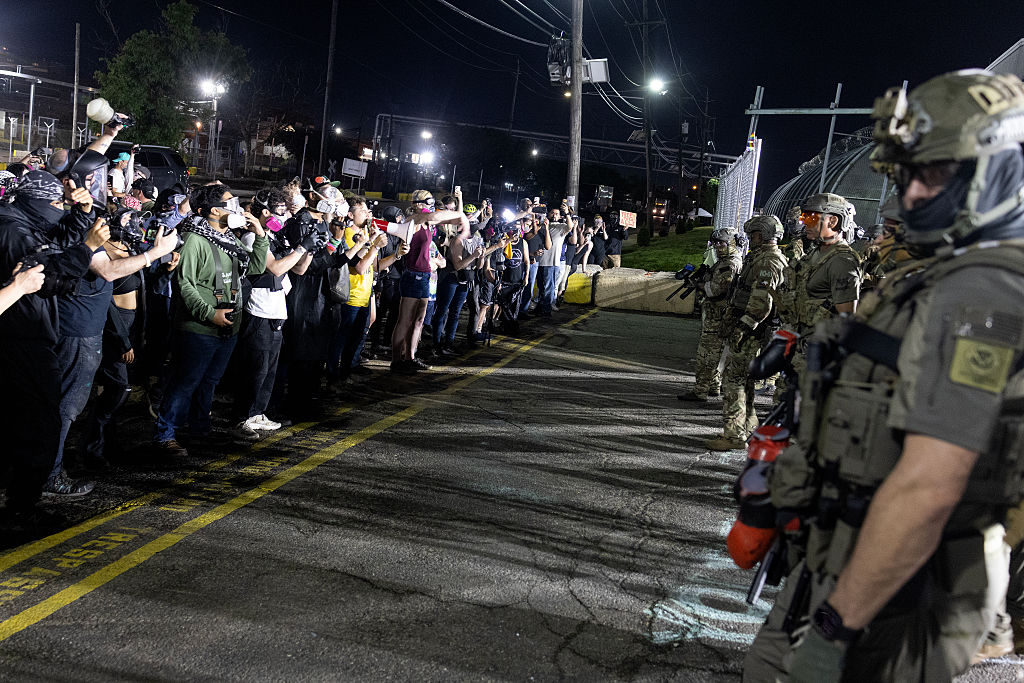
Whenever a gate opened, watchers blew whistles and people ran to record, photograph license plates and drivers, and boo ICE agents who emerged in riot gear to keep protestors from blocking vehicles. Twice while I was there, I heard screeches and shouts as cars nearly ran people over. (On June 5, a car swerved and hit photojournalist Josh Pacheco. On June 21, a car entering the GEO gate ran over a protestor in the driveway.) Most days, organizers told me, state agents didn’t unload on them until later in the evening, though no sundown effect is required for the brutes to lose grasp of reality—troops regularly file out of the detention center wearing enough military gear for a combat zone, only to confront civilians with cameras, traffic cones, cymbals, Pride flags, and metallic string they loop across the driveways. Around 6:00 p.m. on June 7, the first instance of ICE activity I observed, at least 15 agents rushed from Gate 5 to protect an arriving eight-car convoy. After it passed, they retreated in a clump, twitching their guns like amateurs. (Which they are, in a sense: Enforcement and Removals Operation training is only eight weeks long.) At 10:00 p.m., a couple hours after I left, Newark police, who’d been lackadaisically monitoring the Wilson intersection and ostensibly enforcing an unlawful PPE “ban,” grabbed and arrested two people. Officer R. Costa was recorded shoving press to the ground, then striking at another protester. Organizers said the arrests appeared targeted; an investigation by The Intercept found that Newark police had infiltrated protests to arrest a specific protestor, Samuel Becker. (They took Becker into custody with an arm sling, after ICE reportedly fractured his shoulder during an earlier confrontation.) Videos circulating on social media show ICE and/or Newark police arresting, shoving, and pepper spraying protestors unprovoked nearly every night.
When I returned on the scorching afternoon of June 12, a few hours before the Black Alliance for Peace (BAP) rallied to commemorate an uprising and four detainees’ escape, organizers were chatting and singing songs from Hamilton in the mutual aid tent. Around 7:00 p.m., they worked to cover supplies and hold tentpoles against a storm. (“Can I request 'Hurricane'?” someone laughed.)
Just before 8:00 p.m., as stinking gushes of brown drainage gargled down Doremus sewers, two women approached Gate 1, looking for a family member detained that morning. (ICE kidnappings are surging across Jersey.) A GEO employee told them through the fence that they needed a case number. Fifteen minutes earlier, her shift-mate had shouted at a protester, “I’d like to shoot you!” That was a funny thing to hear, given that a different protestor, since banned from Delaney, faces a threat charge with up to 10 years of jail time and a $250,000 fine for threatening to kill the family of an ICE officer who reportedly hit him with a nightstick.
“No tengo nada,” said one of the women. I don’t have anything. Someone directed her to the Radical Hospitality Tent. According to Andrei Camurungan, a Jersey native and tent volunteer, GEO randomly sets and suspends visitation times. They turn away families for retaliatory and arbitrary reasons, including a dress code around three times as long for women as for men. Over the two days following my visit, GEO employees were documented denying a 10-year-old girl visitation to her father, which made her pass out then express suicidal ideation, and denying another woman visitation because she had been involved with protests.
After 8:00 p.m. on June 12, more people arrived for the BAP rally. Cars lined Doremus and traffic began circumventing folks gathered in the street, 80 to 100 at the height of the gathering. The drivers blasted horns and raised fists, counterbalance to an occasional, soundly booed NPD car or surveillance drone. Volunteers with Angry Asian Women distributed Jamaican patties, dried seaweed snacks, and first-aid kits. One organizer pulled a cart up and down the street collecting trash, which I later saw heaped on their pickup truck. Medics handed out water. BAP activists spoke to the intersectional, anti-capitalist, anti-imperialist nature of struggles against all forms of police brutality. “ICE is used to control Black and brown quote-unquote immigrants,” said an organizer who goes by Comrade John, “while police are used to control Black and brown quote-unquote citizens. We must not also forget about the monstrosity right next to Delaney Hall, Essex County Correctional Facility ... They could easily use Delaney Hall to detain quote-unquote citizens, and they could use Essex County Correctional Facility to detain quote-unquote immigrants.” Ajamu Baraka, BAP organizer and the Green Party’s 2024 Vice Presidential nominee, invoked the historical nature of workers’ fight against racism and fascism. Americans who’d battled Nazi Germany were “rolling in their graves,” he seethed.
Two of Baraka’s fellow Green Party members, Lily Benavides and Barry Bendar, showed up to support a friend inside, a 33-year-old immigrant from Guatemala. Benavides organizes with Cosecha, an immigrant advocacy group that has spearheaded activism and mutual aid at Delaney. She told me detainees are in dire need of donations for commissary. “They were charging people 36 or 56 dollars for two minutes [on the phone], saying hello to loved ones,” she said. “They took their tablets away from them so they couldn’t talk to anyone.” Sometimes food is withheld as punishment, so detainees are forced to buy exorbitantly priced, low-quality commissary food.
“You go in and you sit at these tables and they bring the people in,” Bendar said, “and there’s all these children whose mothers and fathers are in here. And then they end it, and you see all the little children leaving… [ICE and GEO] are animals. They’re animals! Anybody who takes pay to do this, if there’s anything at all, they’re gonna burn when their time comes.” He told his friend that as soon as he’s released, they’ll go fishing in San Diego.
Iris Gordon, a warehouse worker from South Jersey, also showed up to support someone in detention. It was only her second time attending a protest. She drove to Newark alone on May 31 after ICE abducted her coworker, Heinrich, during their shift. “I didn’t even realize there was [an ICE] car on the side of the road until I got to Wawa and one of our coworkers told us,” she said. “[Heinrich] went on [lunch] break, like, 15 minutes before us.” She doesn't even know where Heinrich is detained, but plans to return to Delaney as much as possible. “If this is something you care about, just come,” she said. “You also have to bear witness for yourself, to testify to what is happening.”
Around 10:00 p.m., I’d sat down to interview another relatively new activist, who asked to go by Jeff, when pops rang out and white gas bloomed across the asphalt by Gate 1. Jeff and I ducked out of breathing range as a mass of ICE agents rushed out. About 40 minutes later they surged out again, this time guarding an enormous departing bus, so ponderous it seemed momentarily, horribly suspended in the sky as it levered over driveway cracks. Another journalist had pointed me to white transport buses parked behind Delaney, but the organizers had yet to see one leave. Horizontal bars choked the outside of its blacked-out windows. Protestors rushed toward but could not obstruct it; agents deployed more gas.
Not long after, Gate 5 opened. (“They’re loading a fuckton of guns,” a watchful protestor warned.) ICE agents rushed out, firing pepper balls at someone 20 feet to my right. A New York Public School teacher, whom I’d been interviewing before whistles sent him running, stood between the agents and protesters with an open umbrella. “Get back!” one agent shouted, gun at chest level, continuing to stride forward. Two colleagues had to pull him away up the driveway.
“What we just saw,” said Jeff when the smoke had cleared, “these fake ICE officers came out in this raggedy formation—I’m looking at them and I’m like, They’re afraid of us.”
The movement of vehicles continued. I stayed by Gate 5 until after midnight, then flagged a couple who appeared to be heading for a car. Under any other circumstance, a face-gaitered stranger sprinting after you on a dark road screaming, “Wait, are you driving away?!” would be cause for alarm, but Tim and Sherry greeted me warmly and gave me a lift to Newark Penn Station. Tim got so upset talking about Delaney, and the existence of borders at all, that he missed multiple turns despite having driven Uber in the area. Sherry had sent clips of Officer R. Costa hitting people to the Newark Police Department.
“We are definitely wasting their resources, at least,” Tim said, sounding as cheerful as one could about repeatedly and semi-fruitlessly running at state-armed military LARPers. Protestors have not been able to stop the transports, but Governor Sherrill—perhaps in a pang of conscience after siccing state troopers on protestors, though one should never be too optimistic—allocated an additional $12 million to the Detention Deportation Defense Fund (DDDI) and Jersey City will divest from Citizens Bank, which has granted GEO Group and its fellow private prison group CoreCivic more than $2.5 billion in financing.
I got home around 2:00 a.m. It was the day of what would be a glorious NBA Finals for the New York Knicks. The long-term vigil holders at Delaney were passing their 22nd night out on Doremus amid the chemicals. The detainees were facing another day inside with their demands unmet.