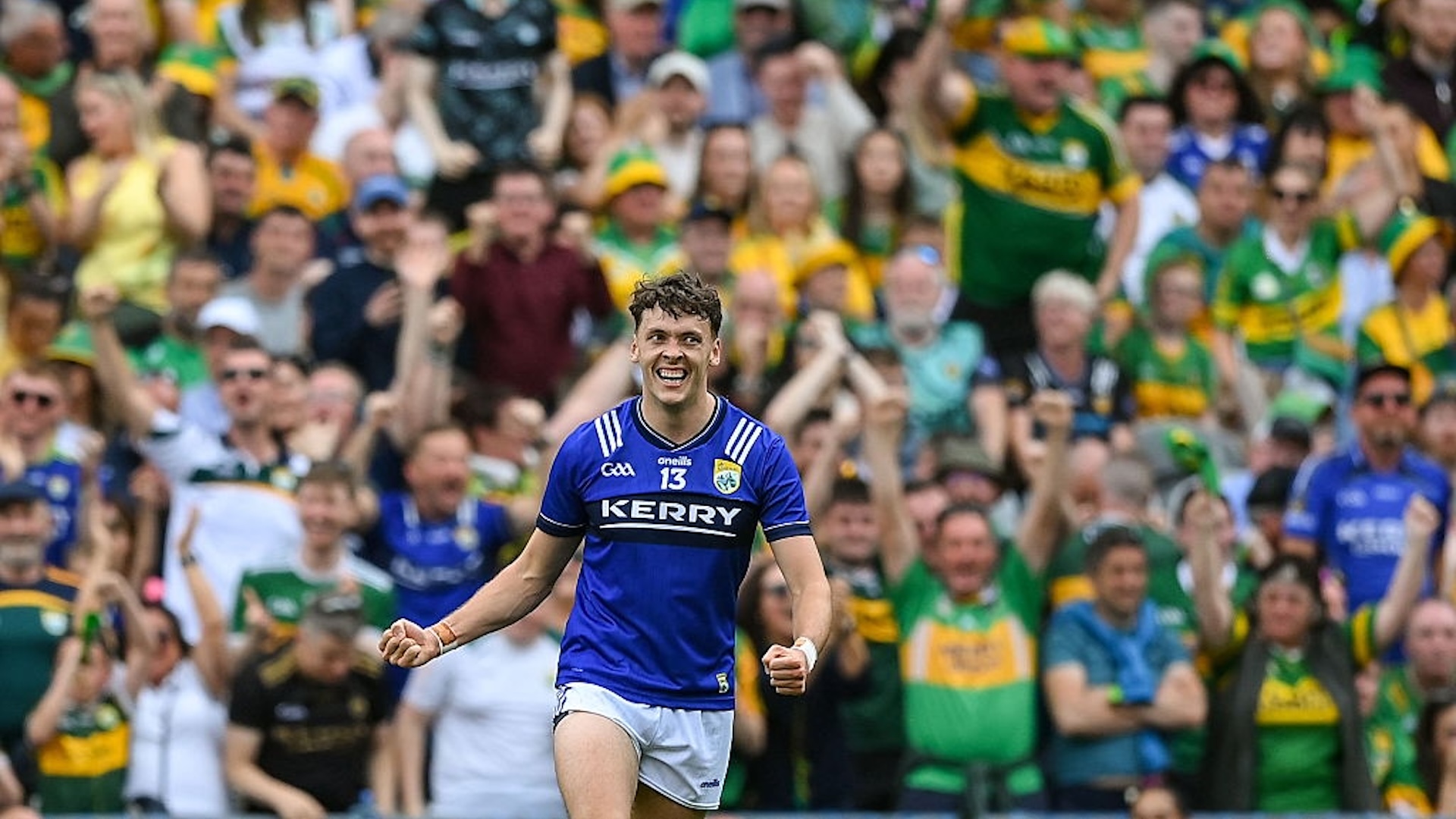
DUBLIN — David Hickey was built for Gaelic football, the sport that can’t stick to sports. Hickey, who was a two-time GAA all-star and four-time All-Ireland winner as a half-forward for Dublin, used football’s biggest weekend as a platform for protests.
First, Hickey loudly refused to show up for a so-called Legends Lunch at storied Croke Park on July 24, where he was to be honored alongside other members of the Dubs’ 1976 championship side. Hickey’s boycott was aimed at the Gaelic Players Association (GPA), the event’s organizer and primary football player advocacy group, for what he called its “failure to take a stance” against Allianz, a Germany-based insurance giant with a fetish for profiting from crimes against humanity. The transnational underwriter has been the preeminent sponsor of Irish games, hurling and football, since 1993, when it acquired naming rights for the national leagues in both sports. Allianz also invested billions of dollars in Israel’s invasion and occupation of Gaza.
“I do not want the memory of that team associated in any way with the GPA, who have failed miserably to stand up for anything worthwhile apart from money,” said Hickey, who became Ireland’s leading transplant surgeon and a high-profile social activist after leaving the game.
In making the announcement, Hickey also declared he would not attend any matches put on by the Gaelic Athletic Association (GAA), the football and hurling sanctioning body, “as long as Allianz is a sponsor.”
“This is a rupture after a lifetime involved in the GAA,” he said. “It is not an easy sacrifice for me to make.”
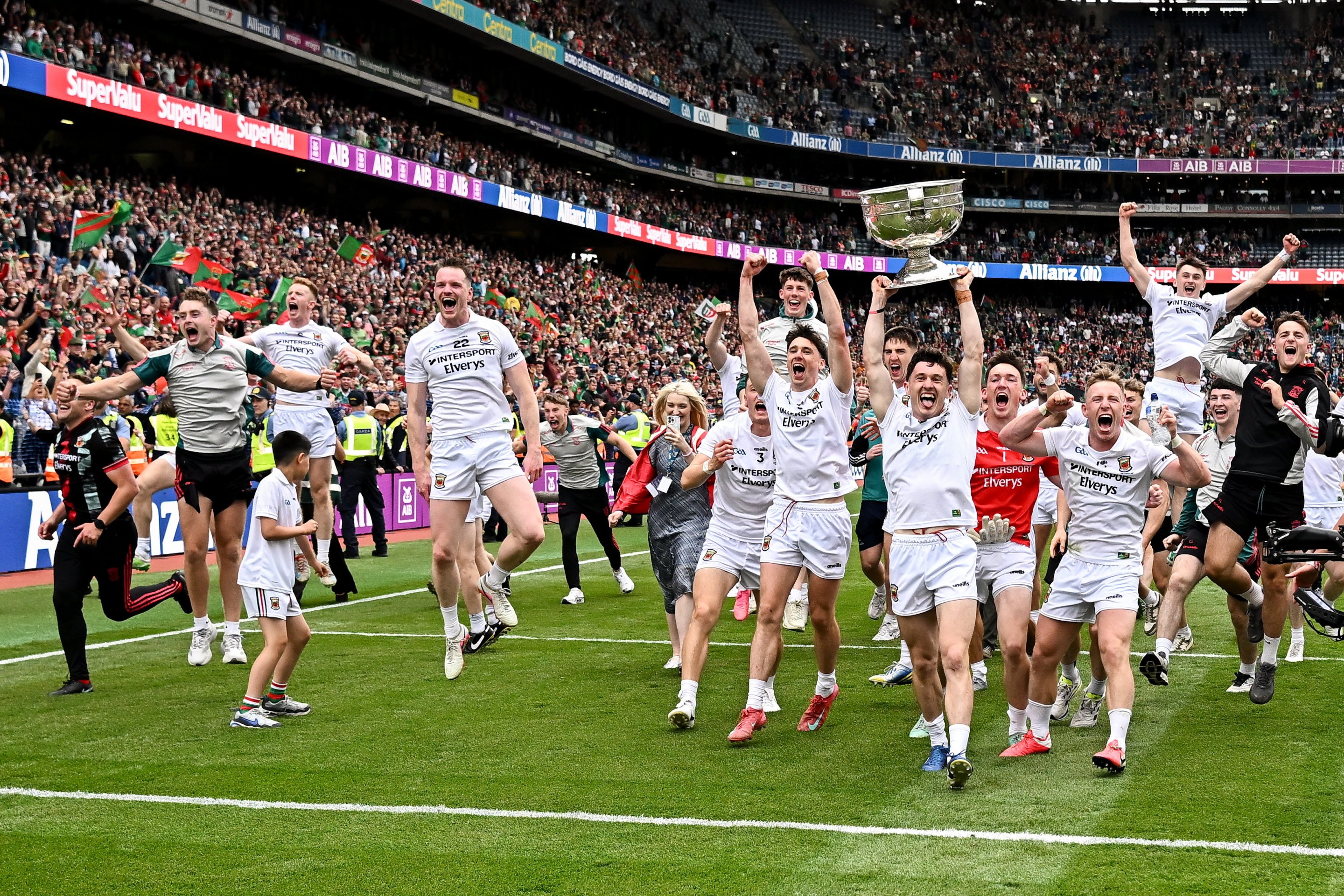
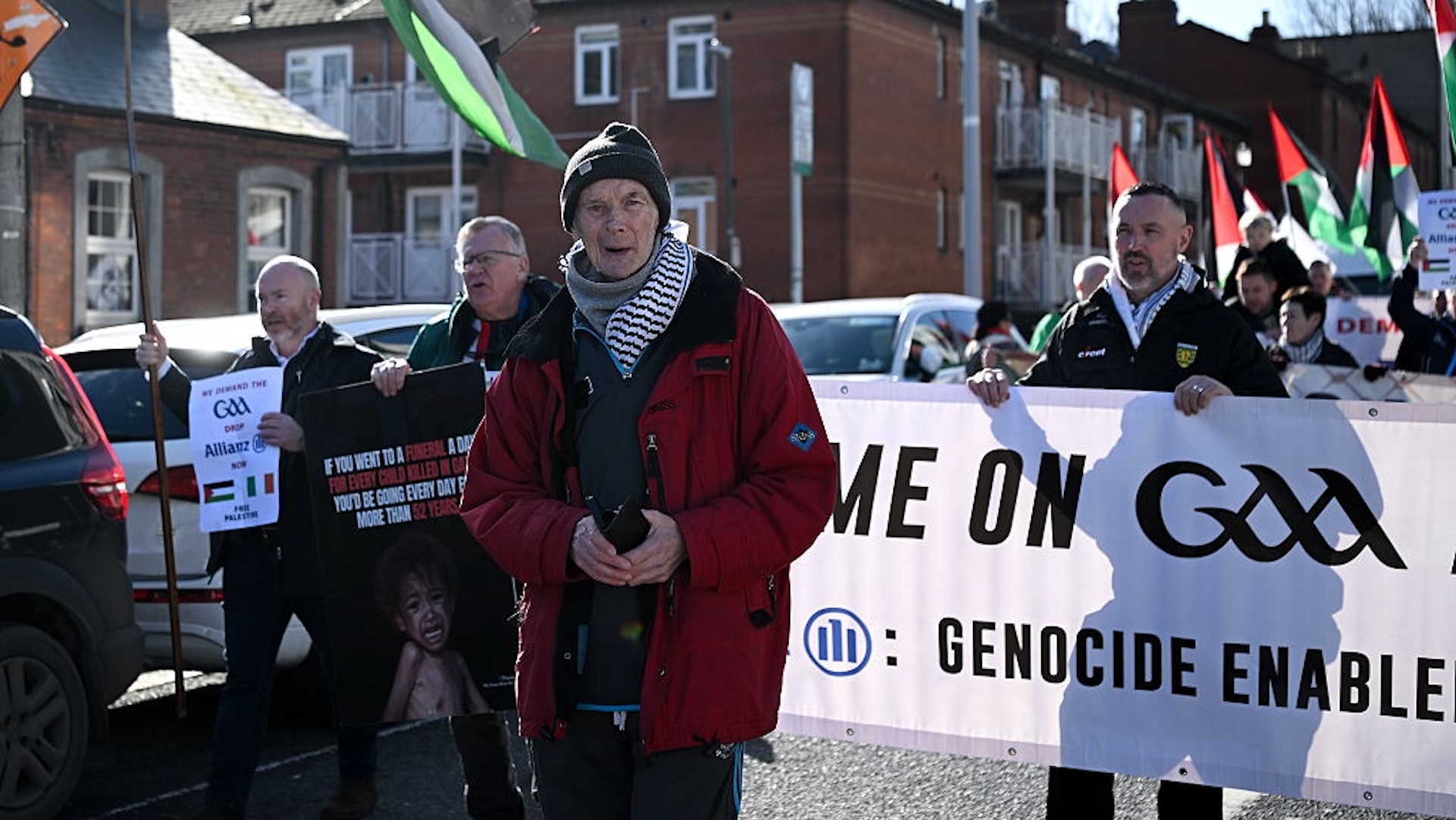
Hickey also showed up at Croke Park on July 26, hours before the All-Ireland football final kicked off, to lead another anti-Allianz, pro-Palestine protest outside the massive venue on Ireland’s version of Super Bowl Sunday. He and other demonstrators held up large banners saying “Stop Sportswashing Genocide” alongside the Allianz and GAA logos as tens of thousands of folks walked past, either on their way into the stadium for Mayo vs. Kerry, hoping against hope to get a ticket, or just soaking in the amazing atmosphere surrounding the most anticipated finals match in memory.
Hickey, wearing a keffiyeh and a shirt from GAA Palestine, a club teaching Gaelic games to kids in the West Bank that he’s fundraised for, found lots of sympathizers among the passersby. He told me he expected the support, and not because his garb, in the colors of the Palestinian flag, had enough green and red to be mistaken for a Mayo jersey. The Irish, he said, are tuned in to Gaza because they know as well as anybody what it’s like to be under an imperialist’s boot.
“We were the original colony! Eight hundred years!” he said. ”And we have been suffering from genocide, famine, murder, rape, for centuries. So we understand very, very well, and we empathize very strongly with the Palestinian people.” Hickey said Palestine demonstrations and/or fundraisers are held “at least once a week, every week,” in essentially every city in Ireland. (The website of the Ireland-Palestine Solidarity Campaign, one of the Dublin-based groups Hickey has protested alongside, has a fairly comprehensive list of those actions.)
As I spoke with Hickey standing outside Gill’s Tavern, a Dublin establishment known both as the closest pub to Croke Park and Brendan Behan’s favorite bar, he recited the shittiest parts of the Allianz’s history to support his argument that the GAA should steer clear. “The finance minister of the Third Reich came from Allianz,” he told me. “Fellow named [Kurt] Schmitt.” He also discussed how Allianz sold Hitler the policies that insured Auschwitz and other death camps during the Holocaust.
The pro-Palestinian sentiment found in football circles in recent years is in keeping with the sport’s hyperpolitical history. It’s no stretch to link the growth of Gaelic football and Ireland’s founding as a free republic. The GAA was formed in the late 19th century to preserve Irish ways and means in the face of British oppression, and the organization quickly banned members from playing soccer, rugby, or cricket, which were regarded by those fighting for independence as English inventions being foisted upon the island’s indigenous population by the oppressive occupiers. The Brits chose to attack Croke Park on what would become known as “Bloody Sunday” because they knew everybody at a football match, on and off the pitch, would be a Republican.
Footballers took up the Palestinian cause in a big way over the last year. The flashpoint for the Allianz protests was a study by the United Nations Human Rights Council (HRC) on profiteering in Gaza that was made public in July 2025. The HRC’s 40-page report identified Allianz, the name sponsor of the GAA’s football league, among a group of corporations who “invest large sums in shares and bonds implicated in the occupation and genocide,” thereby “enabling the commission of human rights abuses.” In a chapter of the U.N. report titled “Financing the Violations,” Allianz’s Gaza outlay was reported as “at least $7.3 billion.”
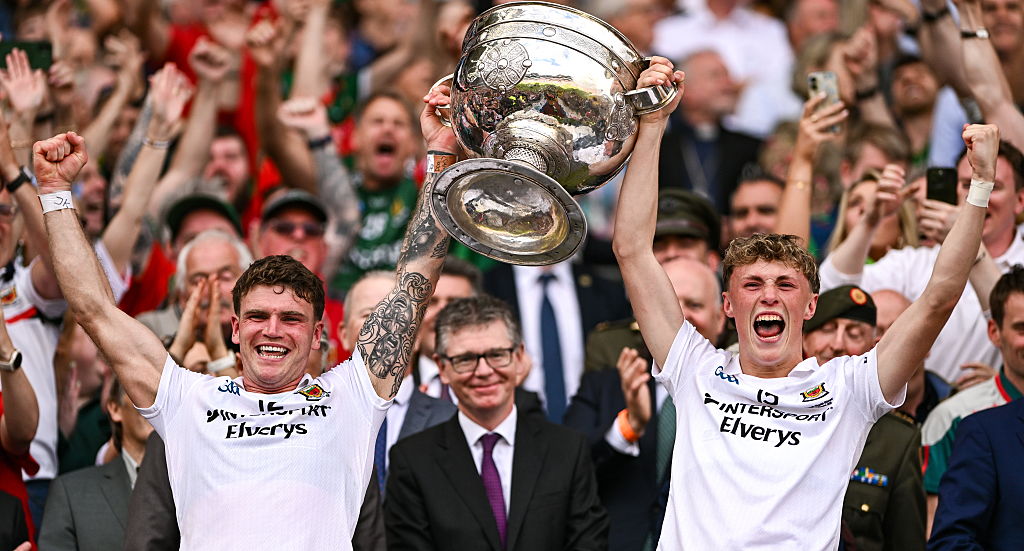
Shortly after the report was released, a demonstrator showed up at the All-Ireland football final and worked his way up to Hogan Stand, and was standing directly behind Kerry captain Gavin White during the presentation of the Sam Maguire Cup. (Football's coveted trophy is named after the guy who recruited Michael Collins into the Irish Republican Brotherhood, jumpstarting his rebel career.) So the protester’s Palestinian flag, emblazoned with “Let The Aid In!” was visible to all television viewers throughout the ceremony. Palestinian flags now show up in the stands of every GAA game broadcast.
The Allianz issue dominated the beginning of the 2026 football season. About 800 former football and hurling players signed a petition earlier this year telling the GAA to find another sponsor. The organization’s leadership tasked its Ethics and Integrity Commission (EIC) to study the matter. And in December, the GAA announced its intention to follow the EIC’s recommendation to “maintain the long-running partnership" with Allianz. According to Allianz, the current deal with the GAA runs through 2030. Though neither the GAA nor Allianz have released specific euro amounts, the Irish news site Business Plus reported in January that the relationship is worth “in the region of €800,000 to €1m per year” to the GAA. Hardly seems worth the trouble.
Former players were among those protesting the decision outside Croke Park in February while a GAA congress took place upstairs. Several protesters barged inside the stadium offices and disrupted the meeting. After the building was cleared of demonstrators and the Congress reconvened, GAA president Jarlath Burns condemned the incursion and said he “didn’t need lessons on illegal occupation.”
"I don't need any lectures or people shouting in my face about what it's like to go to bed at night, fearful that somebody would barge into your bedroom and riddle you with bullets, because that was my lived experience when I was young," Burns said.
Burns actually has been on the business end of colonization. He grew up in the 1970s in Armagh, a county in Northern Ireland, a British colony made up of six of Ireland’s original 32 counties that exists because of English imperialism. (The GAA doesn’t recognize Britain’s border; Northern Ireland counties compete for All-Ireland titles just as they did before the island was broken into two pieces in 1921.) Burns has publicly discussed the atrocities committed around him by British soldiers as a lad during the era known as The Troubles. Last year, Burns spoke about the lack of prosecution of members of a paramilitary outfit called the Glenanne Gang, a Protestant posse made up of military members loyal to the crown that was implicated in the murders of 120 Catholics in Northern Ireland half a century ago. The Silverbridge GAA club, where Burns played football in his childhood, still gives out a Michael Donnelly Cup each year in honor of a childhood friend of his killed by the soldiers.
Peter Canavan, an all-time great footballer from Tyrone, another county in the north where murderous paramilitary groups once roamed, was among the higher-profile players to demand change from Burns and the GAA at the Croke Park protest. Canavan had lots to lose by taking that stand: After leaving the game, he became a football pundit for RTE, the national TV network. The GAA owns the international broadcasts and can control who goes on the air, so Canavan’s civil disobedience risked his job. Yet during his next on-air appearance, Canavan went harder on his demand for Allianz to get out of Gaelic football. He also said that given what Burns lived through in Armagh, he should know better than to quell protests from those trying to stop the sectarian killing of innocents.
“There was no conviction [for the Glenanne Gang killings], that was 50 years ago, because so many people placed their head in the sand and didn’t want to know what was going on. That exact same has happened now,” Canavan said during an RTE game telecast. “We have a moral responsibility. We can’t sit back with what’s going on and just pretend.” Canavan kept his job.
Though Hickey, who was born in 1952, is not in great health by appearances and his own admission—he has been public about his battling oral cancer, years after beating sinus cancer—he attends weekly Wednesday night anti-Allianz, pro-Palestinian protests with other footballers outside the Kildare Street headquarters of Oireachtas, Ireland’s parliament. And on normal, non-All Ireland Final weekends, he can be found outside Dublin's General Post Office, site of the Easter Uprising of 1916, showing support for the Ireland-Palestine Solidarity Campaign and opposition to the GAA/Allianz alliance.
The Palestinian cause isn’t Hickey’s first righteous rodeo. In 1999, he went to Croke Park for the All-Ireland Final because his 1974 Dublin squad were being given medals commemorating the 25-year anniversary of their win. But when he got to midfield with his mates, Hickey removed his jacket to show the huge crowd and TV cameras that he’d adorned his dress shirt with the slogan “End Cuban Blockade.” He told all media that asked that his medical background (he was an acclaimed kidney surgeon and the head of the transplant center at a Dublin hospital at the time) rendered him “morally bound” to protest the U.S.’s archaic, cruel bullying of Cuba through Cold War relic policies that prevented equipment and medicine from reaching Cuban hospitals and patients. Hickey then visited Cuba and alongside a Havana doctor founded a group called the Irish-Cuban Medical Association, which sent money and used medical equipment from Ireland to the oppressed island.
Cubans still aren’t getting enough medicine, and Allianz signage still hangs all over Croke Park and other Gaelic grounds in Ireland on match days. But Hickey told me he doesn’t think he’s tilting at windmills when taking up his noble causes. He knows that Allianz has been defeated before in much the same arena: In 2008, the insurer attempted to get naming rights to the stadium then being built in the Meadowlands in New Jersey. The insurer gave up after fans and Jewish leaders blasted the thought of NFL teams getting in bed with a company that was so cozy with the Nazis.
“The New York Giants and Jets wouldn’t take their money, and that was $30 million” per year, Hickey said. “The GAA shouldn’t take their money either.”
An Allianz spokesperson, responding to Defector’s request for comment, described Hickey as “a well-loved member of the GAA in Dublin, and a well-known activist over many years and many different causes,” but said it “wouldn’t be accurate to say [his GAA] protests are big or large” compared to other protests that can be found in Ireland these days. The spokesperson then declined any further discussion of Hickey’s anti-Allianz activism.
Allianz had been silent on the GAA demonstrations and accusations made against the company this season. But on July 31, Allianz sent Defector a statement from Geoff Sparling, chief customer officer at the insurer’s Irish subsidiary, that ran in full in that day’s edition of the Irish Independent, a Dublin newspaper. After congratulating Mayo on its “unforgettable All-Ireland victory,” Sparling said Allianz has faced a level of scrutiny in Ireland over its Middle East investments that is “largely unmatched” anywhere else in the world. But he asserted that anybody who condemns his company for what’s taking place in the Middle East is relying on “absurd” logic, and sums up the protesters’ argument as: “The Israeli cabinet and an Irish claims handler are equally part of the same chain of moral blame.”
“I hope sustained political leadership and diplomacy can help bring about a just and lasting peace,” Sparling’s statement read. “That responsibility belongs to governments.”