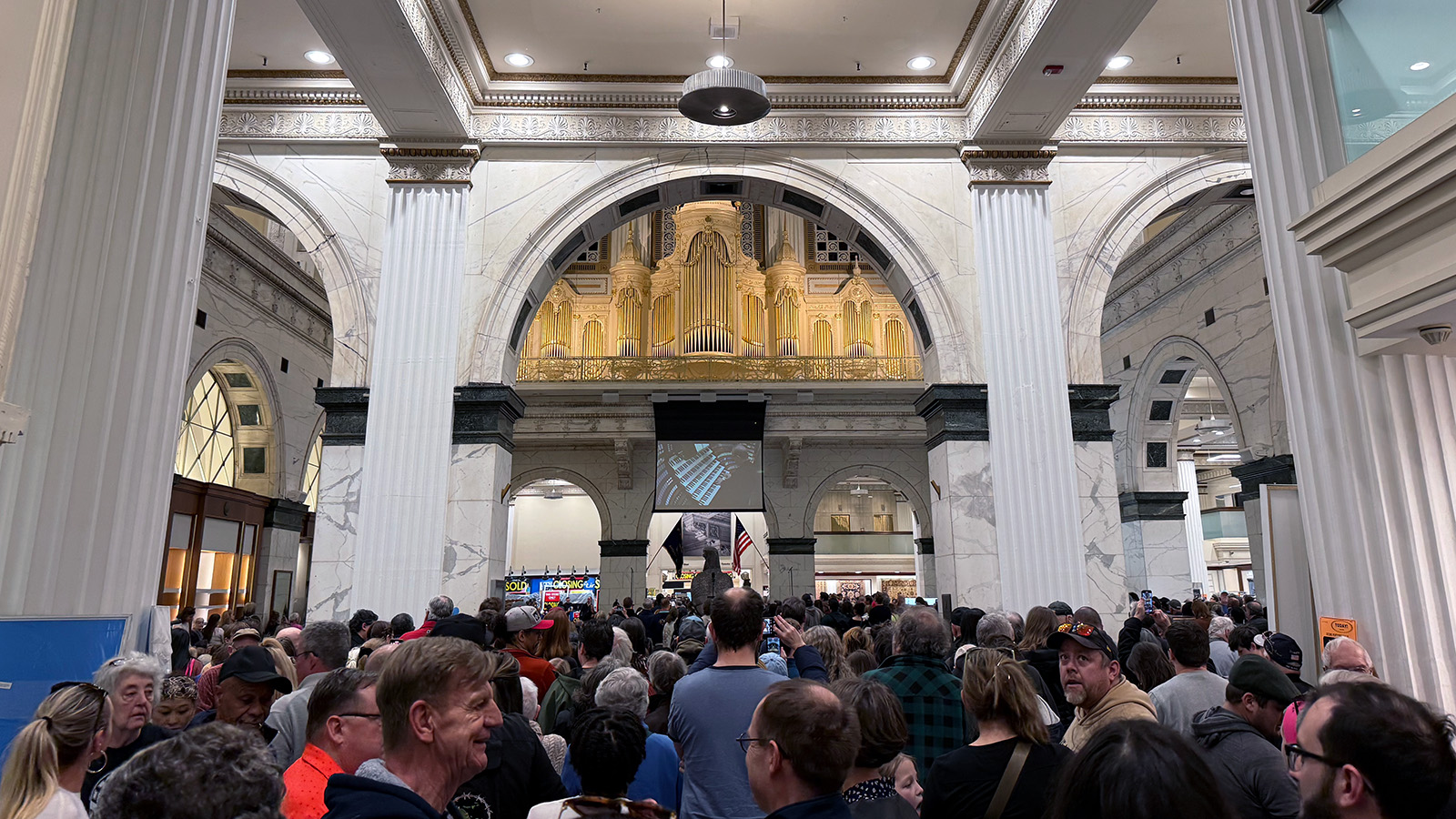


The Hammerstein Ballroom is a beautiful place to watch wrestling. The ring is surrounded on three sides by multiple tiers of scalloped balconies, blue with gold trim, a prestige-TV color palette. From the vantage point of the TV viewer, the audience looms over the action in ornate concentric circles—Dante’s Inferno for people who like a good German suplex. Seated on one of the venue’s upper levels, every seat feels close enough to the action for you to fall into the ring if you lean forward far enough. In events dating back decades, the independent wrestling promotions ECW and Ring of Honor helped make the place a mecca for the sport.
My 14-year-old kid, H, has heard me give variations on this spiel for over a year now. (They’ve also heard me explain it’s owned by the Moonies; they’re big on religious cults.) Now, the Saturday before Christmas 2025, they could finally see for themselves. By the time we made it up to our second-balcony seats for “Dynamite on 34th Street,” All Elite Wrestling’s now-annual holiday stopover at the Manhattan Center, however, H was mostly just winded by taking the stairs. They’re the kind of kid who was born to complain about having to run in gym class; they’ve told me repeatedly they’re physically afraid of volleyballs. We have that in common.
That’s always been part of the appeal of pro wrestling for me, ever since I got into it as an adult seven or eight years ago. It’s a sport for all kinds of people, people who don’t like sports among them. It distills athletic competition down to pure spectacle, staging genuinely impressive and difficult feats of athleticism in such a way as to heighten drama and tell stories of the triumph of good over evil. If, like me, you were raised by Yankees fans, it’s nice to have a rooting interest you don’t have to feel vaguely guilty about.
After catching their breath, H settled happily into people-watching mood soon enough. While I’ve never missed a single AEW episode in its six years of existence, H isn’t a TV-wrestling fan. They love the live experience: the crowd, the characters, the lights, the pageantry, the inventive audience chants. You don’t hear repeated cries of “THIS IS AWESOME! THIS IS AWESOME!” when Shohei Ohtani hits his 12th home run of the game or whatever, but you’ll damn sure hear it if Kazuchika Okada hits someone with an especially well-timed dropkick.
H and I have been going to AEW shows since 2021, when the company set its then-attendance record at the beautiful, punishingly inaccessible Arthur Ashe Stadium. (The NYPD sent me to the ass-end of nowhere to park; H saved us from wandering around lost at one in the morning by remembering we’d found a spot near a Crab du Jour restaurant.)
That pastime of ours had been on pause for over a year, however, since before AEW’s trip to the Hammerstein in December 2024. I wound up going to that show with a friend instead, because when your child is institutionalized with an eating disorder you’d never heard of before they were diagnosed, they don’t let you take them out on field trips to wrestling shows. I asked.
H has ARFID. Only relatively recently named and classified, ARFID stands for Avoidant/Restrictive Food Intake Disorder. It’s an eating disorder, but probably not in the sense you’re thinking of, where a body-image issue drives the disease. The easiest way to put it is that ARFID is neurological rather than psychological in nature, and functions closer to a phobia than to anorexia or bulimia. For some sufferers, there is a fear-based component, an irrational belief that food is poisonous or will cause choking. For others, it comes down to a hard-wired disinterest in food and eating as experiences or drivers, or to sensory aversion to tastes and textures. In H’s case as in many other patients’, it overlaps with autism spectrum disorders.
For a million reasons both simple and complex, we didn’t know anything was wrong until something was very obviously wrong. H had countless foods they wouldn’t so much as nibble at. They never perked up at the thought of a meal or a treat, never sought out food on their own, never said they were hungry unless asked directly. They were small and underweight. But I’m 5-foot-7 and a comically unadventurous eater myself. Moreover, having had difficult experiences with loved ones and eating disorders before, this was a graveyard I was probably all too happy to whistle past. It was a problem tailor-made for my blind spots.
We received the official ARFID diagnosis from H’s doctors along with an ultimatum: H goes into residential treatment now, or into the hospital for intubation in a matter of weeks. There was no third option.
H’s time in rez for ARFID is theirs to describe, and I don’t doubt they will someday, as they have a Costanza/Curb-esque ability to generate and detail grievances at length. What I can tell you is this: If at all possible, avoid dropping your kid off for residential treatment for an eating order you couldn’t protect them from the day after a fascist gets re-elected president, as it will pretty much put a damper on your holidays.
That’s what we did, the day after Election Day 2024: brought our kid to the building in Westchester where they’d spend the next two months learning how to eat, while the rest of the world braced for the incoming catastrophe. In an effort to distract myself from the sheer horror of it all, I put on “Behind the Groove” by Teena Marie on the way up. It is a song I will now forever associate with Nazis and eating disorders. Teena Marie, you didn’t deserve this, and I apologize.
H is better now. They still have ARFID and its associated disinterest in food, which parents, medical team, and patient all agree is something they’ll likely have to grow out of organically. This does happen. But they’re no longer in an acute crisis. They came home older and wiser, mostly but not entirely to their benefit, but they came home healthier.
That’s all on them, on their diligence in doing the unpleasant work of refeeding, which involved a wake-up to bedtime eating routine that can only be described as emotionally grueling and physically punishing. It’s also on the way they endured the countless hours in residential and in various doctors’ offices and therapists’ waiting rooms and CBT-AR specialists’ Zoom calls. At our most recent visit with the doctor leading their medical team, we were given a prescription of “chill out.” I told everyone that H was floating three feet off the floor after hearing that, but really it was me.
Now here we were, at the best wrestling venue in America, a reward I decided to splurge on last-minute. I wanted to celebrate where we were now versus where we’d been a year ago. I wanted to celebrate H’s survival. I wanted to do so by watching some of the world’s best professional wrestlers pretend to beat the shit out of each other—an interest of mine as a writer irrespective of my kid’s health.
“Is this research?” H asked me perceptively as we sat down. “Is this a tax write-off?”
“Yes, actually,” I said.
Speaking as a wrestling scholar, I couldn’t say; speaking as a paying customer there to have a good time with my healed-up kid, the card was sensational. AEW’s December shows coincide with the Continental Classic, or C2—a round-robin tournament pitting many of the company’s best wrestlers against one another week after week.
The leadoff match for this year’s “Dynamite on 34th Street” was a C2 bout pitting Konosuke Takeshita, a golden god who’s currently AEW partner company New Japan Pro Wrestling’s top champion, against H’s favorite wrestler, “Freshly Squeezed” Orange Cassidy. A so-called meme wrestler who’s got the chops to go toe-to-toe against some of the field’s finest technicians, Orange grafted his gimmick from Paul Rudd’s character in Wet Hot American Summer. H has always gravitated toward the character characters, the really distinctive and often comedic figures; “angry beard guys,” as they put it, may be the industry standard, but they don’t cut any ice with H. Cassidy, who wrestles with his aviator shades on and his hands shoved in the pockets of his drawstring jeans, fits the bill for them nicely. (The fact that he’s a freak athlete belies his slacker persona.)
I could see right away how drawn in H was by the antics of their squared-circle hero, whose preposterous cardio never undoes the overwhelming perception that his character would rather be lying on a couch somewhere watching Repo Man. This vibe suits my kid, who finds socks too constrictive to wear and buries themselves under mounds of blankets on any couch they occupy. If Larry David is one of my kid’s gender icons, O.C. is another.
H’s interest in colorful characters makes them part of the target audience for AEW’s women’s division. (So does their interest in, well, women, but hey, let he who is without sin et cetera.) The women’s sole match on the night’s card (boo, hiss, come on, book this division) saw Marina Shafir, a legit MMA fighter turned enforcer for AEW’s sinister Death Riders faction, take on Mina Shirakawa, an ostentatiously pink-colored joshi from Japan. Shirakawa is in both a tag team and a kayfabe marriage with the company’s biggest female star, the Norma Desmond–esque “Timeless” Toni Storm. Watching her wrestle is like watching Lisa Frank artwork assault someone.
All night long I sat next to H, who was wearing one of my hoodies over their own in lieu of a more constrictive winter coat, and watched all kinds of things light them up like the spotlight was on them. Not just the work of O.C. and Mina and other standouts, but the kinds of things you can only see at a wrestling show, live and in person. H paid close attention to how so many of the evening’s audience chants originated from one guy to our left—and how some other asshole to our right got booed into oblivion when he tried to rally the crowd against Mexican luchadore Máscara Dorada with “USA! USA!” (Earlier in the match, the crowd treated Dorada, a fan-favorite phenom who turned 24 on Christmas Eve, to a boisterous rendition of "Feliz Navidad.") Some time after the crowd had relentlessly bullied the heel wrestler Ricochet for his baldness, H told me “GO TO TURKEY! GO TO TURKEY!” was their favorite chant of the evening thus far.
But H also enjoys the—let’s be honest here—sheer stupidity of professional wrestling. They raced for their phone’s camera when the opening matches included an appearance by Big Boom AJ and Big Justice, the good-natured viral oafs known as the Costco Guys. (“WHERE’S THE RIZZLER? WHERE’S THE RIZZLER?” H chanted along with the crowd, in reference to the father-and-son team’s conspicuously absent juvenile associate.) At the end of the evening, when Luchasaurus, a gigantic man who dyes his beard green and wrestles in a dinosaur mask, came out wearing a Santa hat and giving out milk and cookies to the audience, H’s mouth went wide like a little kid’s at the Radio City Christmas Spectacular.
The Hammerstein crowd was hot all night long. It was Christmas, and it was spectacular.
We snuck out early, before a bonus match, so we could catch the next train home. They’re tired out from drama club rehearsals a lot of the time. On the way we agreed that in a more intimate setting, compared to the huge venues like Arthur Ashe or UBS Arena in which we’d seen wrestling before, the crowd played a much bigger role. They—we—weren’t just vocal but passive observers of the action. We were active participants ourselves.
It was truer than H knew. A year and a month after the worst day of our lives, they were healthy and happy beside me. They were the highlight of my evening. They’d won the match of the night.