For a brief period two decades ago, Miami was an amazing place to be a fan of women's professional basketball. The team had a roster full of promise and reached the playoffs in their second season of existence. The locals showed up for games and exceeded the number of required season ticket deposits, thanks to a successful promotional campaign which included a local NBA All-Star making a publicized entrance via personal watercraft. Rosie O'Donnell, at the height of her fame, could be found in the stands cheering on the home team. It was an excellent start for a sports franchise that looked to be around for the long haul. After only three years, it all vanished.
The Miami Sol joined the WNBA for the 2000 season, and were gone by November of 2002. Despite good attendance, a decent overall record, and a playoff appearance, the team suddenly folded, to the dismay of the players and the local community. The team's demise was due to the WNBA's 2003 restructuring agreement, which allowed for independent ownership that was not connected to an NBA team. This also meant that the financial responsibility for the WNBA teams moved from the centralized NBA league to the individual NBA franchises themselves. The Miami Heat declined to opt in to support the Sol's continued existence, and so the team was dissolved.
As today's WNBA grows into new markets, it has also offered nostalgic hope to fans of previously defunct franchises. The other two teams that folded alongside the Sol are still in the conversation: the reborn Portland Fire, who are finishing their first season, and the Orlando Miracle, who were sold and relocated to become the Connecticut Sun (then sold again, soon to become the rebooted Houston Comets). For now, there is no similar plan for Miami. Women's pro basketball returned to the area in 2025 when the player-run league Unrivaled chose nearby Medley for its headquarters. While it's nice to see WNBA stars play three-on-three in the offseason, fans in Miami still yearn for something permanent.
From digging through newspaper archives, speaking to those involved with the team, and drawing from my own memory as a teenager in South Florida at the time, I found that the story of the Sol has lessons for anyone invested in the professional women's basketball teams of today, and tomorrow. It's one of a franchise that fostered so many key WNBA figures within its short existence, of a fanbase that still mourns the team they lost, of a billionaire owner's unwillingness to spend a relatively little amount of money. As the league expands yet again, it's worth revisiting the Sol's demise as a cautionary tale—how the metrics of success for a women's team can be set, achieved, and disregarded anyway.
In June 1999, the WNBA announced four new expansion franchises for the 2000 season: Seattle, Indiana, Portland, and Miami. The league was coming off a labor battle that April, reaching a deal on a four-year collective bargaining agreement with the newly formed Women’s National Basketball Players Association. The CBA raised minimum salaries from $15,000 to $25,000 for rookies and $30,000 for veterans, with salary minimums increasing to $30,000 for rookies and $40,000 for veterans by 2002. It also added year-round health benefits, including maternity leave and dental insurance, and created rules around the incoming players from the recently defunct American Basketball League.
The league had added two teams for the 1999 season, benefitting from the influx of newly unemployed ABL players. Adding another four teams would bring the total to 16, doubling the size of the league from its inaugural season in 1997.
“We had not anticipated expanding this quickly,” then-WNBA president Val Ackerman said at the time. “But the combination of the success of the league in the first two seasons and the strong interest expressed by NBA owners has convinced us that the time is right.”
Reflecting now on this process, Ackerman identified the 2000 expansion as a potential misstep for the young league. “We had some internal debate about [adding four teams], but the NBA was bullish at the time,” Ackerman, the president of the WNBA from 1996 to 2005, told Defector. “[NBA commissioner] David Stern, he was the ultimate decision-maker. I had other views. That’s when some things started to go not as well as we had hoped.”
At the time, WNBA teams were collectively owned by all 29 NBA teams, and the individual franchises were operated by the NBA team in their city, while the league itself negotiated player salaries and television deals. Miami was chosen as an expansion destination, Ackerman said, because the Heat had a reputation for being a well-run organization, and the league felt they had a fanbase that would support a women’s team. Also, hot-weather cities seemed to like WNBA teams: The Phoenix Mercury, Houston Comets, and Los Angeles Sparks had all found success. The Heat Group, owned by billionaire Micky Arison, reportedly paid a $500,000 franchise fee and brought in a women’s team in order to have summer events in the newly opened arena located on Biscayne Bay.
“The Heat felt that air-conditioned, under roof entertainment was sometimes lacking in the summertime, whereas in the winter, there are golf tournaments, football, hockey, boat shows, Coconut Grove Art Festival, one thing after another between November and April, but after that …” Arison told the Sun Sentinel in 2000. “We felt entertainment in the building that appealed to a broad market could be really successful.”
Shortly after Miami was announced as an expansion city, the “Don’t Drop the Ball” campaign was officially launched by Ackerman tossing a WNBA basketball to Heat president and head coach Pat Riley. The campaign was intended to create momentum in the community, aimed at securing the 5,500 season ticket deposits needed to be granted the team. Per a 2000 Sun Sentinel article, one promotional gimmick involved Heat player Tim Hardaway arriving at a September 1999 news conference on a jet ski, to declare that he had personally put the yet-to-be-named team over the 4,500 mark. In October 1999, the team announced that they had surpassed their goal, landing 6,190 season ticket deposits. The announcement was made at the schoolhouse at the Plymouth Congregational Church in Coconut Grove, the site where Miami’s first female schoolteacher had worked in 1889.
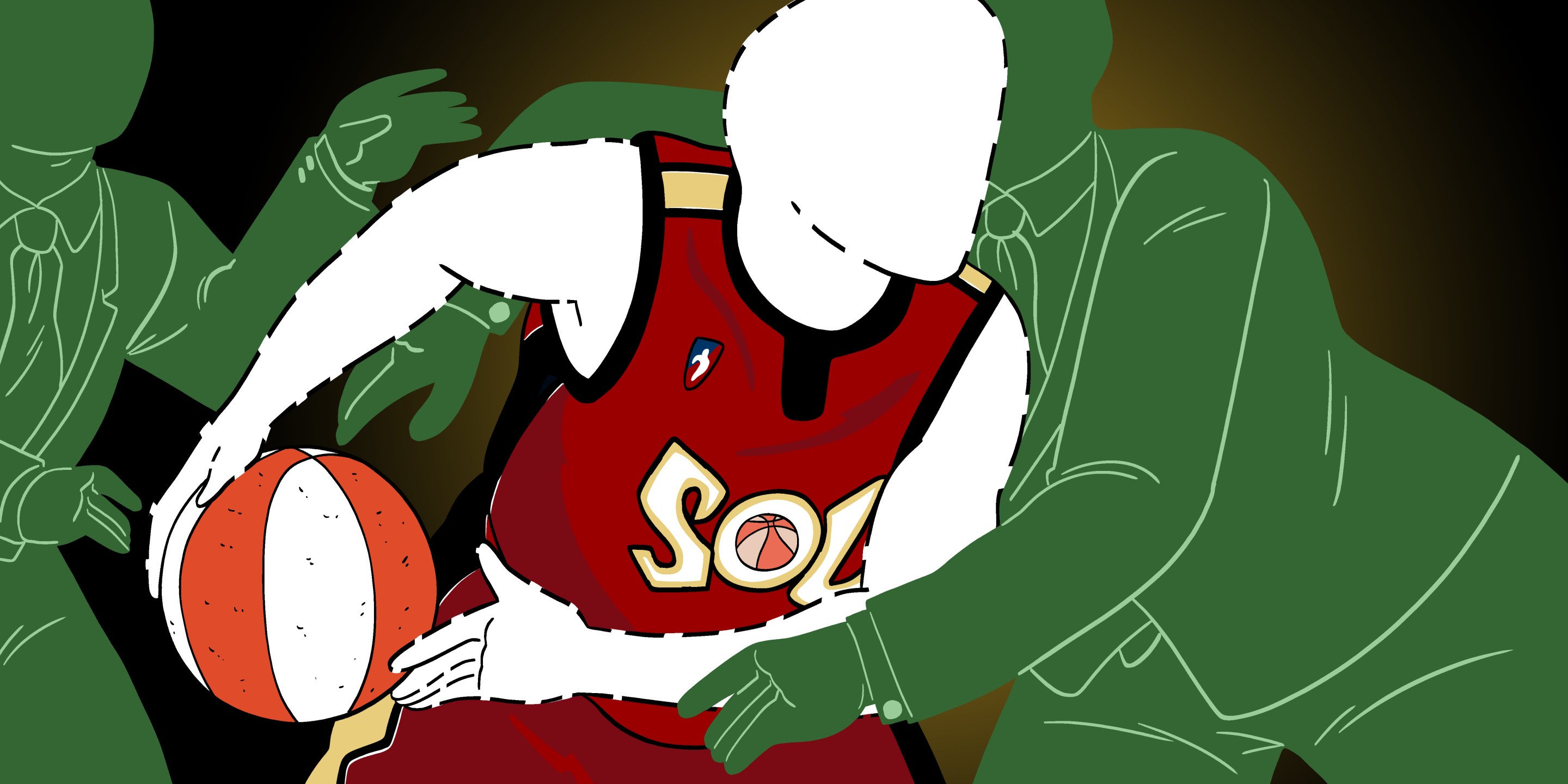
The Heat Group leaned into women’s empowerment for the branding and marketing of their new team. The name "Miami Sol" had tons of possibilities for slogans. The logo, a red and goldenrod yellow sun with an orange and oatmeal-colored WNBA basketball in the center, was required to match the Heat’s colors. The Spanish word for “sun” was chosen not just to reflect its connection to the NBA team, but also to the large Latinx community in Miami. “We’ve got Sol” quickly became a rallying cry for fans.
Though the WNBA only required teams to spend $350,000 on marketing, the Heat Group spent $600,000. “We wanted this to be inspiring to young women in South Florida, to let young women know athletics are possible for them,” Glen Hosking, the creator of the Sol’s ad campaign, told the Sun Sentinel in 2000. Michael McCullough, the Heat Group’s chief marketing officer, described the vibe as “empowerment, fun, affordability.” They labeled the players as “Sheroes” in ads, and had a campaign that featured guard Debbie Black alongside the slogan “Tickets from $5; Heroes from 5’3”." A more ambitious attempt read, “Watch as 11 women give birth to a new generation of girls.”
During the summer of 1999, the Heat Group also began hiring staff to lead their new franchise. According to a May 2000 Sun Sentinel article, the first Sol employee hired was Kim Stone, who would serve as the senior director of operations for the Miami WNBA team. Stone had formerly been the Heat’s director of media operations, having worked her way up after starting as a member of the gameday stats crew at American Airlines Arena, where the Heat played. The nascent franchise also announced Ron Rothstein as the first general manager and head coach, after spending 17 seasons coaching in the NBA. While the team was criticized for not hiring a woman to the position, Rothstein also had long-time ties to the Heat organization: Once upon a time, he had been the very first coach of the Miami NBA team (from 1988-91) and would now serve the same role on the WNBA side.
Rothstein made it clear that he actively chose to pursue the WNBA job. He had been interviewed for the Chicago Bulls job when head coach Phil Jackson left in 1998 and had been offered an assistant coaching job in the NBA just the previous summer. But he told the Sun Sentinel that he felt it was time for a breather and an ego check.
“I think I was at a point in my career where I could be choosy,” Rothstein said in 2000. “It’s a different thing starting a pro franchise … I’ve had some experience doing it and I’m looking forward to doing it again.” He was excited to coach a game that he felt was “purer” than the men’s game, because it was played below the rim.
In December 1999, the WNBA held its expansion draft and Rothstein chose the first six members of his new team. His picks included Kate Starbird from the Sacramento Monarchs; Stephanie White-McCarty, now better known as head coach Stephanie White, from the Charlotte Sting; Debbie Black from the Utah Starzz; Sharon Manning from the Sting; Lesley Brown from the Detroit Shock; and Yolanda Moore from the Orlando Miracle. Rothstein then immediately traded Starbird and the Sol’s 2000 first-round pick for Starzz forward Elena Baranova and a second-round pick, and traded White-McCarty to Indiana for second-round expansion draftee Sandy Brondello and a 2000 first-round pick. Black, Moore, Brondello, and Baranova would become core components of the Sol franchise over their short-lived run, though both Brondello (Team Australia Olympic commitments) and Baranova (knee injury) missed the inaugural season. When she was healthy in 2001, Baranova was named an All-Star with the Sol in 2001, averaging 11.8 points and 1.8 blocks per game.
When Brondello learned that she had been traded to the Sol, she was thrilled. “It was the ideal situation for you to play as a pro, and I loved the beach, so Miami was it,” she told me.
The Sol also traded draft picks to the Minnesota Lynx for center Marlies Askamp. Miami also selected two guards in the 2000 draft: Jameka Jones from UNC Charlotte, and Milena Flores from Stanford. But their biggest move outside of the draft was signing former Orlando Miracle player Sheri Sam, who would play all three seasons with the Sol. Sam, an ex-ABLer, is the Sol's all-time leader in points and rebounds, and had her career-best season in 2002 when she averaged 14.5 points per game and was named an All-Star.
There were more roster spots to fill, so Sol coaching staff traveled around South Florida to scout players at local colleges and training camps. They also held open tryouts just a few days following the draft, where over 200 hopefuls showed up to Barry University for a shot at making the team. Eligibility requirements for tryouts were meeting one of the following criteria: at least 22 years old; completed college eligibility; graduated from a four-year college; or played two years for another pro basketball league. There was a $25 fee to tryout, which included lunch, an inaugural season T-shirt, and two tickets to the Sol’s home opener against the Indiana Fever.
A Sun Sentinel article from April 2000 described the crowd of hopefuls as “a group of women who came in belly rings, ankle tattoos, and ‘Jesus Saves’ t-shirts,” with the Sol's head coach standing among them as “an odd sight,” because “there’s a part of you that figures Rothstein should be in the NBA.”
It wasn’t out of the question that someone could make a WNBA team from an open tryout. Moore, whom Miami had taken in the fourth round of the expansion draft, entered the league in 1997 through a tryout camp for the Houston Comets. At the time, she had a four-month-old baby at home and was taking a full course load at Ole Miss. Moore spent two seasons with Houston before joining the Miracle for their inaugural season, then landed with the Sol for theirs. The billboard campaign that introduced the Sol players to Miami included one featuring a shot of Moore holding a basketball on her shoulder, with the slogan “Mother of Two. Queen of the Three.”
Of the 200-plus women who attended the first day of the Sol open tryouts, only six were called back for the second day, and none ended up making the final roster. Moore was also cut just prior to the 2000 season, due to having knee surgery.
“There are farmers’ daughters and police officers’ daughters,” the Miami Herald wrote of the Sol’s inaugural roster in June 2000. “There are women who played street ball with their brothers in the inner cities as kids—whose mothers couldn’t get them into a dress with threats or promises—and women who never touched a basketball till their teens.”
By media day, uniforms for the new team hadn’t arrived, so the photos had to be taken in the team’s practice gear.
The Miami Sol played their first home game against another expansion team, the Indiana Fever, on June 1, 2000, in front of a reported crowd of 11,241 fans. The home opener was broadcast on the Lifetime network, and the WNBA season boasted 32 games. In attendance were Heat players Tim Hardaway, Alonzo Mourning, and Dan Majerle, as well as Miami Dolphins cornerback Ray Hill. Comedian and talk show host Rosie O’Donnell, who would become a fixture at the games, was also in the building.
“Aside from the voice of public address announcer Mike Baiamonte, the atmosphere at American Airlines Arena wasn’t much like a Heat game,” the Palm Beach Post declared at the time. “It’s more of a wholesome atmosphere than a Heat game,” a season ticket holder named Kevin Griffin told the paper. “It’s more of a relaxed crowd, not so much macho.”
The Sol had a strong start, and were up by 13 at halftime. But they fell apart in the second half and lost to Indiana, 57-54. “There’s not the talent out there to win a championship this first season, but we’re setting policy and precedent about women’s sports in Florida,” Stone, the director of ops, told the Sun Sentinel. Still, the first season was far from the tragedy that Miami basketball had come to expect from a new team. In Rothstein’s first season as the Heat’s head coach, the team started 0-17 and finished with a 15-67 record. The Sol fared better, ending their inaugural season with a record of 13-19.
“[Ron] is one of my all-time favorite coaches that I got the opportunity to play under, and I've been coached by many great, great coaches,” said Brondello, who now coaches the Toronto Tempo and has won two championships with previous teams. “What set him apart was not just that he's an NBA coach and has all this knowledge. It was just more he was really like this father figure that just knew how to coach all the different individuals. He knew how to get the best out of us, and you felt supported.”
Rothstein’s coaching staff also consisted of assistants Tony Fiorentino, who had been his assistant coach with the Heat, and Jenny Boucek, who had recently retired from the WNBA after a season with the Cleveland Rockers. “[Tony and Ron], they'd just been friends for so long, and they had a great banter with each other," Brondello said. "Then obviously Jenny Boucek was just starting her coaching career, so having a young former player there too was great. They had really great chemistry.”
Brondello's coaching career was shaped by the Sol staff; she still considers Rothstein one of her mentors to this day and maintains contact with Boucek, who is currently an assistant for the Indiana Pacers. “I love picking his brain, and how he sees the game,” Brondello said of Rothstein.
Fan attendance for the Sol was solid. In 2022, Stone told the Miami Herald that the team was in the "middle of the pack," averaging 8,857 fans per game for the 2001 season, ranking sixth in the league. Former players told me they felt valued by the Heat organization. Those who spoke with Defector made sure to mention how wonderful the facilities were and how much they enjoyed playing in Miami.
“We were really treated well,” Sam told Defector. “I played for several teams, but we had a really nice locker room that was on the scale of what locker rooms are now. We used the Heat facilities, so there were practice courts, weight rooms. We never felt like less than; we were treated as equal by the organization as far as facilities and being able to have those resources available.”
Even though all WNBA teams were run by their NBA counterparts, it wasn’t a given that the women would have access to the same amenities as the men. After spending two seasons with the Portland Fire, forward Vanessa Nygaard was traded to Miami for the 2002 season. She remembered how jarring it was to see the difference in how the Heat Group was treating the Sol versus some of the other franchises.
“The leadership of the Miami organization made sure that it was very first-class for our WNBA team, so it was a real upgrade,” Nygaard told me. “I'd come from Portland, and we had to practice in a rec center and do our own laundry and stuff like that. Paul Allen owned the team, but we weren't treated the same. When I went to Miami, we used their great practice facility in the arena, we had an awesome locker room. We stayed right on South Beach in this great high-rise apartment. I loved it.”
Over the course of the Sol's three seasons, a few memories stand out for the players. For Sam, it was the team’s playoff appearance during their second season, when they played against the New York Liberty at Madison Square Garden. She also cited how much she valued her time playing alongside Black, who was the 2001 WNBA Defensive Player of the Year and referred to by Sam as “one of the fiercest to ever do it.”
Nygaard recalled a regular-season game that put the Sol on the other side of league history. While WNBA highlight reels are incomplete without Lisa Leslie’s iconic slam dunk on July 30, 2002, less chronicled is the experience of the opposing team. That game in Los Angeles between Leslie's Sparks and the Sol is also remembered fondly by her opponents, but not for the reason you might think.
“I remember it was kind of a back-and-forth game, and then she dunked, and everyone was like, ‘Whoa!’” Nygaard said. “Coach Rothstein immediately called a timeout, and he pulled us all into the huddle, and he said, ‘Yeah, it's really loud in here. But a dunk is only two points, and people are going to be talking about this game forever. But whenever they talk about this game, you know what they're going to remember? They're going to remember her dunk. But you know what you're going to say? You're going to say you won the game.’”
And the Sol did, 82-73. “We beat them, and we shouldn't have beat them. He got us all fired up—they were so excited about dunking and we came back and won the game. I just thought it was brilliant coaching and a great memory, and we just had real toughness as a group, and that was a tone that he set.”
One of the Sol's biggest strengths was their marketing and community outreach. At a time when the WNBA was straightwashing its players and trying desperately to be seen as family friendly (i.e., not gay), Miami was one of the first franchises to deliberately reach out to the local lesbian community. After the Sol's first season, players began making team-sanctioned appearances at South Florida lesbian bars like J’s Bar in Fort Lauderdale and Kicks in Wilton Manors.
“It was almost like you knew every single person in that stadium, which of course you didn't, but it was almost like a satellite bar of Kicks was there, and J’s and every place that lesbians went to,” Karen Kelley, the co-owner of Kicks and a Sol season ticket holder, told me. “It was almost like it was a group outing. I can't tell you how cool it was.”
The team bought ads in She magazine and had planned to be an official sponsor of the 2002 Aqua Girl music festival on South Beach. In 2001, the Miami New Times named the bars at American Airlines Arena as “Best Lesbian Bar” in Miami: “Face it, you’ll find more lesbians at the Sol games than in all of Miami’s gay bars combined on any given night.”
“Lesbians have always been a target group,” Stone told the Orange County Register in 2001. “It’s smart business that’s working for us.” Now the CEO of the NWSL’s Washington Spirit, Stone told The Athletic in 2021 that moving to Miami in the 1990s was the first time she had seen people who were openly gay, and it helped her accept her own identity. Having a director of operations who was part of the lesbian community herself likely helped remove some of the stigma associated with a group of people who were still fighting for basic rights, including marriage equality.
“They definitely knew their demographic, which we just assumed was because there were lesbians in the front office of the Miami Sol,” Kelley said. “Because who supports lesbians back in 2000? Not a lot of people.
“To be embraced by the Miami Sol, it was almost magical.”
The other group targeted by the Sol's marketing was one which I was part of at the time: young women. In 2000, when the team played their first game, I was just finishing my freshman year of high school in South Florida. While I would later come to identify as a member of the queer community, at 15 years old I was too young for the outreach at local lesbian bars or in gay newspapers. But I do remember the ads they ran trying to appeal to people like me. Whether it was the aggressive advertising for the “Summer of Sol” or hiring local high school students to serve as ball girls for the season, the team worked hard to tell the girls of South Florida that this team was different because it was for them.
“Being a girls basketball coach, we attended several games with our team,” said Miguel Diaz, the program director for the Miami Suns youth sports development program. “It was the first time they were able to experience a pro women’s game, and it meant so much to them.”
I never made it to a Sol game in person; it’s one of my biggest regrets. I guess I just always assumed I would have more time. Almost 15 years after the team folded, I would attend my first WNBA game and alter the trajectory of my professional career as a result, dedicating myself to covering women’s sports because it felt like a place designed for people like me. Sometimes I wonder, if I’d gone to a Sol game when I was a teen, whether I would have come to that realization about what I wanted to do sooner. Even still, my home office is covered in Sol memorabilia I’ve collected off eBay, a little tangible proof of a team that sometimes feels like it never really existed at all.
Kelley, too, clings to her beloved Sol poster that she diligently carried with her to every home game, eventually getting the entire team to sign it. She had it professionally framed, and said that each time she moves, it’s the first thing she hangs up in her new space to claim it as her own.
“I’ll never forget the call,” Sam said of finding out that the Miami Sol would be no more. Fresh off an All-Star season, she hadn’t gone overseas that year, so she was at home when she got a call from Rothstein informing her of the news.
The head coach personally phoned each of his players the day before Thanksgiving 2002 to inform them that the Heat Group had decided to cease operations of the Sol, following a restructuring agreement that changed the WNBA’s business model. No longer were teams centrally owned by the NBA; they would become individually owned to allow for non-NBA cities to have teams, or for cities whose NBA teams didn’t want to sponsor a W franchise to enter the league.
“The franchise model allowed more flexibility in terms of ownership, attributing asset value to the WNBA team, and allowed teams to negotiate directly with players versus having the league do all the negotiating with players from the center, in accordance with the new CBA which had free-agency rules and a salary cap,” Ackerman said. “It was a natural evolution. These changes were more in line with how other leagues operated.”
The restructuring agreement led to the folding of the Utah Starzz, who were moved to San Antonio and became the Silver Stars, then just the Stars, and then the Las Vegas Aces. The Orlando Miracle also folded, but were purchased by the Mohegan Tribe to become the Connecticut Sun. The Sol and the Portland Fire both just ceased to exist, and their players were sent to a dispersal draft.
“It's not what you want,” Ackerman said, about whether the NBA anticipated that so many teams would fold once the league restructured. “I think all the teams that we awarded, we awarded thoughtfully and carefully. They were based on representations from the [owners] that they thought they could make this work in their markets for whatever combination of reasons, and we trusted their judgments on that.”
Ackerman said that in Miami, like the league’s other Southern teams, they believed fans would want to come inside during the summertime. She also cited the strong management of the Heat Group, including Arison, Stone, Riley, and Rothstein.
“This was one of our best-run franchises,” the former president said. “They were very thoughtful in terms of how they marketed with the name they chose, which was an attempt to appeal to the Hispanic audience in Miami, and in using a lot of the same staff as the Heat, who are top-notch.”
The argument was that the restructuring agreement would give players more agency, but “I’m not sure that I buy that,” said David Berri, a sports economist and professor of economics at Southern Utah University. “I think the big issue is that the NBA owners who didn’t own a WNBA team wanted to have less to do with the WNBA. There are elements in the NBA that never seemed very enthusiastic about the WNBA.”
“Micky made the decision to not bring the team back, and with the league changing the structure, it could have been the unknown uncertainty,” Sam said. “It was a disappointment. We had a great team. We just had Ruth Riley as [a 2001 first-round] pick. So we had a lot of optimism, but we can't change how it happened.”
Fans of the team were furious, with many telling local papers that they felt betrayed by the franchise. “We blamed the Heat,” Kelley said. “We still blame the Heat.” Media framed the team’s demise on “lack of support” and a “tough economy.” One Sun Sentinel columnist wrote an article with the print headline, “Few will lament—or notice—Sol’s exit.”
The players don’t think that was true. “Everywhere I went, I would run into Sol fans,” Nygaard said. “I think they did a good job of marketing us through local TV and whatever ways they could, because people knew that we were the players on the team. It felt like a really strong home base, and there were a lot of committed fans.”
The Heat Group claimed financial losses of $7.5 million over three seasons and said it wouldn't be able to raise the capital for a WNBA franchise without the NBA. However, the team ranked seventh in league attendance in 2002 and had a .500 record over three seasons, along with one trip to the playoffs. During their final season, they were without Riley (who was out with a knee injury) and Baranova, and they still came within one game of making the playoffs. A billionaire could have continued to support a WNBA team if he had wanted to, regardless of whether it was profitable.
“It is silly to think a new professional sports league would see a significant return after only three years,” Berri said. “In the first decade of the NBA, franchise failure rates were 65 percent. No one should have invested in the WNBA if they thought the fans were going to be there after just three years. That shows the investors were completely ignorant of professional sports league history. It does sound like the Sol were doing very well given the age of the team and the league. For someone to not be happy with that says they didn’t really understand the business they were investing in.”
Ackerman brought up another factor that sometimes comes into play when these ownership groups decide to fold a WNBA team: the status of the men's team. “The NBA team, that was the priority,” she said. “That’s where the real money was, and so the NBA team needed focus. We had a few instances where the NBA team needed to have all the energies directed back to it, and that sometimes resulted in a cessation of operations in the case of the WNBA team.”
But of the Sol folding, Brondello remembered just feeling “sadness.”
“I thought that's where I wanted to finish my career,” she said. “I thought we had everything. It was a great organization. They really took great care of us. Very professional. We had great coaching staff. I thought our team would continue to get better and better being an expansion team too, and so I was sad.” Brondello would only play one more WNBA season, for the Seattle Storm, then retire after the 2004 Olympics.
Sam went on to play several more seasons in the WNBA, bouncing around from team to team but winning two championships: one with the Storm in 2004 and another with the Shock in 2008. After she retired from playing, she went to work for the Portland Trail Blazers, where she served as their scouting manager. She currently does broadcast work for the Portland Fire. Nygaard played one season for the Sparks before moving into a coaching role; after a stint as Phoenix Mercury head coach, she now serves as associate head coach at UC San Diego.
Ruth Riley (no relation to Pat) returned to Miami after her playing career ended. In 2022, she took a job in the Heat front office as their senior director of team development. Rothstein also remained with the organization, transitioning into a broadcasting role for the team. Both Rothstein and Riley declined to be interviewed for this story.
Even though the Sol existed for only three seasons and folded nearly a quarter-century ago, it's useful to reexamine their fate through the lens of the current WNBA. Folded franchises are a hallmark of any professional sports league, especially in the early days, but the WNBA suffered from what often plagues women’s leagues: a lack of investment of either time or money by the men who own them. While the Sol died in 2002, the Miracle were offered new life and a new location. And when the Mohegan Tribe was ready to sell the Sun to a Boston ownership group, the WNBA stepped in to scuttle the deal and instead force a sale to a Houston group for less money.
This transaction will bring back the Comets, a franchise that folded after the 2008 season, and the WNBA has once again begun to prioritize NBA cities and ownership groups in this latest round of expansion. Those pining for the days of the Cleveland Rockers and Detroit Shock will have teams in those cities within the next few years. Everything old really is new again.
Meanwhile, fans in Miami wait for a WNBA team—any team, really. The city is one of the few major markets without a single women's pro sports franchise. Unrivaled isn't the same as having a hometown squad. A 2025 WNBA player poll conducted by The Athletic found that Miami was the top choice for an “ideal” expansion city.
“Obviously, we didn't sell out the arena like we're doing these days, but I thought we had a really good showing of really passionate female fans,” Brondello said. “It's a shame that the team didn't last more than three years, because I know it's an ideal location for many players that would want to go and play there.”
Even in the hypothetical world where Miami one day regains a WNBA franchise, Sam cautioned that it would have to go to deserving ownership. “You'd have to find the right owner that's fully all in and won't waver with the times,” she said. “Miami's a great city, I wish they would get a team, but it would have to be under the right ownership that fully supports women's basketball and the growth and the ebbs and flows and all that. You know, they stay in it.”