

Having leisurely picked it up one day without expecting to be taken in, Jon Krakauer’s Into Thin Air arrested me from the first page. “Among my five teammates who reached the top [of Mount Everest], four … perished in a rogue storm,” Krakauer writes. “By the time I’d descended to Base Camp nine climbers from four expeditions were dead, and three more lives would be lost before the month was out.” Twelve deaths seemed to me a Shakespearean number. But the more I read about mountaineering, the more I realized that there was nothing extraordinary, per se, about tragedy in the mountains. On Everest alone, as many as 10 people die on average every year, a number that keeps climbing as temperatures rise. Krakauer’s book is so affecting because he refuses to look at this fact with nonchalance.
In that, Krakauer seems to be a bit of an outlier. Nonchalance is a common trait in adventurers whose impossible feats break through to the mainstream; consider Alex Honnold’s maddeningly blasé attitude toward his own chances in Free Solo. For those of us who are fearful, this ability to repress or at least temper the fear of death is the root of our fascination with extreme sports athletes. Most depictions of their exploits ask an obvious question: Why do this? But that’s a deceiving question, because the answer, at least as far as the psychologies on display are concerned, is equally obvious: Why not? When he was asked why he wanted to climb Mount Everest, George Mallory—the English mountaineer who was among the first to break trail on Everest, and who died on his third attempt to summit the mountain in 1924—famously replied: “Because it is there.” But the rest of his quote is just as telling a glimpse into the reasoning of the high-elevation climber. The urge, he said, is “a part, I suppose, of man’s desire to conquer the universe.”
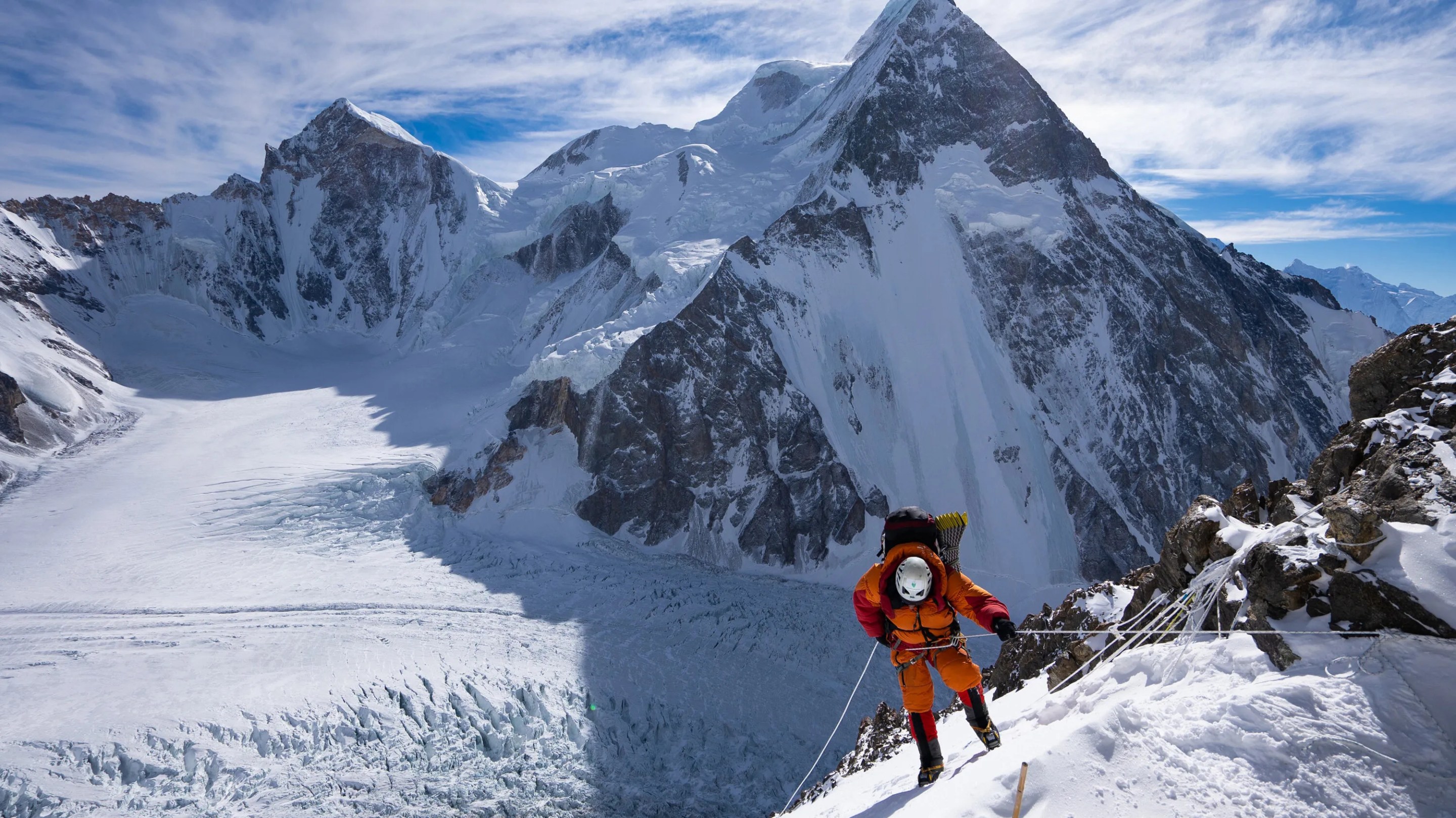
I imagine many modern-day adventurers regard Mallory with envy: He devoted his life to an undeniable, history-making “first,” the first ascent of Everest. These days, a “first” is hard to come by. As the journalist Grayson Schaffer put it, “the big obvious firsts—climbing the tallest mountain, visiting the bottom of the ocean, discovering America—have all been done.” In 2021, several alpinists set about claiming one of the last remaining firsts by undertaking a winter ascent of K2, the second-tallest mountain in the world, only a little over 200 meters below Everest. Even among the uninitiated, K2—known as “the savage mountain”—is notorious for being deadly. Located in the Karakoram mountain range on the border of Pakistan and China, K2 is steeper, colder, and more unpredictable than Everest; it is the technically harder climb. Until 2021, it was the only one of the 14 8,000-meter peaks in the world that had never been summited in winter.
The race to claim this “last first” of mountaineering is the subject of documentarian Amir Bar-Lev’s latest film, The Last First: Winter K2, which was released on Apple TV on Oct. 2 after premiering at the appropriately high-elevation Sundance Film Festival. For the most part, the film follows the Icelandic mountaineer John Snorri, who enlists the help of Pakistani father-son duo Ali and Sajid Sadpara in hopes of snagging the first K2 winter ascent. For the first few weeks of their expedition, during those early post-COVID months, they have the run of the mountain. As they prepare to climb, we watch their bond intensify in the forced proximity of camp. Sometimes, they literally play in the snow. Ali Sadpara, an accomplished mountaineer, is depicted with a home-movie warmth that makes you sit up straighter: Something bad is going to happen.
Then again, we have been warned. The film opens with a sequence in which an American voice—belonging to the sometimes controversial collector of firsts Colin O’Brady—desperately radios Base Camp from Camp III, saying that there aren’t enough tents for everyone to sustain the below-below-below-freezing temperatures. From there, the movie puzzles together how the 2021 winter season went from a barebones, collegial team effort to a crowded, ruthless competition.
For starters, the renowned Nepalese climber Nirmal “Nims” Purja—who died earlier this summer in an avalanche on Broad Peak, another 8,000er in Pakistan; and who was accused of sexual assault by two female climbers in 2024—showed up. When he arrived at K2 in late 2020, Nims was still riding the high from 2019’s “Project Possible,” the gonzo scheme that made him famous: He climbed all 14 of the world’s tallest peaks in six months. Just to put the scale of that achievement in perspective, the previous fastest ascent of all 14 peaks took seven years. At an elevation of 8,000 meters, a region mountaineers call by the friendly epithet the Death Zone, the expenditure of energy required to keep your body alive is enormous. The air is so thin that your brain can’t receive the appropriate amount of oxygen.
In 14 Peaks, the promotional documentary for Project Possible, Nims separates himself from Mallory’s universe-conquering ambitions. His motivation is to inspire people. Brandishing a swaggering self-confidence, he wants to show the world what the human body can do—more specifically, what the Nepali body can do. In the aftermath, Nims started an all-Nepalese guiding company, Elite Exped, and by 2021, he was determined to bag the first winter ascent of K2 for Nepal. Beyond making the summit, his goal was to beat the Westerners.
In that context, the competition between his team and the rest takes on world-historical proportions. The Sherpas, a Nepalese ethnic group, have too often been an essential but overlooked footnote in the white history of mountaineering. For as long as Westerners have been climbing very tall Eastern mountains, they have been exploiting the Sherpa labor force physically and financially. When Nims says, “If there are any foreigners behind us, I will pull up the ropes,” he has anti-colonial intentions on his mind. Nims didn’t actually pull up the ropes, but he did blindside the Sadparas and Snorri. Having worked together to fix the ropes, he agreed to share his summit plans with them. But when a rare weather window finally appeared, Nims’s team stole away in the middle of the night and climbed to the summit, alone, singing the Nepalese national anthem.
For a documentary with such a broad thematic scope, Bar-Lev is a surprisingly passive chronicler. Most of the footage used in The Last First is archival: Bar-Lev and his team didn’t need to be—and indeed, weren’t—present on K2 that winter. As several interviewees point out, most people venturing into high elevations today bring a camera, to be operated by them or someone else.
Though it’s impossible not to wonder if Bar-Lev’s presence at Base Camp would have given the film a sharper focus, or a more personal sense of stakes, the archival footage serves to make a critique of the influencer-fication of high-elevation climbing. Elia Saikaly, who is identified in the film as a “filmmaker/influencer,” comes to Base Camp looking for “the right story.” By the time he arrives, Nims had already summited, but, he says, “on K2 in winter, you’d be a fool to think that nothing else is going to happen.” Having learned that the Sadparas were still on K2, Saikaly “pitches” the Pakistani military on making a film about their summit attempt. The idea is that Pakistan could use Ali Sadpara’s already known and beloved image to attract tourists to, I guess, the extremely dangerous beauties of Pakistan.
At that point, the atmosphere at Base Camp is funereal. One accomplished climber, Sergi Mingote, had fallen to his death. The Pakistani military had shown up to congratulate the Nepalese team and wonder how come the Sadparas hadn’t yet made it to the top. Despite their obvious reticence, the combination of men in fatigues and the prospect of a film is enough to pressure the Sadparas to summit, and Snorri follows optimistically along. But through a series of catastrophic oversights, clients of the guiding company Seven Summit Treks end up at Camp III after nightfall without their tents; this is when O’Brady starts desperately radioing Base Camp. Along with Snorri and the Sadparas, he does what he can to accommodate the extra climbers, but in crowded tents, no one is able to properly boil water, rub their feet, or rest, all essential to surviving the high elevation. In the morning, most of the group descends. Snorri, the Sadparas, and Juan Pablo Mohr Prieto, a Chilean climber, continue on to the summit. Along the way, Sajid has a problem with his oxygen regulator and turns back. He is the only one to survive; the others die in a storm.
The Last First’s final stretch depicts Sajid returning to the mountain, in the warmer months, to find and bury his father’s body. Saikaly’s camera—and, by proxy, Bar-Lev’s own—is still around. Having located Ali’s body several meters below the summit, Sajid asks the people with him not to upload photos of it to social media. It’s striking to watch Sajid interact with Saikaly on the mountain, and with Bar-Lev in his interviews: He knows that his bereavement will be useful, in some way, to the documentarians. Rather than face his shrewdness—maybe even his anger—with honesty, Bar-Lev capitulates to cliché. He uses Sajid’s grief to punctuate that age-old question: Why do this?
After going to great lengths to touch on the commercialization of mountaineering, its colonial heritage, the competition it inspires and the sense of responsibility we might feel toward others, the film closes with a haunting image of Sajid burying his father’s body in the snow—it’s the conclusion to “the right story” Saikaly had come to K2 looking for, magnified as an end-piece that aims to stun us into contemplation. We are meant to feel a sense of random unfairness, of the unbearable shortness of life and the equally unbearable fixity of mountains, which will always be there, no matter how many people live and die trying to get to the top.
But the longer I sat with it, the less satisfying that conclusion became. In an interview at Sundance, Bar-Lev correctly surmised that when it comes to this kind of story, “adrenaline is the low-hanging fruit.” But so is the appeal to the morbid. On rewatch, the film’s first images, like its last, seem ghoulish: We see John Snorri say goodbye to his wife and six children before leaving for K2. It rings hollow to conclude that arc with a gesture of quiet humility in the face of nature’s awesome power. George Mallory’s instinct was no passive act of introspection. A summit attempt is also commonly described as an assault. It’s a violent thing to want, and a violent thing to do, which often produces violent results. Let us be honest about it.