

Sisi is a Volvo Ocean 65 racing sailboat. She is fast as hell and built for sickos. She is not a comfortable luxury yacht, I assure you. Sisi is a frightening, angry, 72-foot, 12-ton sea monster.
Sisi, owned and operated by an Austrian company called Kora Yachts, is used for racing, her calendar divided between summers in the Mediterranean and winters in the Caribbean, or what the rest of us know as "the life." In between all the racing, Sisi has to be delivered from port to port. To get to the starting mark of the Palermo–Montecarlo Regatta, she had to be sailed from the finishing mark of the Aegean 600, in Sounion, Greece, to the port of Palermo. With roughly a month between the two races, Sisi's crew first delivered her to the top-of-the-line facilities at Marina Genova, adjacent to the international airport along the western waterfront of downtown Genoa, in northern Italy. There, across the harbor from the vast and imposing Fincantieri shipyard, Sisi was cleaned up, tightened up, and provisioned, and prepared to take on fresh crew for a three-day, 480-mile transit down the Tyrrhenian Sea.
On Monday morning, Aug. 10, at approximately 9:00 a.m., I sat on a duffel bag in the shade of a dockside oleander at Marina Genova, watching from an awkward distance as several youthful Austrian crewmembers bounced around in Sisi's shallow cockpit. Photographs I'd consulted in preparation for this moment showed her painted a cheerful blue, but sometime recently Kora Yachts had decided to repaint Sisi's sides and keel a decidedly uncheerful black, all the better to represent her vicious demeanor. Sisi, already shimmering at this early hour behind rising columns of heated air, seemed small beneath her own towering mast, and to sit conspicuously low in the water. Hunkered down at dock Sisi looks lean and stark and scary, her low white deck gleaming above her black sides like the bleached skull of some primordial monstrosity. The feeling, watching her in the morning's meager shade, was not unlike the moments before skydiving out of an airplane. What am I doing here? Am I really about to do this? Why have I done this, and is it too late to back out?
Sailing is too expensive. I can go down to the sailing marina on the Potomac River and rent a fun little 19-foot Flying Scot for a couple of hours and it's $75, which isn't too bad. But I want more. People should be able to go places on the wind. That has always been logistically complicated, but the expense nowadays is outrageous. Boats, famously, are money pits, and now that private equity is getting involved in the marina business, the whole shebang is accelerating toward an inflection point.
If buying and maintaining a boat is beyond your budget—and it is, because you are a sensible person—another option is chartering. Chartering is also expensive. You can charter a boat for a week out of, say, the British Virgin Islands, but it's going to run you a few thousand dollars, in addition to the cost of getting there, and provisioning the boat, and paying for transient slips and any non-boat excursions you might want to throw in there. The money, in context, looks absolutely preposterous. The cost of chartering for just one week of cruising could pay to buy a whole fleet of boats available today on your local Facebook Marketplace, so long as you are willing to have your life ruined by the breathtaking expense of owning a cheap boat.
This, more or less, is how a person winds up aboard Sisi. This is the third option for the would-be sailor: Someone else's boat. Because there are boats already out there on the water, there are opportunities to work or to pay (or very often both) your way aboard someone else's voyage, to split the costs of traveling by wind, and to partake of the experience you're after without the commitments of buying or chartering your own vessel.
On the app SailTies, sailors throughout North America and Europe are posting their voyages. In many cases, they are seeking hands for lengthier passages and deliveries. In the app's new Adventures program, commercial outfits are offering more exciting opportunities: regattas and transatlantic crossings and even weeks-long passages to the South Pacific. Some of these are still outrageously expensive, to the point of exploitation. There's an outfit on there offering crew positions for a long voyage and hoping to charge a whopping $10,000 per person, for the privilege of, uhh, having a full range of responsibilities for delivering someone else's boat.
Kora Yachts, to its credit, is offering something more legible as an experience worth buying: If the seas are crammed full of disintegrating decades-old cruising yachts, they are comparatively blank where it comes to large top-of-the-line racing vessels, and the few days that a normal person, with a normal suite of human responsibilities, spends aboard a VO65 are likely to be the only days of that person's life on which they experience sailing with this kind of power and precision. For the somewhat more manageable price of $1,100, you get three to four days (pending wind) of accommodations aboard a particularly fascinating vessel, including meals, plus the passage from Genoa to Palermo, plus access to a professional crew of sailors to (ahem) show you the ropes. That is still not nothing, but it feels somewhat more doable.
What would $1,100 buy you in accommodations for, let's say, three days in Genoa? At the Grand Hotel Savoia Genova, a swank five-star joint located uphill from the historic port on the east end of town, you get a king bed, a separate dinette, a soaking tub, his-and-hers vanities, and a television. You get free toiletries and bath robes, and a mini-bar. The hotel has a lounge, restaurant, and swimming pool; it has laundry facilities and a fitness center; it has maids. It even has babysitters. There is a shuttle service to zip you around to the local attractions. You can rent cars on-site. It should go without saying that there is air conditioning, and that your room has its own toilet, and that the toilet does not swivel.
Aboard Sisi, you get what is called a berth. The berth is a thin mesh stretched over a PVC frame. It is about seven feet long by two feet wide, and it is along the inner hull of the boat. There are 12 berths, six along each side. The bottom berths are about 18 inches above the floor; the top berths are about 18 inches above that. About 18 inches above the top berth is the ceiling.
In addition to a single toilet, there is one sink, and it is just large enough to fit two human hands. There are two spigots: One pumps sea water and is used for cleaning dishes. The other pumps from Sisi's freshwater tank, which is filled by Sisi's water-maker, an electric desalinator that is run when Sisi's diesel motor is engaged. Fresh water trickles from this spigot at the push of a green button, and the water is warm. If you want to boil the water, you can open the valve on the mounted camp stove and use a lighter to create a low blue flame in the single burner, and then place above that flame a tiny metal tea kettle. If you think about it as camping while moving—and over the cobalt Mediterranean, no less—you'll get into the proper state of mind.
There is a box of packaged snacks, a delightful variety of cookies and crackers. There are two hanging mesh bags of fresh fruit: apples, oranges, and lemons, a blessing. In another box, tucked beneath hanging life vests over on the port side, there is a pile of bagged dehydrated meals: pasta bolognese, pasta carbonara, vegetable curry, spiced chicken and rice, daal, and so forth.
What you do is, you boil some water in the kettle, and then you tear open your bagged meal and you pour into the dried scraps and pebbles therein a cup or so of boiling water, and then you stir it around with a spoon. You reseal the bag and take it up to the boat's open-air cockpit, and you set it out of the way, in an open-top station at the very back of the boat, behind the helm, dubbed the mini-bar. After 15 minutes you retrieve the bag and open it, and with your spoon you go to town, hopefully not slopping wet rehydrated bolognese around on Sisi's heeled deck. It's an adventure!
Sisi's toilet situation is, uhh, challenging. I have never crapped on the flanks of Mt. Everest, but it's my understanding that as high as Lobuche village, some 16,000 feet above sea level, as wind-scoured and inhospitable a habitation as exists anywhere on the planet, the squat toilets are at least surrounded by walls, offering a modicum of privacy. In any case, they are at least fixed in three-dimensional space. Not so aboard Sisi. This takes some getting used to.
Kora Yachts wants to prepare you for the rustic toilet situation, without necessarily telling you explicitly that you will be crapping into a swivel-mounted bucket in a large forward storage space, just feet from your fellow crew, separated from open bunks and what passes for the boat's kitchen (or galley) by a narrow thin barrier and flanked by two completely open and unguarded bulkhead passthroughs. "There is no luxury below deck," warns Kora's online info sheet. "Just the essentials and the sound of the hull cutting through open water."
With each next pooper just sitting out in the open, protected from intrusion only by the caution with which fellow crewmembers approach the forward hold, you can go ahead and assume there will be other audible noises below deck, beyond the sluicing of sea water. Where "essentials" refers to the boat's lone commode, it means that there is in fact a hole for your poops to flow into, but it is a tiny one, and it clogs easily. Sisi's professional crew promises to unclog one stoppage, but only one.
If that tiny dark toilet clogs a second time, all remaining toilet activities will require the use of biodegradable baggies. It would then be each person's deeply surreal responsibility to carry their bodily waste onto the boat's deck and there, in front of as many as a dozen awake and alert fellows, to huck it into the sea, perhaps winding the baggie like David's sling for maximum distance.
Each crap taken aboard Sisi, by the 13 crewmembers of this passage to Palermo, is thus a dance with fate.
The toilet swivels. It does this because it is mounted to a gimbal, and it is mounted to a gimbal because a modern monohull sailboat—just as you are picturing it, a long narrow spade-shaped vessel with two big triangle sails over it—will tilt over to the side on most points of sail. This is known as heeling.
A monohull sailboat like Sisi is supposed to heel, and can safely handle some pretty severe heel angles. Sisi's sails are enormous, and the forces generated by even moderate winds are so extreme that the control lines for her sails could quite literally sever a person's fingers. Sisi has technology to monitor and distribute these forces, in some cases to make her safe for her crew but in most cases to make her fast, and in almost no cases to make her comfortable. If Sisi is somewhat stiff to the wind—if she resists heeling forces more successfully than the little bobbing bathtubs you can rent at a public marina—it's because boats sail faster if they can keep their angle of heel at or below 15 degrees. But in some wind conditions it is simply not possible to fight the power, and Sisi is not really doing anything her professional crew would consider extreme when heeled over at 30 degrees or more.
You hate to think of someone, perhaps a poor unsuspecting blogger who is merely trying to survive a series of uncharacteristic life choices, perched trouserless in a dark sweltering half-closet, being heaved onto the damp floor by a tiny toilet that suddenly pitched over at the angle of a commercial staircase, right out from under his exposed butt cheeks. This is why Sisi's toilet is built to convert the weight of a human butt into a leveling force, ignoring the hijinks of the boat around it, the way that a sensitive pendulum records the rotation of the Earth without regard for the initial plane of oscillation.
When Sisi is heeling, what you have to do, when you are mentally preparing yourself to mount Foucault's toilet, is anticipate that the weight of your butt, pulled by gravity toward the Earth's core, is going to cause the toilet to lurch over. But the toilet only swivels so far: Pooping aboard Sisi (and pissing—the men aboard Sisi were told by her captain not to attempt any toilet activities while standing, that none of us possess the balance and agility for accurate pissing below deck in the close darkness of a rolling and pitching sailboat at sea) in zesty conditions requires a degree of athleticism.
If you're anything like me, you think about this not only while you are astride the toilet but while you are helming the boat. They did let us do that. After all, the eight of us who'd signed up to join the professional crew for this voyage did so expressly for the thrill of being trained up for most of the duties required to power a VO65 across the open sea, and trusted with the responsibilities of real-deal crew. Helming, somewhat counterintuitively, is the shallow end of that pool of duties. When you're at the helm of Sisi, in addition to maintaining the course of the boat and marveling at the sensitivity of the steering, your mind does tend to cast itself below, to hope that some poor crewmate will not be thrown from the throne and soaked in their own waste if you fail to smoothly guide Sisi through the combined forces of a rolling swell and a broadside gust. There's some stakes to all of this.
Sisi is not always heeled. Sailboats are powered by a force called "apparent wind." Apparent wind, as the name implies, is the wind you feel, a combination of the direction the air is moving on its own and the direction the boat is moving in relation to it. The easiest way to conceive of this force, and thus the example used in 101-level sailing classes all over the world, is to think of a car with the windows down. You get into a car. Today there is zero wind outside. The car moves forward and you stick your hand out the window. You feel wind on your hand. That wind is sort of fake, right? It's caused by the movement of the car through the air. When there is no real wind, whatever direction the car points, the apparent wind is coming from directly ahead of the car. The car is making the wind.
Later on your car trip, clouds blow in and bring what is called "true wind." Let's say the true wind is nice and fresh, and is blowing from behind the car, at an angle off the rear bumper. When you stick your hand out the window, you feel the combined force of that true wind and the wind caused by the forward movement of the car. The apparent wind now feels like it is coming from over to the side. Fore-and-aft rigged vessels can sail up to within about 45 degrees of the wind. When the true wind is over Sisi's side, her forward movement adds headwind, and thus pulls the apparent wind forward. Because Sisi is such a fast and efficient vessel, her speed over ground can shift the apparent wind pretty significantly, so that true wind that is blowing from the side will feel to the helmswoman as if it is blowing in her face, and Sisi will behave as if she is sailing upwind, because as far as her sails know, she is.
Sailing upwind is hard on a boat and its crew. Drag and lift combine to create heel and leeway, putting a lot of strain on the boat's rigging, creating uncomfortable conditions for the crew, and requiring additional maneuvers in order to hold a straight course. But sailing upwind, especially in moderate conditions, has the benefit of feeling very lively, as the force of the true wind combines with the boat's forward movement to drive a zesty living breeze over the deck, whistling through the rigging, sweeping your hair back from your face and neck, and cooling your skin. The bow will slap down onto a swell and fine spray will blow through the cockpit, causing every soulful being who has ever lived to smile involuntarily.
Sailing downwind is comparatively easy. You let the sails out wide to block and thus capture the most wind possible, and the boat rides mostly flat and straight. The problem with sailing downwind is terrible, terrible stillness.
Back to the car, and the apparent wind: You are driving at 10 miles per hour, and there is 10 miles per hour of wind coming from directly behind you. You stick your hand out of the window and you feel nothing, zero movement of air. Aboard a sailboat, it is possible to make downwind progress while the boat's crewmembers feel not one single breath of air. A helmsman can sit in suffocating stillness, at what feels like a dismal, pointless crawl, even as digital readouts insist Sisi is making perfectly respectable headway. In summer, in the hot parts of the world, sailing downwind in light air can be torture.
It is in these light conditions that a crew member aboard Sisi really encounters the limitations of Sisi's accommodations. A trickle of warm water from the tap, no refrigeration, no ice, no shower. No air conditioning. The deck is broiling under the Mediterranean sun. The black planks underfoot could be used to fry eggs.
The crew hauls out a tarp and some spare lines and rigs a low roof over the cockpit; to facilitate this improvised shade, the boom is centered and lashed in place, and the diesel engine is fired up. Sisi makes seven knots under motor, but the progress is noisy and Sisi vibrates under your feet. Air as you know it seems somehow to evaporate, leaving a person to sip from that hot dust-colored funk on the horizon. The heat squeezes in, thick and furious.
The berths below are dark but sweltering. Heat pours down the open companionways, settles, and swells, trapping and aerosolizing every drop of human perspiration. To compensate for the lack of air conditioning, mounted to the ceiling at the stern end of each berth is a tiny plastic motorized fan. When you get into the berth, which you do only for sleep unless you are psychotic, you lie with your head astern, so that if the boat hits something in the water, you will slide forward and bonk a wall with your feet instead of your noggin. The fans blow gently down onto the head and shoulders of the sleeper. Except for in my berth: My berth—the upper aftmost berth on the starboard side, the darkest part of the cave—has a malfunctioning fan, which blows only when it is pointed at the ceiling.
There is something attractive to me about the idea of working hard enough or living fully enough to achieve a kind of tiredness in which I would sleep absolutely anywhere, where a flat and reasonably soft surface of any conceivable condition would be encountered as a gift from God. When Sisi is charging into a lively breeze and heeling over and bouncing along the swell, it's possible to think of that berth down there as something you could almost earn, something you would return to with gratitude, where you would sleep the deep restoring sleep of the perfectly content. When Sisi is motoring noisily but slowly downwind in infuriating stillness, under that merciless fucking sun, and nowhere on the boat is there a puff of moving air, and the hours tick away in flat, featureless monotony, that dank black shelf might be the least appealing spot on the planet.
Out on the deck, there is no escape from any of it. The heat presses in from all sides and every angle. Sunscreen melts into your eyes. Your elbows, knees, and armpits sting from salt. You dry your face with a towel and your skin instantly shrinks and hardens into a shiny crust. Sisi's lone square of shade lies directly beneath the improvised cover; as the sun arcs overhead it ruthlessly slides that shade away from the helm, so that as the helmsperson you alone are standing in bright hell.
Nothing but an IV could deliver water into your system fast enough to outpace the rate at which it is being squeezed out again through your pores. You wonder when you have last pissed, and if you will ever piss again. Everyone aboard Sisi is as close to naked as they can stand. Your clothing is drenched; your shorts are becoming pants. You taste sweat as it trickles from your upper lip, and it is thick brine. You could pickle cucumbers in it.
Water laps Sisi's sides, but there is not enough heel or forward speed for it to spray up onto the baked deck and cool the sufferers. The headsails are furled, in order to protect their incredibly expensive panels and seams from pointless ultraviolet damage. The enormous mainsail sends its shadow down in an infuriating narrow line, thinner than shoulder-width. The expanse of white deck forward of the cockpit is a blinding scoured desert.
The Austrians huddle together under the tarp, red-faced but stoic. A Spanish man soaks himself with a bucket four times in an hour. His father, 70 years old, sleeps below. It is the most impressive thing anyone will do on this entire voyage. The thought of being down there, strewn on a mesh platform in the moist baking dark, is mind-boggling. Should we check on him? Did he go down there to die?
The only way out is through. You remind yourself that this is also what you signed up for: If you are delivering a boat from Genoa to Palermo in the month of August, this is what you get. This, just as much as bounding along in a gale above a tremendous bow wave, is what sailing is. You are having the experience that you paid for, here at the helm of a becalmed sea beast, your life melting down into her exquisite fibers.
The stretch of water between Genoa and Palermo, compared to the open ocean or some of the really dramatic bucket-list-type sailing grounds, is baby shit. Any combination of four people aboard Sisi for this passage could very comfortably deliver a normal boat from Genoa to Palermo without incurring any injuries or encountering anything like real danger. They would split up into watches, and take turns on deck, and they would sail through the night, and it would take three or four days, and they'd have all the heat and tedium and a portion of the exhilaration, and it'd be fine.
What makes the passage a noteworthy adventure is Sisi herself. Sisi is not the biggest or newest or fastest sailboat out there, but she is still very significantly unlike the kinds of comfortable cruising vessels you might ever charter out of any of the ports along the Tyrrhenian Sea. If Sisi's professional crew were to vanish—if they were to be swept overboard by an accidental gybe, say—the remaining crew would be in trouble. If the wrong combination of four of this passage's crewmembers tried to sail Sisi 480 miles down the coast of Italy, they would require rescue by the Italian Navy before they'd covered a third of the distance. It's the systems and forces, so extreme relative to those found aboard a normal sailboat, that would defeat them.
An example: Late one evening a member of Sisi's non-professional crew, helming in mounting upwind conditions, drifted out of the steering groove, such that Sisi's sails were momentarily becalmed. They then overcorrected, swinging back through the wind, such that Sisi's sails powered up with appalling suddenness. One of the lines controlling the larger of her two headsails, cleated tight as a guitar string, shifted on a winch and made a popping noise so shockingly loud that several shipmates slumbering below, professionals, raced onto Sisi's deck, hastily pulling on life vests and looking around for the emergency.
Sisi's crew is divided into three watches. Technically only those actively on watch are required to be on deck, but the oppressive daytime heat tends to push everyone up from below, to say nothing of basic circadian shit. Around dawn and toward sunset there is beautiful shade from Sisi's enormous headsails, and the crew spread out to enjoy it, reading or crocheting or chatting in little comfortable nooks. All 13 of her crew were up and about one late morning when a pod of dolphins zoomed by and spent a few minutes cavorting up by Sisi's bow. All 13 were on deck on the evening of Aug. 12, when the sun dropped out of a low cloudbank on the western horizon and was briefly and partially obscured by the moon.
Things change at night. For one thing, Sisi's captain is very serious about safety. The moment the sun dips below the horizon, he orders in his calm German-accented voice for everyone to wear a life vest. At night you are also expected to wear shoes, and you are generally not permitted to venture up onto Sisi's bow or, if she is heeling, to dangle your feet over Sisi's leeward side. These measures take some of the easy delight out of hanging around on deck.
For another thing, because you really do not want to be below during the scorching mid-day, it is important that you get what sleep you can during the comparatively cool overnight. Once proper night closes overhead, people who are not actively on watch tend to go below, to queue up to brush their teeth at the tiny sink, to wriggle out of whatever soaked and stretched clothing they've been wearing and into whatever they've got that passes for dry, and to duck into berths for a few fitful hours of shuteye.
Overnight shifts have a surreal quiet, even with the watch crew huddled together in the cockpit. A person can maybe more easily concentrate on the steering of the ship, but also there is less total sailing experience up on deck, and sleepers outnumber alert crewmates two to one. Sisi's captain reminds the crew, often enough, that most of the bad things that happen aboard a sailing vessel tend to happen either during storms or overnight. It can be a little bit anxious.
On the other hand, most of the best sailing conditions encountered during the passage to Palermo came well after sundown. The wind tended to freshen, and Sisi's sails would belly out and go tight, and suddenly she would be ripping through the water. One of Sisi's professional crew, a young Austrian part-timer, told me about crewing during a transatlantic voyage where Sisi was going downwind in a gale and made 30 knots of speed over ground. To me this is astonishing: Most cruising monohulls need ideal or possibly even dangerous conditions to make an honest third of that speed. In the Tyrrhenian Sea in August you do not tend to encounter gale-force winds; even for a vessel like Sisi, one that can outrun a breeze, that kind of performance around these parts is exceedingly rare.
Now we have arrived at a bare truth: Sailing is the most expensive method humankind has ever devised for traveling at jogging speeds. Most sailboats will never ever cover a mile of distance faster than an athletic middle-schooler can do it in gym class. Nine knots of speed over ground—a proud rate of headway for a solid majority of all monohull sailboats ever built—is bupkis. The fastest Sisi has ever gone over water is a speed that you would absolutely not accept from the car in front of you in the left lane of an interstate highway. All I can say to you is that parking-lot speeds hit entirely differently when you are being moved by the wind. You really need to get out there and feel it, man.
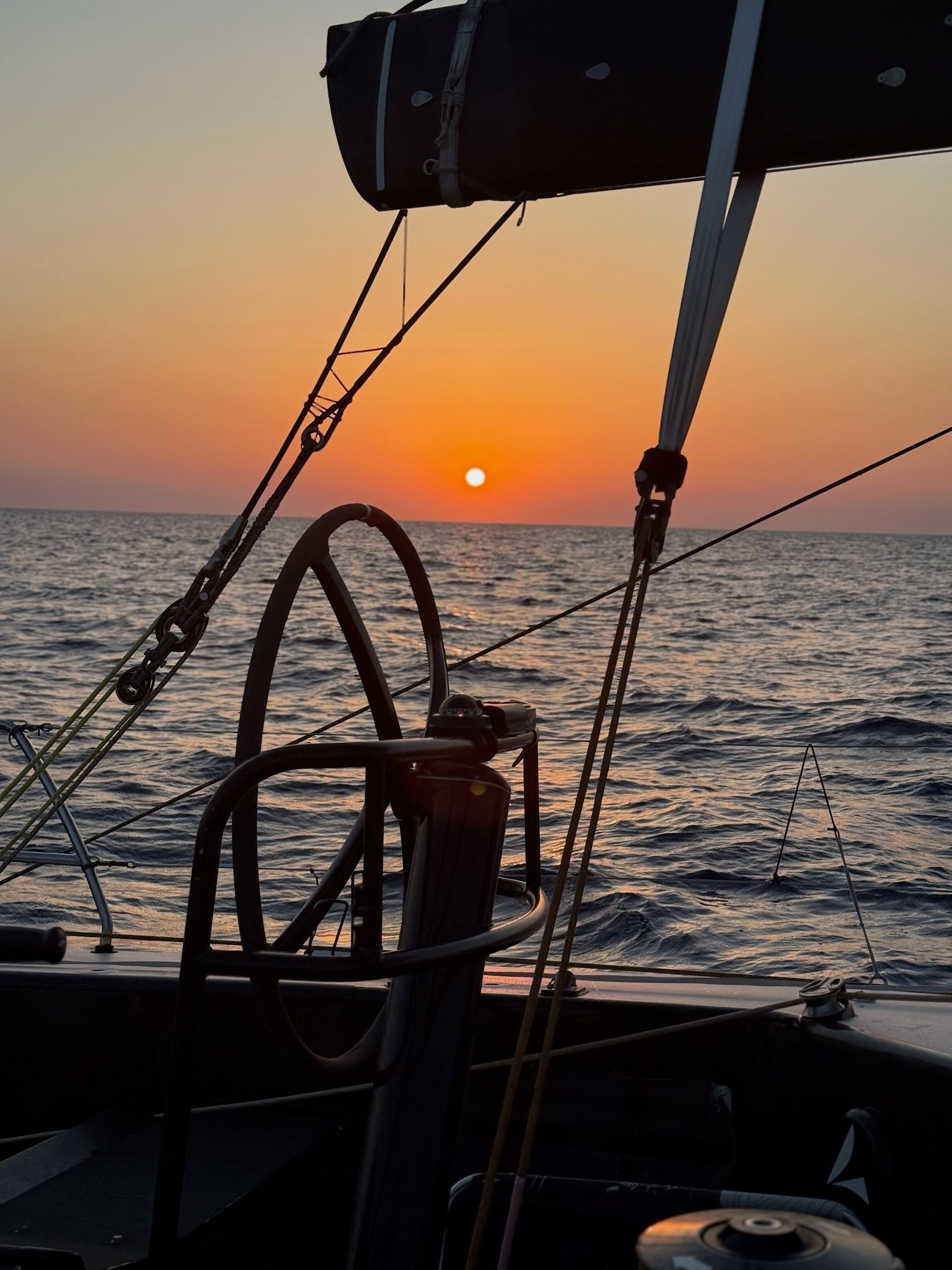
Here is what it is like to helm Sisi upwind—or "close-reaching"—into a stiff breeze after midnight, with the Milky Way splattered thickly across the night sky and the lights of Palermo glowing to the south, with dark islands making jagged voids along the eastern horizon and the Perseids soaring overhead like bottle rockets:
You stand at the port helm. The captain, in his calm German accent, has asked you to hold a heading of 145 degrees, which puts the true wind just abaft Sisi's port beam. The wind has joined the party, and is blowing in at 15 to 22 knots. Sisi eats, chewing 60 degrees out of the true wind and spinning it forward to her port bow. The heel to starboard can be felt in your knees and ankles. Frothing seawater churns and bubbles down Sisi's hull. A distant thunderstorm rages silently just east of your heading, blinking imposing cloud shapes into and out of the blackness.
You refuse to be distracted by the digital readouts. Every sloppy correction is an unsubtle rudder input and every one of those takes a too-large fraction of speed out of Sisi's galloping pace. No, dammit. No. Not tonight. You cannot close your eyes and still consider yourself a moral person, but you do the next best thing: You tear your eyes away from the red-glowing readouts and glance up, seeking out and finding a bright star situated one finger to port of Sisi's absurd mast. You glare at the star, you hold the star right exactly there, steering by its position and by how and where the wind tugs on your crusted and reeking T-shirt, by how it howls in your ears, and by that sideways tug of gravity.
Sisi overtakes a swell and the bow lurches, the mast leans and the star darts away. It's only a swell, hold your horses, you tell yourself, and then the swell sweeps astern and Sisi rights and the star is now two fingers to port of the mast. You fling the wheel over and then fling it back, and you feel the slight check in Sisi's headway, but then she dives back into the groove and bursts forward and electricity races down your spine. You are becoming one with the beast. You allow yourself a glance at the readouts. 142 degrees. Not bad.
A cloud overtakes your star. Hell no. You fling your eyes further skyward and find another bright star, and now you cannot see any of Sisi's bulk anywhere in your line of sight, just the starry field, darting meteors, the mast and upper rigging, and that huge black trapezoid of the mainsail, so much darker than the night. The upper mast swings more dramatically, but you've got a spooky mind-meld feel for it. With the tips of your fingers you are flicking Sisi's wheel back and forth.
The wind suddenly bellows audaciously and Sisi makes to throw herself into it, but this time you are way ahead of her and already the wheel is turned to starboard, resisting Sisi's impulses and forcing her to stick in the groove. She heels further in protest and you find that you are smiling. I know what you're up to.
Her bow slaps down into a trough and there is a loud splash, and a spray of fresh cool water sweeps over the deck. The other members of your watch laugh aloud. The captain, with his calm German accent, calls your name in an accusatory tone. "Did I do that?" you ask.
"Yes, you were going the speed of sound," he intones, and your watchmates chuckle. You know that he has sailed this boat at twice this speed, and that he is humoring you—the following morning, in a slip at the port of Palermo, where they have somehow invented a new kind of earthly heat, this man will apologize to the crew for never having shown us what Sisi can really do—but in this sublime moment you think that maybe when this journey is over, you will throw it all away and follow that calm German-accented voice to the ends of the Earth.
It is a moment for only the four of you. A consequence of steering on rails in a blessedly accommodating breeze is that everyone else gets to relax below: no thundering motor, no wild lurches, no alarming pops. No one's toilet activities are rendered catastrophic. It's as the brochure promises: "Just the essentials and the sound of the hull cutting through open water." It's not quite everything sailing has to offer—the Austrians aboard don't get out of bed for a mere 15 knots of speed over ground—but ripping along under the wheeling cosmos in flirtatious dalliance with a savage wind-gulping dragon is as much as you could ever decently want from sailing, camping, transiting, or breathing air on planet Earth. It rules so hard you feel like your heart could explode.
Two more minutes of this crazy glee, your senses four times more awake than they have ever been before, and then your faithful watchmate from Frankfurt almost apologetically arrives for a turn at the helm. A half-hour later your adrenaline has finally waned, and you yawn, and then 15 minutes after that, your final watch aboard Sisi has ended. Sleepy-eyed shipmates clamber onto the deck. The wind is easing, but that is not your problem. You thump down the companionway, hang up your life vest and your headlamp, stuff your soaked and putrid clothing into your bag, brush your teeth at the tiny sink, and then throw yourself into that terrible berth, where against all odds you relax all the way down at the cellular level, there beneath the tiny malfunctioning fan, which blows gently and quietly, onto the ceiling.