

The only interview that the filmmaker Kristoffer Borgli lists on his website is titled Filmmaker gets shot during interview, in which Borgli—you guessed it—gets shot during an interview. The short film opens with Borgli and his interviewer, standing against the idyllic horizon of Hollywood Hills, discussing the creation of Borgli’s first feature, Sick of Myself. Their conversation is sincere and frank—until Borgli is shot. The rest of the short, filmed as promotional material for Sick of Myself, is dryly funny. The paramedics go to the wrong address. Borgli insists on continuing the interview and gets shot again. The interviewer hangs his head in guilt; someone tries dangling a banana in front of Borgli’s paling face. “This is the same thing that happened to Werner Herzog,” someone on the film crew exclaims.
Such a short, acerbic and darkly humorous, says much about Borgli: He is a filmmaker who understands, very well, how to bait a public and lure an audience. The trick is to get shot by the public before you have the chance to be sincere—that way, you’ll never have to show your cards. Controversy has played strategically into the popularity of his latest film The Drama, which he directed and wrote. A week before the film’s release, TMZ reported that the parent of a victim in the Columbine High School shootings condemned the film for its “twist,” the same plot event that leading star, Zendaya, referenced on her recent Jimmy Kimmel Live appearance. (The twist will be discussed in greater detail in this piece.) At the same time, a 2012 essay by Borgli, published in a Norwegian magazine, garnered renewed attention after it circulated on the A24 subreddit. The essay describes Borgli’s romantic encounter with a high schooler, as a 27-year-old. “She was May; I was December,” the translated essay ends dramatically. Coyly, even. A recent Vulture headline asked: “How Much Is Kristoffer Borgli Trolling Us?” A lot, I think.
Borgli called, and the public answered. The internet is alive with chatter about The Drama: This is a film about gun violence, about morality, about the state of America. It's good; it's bad; it's amazing; it's terrible. I'd argue that The Drama is, above all else, a good time in the theaters. The film is cleverly written and surprisingly hilarious. Before all other grand postulations, The Drama is a movie about an asshole and the woman he wants to marry. A flaw of the film might be that at times, it feels too dependent on its own cleverness, almost foreclosing itself from approaching even more depth by cloaking itself in irony. However, these defensive pretenses fall away as we approach the ending. At the film's conclusion is a small spark of sincerity. It happens to be just enough.
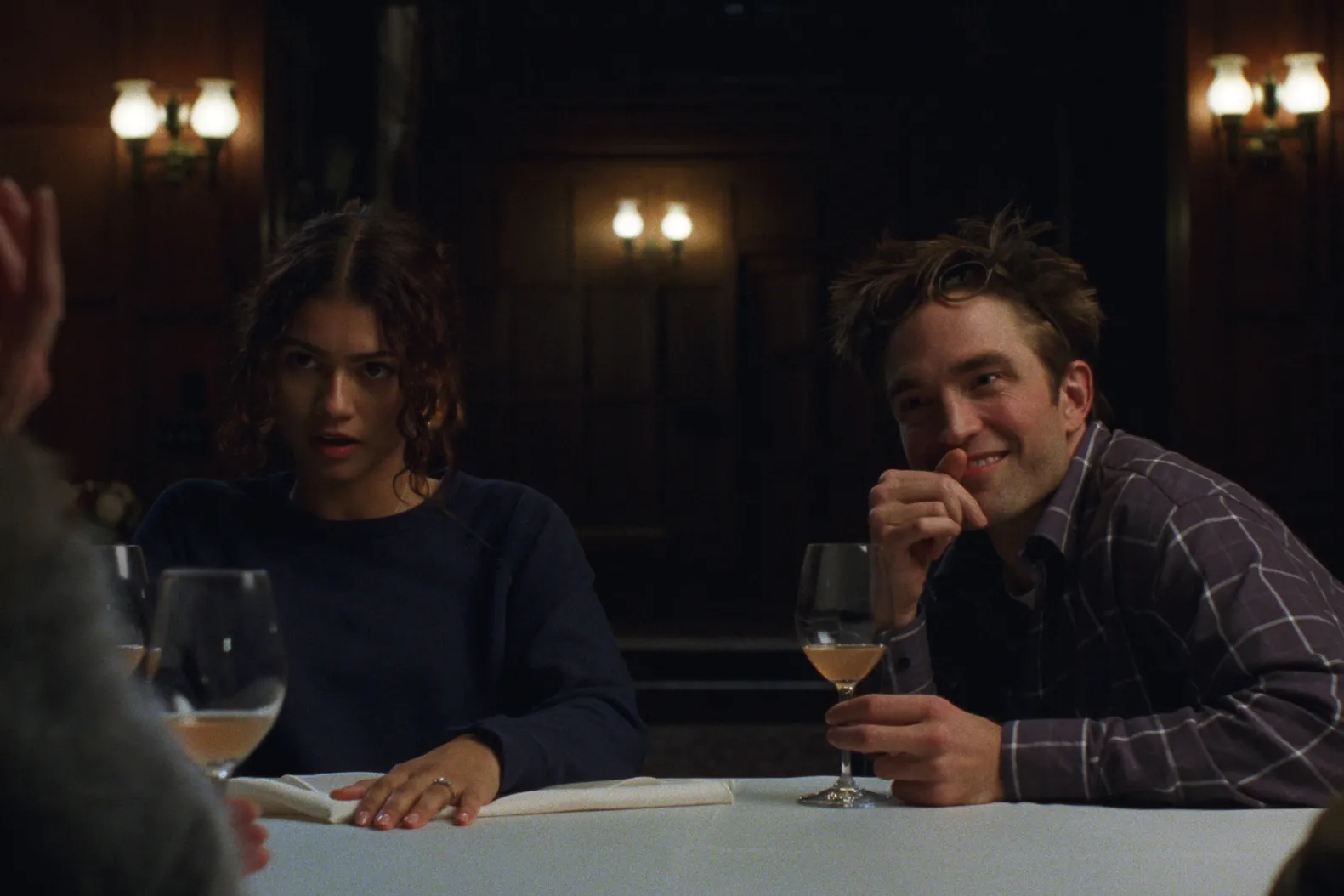
Sincere, though, is not the word you might use to describe Charlie (Robert Pattinson), the head curator of the fictional Cambridge Art Museum. A wedding—like an exhibition in a museum—is a tightly orchestrated spectacle. Interestingly, we meet Charlie at the beginning of The Drama performing an act of curation with his wedding speech. He’s asking his best friend—and best man—Mike (Mamoudou Athie) for advice on the draft. He’s already cross-referenced his speech with Emma (Zendaya), his fiancée, to ensure that neither share the same stories about their love together. For instance: The story of their meet-cute in a coffee shop, a story so romantic that, of course, both Charlie and Emma want to share it. Charlie reads his speech to Mike; Mike is so moved that he cries.
The Drama is Borgli’s third feature film after Sick of Myself and Dream Scenario, both of which prod contemporary social pieties. Those films revolve around protagonists whose desire for adoration in their broader worlds upends their personal lives. In Sick of Myself, Signe can’t stop lying about her self-induced affliction, because trauma also garners her sympathy and fame. Similarly, Paul in Dream Scenario is an unhappy professor who realizes he can win the success and respect he's always desired, quite literally, in other people's dreams. Both Signe and Paul are individuals bereft of stable interiority; Borgli positions them as products of our modern culture, sunken deep into channels of self-worth far removed from themselves. Their identities are constituted by the validation they receive from others, friends and total strangers alike. Charlie in The Drama fits perfectly within Borgli’s stable of needy, narcissistic protagonists. Did I already mention that he’s an art curator? The Drama is a little too on the nose with this.
I have nothing against art curators, categorically—really only against Charlie, whose career mirrors his orientation toward his own life. You can see this in the apartment Charlie shares with Emma, where he and Mike sit as they mull over his speech. Their home is flushed with sunlight, courtesy of generous bay windows. Few gaps exist in their towering bookshelves; along their walls are paintings by artists like Sara Cwynar and Tristan Unrau. Charlie and Emma wake up in Harper’s Magazine T-shirts and drink coffee in mugs from the American Museum of Natural History. Our couple is not only beautiful, they are erudite and cool. Not all of the chairs in their living room match; they probably scored a few off Facebook Marketplace—relatable! Charlie works in art; Emma has a job in publishing; and together, the two are the romantic ideal of the cultured intelligentsia. That is, until Emma drunkenly reveals that she had wanted to shoot up her high school when she was 15 years old. That’s why she’s deaf in one ear: While testing out her father's rifle in the woods, the sound from the rifle's fire caused her to lose her hearing. This, Emma confesses when prompted by Rachel (Alana Haim), Mike’s wife and Emma’s maid of honor, during a game where all four reveal the worst thing they’ve ever done. Rachel once locked a disabled child in the closet of a remote and abandoned RV overnight, prompting a harried search party the next day, but she is too appalled by Emma’s past to want to remain friends with her. Charlie, meanwhile, is mostly baffled.
The real twist is not Emma’s secret, but how incurious Charlie has been about his wife. Justin Chang in the New Yorker knocked The Drama for its derelict “psychological illumination” of Emma’s character. Here, I’d argue: Is that not the point? The most understatedly hilarious premise of The Drama is that Charlie might not have ever asked his bride-to-be, as the joke goes, a real question. Had he even cared to learn about Emma’s adolescence, the alienation she felt in her teenage years as a result of a peripatetic childhood, Charlie might have known this fact about Emma sooner. But the reason we know little about Emma is the same reason Charlie knows little about Emma: Both of us experience her as an image. An object, even. A beautifully curated object in his life.
The Drama changes in tone after Emma’s revelation. Where in the beginning the film felt like a dreamy romance, The Drama soon becomes a film about Charlie’s neurosis. What is he worried about? Well, he’s worried about not knowing the woman he’s about to spend the rest of his life with—true. He’s worried that he never really knew Emma at all—true! Most of all, he’s worried about himself. He’s not really worried about Emma, more about reconstructing a version of her that he can sell to himself and others. He wants to give her a traumatic backstory to explain her actions. Suddenly he’s citing Freud in bed and talking about suppressed emotions; suddenly he can’t get it up for the woman he’s about to marry. He begins to externalize his internal spiral, seeking everyone else's opinions, deaf to Emma herself. At his wits’ end, he asks his attractive coworker, Misha (Hailey Benton Gates), what she might feel if she learned her boyfriend had wanted to shoot up his school when he was younger. Her answer makes him cry. He kisses her.
The real intelligence of The Drama is that it offers you a choice: Do you, like Charlie, settle for what the film offers on the surface? Borgli tempts you to stay there. Look more deeply and you’ll see that The Drama is simply sick of the superficiality that ruins our deepest intimacies. In plainer terms, it's trying to say something about love. It's Emma who asks Charlie, early in the film, why they need a choreographer; why can’t they dance how they do at home, just the two of them? It's Emma who reminds Charlie, in spirit and in question, that they can always start over. The sincerity of the film is in Emma's character, embodied by Zendaya, aloof in her appearance and enduring in her heart. I almost pity Charlie by the end: He is someone who has mistaken image-making for real connection.
The actual speech that Charlie delivers at his wedding is unscripted and humiliating. He reveals his infidelity, and, with the most earnestness he's mustered in all two hours of The Drama, that Emma, in spite of everything, is the love of his life. Misha's boyfriend still beats him up, and Charlie returns to his and Emma's once beautiful, now pathetic home, alone. Their meticulously collected abstract art stares down at him in his misery as he peels off the fancy black shoes he had been trying to break in before his wedding, all while Emma, in the background, was trying to explain herself to him. He goes to a diner in his newfound loneliness: a place with bad decor and even worse lighting. Bloodied and bruised, Charlie looks awful; in other words, he appears the most truthful we've ever seen him. Emma walks in. Here, they can finally begin.