Cheri Kempf knows exactly how hard it is to sustain a professional women’s sports league. She was the commissioner of the now-defunct National Pro Fastpitch league. During her tenure, the NPF’s league office had two full-time employees, one of whom was Kempf. It launched in 2004 and went through rounds of expansion and contraction, but didn’t have the television contracts or budget to sustain itself long-term. When the COVID-19 pandemic came and canceled the 2020 and 2021 seasons, the league folded.
It was around this time that she received a call from Jon Patricof, the co-founder and CEO of Athletes Unlimited, an organization founded in 2020 that has been attempting to establish pro women’s leagues across various sports. Patricof reached out to Kempf for her expertise, and right away she could tell that Athletes Unlimited had advantages that the NPF never did.
“That included it having the financial structure behind all of that as the foundation, so that is something that professional softball in this country has never seen, certainly to that degree,” said Kempf, who is now the AUSL’s chief broadcast officer and executive producer. “The NPF really was just a fraction of any of that, in terms of budget and league office and enablement.”
Professional softball is not a new phenomenon. The college game took off when softball became an Olympic sport during the 1996 Atlanta Games. College softball had existed before, but the Games—and the American team winning a gold medal—prompted more universities to fund programs. Professional leagues followed suit; the Women’s Pro Softball League existed from 1997 to 2001, and the aforementioned NPF followed.
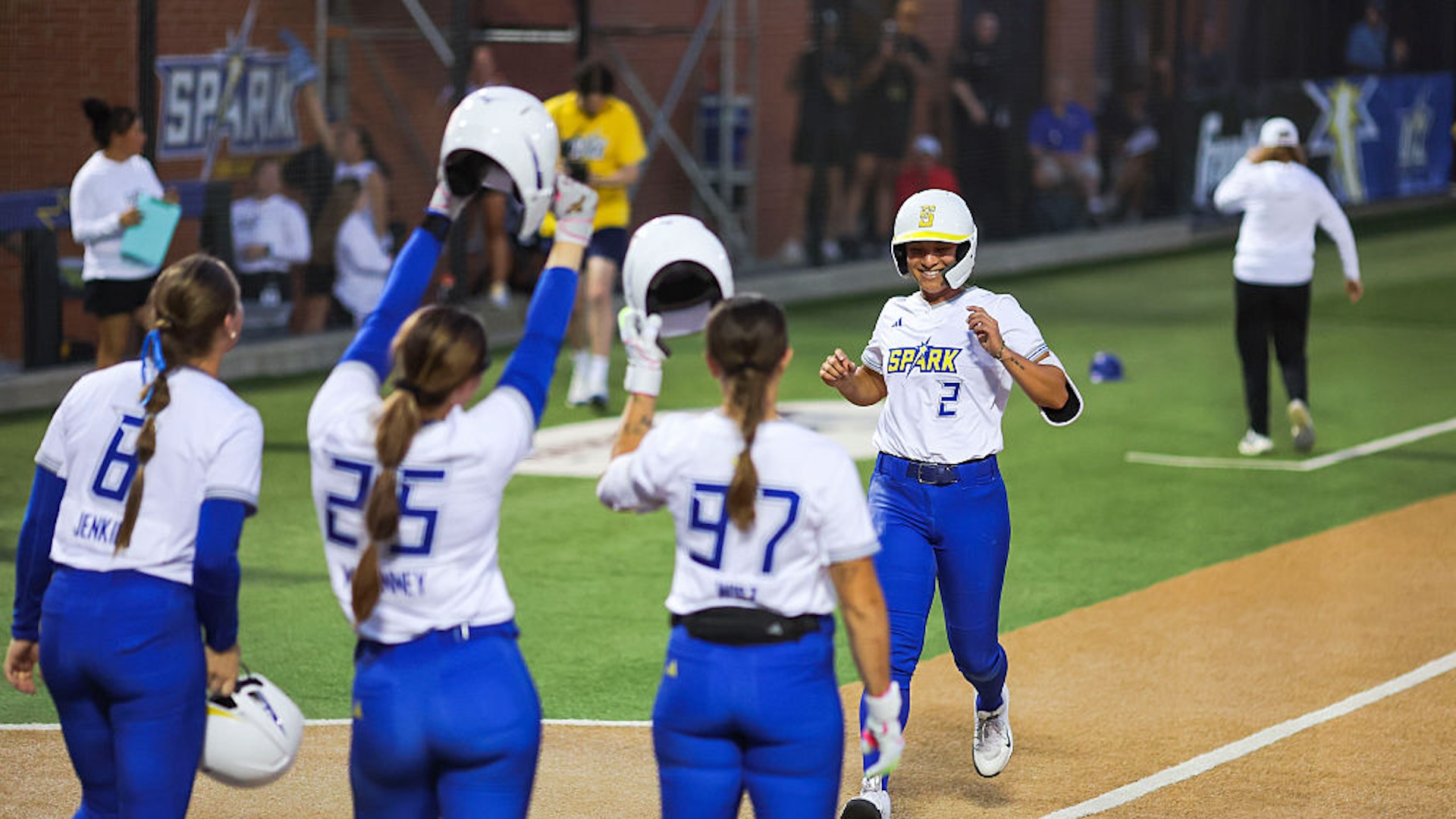
Around the time the NPF folded, Athletes Unlimited started to get involved in the sport. It played a five-week season in 2020 called Athletes Unlimited Softball, then added a two-week competition called AUX in 2022. The company continued with that format for a few years, then launched the Athletes Unlimited Softball League for the 2025 season. It toured four teams around the country, testing potential host cities and sending high-quality softball to all corners of the continental United States. For the 2026 campaign, the AUSL expanded to six teams and assigned them all home markets: the Carolina Blaze, Chicago Bandits, Utah Talons, Texas Volts, Oklahoma City Spark and Portland Cascade. The two-month season culminates in the league crowning a champion, then 45 players continue with a four-week individual competition called the All-Star Cup.
The increasing popularity of women’s sports has given rise to sustainable pro leagues in basketball (WNBA), soccer (NWSL) and hockey (PWHL). Every other attempt to replicate those models in softball has failed. The people involved in the league that I spoke to all believe in the AUSL’s ability to survive. In their minds, the increased financial backing, broadcast rights, investment from Major League Baseball, and softball’s increasing popularity will prevent the AUSL from meeting the same fate as its predecessors.
Carolina Blaze pitcher Keilani Ricketts has enjoyed her time in the AUSL so far. The 34-year-old led Oklahoma to a Women’s College World Series title in 2013, then began playing pro ball. She spent 2013 to 2018 playing for both the NPF’s USSSA Pride and Toyota Industries Shokki in the Japan Softball League. Later, she joined the Oklahoma City Spark—now an AUSL franchise but then part of Women’s Professional Fastpitch—in 2023, before participating in AUX in 2024. The Blaze took her in the sixth round of the AUSL’s initial player draft in 2025, and she has been with them ever since.
“They really just made us feel like we were actually professional athletes,” Ricketts said. “Sometimes, when I was in the other pro leagues, it almost felt like we were kind of playing club ball at times—like, OK, just keep playing, this is how you stay in softball shape. It was just really cool to be a part of something [where] they were very professional in every manner.”
In the 13 years since she graduated college, Ricketts has seen players’ attitudes toward pro ball dramatically shift.
“When I was in college, we would think about the pro league and it made girls nervous. It just made us nervous because it was so insecure back then,” Ricketts said. “We would just hear stories about their games at public parks and stuff like that. A lot of times, teams would pop up and then the next year the team would fold. So, I think it made people nervous back then to be able to join the NPF.
“But now, this year especially going into our second season, it’s cool to be able to see the highest athletes in the Women’s College World Series want to be a part of the AUSL. It really just speaks for itself that you have the most competitive athletes in our country that want to be part of this league.”
Patricof didn’t disclose player salaries in an interview with Defector. Athletes Unlimited owns all six teams under a single entity—similar to the PWHL’s structure—and players negotiate salaries at the league level. Player compensation varies and includes performance incentives for playing in the All-Star Cup in August and for playing well in it. Kim Ng, the league commissioner and former Miami Marlins general manager, said in an interview ahead of the 2025 season that the average salary was about $40,000 for the season, plus bonuses for the All-Star Cup. Teams fly commercial, and Patricof said the league considered proximity to hub airports when selecting host cities. The AUSL also offers year-round access to training facilities, health insurance, childcare, and support during pregnancy.
The AUSL’s players are not unionized, though Patricof and some other senior executives meet with a council of players, known as the Athletes Unlimited Player Executive Committee, once a week. When she was in the NPF, Ricketts and some other players considered unionization, but they didn’t have the necessary legal help, so the situation never progressed. Ricketts said forming a union is something the AUSL’s players could consider down the line, but it is not imminent.
“We have talked about it, especially with Athletes Unlimited,” Ricketts said. “But as of right now, we do feel like we are very supported and they do hear out the athletes and they want to be able to do that—where they don’t want it to be players union vs. the league, and I think that they’re very accommodating with that so far.”
The two-month season, while a sign of progress, still isn’t a full-time job. When she isn’t playing softball, Utah Talons infielder Hannah Flippen works part time as a neuro technician. She initially wanted to be a teacher once her softball career ended, following in the footsteps of her mother, Mary Lou Flippen. She completed her degree from the University of Utah with eligibility remaining, so she leaned into another interest.
“Rather than taking bowling or swimming, I took psychology classes,” Flippen said, “and I really liked it.”
A mother of one of Flippen’s former teammates owns a neuropsychology practice in Tucson, Ariz., where Flippen resides, so she helps out during offseasons. People come into the office with Alzheimer’s, dementia, brain injuries, memory loss or any other neurological issues, and Flippen guides them through tests.
During her professional career, Flippen has spent offseasons coaching college teams or giving lessons, along with the neuro-technician job.
“That’s kind of the gig of being a pro softball player, too. If you’re not one of the premier names in the league, typically that doesn't come with the best sponsorships from other entities and things, and so you have to find ways to make the ends meet,” Flippen said. “A lot of players, they coach in the college ranks or they give lessons or they do camps or they have part-time jobs. We’re still not completely where we want to be financially, but we’re definitely in a better spot than we were when I first joined professional softball—and we’re just going in the right direction.”
If there’s one thing that sets the AUSL apart from its predecessors, it is an infusion of more TV money. As part of its new three-year deal with Athletes Unlimited, ESPN platforms are broadcasting 47 regular-season games in 2026, plus the best-of-three championship series at the end. Other games are appearing on the CBS Sports Network and MLB Network.
The first game of the 2026 championship series will air on ABC, marking the first time professional softball has aired on broadcast television. The 2025 championship series on ESPN averaged 230,000 viewers, and the 2026 iteration will feature increased exposure.
The television contracts work in tandem with an investment from Major League Baseball ahead of the 2025 season. ESPN reported that MLB’s investment was for more than 20 percent equity in the league and Yahoo reported the capital exceeded $10 million.
“Their capital was important—and capital is always important,” Patricof said. “It’s really about the strategic partnership that we have, and in the way in which they’ve leaned in to support us.”
“When I think back at NPF, we’d always talk about, ‘Oh, we need the backing from MLB or we need ESPN packages.’ We didn’t know quite how that would happen,” Ricketts said. “… For the AUSL to be able to pull off being on ESPN and us being partnered with MLB within just the first few months of our inaugural season has been just incredible.”
Through their investments, MLB and the broadcasters are hoping to capitalize on softball’s rising popularity. The 16 games of the 2026 Women’s College World Series averaged 1.6 million viewers, a 20-percent increase from a year ago. Texas’s championship-clinching win over Texas Tech had 2.5 million people watching, which ESPN said is the most-watched college softball game on record.
NIL contracts have also helped turn the best softball players into national brands while demonstrating the value of investing in the sport. Texas Tech pitcher NiJaree Canady famously inked two seven-figure contracts when she transferred from Stanford and led her Red Raiders deep into the Women’s College World Series twice. Tennessee arm Karlyn Pickens, the No. 1 overall pick of the 2026 AUSL draft, went viral for a 79.4-mph pitch that shattered the all-time velocity record—and has endorsement deals with New Balance and Rawlings. Now, Canady plays for the Texas Volts and Pickens throws for the Carolina Blaze. For the first time, softball players are entering a professional league having already received compensation for their labor.
“They used to come out of college on the heels of a scholarship and their education being paid for and a great experience in college softball often, but not coming out of a revenue source,” Kempf said. “In a lot of ways, they probably had expectations based on baseball or something comparable in their minds at the professional level. But now, they certainly—I would assume—have expectations coming out of NIL deals. I think, at the end of it, we all want these women to make money and to make money that’s comparable to their male counterparts for performing the same type of action in the sports entertainment space. So, I think it’s another step closer to getting them there.”
It will certainly be a while before AUSL team payrolls can compete with Texas Tech’s NIL budget, but the people I spoke with won’t discount what the league has already brought to the sport. Softball fans can watch high-quality games on the professional level this summer in Oklahoma City, Durham, Salt Lake City, Portland, Austin and Chicago—and, with a television, around the globe. Ricketts, the oldest player in the AUSL with more than a decade of professional experience under her belt, shares a dugout each night with Pickens and all the other professionals for whom she helped lay the foundation.
“I hope that we’re able to keep growing the way we are,” Ricketts said. “I think we’re definitely on an upcoming trend, and so I hope that we’re able to get to a space where so many more athletes have the opportunity to play in this league.”