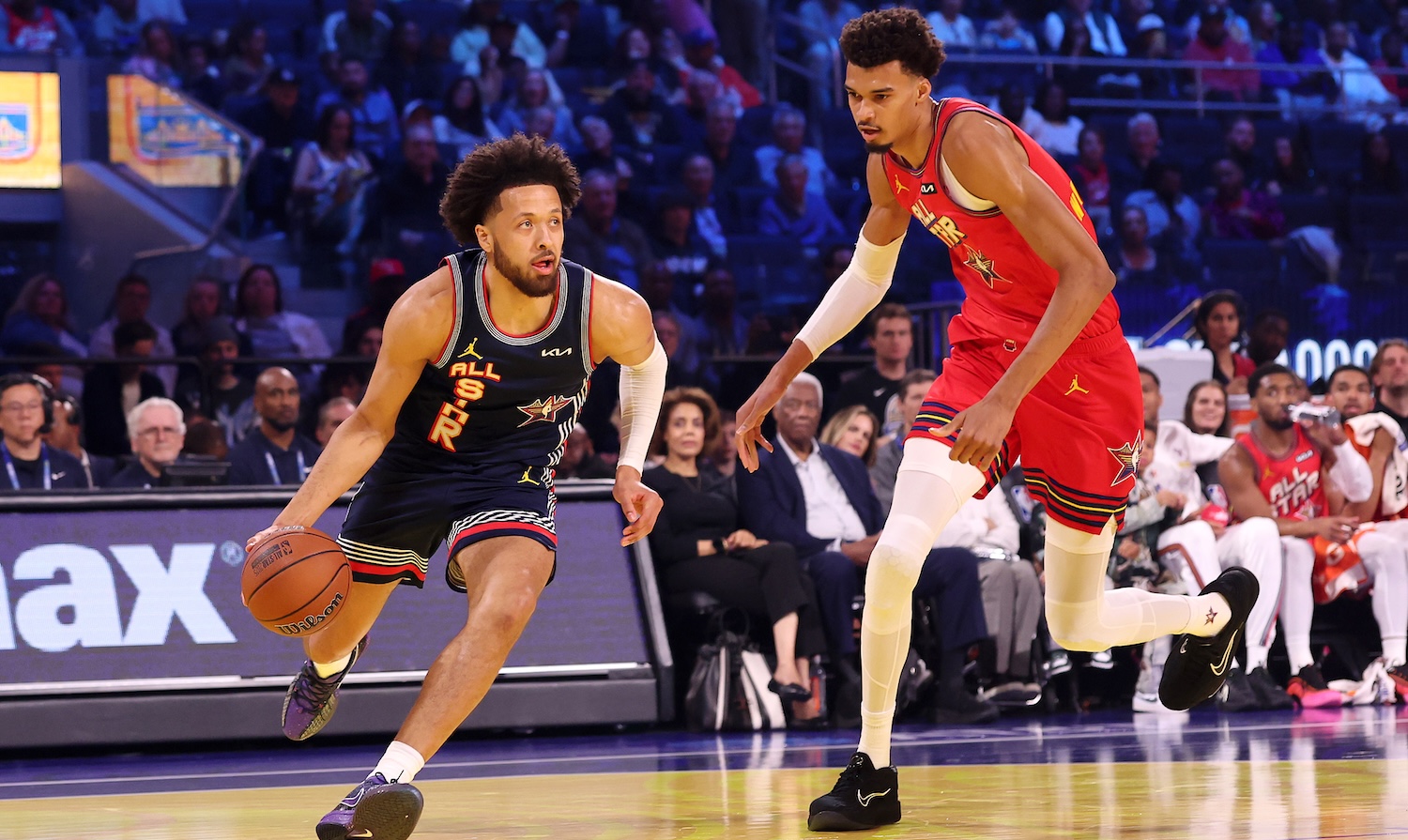
The final week of the NBA's regular season is here, and with scant meaningful basketball on the horizon, it's time to debate various NBA awards. Will Victor Wembanyama's narrative momentum help him overtake the obviously correct MVP choice, Shai Gilgeous-Alexander? Will Karl-Anthony Towns sneak onto the All-NBA third team? Will Sacramento's Maxime Raynaud or Utah's Ace Bailey earn the final All-Rookie first-team slot? All valid questions, but discussion around any award must necessarily reckon with the strange boundary circumscribing the parameters of every end-of-season award, except for the rookie ones: the 65-game rule.
As part of the 2023 collective bargaining agreement, the NBA and the players association agreed that in order to be eligible for any end-of-season award (except the rookie ones), a player would have to have played at least 20 minutes in 65 games. The precise language affords some wiggle room—players who hit 62 games and then suffer a season-ending injury can be eligible, and there is a grievance process in place for players who experience "extraordinary circumstances"—though not enough to prevent several star players who had great seasons from missing out on their deserved rewards, or having to hustle back from serious injuries to play in meaningless games in order to scrape onto the ballot.
Cade Cunningham suffered a collapsed lung five minutes into his 61st game of the year with the Pistons, and he will have to play all of Detroit's final five games to be eligible for All-NBA honors which he has more than earned. Anthony Edwards hurt his knee and will not get to 65. Luka Doncic is on 64 and out for the remainder of the regular season, and will file a grievance. Detroit's Isaiah Stewart, who should be All-Defense, won't get to 65; his teammate Ausar Thompson, who should join him in that honor, has played 70 games but has gotten to 20 minutes in only 61 of them. Wembanyama hurt his rib against the Philadelphia 76ers and is one game short.
In other words, the end-of-season awards will not accurately reflect the performances of the 2025–26 season. For example, if Chet Holmgren wins Defensive Player of the Year, it will be seen as fraudulent, and rightly so. This would be a problem even if achievements like All-NBA were mere points of pride, but the structure of the CBA also ties supermax contract eligibility to end-of-season recognition. This means that players are incentivized to risk their bodies in order to get over the 65-game hump, as Tyrese Haliburton did when he famously rushed back from a hamstring injury in order to secure an All-NBA slot two years ago.
The entire NBA media is against the rule, as are the players: After Cunnningham's injury, the NBPA called for the abolition of the "arbitrary and overly rigid quota." The next day, Adam Silver rebutted this and said the rule was working as intended.
At this point, close observers will note that the rule the players are calling to abolish was part of a CBA they agreed to. That doesn't invalidate their annoyance with it: This is something the owners pushed in that negotiation, and reflects the skewed dynamics that led to its implementation. Remember, the CBA was signed as league stakeholders were grousing big-time about player load management, and the 65-game rule and the player participation policy were intended as twin correctives. It is worth teasing out why this was seen as such a serious problem.
Putting the 65-game rule in its proper context begins not with the result of the 2023 CBA negotiation, but with the massive TV deal that followed in that negotiation's wake. The point of the 65-game rule was not to clarify the task of awards voters, nor even necessarily to get players to play more, but rather to credibly sell certainty to bidders for TV rights. In order for the league to get the deal it eventually negotiated, it needed to have something in writing preventing players from sitting out as often as they felt like it—something, in particular, that protected the league's national telecasts from superstar absenteeism.
But here we see the two fatal misunderstandings of load management that led to the league insisting on fighting for this stupid rule. First, star players sitting out games is not a disease, but rather a symptom of an overlong and punishing regular season. Second, load management, such that it existed, was geared toward those star players competing and playing their best in the playoffs, while the 65-game rule prioritizes the regular season over those playoffs.
This is the most glaring category error to me. The playoffs are without question the most important part of the league's calendar, both competitively and in business terms, and pressuring half-injured players to hobble through Tuesday night yawners in Sacramento comes at the expense of having the sport's stars as fresh as they possibly can be when it matters most. Regular-season TV ratings and narrative gravity are not as important, or nearly as compelling, as the intrigue and spectacle of the playoffs.
Beyond crowning a champion, the playoffs create the storylines and stakes that give weight to the following regular season. They should showcase the league at its best. If Cunningham rushes back and breathes too hard, and his lung folds back in on itself, and the Pistons—presently leading the Eastern Conference and on track to host a playoff series for the first time since 2008—flame out, that is far worse than having him watch a few pointless games in April from the bench.
The devil's-advocate argument here would note that the hard choice players face, of cutting short injury recovery to hit 65 regular-season games, is the tradeoff for a TV deal that guarantees them more money than ever before. Players shouldn't complain, then; they should accept this as the price to pay in order to, well, get paid. But again, this hypothetical case misunderstands that the regular season is an accessory to the playoffs, not the other way around. What matters most is what happens after the 82nd game, not in the first 65.