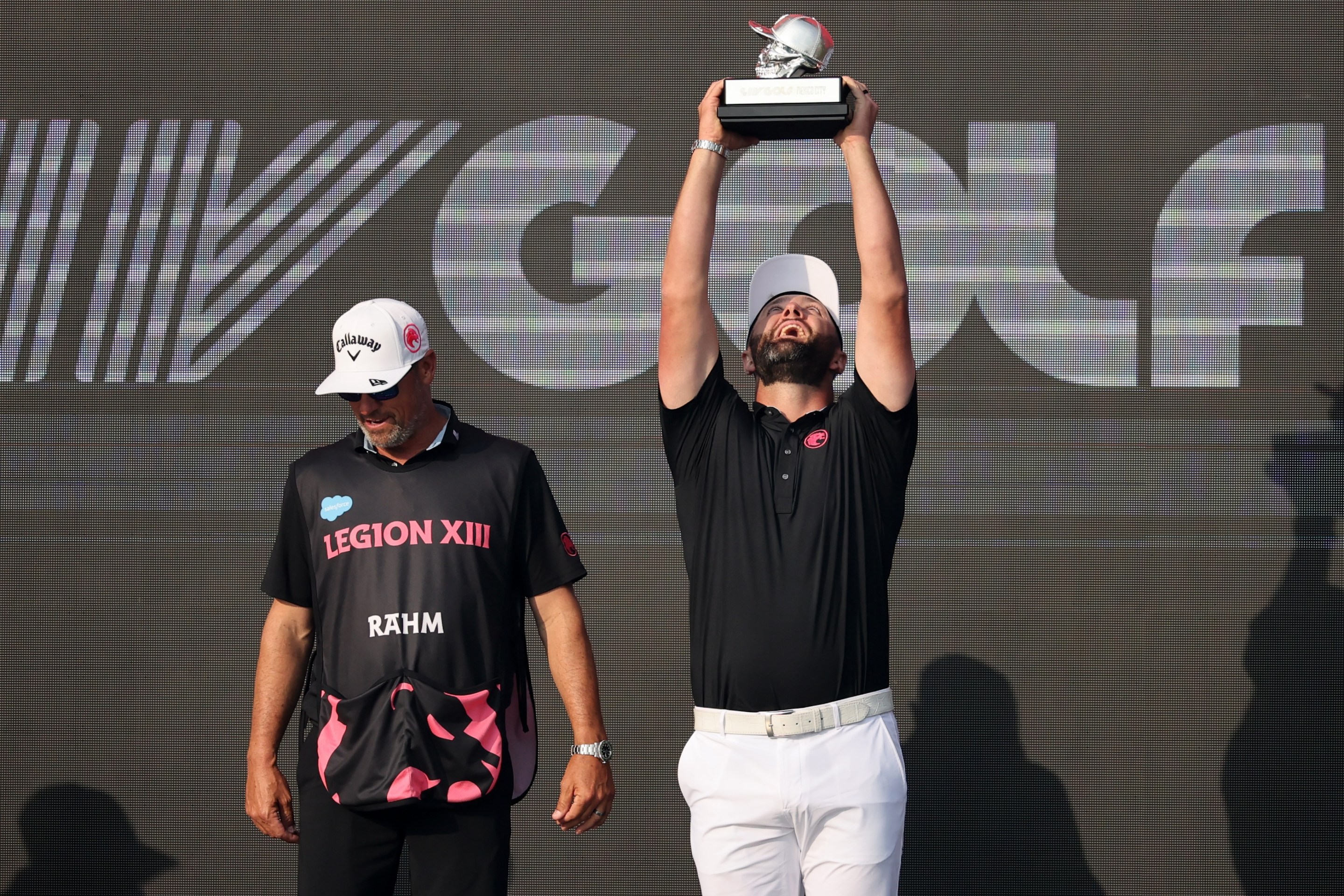
When LIV Golf launched in 2022, many were skeptical that there was a viable commercial lane for a new professional golf tour, even if it was bankrolled by Saudi Arabia's seemingly bottomless Public Investment Fund and driven by the definitely bottomless cynicism of contemporary global power politics. With the news on Wednesday that the Saudi PIF would no longer be funding LIV Golf after this season, we can probably go ahead and hand it to the skeptics. As a soft-power gambit channeled through the universal language of sports, LIV was a flop, but it wasn't a total failure. As a way to get some cheesy bribes into various pockets, it worked out fine.
The PGA Tour, which was stodgy and exploitative and had alienated some of its most prominent players, really was ripe for competition. But what LIV offered was instantly recognizable as something else: This was disruption, the already antique-feeling pejorative for what happens when an unconscionable amount of venture capital is blasted in the direction of something that already exists, to see if the pressure of all that money might somehow fracture it in a profitable way. The results of this particular gambit were inessential at best and stupendously wack at worst. LIV Golf's signature innovations on the form were that events were three days and 54 holes instead of four and 72, and that they would have the sort of corporate-event party vibe that ensured a Chainsmokers song would be audible during every one of those holes. It was always going to suck; the question, from the beginning, was whether that still mattered.
From its inception, LIV was a rich-guy nuisance lawsuit in the shape of a pro sports league. The vibes were appallingly wretched, even by the low expectations you might have for a collaboration between Phil Mickelson and Saudi Arabia. But the people pushing LIV—the most aggrieved current and former pro golfers; Donald Trump and his greasy inner circle of Bribe Guys; various sheikhs—were making a bigger bet. They proceeded as if all that money and influence would make the low quality of the actual product irrelevant. As with so many other things in the culture that could be described as Trumpy—lavishly gilded, obviously corrupt, all done on the fly and in the open and with a bunch of visibly rotting celebrities sucking around—it felt both obviously doomed and somehow inexorable.
But four years, multiple lawsuits, and billions of petrodollars later, the end appears near for LIV Golf. It sucked every bit as much as everyone expected from the start, and never came close to cultivating any kind of audience or profitability. Despite assurances from LIV CEO Scott O'Neil earlier this month that the season would continue "exactly as planned, uninterrupted and at full throttle," LIV is currently deep in triage mode. On Tuesday, the league announced that it would be postponing the scheduled late June tour event in Louisiana so as to "avoid the peak summer heat," a clever pivot out of a sticky situation that could only otherwise have been prevented by not scheduling an event in Louisiana in late June in the first place. LIV's May event, at a Trump-owned course in Virginia, appears to be going ahead as planned. A grounds pass for LIV's August event, at a Trump-owned course in New Jersey, will cost you around $70 all in on the secondary market, which is around double the listed price.
Per the Wall Street Journal's Andrew Beaton, LIV is currently talking to potential outside investors about keeping the tour going. If they succeed in finding a party interested in funding a league that reportedly lost $590.1 million in 2024, and has never been able to attract any kind of TV viewership or popular following, then LIV will live on. How interested those investors will be depends on how highly market actors value the opportunity to barf a billion dollars down the front of your shirt in a way that might deliver a chance to be photographed with Greg Norman and the historically unpopular and uncannily flavor-blasted President of the United States. Let's call that a wait-and-see proposition.
Harder to know is the future that awaits the apostate golfers who left the PGA Tour for LIV, and will now have to find some way back. Brooks Koepka, one of the biggest names to hop from the PGA Tour to LIV, returned to the PGA Tour this year. Per Beaton's reporting, the terms of Koepka's return "could cost him up to $90 million between charitable donations and forfeitures of bonuses and equity." Another big-ticket LIV signing, Patrick Reed, is playing on a European tour and working towards getting his PGA Tour card back for next year; because he resigned from the PGA before joining LIV, his path back will be easier. It will be harder for the players that remain in LIV, 11 of whom either burned or badly damaged some bridges by joining a 2022 antitrust suit against the PGA, and many of which, as Rodger Sherman notes in his newsletter, seem to have gotten notably worse while playing on the LIV tour. “We’re interested in having the best players who can help our tour,” PGA Tour CEO Brian Rolapp told Beaton. “Not every player can do that.”
If there was ever a plan at work with LIV Golf beyond spending money, it was never clear what it was; the tour was raising its championship purses right up until the moment its benefactors pulled the plug. If there is a lesson to be learned here—about the appeal of golf played on second-tier courses alongside the faint sound of Billie Eilish's "Bad Guy" playing through a distant speaker, or perhaps about the risk of selling both your eternal soul and professional future for a sufficiently generous bonus—it seems likely that everyone involved is too rich to feel compelled to learn it. This was always the gamble: that a sufficient amount of stupid money might be enough to change the world even if there was nothing at all behind it—no discernment, no vision, nothing that would benefit or delight the broader public, and no greater motivation beyond some aspiration or entitlement relating to ownership. LIV might be a failure, but it's harder to say that the last part hasn't worked out as hoped.