

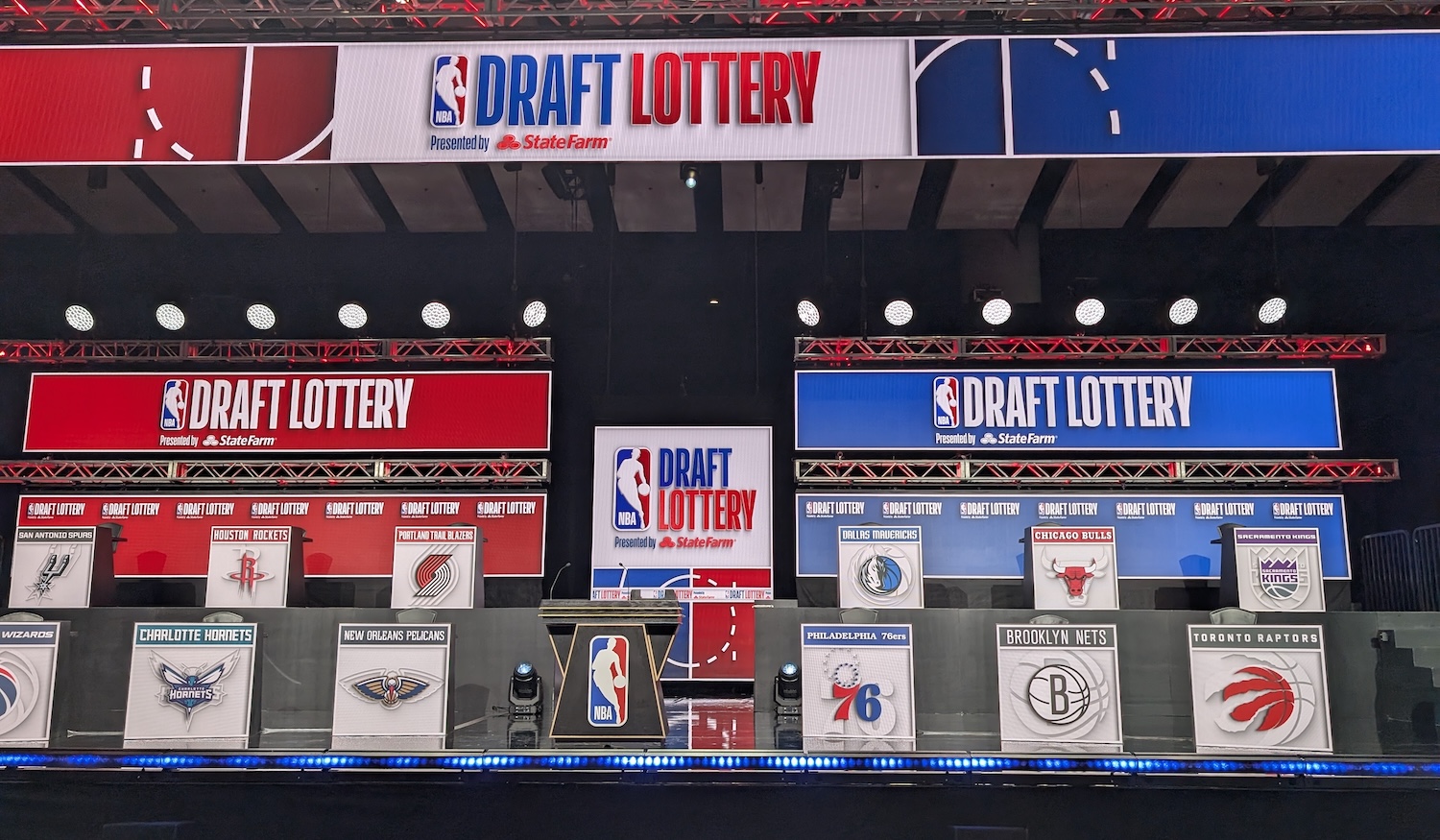
If you paid any attention to the NBA after the calendar flipped to 2026, you were inundated with feverish debates about how to solve the supposedly existential crisis facing the league: tanking. With a strong 2026 draft class awaiting them, the worst 10 teams in the league attempted to lose as many games as possible to maximize their draft lottery odds, resting their good players with fake injuries, pulling effective players from close games, and playing G League–level guys for 48 minutes.
While tanking is not new, it had never been this widespread. The worst teams in the league losing games heralded a crisis of legitimacy that the NBA resolved to correct. On Tuesday, ESPN's Shams Charania reported on the league's strategy to fix tanking: Move it around so a different class of team has an incentive to tank.
Per Charania, the NBA has held a bunch of meetings with the board of governors, the competition committee, and every general manager in the NBA over the past few months to talk through the various proposals it leaked last month. The owners will vote on it in a month, though both the substance of Charania's reporting (which is that "key points of the framework have a majority of the support from teams") and the fact of its publication through the league's willing mouthpiece make it seem likely that the new changes will be adopted ahead of next season. So what are they?
The new system is being termed the "3-2-1" lottery. In it, should its adoption come to pass, some teams will get three ping pong balls, some will get two, and others will get one. The lottery will be expanded from 14 to 16 teams, meaning that not only will every non-playoff team get a chance, both conferences' eighth playoff seeds will, too. The lottery will determine all draft positions, not just the top four, though the worst three teams will be protected from dropping further than 12th. Teams will not be allowed to pick first in back-to-back drafts, nor make three top-five picks in a row, nor protect picks 12–15.
The key to the new proposals is how the distribution of ping pong balls will be determined. The worst three teams will be penalized, only getting two apiece. The teams with the fourth- through 10th-worst records—above what the league is inaccurately calling the "relegation zone" but below the play-in threshold—will get three apiece. The 9 and 10 seeds in both conferences will get two, while the losers of the 7-8 game will get one. This increases the chances both of the worst teams picking in the middle of the first round and of the best lottery teams getting to pick the incoming stars. If this sounds too abstract, I found this visualization useful.
The theory of these reforms is to eliminate two forms of tanking: the structural form, where teams enter the season with cheap rosters full of young players, purpose-built to lose, and the sort we saw at the end of this season, where the Washington Wizards rested their "stars" and the Utah Jazz played various Yale alumni to safeguard against any accidental success. On those grounds, it will certainly be successful. The anti-spectacle of a third of the league essentially ruining the theatrically interesting aspects of the final two months of the regular season is over. Instead of playoff teams beating the Sacramento Kings by 7,000 points in March, you will see instead Kings-style teams attempting (and in their case, failing) to play spoiler. The "relegation zone" also creates pressure on the worst organizations to build real rosters. In the aggregate, this will eliminate hundreds of bullshit games.
The problem is in what new forms of tanking the new system will incentivize. Read any story about tanking or ask anyone who follows this stuff closely, and they'll say the same thing: As long as record is inversely correlated to draft position in any meaningful way, teams will tank. The value of superstar players is so high in the NBA that unless you are a serious contender, which as a practical matter requires already having a superstar player—many actual playoff teams could not sanely consider themselves serious contenders—just about anything you can to maximize your chance of getting one is worth doing. The draft is the only reliable path, especially for teams that aren't serious free-agent draws.
Under the proposed system, teams will be strongly incentivized to lose the 7-8 play-in game and tank out of the play-in altogether. To me, that seems like a far worse behavior to incentivize than already rotten teams simply making themselves worse. I think the logic here is that selling your players and fans on tanking at that level will be harder than it is for a bad team under the current rules, especially in an era when play-in teams have won series and made runs.
However, it's not foolproof; we have already seen the 2022–23 Mavericks tank out of the play-in to keep their pick. They selected Dereck Lively II and made the NBA Finals the following season, proving that tanking works and is basically impossible to weed out. A team in a similar situation under the new rules would have much more powerful incentive to do the same.
This gets at the essential absurdity of the new system: It puts the draft structure at odds with its own explicit (nominal) purpose, which is to balance the league-wide distribution of talent. The NBA wants the draft to redress talent disparities and also to reward the effort to win games, but it can't do both of those things effectively: Each undermines the other. So now the balance tips toward the effort end.
The best and surest way to actually get rid of tanking is to abolish the draft. Owners will never surrender that level of control to labor, so the next best thing is to completely flatten the lottery and scrap all connections between record and draft position. That would herald an abrupt steepening of the talent curve, one that would make it significantly harder for a bad team to claw its way to the top or even the middle of the league, reproducing the exact problem the draft theoretically exists to solve. So the league has settled on this half-measure, one that does not solve tanking so much as move it around.
Embedded in the logic of the new system, and in much of the opposition to the praxis of tanking, is an idealization of parity. But in a 30-team league, some teams necessarily will be bad and some teams will be good. I don't understand why the worst teams in the league, spending the final month of an overlong regular season accepting their fate and actioning rationally within the system, is such a bad thing. Because Wizards-Nets, which would be boiled ass under any circumstances, is harder to watch? The fans of both of those teams want them to lose. If the only crimes of the bad teams are aesthetic, that seems like a fine trade-off to me, especially if the alternative is incentivizing teams on the fringe of the playoffs to back away.