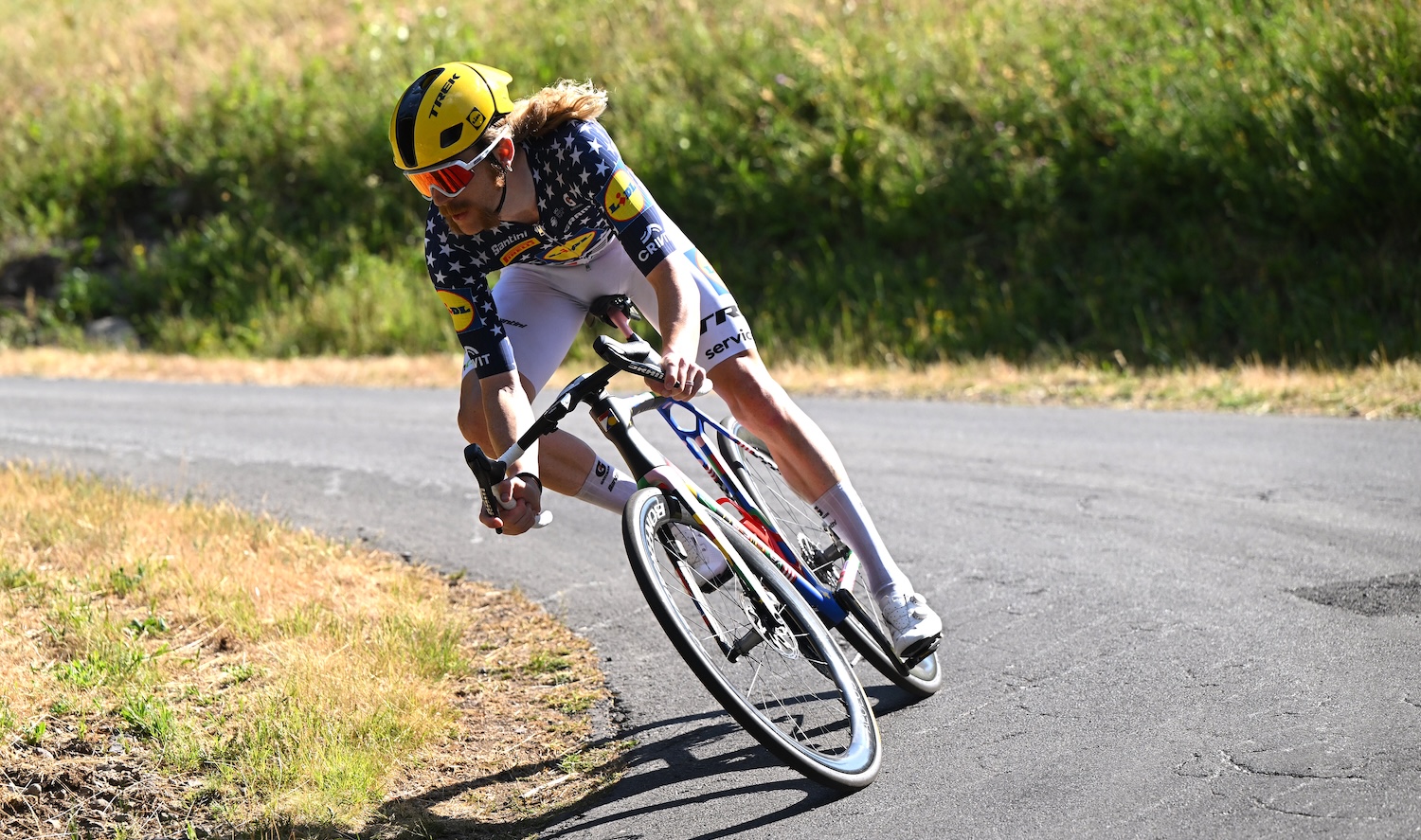
MULHOUSE, France — Stage 12 of the 2026 Tour de France was supposed to be boring. Maybe it would have been were it not for Quinn Simmons, who did what he does best and made the peloton quake with a thumping attack. The American champion seized the initiative with 35 kilometers left, splintering the bunch and dragging a dozen strong riders with him, turning what would have otherwise been a dull procession into a thrilling finale. Very few riders are strong enough to cleave a charging peloton like that on a flat day; fewer still have the casual power to be able to initiate and execute a full-speed high five with their flag-waving father while doing so; and only Simmons could inspire equally strong reactions of annoyance and excitement with such a cool, daring move.
Quinn Simmons high-fives a spectator waving the American flag during a climb in the Tour de France.#TDF2026 pic.twitter.com/0jxdVbkG9T
— René Bugner (@RNBWCV) July 16, 2026
There really isn't anyone like Simmons in the professional peloton. As is evident in the clip, Simmons has one of the biggest engines in the world. While he's won stages at a handful of big races and gotten into some strong top-10s, his racecraft hasn't always matched his strength, so he's still searching for a career-defining win. But what truly makes him stand out is his willingness to use that engine to cut straight into the wind. This makes Simmons both an incredible domestique when he's riding for a teammate and a supreme animator of bike races when he's riding for himself. He helped Jonathan Milan win last year's points jersey and is currently helping Mads Pedersen do the same this year, setting up a dominant breakaway win for Pedersen on Stage 4 and still finding the time to drive several moves. Cycling involves so much strategic passivity. Simmons races in refusal of that notion.
To a certain, finely circumscribed extent, he brings that energy off the bike. The sport is mostly populated by reserved, bird-thin Western Europeans, whereas Simmons has a distinctly muscular American aesthetic and persona. He's comfortable talking a little bit of shit about his competitors and has called for the peloton to loosen up. The 25-year-old has been national champion three out of the last four seasons, which means he races in the stars-and-stripes kit, accentuating it with a bushy handlebar mustache and flowing red locks, a sincere "Rock, Flag, Eagle" look.
But there's a tension between how Simmons is covered and how a good slice of the American cycling public views him, since he's as known for his heroics on the bike as he is for a Twitter whoopsie at the very start of his career. In September 2020, he replied to a tweet from journalist José Been in which she urged people who liked Donald Trump to unfollow her. Simmons, then 19 years old, hit her with a "Bye 👋🏿," which got him briefly suspended by his team. I think it's important to establish the odd balance that's persisted over the next six years before going too far into 2020, because the kerfuffle remains the defining point of strain in Simmons's public perception among American fans.
Wade into any comments section or Reddit thread about Simmons, and the sentiment will be split between straightforward praise of a rider going nuts and condemnations of what the audience sees as an unapologetically Trumpy shithead. It makes writing about him simply as an excellent rider a mild but ultimately sensible exercise in willful denial for the cycling press, and writing about the Twitter fiasco on its own an unworthy dredging-up of old stuff. Some permanent fan opprobrium towards Simmons isn't surprising, even if he hasn't remained persistently antagonistic as his career has blossomed. He's not Olympic hero Chloe Dygert, who rode the World Championships with an "I Stand With Charlie Kirk" sticker last year. But it's still clearly worth addressing at some level, because it's something tons of people still care about and are annoyed with.
The problem is that Simmons has put himself in the Alexander Zverev zone because he's never expressed any contrition, and he doesn't want to talk about it at all. After Stage 12, my colleague Jonny Long of Escape Collective tried to talk to Simmons, and after he identified himself, Simmons said, "Sorry, I don't talk to Escape." (Been, the journalist to whom Simmons replied in 2020, was at the time working for Escape's predecessor CyclingTips, and freelanced for Escape in its early years.) I was also told by Trek PR that I wouldn't be able to talk to him. The incident has clearly informed the way Simmons has carried himself through his whole career, with a real wariness of the media, which I can sort of understand, because it happened right as he became a pro.
After winning the 2019 junior World Championships, he skipped the U-23 developmental circuit and jumped straight into the WorldTour with Trek. That put him on the map with hardcore cycling fans, though the rest of the world found out about him after the Twitter dustup. The next day, Trek suspended him, citing "statements online that we feel are divisive, incendiary, and detrimental to the team, professional cycling, its fans, and the positive future we hope to help create for the sport."
Simmons said he wasn't trying to be racist. "I would like to apologize to everyone who found this offensive as I strongly stand against racism in any form. To anyone who disagrees with me politically, that is fine. I won't hate you for it. I only ask the same," he said. In November, the suspension was lifted. Three months later, Simmons held a roundtable interview with some of the cycling press to emphasize that he'd been wronged. "For me, I don't feel like I deserved the suspension," he said. When asked if he understood why some people were upset, Simmons said, "If I'm honest, no, not really." He continued, "This whole concept of digital blackface, or whatever they want to call it, I never even heard of that, and I don't think the majority of the population had ever heard of it. If it had been two months earlier and not in the middle of an election in the U.S., it would have been a non-issue."
That's the most he's talked directly about the incident in the intervening years, a period in which he's become one of the strongest riders in the world, though he has made occasional oblique references to his public perception. In an interview with Cyclist published last month, Andy McGrath asked him if he'd ever been affected by a negative social media comment. "The way I look at it is there are certain people who have basically harassed me my whole career," he said. "It’s almost kind of sad: it’s been six years of every time I post, someone wants to make a comment. Like, dude, I’m just living in your head rent-free. It’s not going to change my life, it is what it is."
What I want to know is how much he's changed in the time since he began his career, though I suppose he's given us that answer in the negative. I don't expect him to have abandoned his politics or even to apologize for a tweet he posted as a teenager, but I think he could get a lot more people to at least appreciate his talents as a bike racer and move on from something that happened in 2020 if he were to at least acknowledge it.
Being a fan necessarily involves some amount of cognitive dissonance, whether that's cheering for a team owned by a spiteful dipshit or loving Steph Curry despite his many regrettable stances. Liking an athlete with malodorous personal views winds up being something most people can make their peace with, because ultimately said views have nothing to do with an athlete's ability to do their job. It's a little different in a cycling context, with its diffuse culture of fandom. In the United States, cycling is a left-coded pastime and cycling fans tend to be relatively liberal, whereas professional cycling's reputation in Europe is slightly more conservative, largely because it's a fundamentally rural sport here. Teams and sponsors turn over all the time, so if there is any axis of alignment, it's along national lines, though mostly people cheer for individuals.
Simmons, with his brash Americanness on full display, is such a singular figure for the way he epitomizes so many distinct strands of cycling fandom at once. His persona typifies the sort of American that everyone in Europe assumes all Americans are like. Non-European riders tend to come over and assimilate, but in Simmons's elbows-out manner, hyper-aggressive racing style, and level of aesthetic dedication to adhering to the stereotype, he doesn't come off as someone willing to compromise.
That probably makes it harder but, critically, not impossible for non-conservative Americans to at least accept Simmons in a world where he were to express some contrition or even ask to be understood. His position is not entirely unsympathetic, even if it's motivated by beliefs a lot of people find rotten. But he doesn't seem interested in being understood by us, so all we have to interface with is the little Quinn Simmons has showed us.