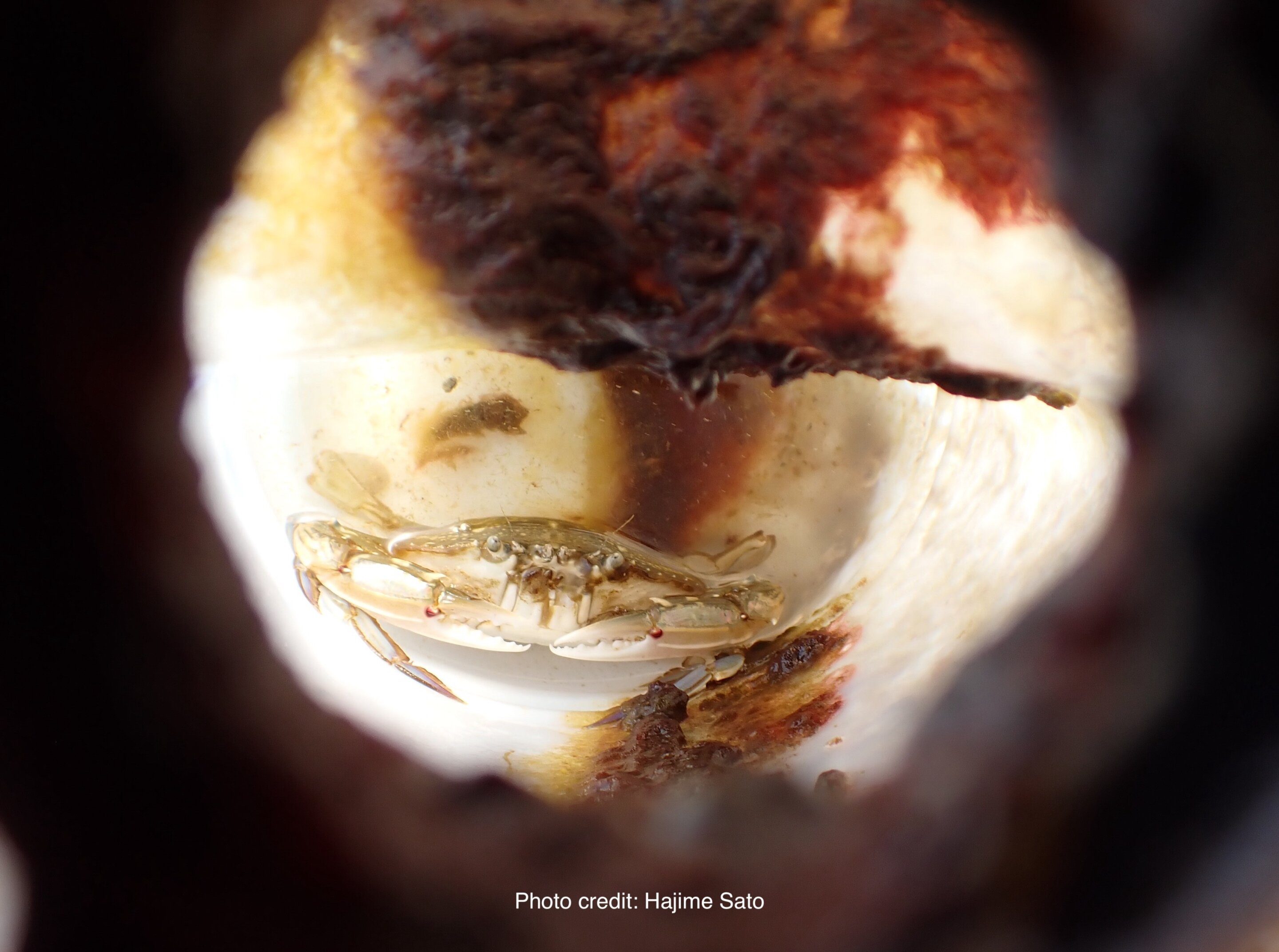
Sometime in the late spring or early summer of 2022, a baby three-spot swimming crab was drifting in the open ocean, as baby crabs often do. The crab came across a white plastic bottle that once held Shaoxing wine—a fact both incomprehensible and immaterial to the crab—and went inside. This decision, if it was in fact a choice or rather the result of a chance oceanic current, offered some obvious benefits to the baby crab. A plastic bottle offers precious shelter to something so small, soft-shelled, and delicious. So the crab stayed, feeding on whatever else swam or drifted into the bottle's small opening. As the months went by, the crab grew larger.
On July 15, 2022, a group of researchers sailed a small boat off the coast of Sesoko Island in Okinawa, Japan. They were searching for oceanic nurseries: floating objects like driftwood and sargassum that shelter larval fish in that vulnerable stage of their lives. The researchers saw the bobbing whitish bottle was surrounded by larval fish, which they scooped up with a net. There were two baby rough triggerfish, five rainbow runner, five Indo-Pacific sergeant, and one freckled driftfish—a veritable daycare. And then the researchers peeked inside the bottle, which was furred with algal growth and encrusted in barnacles. And they saw the crab.
She was a three-spot swimming crab, about the size of a business card, and she was missing her third leg. It was immediately clear she could not escape via the mouth of the bottle, which was less than an inch wide. The researchers wondered how she'd gotten inside the bottle in the first place, and how long she'd been there. Their investigation was published in the journal Ecosphere.
The bottle itself was a clue, embossed as a Shaoxing wine bottle and manufactured in Zhejiang Province, China eight months earlier. The researchers sawed open the bottle to retrieve its crustacean passenger, whose journey, unfortunately, had come to an end. "We dissected the crab and carefully examined its condition using various biological approaches, including DNA analysis of the stomach contents and estimation of its maturity stage from the gonads," Hajime Sato, a researcher at Hiroshima University and an author on the paper, wrote in an email. The researchers dissected the crab to understand how she had survived inside the bottle for so long, and more clues lay inside her stomach. They found nine fish scales and some hard fragments that probably came from fish bones, as well as some shards of algae. A DNA analysis revealed the crab had certainly been eating rough triggerfish and algae and probably been eating Indo-Pacific sergeant. This diet seemed to have worked great for the crab, which was a mature adult that weighed more than her wild counterparts.
But how long had she been inside the bottle? Three-spot swimming crabs small enough to squeeze through the mouth of the bottle can be found hiding in drifting seaweed in June and July and then mature to this size between August and September. The researchers could not tell how long the bottle had been afloat, but when they measured the goose barnacles that sprouted from its surface, they found the barnacles had been growing for around two months. So even if the crab entered the Shaoxing wine bottle when it was as large as its mouth, it likely spent at least two months inside. They speculated the bottle became flotsam south of Okinawa and was carried to Sesoko Island by the powerfully warm Kuroshio Current. "We found that this crab was able to maintain good nutritional condition and continue growing inside the bottle for at least two months," Sato said.
This is not the first report of a three-spot swimming crab trapped in a plastic bottle. The researchers point to an earlier paper from 2011 that found a bottle-bound crab around Japan. This is unsurprising. Plastic pollution is famous for trapping all sorts of sea creatures, cinching sea turtle necks and nets ensnaring whales, dolphins, and fish. A 2025 paper found that even a Ziploc bag can become a death trap for fish, shrimp, squid, and crabs, especially animals that are passive swimmers, which drift with the current and are less able to escape.
When the researchers saw the captured crab, they were reminded of a famous story, "The Salamander," written in 1923 by Masuji Ibuse. Ibuse's salamander discovers he has eaten so much that he has trapped himself inside his slimy burrow. "The doorway of his stone cave, now to be his lifelong dwelling, was too narrow," Ibuse wrote. "And inside it was gloomy." The salamander is doomed to watch the world pass it by from the narrow entrance of its cave. It watches schools of killifish flit in and out of the grasses and a shrimp lay her eggs. When a hapless frog enters the cave, the melancholic salamander traps the frog inside, dooming both to imprisonment. "A similar tragedy, hardly noticed, has occurred in the ocean," the authors write in the new paper.
Although science suggests crabs can feel pain, it less clear, and less likely, that they can feel melancholy. While it is impossible to know the three-spot swimming crab's experience inside the bottle, we can know that her entrapment would likely have prevented her from living her life to its full capacity. Unlike other three-spot swimming crabs of her age, she would never mate in a strange and seemingly uncomfortable position on the sandy seafloor. She would never lay hundreds of thousands of eggs, almost all of which would die, except for the few lucky enough to find shelter in their vulnerable larval state. In our increasingly polluted oceans, such shelter is more and more likely to double as a prison.