
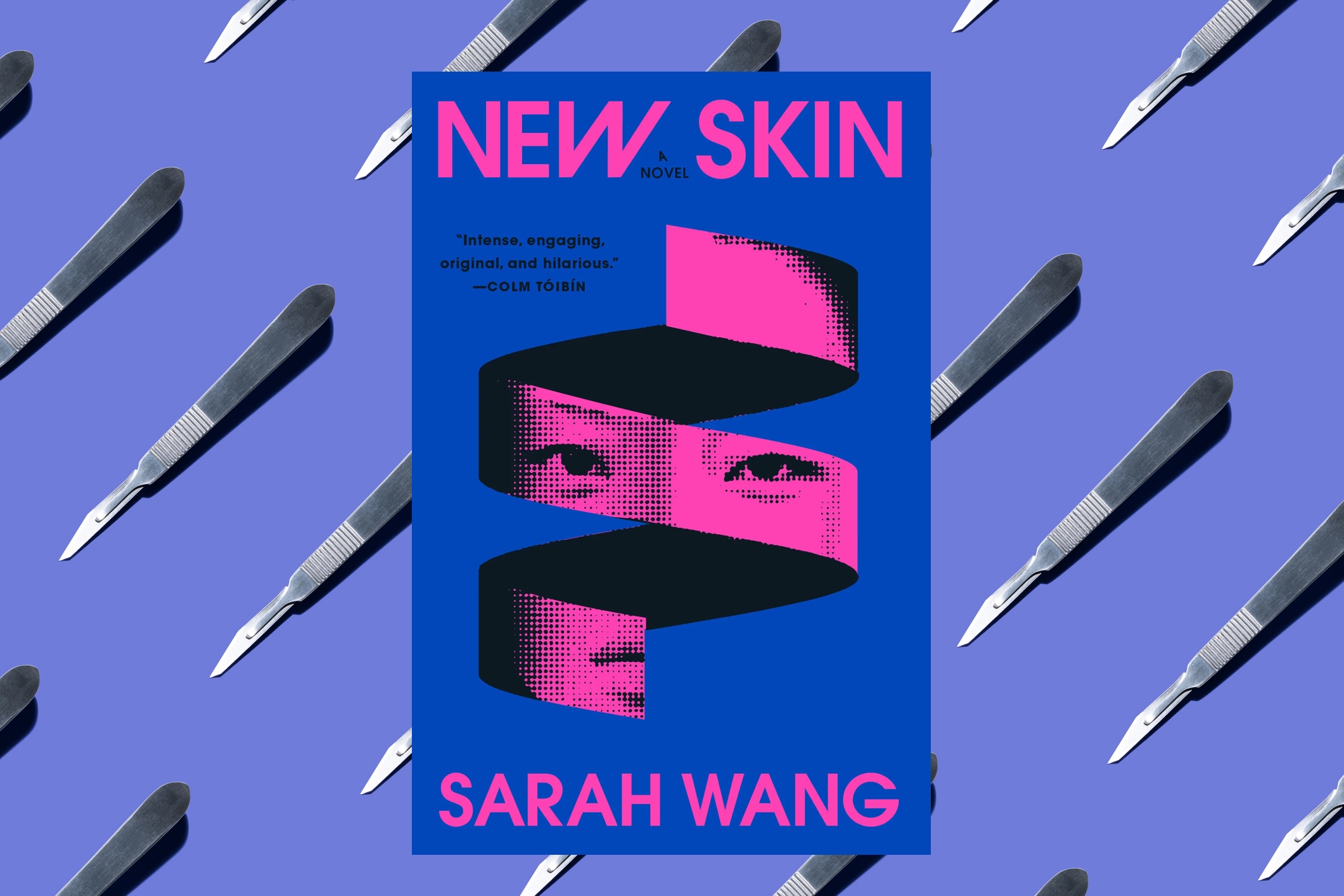
In the era of looksmaxxing, plastic surgery, Botox, and Ozempic, it's impossible to escape the tyranny of good looks. Are beauty standards fascist? Is losing weight about giving in or being healthy? The endless overdetermined debates about the ethics of aesthetics continues to haunt us. Even as we chase Kant's sublime through facial symmetry, we struggle to justify and categorize the various forms of body modification and whether or not they are feminist. In her debut novel New Skin, Sarah Wang wades into the culture wars with her own fictional take on facelifts, race, and desirability.
While trapped in a toxic mother-daughter dynamic, Linli Feng and her mother Fanny fall prey to a black-market plastic surgery ring. Fanny, a Chinese immigrant struggling to make rent, continues to get botched procedures in a failed bid for beauty, chasing after an imagined white-centered ideal. Linli, meanwhile, hopes to escape her mother's manipulative grasp in Los Angeles and go to graduate school in New York, but her mother continually sabotages her attempts to escape. Instead, Linli ends up taking care of Fanny after yet another dismal surgery.
Soon, Fanny cooks up a plan to appear on a new reality TV show: America's Beauty Extreme. If she wins, she'll get the grotesque work on her face fixed. Meanwhile, Linli ends up working at Another Horizon, an abolitionist rehabilitation center as a way to pay her family's creditors. But she soon discovers the botched surgeries her mother receives may be a malicious attempt to weasel money out of poor immigrants looking for a cheap beauty fix. Like mother, like daughter, Linli ends up getting some whitening treatments in an attempt to nail down the shadowy gang who preyed on her mom. It's a packed novel that moves briskly in about 300 pages, full of politically minded plotlines about identity, class, and ICE raids.
At first, Linli is quite judgmental of her mother: "My memory of her presurgical face still overrode the face in front of me, my eyes refusing to accept what she'd done … Now her face was bloated, pulled stretched; the surface was proofed dough." She complains that "the differing aesthetic goals of myriad doctors had made her face a background of warring ideals." In the next chapter, she calls her mother a witch with a pointy nose. The two struggle to see eye to eye after Linli's mother drugs her in order to keep her beloved daughter close to her. Then her mother pushes her out of the car on the freeway, forcing the two of them further into a codependent dynamic in LA. "Had I aged out of child abuse?" she wonders.
New Skin is a darkly humorous, bitter novel that could fall into the camp of young twenty-something nihilistically taking painkillers, but its horror elements and riff on facial surgery and reality TV sets it a cut above the rest. Linli is not just a disaffected narrator sliding into the abyss, though that too is a part of her story. Her dread is not just individual, it's communal. In the past, Wang has written about the violent scapegoating and targeting of Asians in the wake of Covid, something that echoes in the plot of New Skin. A few of the characters are taken by ICE during the novel's climax. Wang wisely sets Linli's story alongside that of her mother's and the wider Asian immigrant community, as well as a rehab center for those who need a second chance at life. There's a never-ending chain of victimization and culpability.
Where other recent attempts at body horror, like the flat and prudish film The Substance, are afraid of the body, Wang has no such qualms. Faces rot with the yeasty smell of bacteria and "whitish crud, like vaginal discharge." One character gets off on eating used maxi pads. At one point, another face is described as "an archipelago of scabs." It's full of such grotesque descriptions alongside philosophical musings on modification itself:
"The original is not important. This version is superior, much more imaginative and fun. That's what we Chinese do—take something and make it better. Things are always changing, becoming different. Consider evolution. There is no original in nature. Nature is innovative. A story doesn't belong to one person. Anyone can take a story and reshape it, cut off an arm and sew a leg in its place. That's how we free ourselves from control."
Fanny is talking about fanfiction here, but she may as well be talking about her relationship to her own body. Linli is no different, making jokes about imagining women evolving to only have one hole instead of three, and evaluating women’s rhinoplasties. When her mother goes on a reality show to try and make something of her life, Linli investigates the very same procedures her mother once got, the words and face of her captor and best friend echoing in her mind: "Her belief that if she looked good, her life would be good." It doesn't sound so different from the maxims of looksmaxxers or women who go on Ozempic, even if the context is vastly different.
For some, however, it is impossible to read these kinds of narratives and not think of how anti-surgery sentiment has been weaponized by feminists and the right to deny the rights of trans people and bodily autonomy at large. "The right standard is not that of bodily purity but that of aesthetic agency," Becca Rothfeld once wrote in Boston Review, marking how anti-body-modification ideology often attacks transness as a form of cyborg-ification. (One only has to note the way Janice Raymond and Mary Daly called transsexuality a form of mutinous, infiltrating Frankenstein-like transhumanism that destroys the holiness of womanhood.) Surgery is often a capitulation to patriarchal norms, but it can also be a way to change gender, to exercise authority, or simply change one's aesthetic output. Some exceptions may defy easy categorization even as such freedom has a tricky political history. All autonomy comes with the weight of responsibility. The beauty industry can be incredibly predatory and destructive—but that doesn't mean it should be entirely cast off in favor of an imagined untouched purity ideal. The problem is knowing when to draw the line. When does beauty become a weapon? Who wields it?
It's a difficult balance to write about plastic surgery without preaching. Instead Wang wisely writes about the way whiteness and class play a role in those who pursue cheap beauty procedures in order to climb the corporate ladder, find a husband, or reach a new zenith of perfection and pulchritude. Wang dramatizes the idea of the immigrant arriving in the U.S. and remaking herself in the country's image. But this isn't a narrative about liberation or assimilation—it's a horror story.
In a recent essay for Harper's Bazaar, Wang discussed the way some are now "Chinamaxxing." The "East Asian aesthetic ideals uniformly adhere to a specific look: pale and pearly with poreless glass skin, a slim jawline and tapered V-line chin, wide eyes, and, above all, youthfulness," she writes, before admitting she tans easily. Some go to dangerous lengths to achieve this standard: "Picture Sailor Moon. If this sounds nearly impossible, think again. After all, we live in a posthuman, cyborgian world. The bodies that we were born with do not have to be the bodies we have to live in for the rest of our lives."
People of color, Wang knows, are held to a different standard. "These immigrant cosmetic procedures were as ordinary as they were unexceptional," Wang writes in her essay. When Fanny goes on America's Beauty Extreme, she's demonized by the others on the program who feel she is both a witch and playing into beauty standards rather than challenging them. Only when she returns home do some young women come up to her and praise her performance on the show as a defiant challenge to the status quo. This is as close as we come to more explicitly conversations about plastic surgery and beauty standards—Wang prefers to lean into the grotesque. Horror is great for moving through morality without staking out specific positions, though we know from the narrative that whiteness is a villain.
Is there a way out from the global demand for beauty? It's a nearly unanswerable question. There are many ways to square the body with our contemporary political moment; all require a sensitivity to context and the ability to see how race, gender, and class shape the kinds of body modifications we make. New Skin is a thrilling cautionary tale about desire, told with grit and empathy. Hopefully we won't have to cut off an arm or a leg to get what we want.