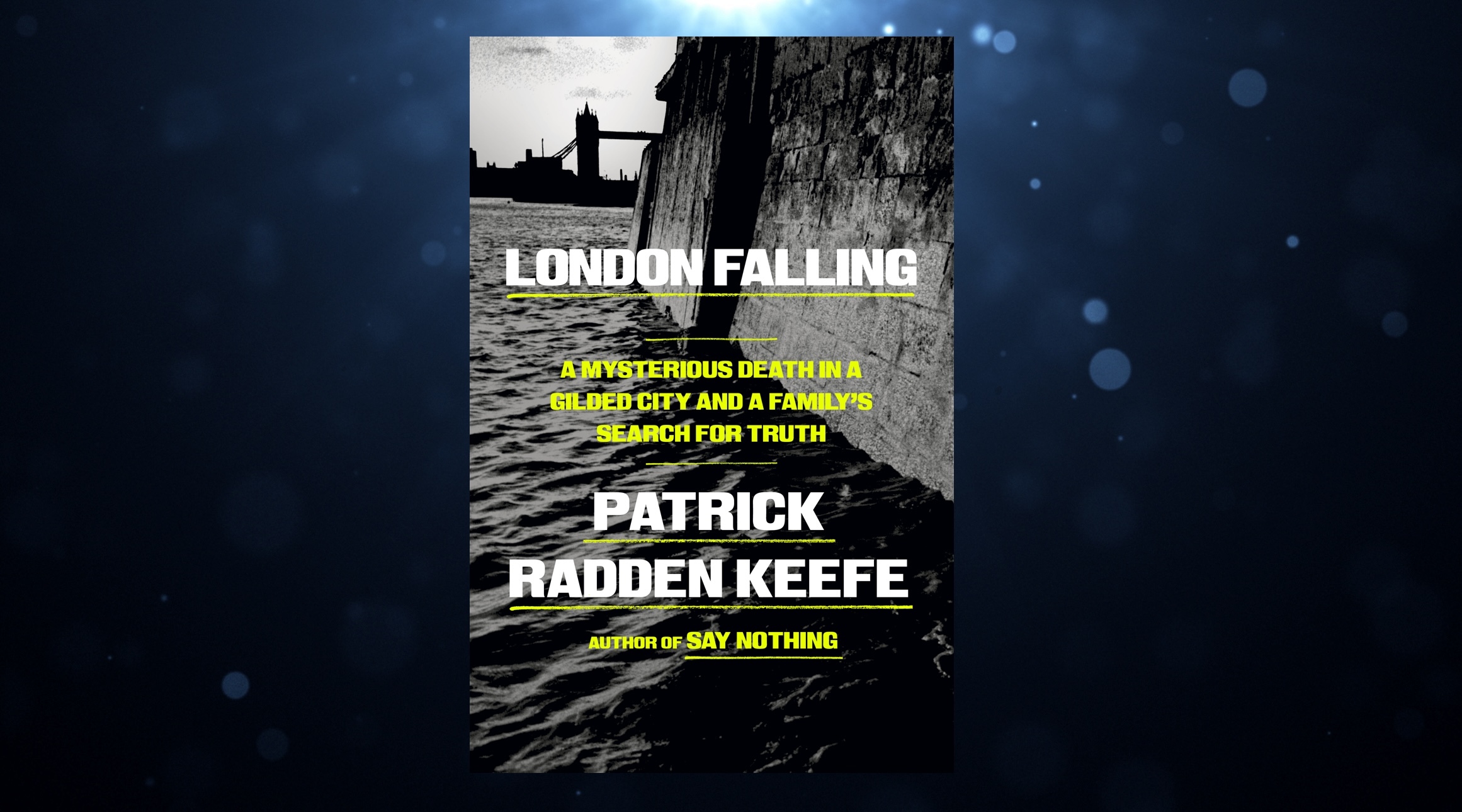
Patrick Radden Keefe is interested in blockbuster stories. He once told The New Yorker’s Critics at Large podcast that he wasn’t a fan of “true crime.” Instead, he often writes about fraud, gangsters, scammers, and high-powered lawyers. He’s the bad boy at the legacy magazine, the Anthony Bourdain of journalism, whom he coincidentally profiled in 2017, a year before his death. In another recent interview for the magazine, Keefe discussed his interest in the moral gymnastics people do to justify their actions. His previous book of collected essays was titled Rogues. His critically acclaimed book about the Troubles, Say Nothing, was adapted into a daring series by Hulu. While London Falling, his newest book-length work of investigative nonfiction, has already been optioned by A24, it is somewhat of a departure for him. There are the requisite fraudsters, scammers, gangsters, and a few high-powered lawyers, but at its heart, this is the true story of one particular crime.
Keefe’s work is often described as propulsive or novelistic, carefully balancing his primary narrative with just the right amount of historical context. London Falling explores the mysterious death of Zac Brettler, a teenager who—unbeknownst to his family—was leading a double life. Brettler, an upper middle-class kid from a respectable family, had been posing as the child of a Russian oligarch and got mixed up with some very frightening people. It’s a gripping tale of crime, grief, deceit, and the glittering darkness of the River Thames. After Zac’s body is discovered face down in the mud, his mother Rachelle and father Matthew begin a desperate investigation to uncover the truth about both his death and his life. It’s a moving story about family that runs parallel to the colonial history of London. The influence of wealth slowly warps Zac’s desires as he desperately tries to climb the social ladder of London’s elite private schools and slippery club owners who flirt with Russian mobsters and financial frauds. In this illicit world, everyone’s a possible mark. Zac seems to think he could wield his street smarts and natural wit to ingratiate himself into a scene of foreign investments and backroom deals. His parents did not seem to suspect the full extent of their child’s "materialistic" yearning or his desire for the “adrenaline of the fast life.” Or, as Keefe puts it, “Zac was coming of age not just in a city that was drunk on foreign lucre but in an era of social media.” Even Keefe’s algorithm begins displaying real estate while he conducts research for the book.
“In the twentieth century, power announced itself,” Keefe wrote in Empire of Pain. But eventually a new kind of wealth preferred the model of quiet luxury. The Sacklers were careful to control how their wealth was publicized, slowly becoming embraced in London and the art world globally. The city is still open to taking cash from those who show up with it. This is how Zac seemed to infiltrate the world of Verinder Sharma and Akbar Shamji: He claimed to be the son of an untraceable Russian oligarch. Of course, in order to hide his lie, Zac had to keep changing his story, even as his two new friends started to bug him for money.
It’s hard to grift a grifter. At some point, something went wrong. The timeline is a bit fuzzy, but it seems Shamji and Sharma started to suspect something was off about his story. He claimed to be a heroin addict, a rich kid of royal means, and an orphan. Eventually, he found himself on the balcony of an expensive high-rise. He jumped.
After Zac’s death, his “friends” got cagey. When questioned by the police, they resorted to half-truths or “no comment.” The police slowly let the case go cold, deciding it looked close enough to a suicide. Zac’s parents don’t buy it. He was a canny kid, planning for a future. He’d just gotten in over his head. Keefe is able to construct the many coincidences and troubling connections that surround Zac’s death through the sheer amount of data that the Brettlers collected. Both the children of Holocaust survivors—Rachelle’s father was Hugo Gryn, a very well-known British rabbi—they rely on their dogged instincts and stubborn force of will to find more information about Shamji and Sharma. A few years later, Keefe joins Matthew and Rachelle in their search for answers after meeting a mutual friend of theirs in London.
In order to set the mood, Keefe often quotes Charles Dickens’ Bleak House, which remains one of the best books written about London. It’s a city rich with literary history, as well as a troubled relationship to economics and foreign investors who buy up property in order to evade taxes or lead their own double lives. Like Dickens, Keefe’s London Falling could be seen as a social novel, an exploration that takes many detours to explore the various corners of the city. Keefe writes about the influx of Russians who, after fleeing Vladimir Putin’s rule, were assassinated or died under suspicious circumstances. He’s adept at setting the mood—both the danger and the alluring pull. One club is known for “Range Rovers, gin and tonics, and a jaded atmosphere of withering politeness.”
Clearly, the scope of London Falling is immense. There are occasionally moments that can feel like an extension of Keefe’s original 2024 article that his book is based on, but he is skilled at sewing together a rich tableaux of coincidences into a single braid. While Zac and his parents are foregrounded, Keefe expands on his article by diving into such coincidences and international forces. Shamji and Sharma represent a class of people who live by debt, never quite paying off their own expenses. Keefe explores how the financialization of London coincides with different waves of immigration, taking us across the world in order to understand how the city’s current post-Brexit landscape came to be. These geography lessons are rich and textured accounts of migration that may not feel immediately relevant to the main plot, but ultimately pay off with their emotional punches. Keefe humanizes his entire cast of characters. His digressions allow the reader to question what they want out of a book that has a tragic death at its core.
All of Keefe’s trivia has a point: He’s trying to tell us how London became a city stratified by class, and how those who come to the U.K. by birth or by choice come to desire a certain kind of luxury. Plenty of surprising characters pop up: Muhammad Ali, Salt-N-Pepa, Indira Gandhi, Margaret Thatcher. Even Mahmood Mamdani, anthropologist and father of New York City Mayor Zohran Mamdani, turns up at one point as an expert on the expulsion of Asians from Uganda to the United Kingdom. This is what happened to Shamji’s family before they attempted to set up a new business in London. These moments allow Keefe to gesture toward the complex role immigration plays in Zac’s story, as well as the desperation many feel to get ahead. “Revenge would be success,” Keefe writes. Acting rich is almost more important than actual money. Almost.
Zac’s compulsive lying clearly led to some grim places. But he wasn’t the only one in the family with secrets; his mother’s father had a secret love child. Keefe drops many such details in London Falling—the serendipitous events that a reporter can find if one digs far enough. Another one of Zac’s relatives even committed suicide. It’s the way Keefe slowly unspools these events that feels novel. As Keefe uncovers the violent pasts of men like Shamji and Sharma, he reveals unnerving episodes that will make the squeamish reader flinch. These were not the kinds of people with whom you'd want to be stuck in a high-rise apartment after they have realized you’re a fraud.
Further answers, however, prove evasive. Perhaps the Brettlers trusted the cops too much and should’ve pushed earlier instead of being so “obedient.” Keefe continually circles their grief throughout the book, worried they may never move on, simply reliving that horrible night over and over. Even after Sharma commits suicide, Zac’s family continues to chase answers about what happened in that apartment between the “three bullshit artists.” Shamji, for his part, hasn’t divulged much since the incident. He kept on building new companies and failing, locked in the same cycle “selling air.” He’s now, of course, involved in crypto.
Keefe is a phenomenon for a reason. His heirs and peers include talented reporters like Gideon Lewis-Kraus, Ezra Marcus, Rachel Aviv, and Karen Hao, masters of long-form nonfiction. Keefe’s empathy guides him, transcending any potential true-crime cliches. When he visits Zac’s grave with the Brettlers, he lays a smooth stone on the young boy’s grave. He renders their anguish with gentle, considered strokes. Grief, unlike the circumstances of Zac’s death, is not a riddle to be solved. “It’s not that we don’t like it … it’s that we find it incomprehensible,” his parents tell the officer assigned to their case. “You don’t like it because it’s incomprehensible,” he replies. Keefe, to his credit, understands the limits of comprehension. Sometimes the ineffable is all you have.