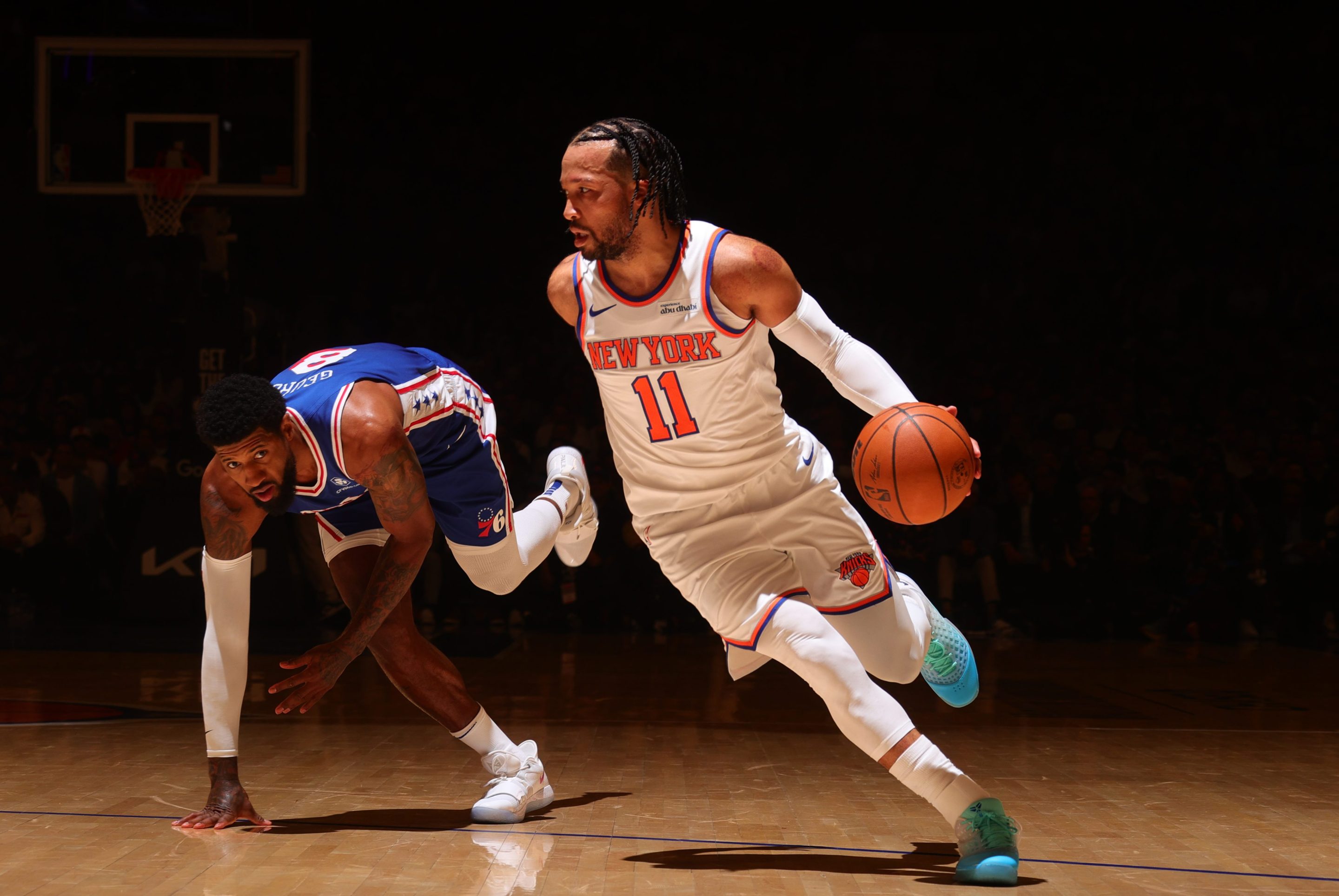
The Defector basketball chat was captivated by a sequence of artfully stage-lit photos in Game 1 of the Knicks-Sixers playoff series at Madison Square Garden. They were the work of Nathaniel S. Butler, senior official photographer for the NBA. Butler has shot the league from up close for over 40 years, from the era of cigarette smoke to the era of outthrust smartphones, and he compiled some of those images in a 2024 book titled Courtside. I caught up with him last week to talk about how he crafts these images and finds new ways to look at the game. Our conversation has been condensed and edited for clarity.
We were admiring some shots you took at MSG during this series. In particular, we really loved the ones where the foreground is softly lit, and the background is so stark and dark. What is it about MSG and the lighting setup there that allows you to capture these images?
MSG, as we all know, is such a unique place. The first thing anyone notices is the ceiling, which is very, very unique. And I go through stages. Oftentimes I'll set up or hold the camera low to get the ceiling in the image. Then [I'm] just always trying to—not recreate the wheel, but always trying to do something a little different.
Working with the NBA, and being at MSG for so many years, does afford me the opportunity to try some different things, with lighting up in the ceiling, that I'm in a unique position to be able to try. The Garden lends itself to doing that. I like the theatrical lighting of it, the Garden is lit that way naturally. I supplement it with some of the photography strobes that I have up in the ceiling, to create that real special look.
Got it. So you've got a kind of strobe light set up in the ceiling that you activate when you're ready to take the shot.
Yes. Having a flash on top of the camera, obviously, you can't do that because of disrupting the players. There are certain positions up in the ceiling where it doesn't disturb players, doesn't disturb the broadcast. It's a very, very subtle little pop of a flash, an 800th of a second. Most people don't even notice it. On TV, every so often you can see it if they do a slow-motion replay. But even then, you don't really notice it. It's kind of a fun, creative, technological way to shoot. I enjoy the challenge of that.
And with a high shutter speed and small aperture, you can block out the ambient light in the arena.
Yes, with a combination of the "spotlight" strobe. The one thing with the strobe lights that is a huge disadvantage is you can't shoot on a sequence or on a motor drive or anything. It's one frame right at a time, and it's a little bit more of a cerebral approach. Just trying to get that one, or a couple images that have a lasting impact.
Maybe it takes you back to more of a film mindset.
Exactly. When I first started out, believe it or not, there was still smoking in some of the arenas. The haze of people in the upper deck smoking, if you look at the old Boston Celtics or something, it's kind of cool, because something like that will never be able to be replicated.
Each era will have its own atmospheric details. I wanted to touch on the technique and the technology you're bringing to MSG when you do work these games. Are you using a separate camera to shoot these strobe-lit shots versus the other shots during the course of play?
I like having everything strobed, per se. I do have a multitude of cameras. I typically have two in my hand, then four or five that are different remote angles. People like that angle that's up through the backboard glass. And those are all set to their own settings: their own exposures, their own color, temperature—it's a pretty involved process. And it just makes it fun. I enjoy that challenge.
How do you think through which of those cameras you're going to be operating at any given time?
It's a great question, because it is a live event, right? I'm not in a studio. Can you do that over again? So that's where the experience does come into play. I've been a basketball fan my entire life. I've been shooting for 40-plus years now. You do have to anticipate. The adage with sports photography: If you see it through the viewfinder, you're already too late. We're talking milliseconds of peak action to get that one frame.
It is a lot of physical prep. For a 7:30 [p.m.] game, I'm at the Garden typically at 12:30 or 1:00. We have to set everything up every single day, because as you know, the Garden has a concert, the Rangers, or some other events. It's very rare that they have back-to-back Knicks games. So during that setup process, while we're doing it physically, I think about the game, think about the matchups, and try to even anticipate what may or may not happen in the game, to keep my eye out for certain things.
That's incredible. You kind of develop a scouting report yourself, as a photographer.
Sort of, yeah. Like I said, I've been doing it a long time. There are different things in different situations, similar to being on the bench or something. Do they have a timeout? Do they have a foul to give? What's the score? There are a lot of facets that go into it.
I really loved in particular that shot of [Jalen] Brunson driving, with Paul George scrambling behind him. When you are following a player for so long, as you have been shooting Brunson now for a few years, do you get a feel for how they move through the court, and does that help you direct your attention and anticipate the shot that's coming?
Yeah, well, first of all, he's left-handed, and that throws you off a little bit. Secondly, like I said earlier, we get one shot. So I can envision a coach telling a player, Don't go for his pump fakes. Don't go for this. He has great footwork, he's gonna pivot. Literally, those types of things are running through my mind at the same time. But then from that dribble drive, he could pull up for a jumper, he could do a finger roll, he could burst by someone or do a pass. Again, I love the challenge, but it is tricky. There have been times where I love the shot, but it might have been a millisecond too early or too late, where the ball is blocking his face a little bit.
Talking generally about this Knicks team, there are a lot of great characters. Karl-Anthony Towns, for example, is incredibly expressive with his face, his body language—has that been fun to document as well?
Yeah, absolutely, especially this time of the year. As we all know, the NBA season is a grind. It's long—January, February, you're in the hump of the season. But playoffs is money time. I love the emotion: Someone does something and then they'll pump or scream or high-five a teammate, and especially in the Garden, because it's such an electric venue, I typically would shoot maybe a little wider to show, if there's a player like Karl in the foreground, pumping, screaming, then you want to see the first row of fans up and yelling and clapping, right? You just want to be able to show the moment, a little bit of what the playoffs mean.
I heard an interesting story from a guy who used to operate the official cameras in pro tennis. He said that Roger Federer was kind of aware of where the camera was located, and would turn to him a little and frame his celebration to make sure the shot was perfect. Do you ever feel that back and forth between the players, where they know where you are?
To be honest, not really. I pride myself with blending in, not being noticed. I think the guys are very smart. They know typically where the TV cameras are, sure, it's a little different from us. I try to stage myself when I can. If the Knicks make a run, they oftentimes will turn and face their bench to react or celebrate or something. So you anticipate, there are little nuances. I do get some good Karl reactions because his dad sits a little bit behind me. Sometimes he'll do a little wink or smile at his dad, and that's kinda cool.
You must be pretty familiar with the courtside regulars. Do you ever kind of station yourself near Spike [Lee], for example, to capture some of that, or is it better to be opposite from him and get his reactions?
The one thing that is different with basketball, as opposed to tennis or football or something: You're locked into your position, they don't want you moving throughout the course of a game, to distract the players or fans. I'll change it up every so often, just to keep the creative juices flowing. But typically, for a game, you are locked into that spot, and then you scope out the background. We know where Spike sits every game—Timothée Chalamet or Ben Stiller are there pretty much every game—and they are part of the fabric of the Knicks. Chalamet, he talks about sneaking into the Garden as a kid. He knows the most random Knick players. He's not just about the stars. It's cool. You know, we're all fans, right?
It is cool. Do you feel your fandom when you shoot, or does it shut down temporarily and you become a neutral photographer?
You 100 percent have to keep it under control. I grew up a Knicks fan. I'm a Knicks fan, but you can't ever let your emotions get the best of you. Throughout me shooting [Michael] Jordan and LeBron [James] and all those guys in crazy games, you just really have to stay dialed in. Then maybe, when the night's over, you're back at the hotel, you have a chance to reflect on those things. That's what's been cool for me, to be honest. I'm a fan, but when you've been doing it for so long, you are caught up in the moment. It's your job. But being able to look back on some old photos from 10, 15, 20 years ago and say, yeah, that was pretty cool when Larry Bird hit that jumper.
Any favorite Knicks antagonists that you've enjoyed shooting over the years?
Reggie Miller was great. He's a super nice guy, but he would like create things to get himself juiced up. They talk about him being the Knick Killer, blah blah blah. He won some big games, you could feel that for sure, and he enjoyed playing the villain role. When MJ ever came into the Garden, in those days, if it was an NBC Sunday afternoon game, he always knew the magnitude of playing at the Garden. He's not a vocal kind of guy, he let his work speak for himself. The opponents, they do get pumped up to play at the Garden. There's no doubt about that.
Curious if you had any reflections on this current Knicks playoff run, whether as a fan or as a photographer, or both.
Personally, I'm based in New York. It makes going to work fun. I listen to talk radio on the way in: The Knicks are going to do this or that. You walk in and the parking attendant is like, Man, we got to get them tonight. When the Knicks are good, New York is just different.
The thing about this particular team that I feel as a fan, it's a pretty good team. I mean that literally: Everybody has a specific role, they do their thing. Everybody gets along. You can see the chemistry,
I've been enjoying watching them come into their own, and I always enjoy OG [Anunoby] in particular, the way he holds this team together defensively. Got me a little nervous [after Game 2] with his [hamstring] injury, but I'm hoping.
He's just a super guy. He's a guy that 29 teams would want. You know how it's become a huge thing, these walk-in tunnel shots and guys are in their nice clothes and styling from head to toe: a watch, shoes, whatever. OG comes in a hoodie and shorts and flip-flops, yeah, it's just not his thing. I don't take his picture walking in; he just doesn't want it. He's like, No, I'm just going to work. He reminds me of Tim Duncan, or somebody who was like that. Defensively, he does his thing. As a fan, yes, I'm a little concerned about his injury, because that type of injury can linger for a while. 100 percent need him healthy.
Talking about defense: You take a player like Jose Alvarado, NYC local, great story in itself, but a lot of his big contributions will be on the defensive end. Traditionally, we think of photography as capturing offensive excellence—not completely, but that's what it tends toward. How do you approach capturing the defensive brilliance as well?
He brings that energy when he's at the scorer's table, the crowd starts getting loud. Right off the bat, I notice that he's coming in, and then, to your point, you know what he's doing. Although he does hit a three sometimes, he's coming in to do his job, which is to play defense. If you get him real tight up on the other team's point or two guard, it shows that intensity. If there's a turnover or steal, you just always stay on him and not pan, to get his reaction, and then the crowd starts going crazy.
How has evolution in basketball strategy over the decades changed your creative process? For example, as the game has gotten more spaced out, has that changed you how you shoot?
Yeah, 100 percent. The game is different. When I first started, I mentioned those—we call them the glass camera, you set the camera up behind the backboard, and inevitably, every game, you'd get two or three crazy dunks. We don't really get that as much as we used to. A guy can penetrate and almost have a clear lane, and he'll kick it out to the corner for a three.
The game has has changed a lot in that it is not as physical, which I used to love. You'd have [Charles] Oakley boxing out Dennis Rodman, pulling his jersey, ripping it, there's an elbow in the head. That doesn't really happen anymore. It's a much more free-flowing game, which does lend itself to some beautiful imagery, but it has 100 percent changed: I can set up those cameras for a dunk, two or three games in a row, and not get a crazy Kevin Garnett dunk. If Kevin Garnett was playing now—he did have a nice jumper—he would probably be a lot more out of the perimeter.
You say there's beauty to the free-flowing game. Do you find yourself composing shots to appreciate, say, jump shooting, or passing in space, or handling the ball? What are you drawn to now?
The way that the game has evolved, it has evolved with some of these shooters, like Kevin Durant, or Steph [Curry]—obviously you can't take your eye off him for one second. His release is so quick, he could shoot it from the logo: the beauty of the shot, and then a defender reaching out and trying to defend it.
The athleticism has always been fun with these NBA guys. I use the analogy all the time: It's not like football or hockey, where they're wearing a helmet, pads and everything. They're in shorts; you can see their face. That, in and of itself, lends itself to beautiful photography. It goes a little bit full circle for me to then try to do something different with the lighting, to make it stand out a little bit more.
So in the same way that a really dynamic shooter like Steph has gravity for the defense, he does for a photographer as well.
Right. Again, it's tough, especially with his release. You want the ball right on his fingertips, with the defender lunging at him. I don't want the ball 10 feet out of his hand—too late. So it keeps you on the edge of your seat. If it's in a key moment of the game, he could turn and do a nice celebration. He doesn't do it a lot, but if he ever does the "night, night," you want it.
With the speed of the game now, and the speed of the release, how do you meet that challenge technically? Are you shooting a burst of images to try to get the right one?
Well, that's where it's tricky with using the strobes: I get one image only. The way I shoot, and a lot of the NBA guys shoot, is very different from a newspaper or some of the Getty [Images] guys. It's one image, right? So you do have to study. Like, OG has a certain release point. Mikal [Bridges] has a little bit of a hitch, but you want to show the length of his arm. Towns, when he's out at the top of the key, he'll do a lot of pump fakes, so you can't go for the pump fake, but then his release for a big man is crazy quick. Those are all things where it's just knowing the players, knowing the game, a little bit of muscle memory. It doesn't happen every time. But if you were shooting on a motor drive, that would just be one frame of six or seven, and you would get the shot. But I still like the strobes, and the motto is: Try to get something of a super quality over quantity.
Victor Wembanyama is such a unique and disruptive player in the sport's history. Do you find yourself even composing the shots differently, because you don't expect any human to be moving through space the way he does?
Yeah, I do things a little differently for him and shoot a little bit wider. I said earlier, [with] playoffs you want that intensity, you want the sweat, so you go super tight, showing that emotion. With Wemby, that could come back to bite you, because he could take two strides and be from mid-court to the basket. Mentally, I'm preparing myself to shoot a little wider with him. I shoot a little more horizontal with him because of his length, from left to right. We all know basketball is a vertical game, right? But for him reaching out for a block, a little more horizontal. He's crazy quick. It's cool for me to see, sometimes when he does something absurd, he doesn't often show a lot of emotion, I would pan to a different player, and they have their hands on their head, or like, Oh my god, did you just see that? [That] kind of reaction is cool for me.
To take a different angle on that: Is it nice as a photographer to work with subjects who play at a slower pace, like [Nikola] Jokic or Luka [Doncic] or [James] Harden? Does that make the job a little bit easier?
It's probably easier, but I like to challenge different things, and knowing what the guy's skills are. Jokic: slower, methodical, but again, not going for a pump fake. Luka, you could think that the defender's right on him—and he does a step-back, it's a crazy three. James is tough, because he has great footwork and you can't fall for a pump fake or something. But he's not going to come in and do a flying dunk. It's almost like an internal scouting report, you know?
That seems like a very cool part of the job. Any noteworthy internal scouting reports from the last season, players who were a particularly interesting challenge in terms of the composition or timing of shooting them?
There's always a crop of younger players. You talk about Cooper Flagg, very athletic. I didn't see him a lot, probably four or five times through the course of a season, so it's fun for me to get to know his game. Kon Knueppel, another big name. His release is crazy quick. The catch-and-shoot, he doesn't need a dribble to square up. In this Philly series, I'm a big fan of Tyrese Maxey, because he's so fast, the still [image] doesn't even do it justice. There is a difference between being fast and quick, and he's both. VJ Edgecombe: For a rookie, he's not afraid of the moment. He could have a deep three, and I have to know that he's gonna shoot that. He could blow by his guy to the basket, or he's confident enough and good enough to bury a three in a key moment. All those things are always going through my mind.
You mentioned having a couple of remote cameras. One is on the backboard. What other vantage points do you like to play around with?
Every arena is a little different, logistically. At the Garden, I have one up in the ceiling, aiming straight down over the basket. If Mikal or OG do a reverse layup, and they're looking straight up, you try to get their face through the net. Typically I would do my "remote" cameras at the opposite end of the court. You have one in the basket, shooting up—like we mentioned earlier, the ceiling at the Garden looks so cool to me. In some other arenas, it's a big advertisement or something up on this Jumbotron, and that detracts from the photo.
Do you have any favorite photographers outside of sports? Are you influenced by any other visual medium?
Life is all about timing. I grew up a sports fan, but I had the privilege of working at Sports Illustrated many years ago as an assistant, and learned so much from those literal masters. Every day was a different day. I was the young kid on the block, and I would work with one person one day, another person another day. You'd go to the cafeteria and see the Life magazine photographers having lunch. I was in awe of the talent: the sports guys, Walter Iooss and Heinz Kluetmeier, Neil Leifer. And then you'd see Alfred Eisenstaedt and John Zimmerman and these other Life magazine photographers. It was just a different time.
Additionally, I would have friends that worked in the fashion world, and that was just beautiful. Obviously, very different from sports, but beautiful thought goes into a portrait. You would try to emulate something—if you were fortunate enough to have a portrait shoot with a player, I'm like, What would Annie Leibovitz do? What would Herb Ritts do?
I know the demands of the job are different, in terms of speed of processing the images, but do you have any chance to shoot basketball on film these days? If not, what do you feel is missing from that era?
It's funny, I held on to film as long as possible. The world was changing. I wanted to shoot LeBron's rookie year on film. That was the last year I did an entire season on film, which is kind of crazy. That was 2003. There are certain things that can never be replicated with how beautiful the film is. We've had some conversations about doing different events and certain matchups going forward with film, which I would love. It's an entirely different process with different cameras, different lenses and things.
As you know, when you're watching a game, they're like, Oh, let's go to Secaucus for a review, right? Every one of my cameras—we call it "tethered"—it has an internet connection, so I press the button and [the image] in Secaucus in two seconds. They have staff with people working nights, editing the games. Literally, I press the button—two seconds, an editor would get it. If they like it, they'll caption it and put it on Getty. It's out in the world in two or three minutes.
[Back then,] I would shoot a game at the Garden. You pack the film up, you go downtown, you find a lab that's open all night, process film, you edit the film, that's 2 or 3 in the morning before anyone sees anything. It's kind of cool, the way things have changed, but there is something very special about an old MJ picture on film: You could see beads of sweat, and you could tell that it's just a beautiful image shot on a Hasselblad. The quality of the images is unmistakable.
It's a beautiful medium, and it's very cool that you got to shoot LeBron's rookie year on film. I could imagine a kind of a capstone, where you would shoot his last season on film, too.
I was just talking with our head of photography about certain players, shooting Wemby on film. You know, the first digital cameras were terrible—an iPhone now is 10 times better than the first $15,000 Kodak digital camera, right? The technology obviously has changed. But I like shooting film being a little bit more cerebral, with your choice of when to click that button. You get 12 frames on a roll of film. It would be a great thing to do.
What would be your ideal film camera to be shooting with?
For the action? It's Hasselblad, and it's just a beautiful camera. The lenses are crazy sharp, and that's a square format, which you might think doesn't really work—I said basketball was a vertical game—but then when you look at a square image that's composed, like a dribble drive or jumper or something, the square really does look beautiful. It looks great on those glass cameras, on the low-angle camera—you can tell, the film is beautiful.
What favorite film stock would you be shooting?
That changed over the years, but in the '80s, Fuji made a beautiful RDP 100 ISO film, and you could use that with strobe. Otherwise, film was 2500 ISO or something, but it was just as beautiful. It was very diverse in that I could buy a bunch of the Fuji film, and it would be good at the Garden, it would be good when I go to Chicago Stadium. It was very transitional with that kind of use. Some places, you could shoot Kodachrome, but it could be a little too red if you went to Houston, because it had a red key. But Fuji, at that time, was making a big splash.
Now that we are so saturated with images—from the broadcast, then fans at the game are taking their own images, and all these things circulate—do you look at your job a little differently as the official keeper of NBA images?
Yeah, I think it's very different than it used to be. For sure, there's a crazy amount of really talented young photographers out there. The equipment and technology has made things a little easier. There's no doubt about that, but I don't begrudge people or anything. No one's using a typewriter and using Wite-Out—people make a mistake and they hit Delete.
Having said that, there was a thing at the Masters that I didn't realize: It doesn't allow the fans to bring in cell phones. And there was a beautiful golf picture, and all of the fans on the 18th hole were looking and watching someone putt out. No one was holding up a phone. It just really struck me as somewhat timeless. There are people at the game sitting in the front row, not watching the game. You paid a lot of money for that front seat. You know, you might want to watch the game.
But some of these teams have killer social media teams and content teams that are creating really cool stuff. It's a generation of athletes that are accustomed to people having their phones out and having cameras around. If I pulled the camera out in the locker room in front of Larry Bird, he might have had some harsh words.
These are a younger generation of athletes that are accustomed to it. LeBron is great. We film him walking in. We film him lacing up his shoes. He understands the value of that.
Shooting LeBron over the years, what tendencies or things about his play style have been fun to capture?
You literally never know what he's gonna do. Still. He could have two dribbles and a crazy dunk, or he does a look-away pass to AR [Austin Reaves] in the corner. LeBron does play moments with defense. His intelligence and knowledge of the game is off the charts; the average fan might take [it] for granted. He has a presence: just standing there, hands on hips, with beads of sweat could be a cool photo. You know what I mean? He commands that, and has that presence. All the behind-the-scenes stuff, I love doing as well, and doing his workout. I love the feet in the bucket—that kind of stuff is cool to me.
I've seen so many great images, I'm sure many of which you've shot, but him manipulating the defense with his eyes and then throwing the no-look the other way: a very iconic LeBron image for me.
And then, when you do get to know him a bit, and you hear some of the conversations, it's a chess match. He knows exactly—he'll do something very deliberate, to draw a double team, and do something like that, you know? It's very interesting to me—again, not even on the photography side, just as a basketball fan.