Excuse me while I go Dave McKenna mode: I watched Jose Alvarado as a high school star in Queens nearly a decade ago. His team at Christ the King Regional High School took on Bishop Loughlin, another local powerhouse, in the Brooklyn-Queens Catholic High School Athletic Association semifinal back in February 2017. I paid $5 to get into a very loud gym, and distinctly recall thinking to myself that it was the best basketball game I'd ever attended in New York City, at any level. Aptly for the city, it was a battle between two slight, speedy, hard-nosed point guards: the 5-foot-11 Alvarado and the 5-foot-7 Markquis Nowell. But Alvarado fouled out at the end of regulation, and Loughlin pulled away in double overtime, 98-90.
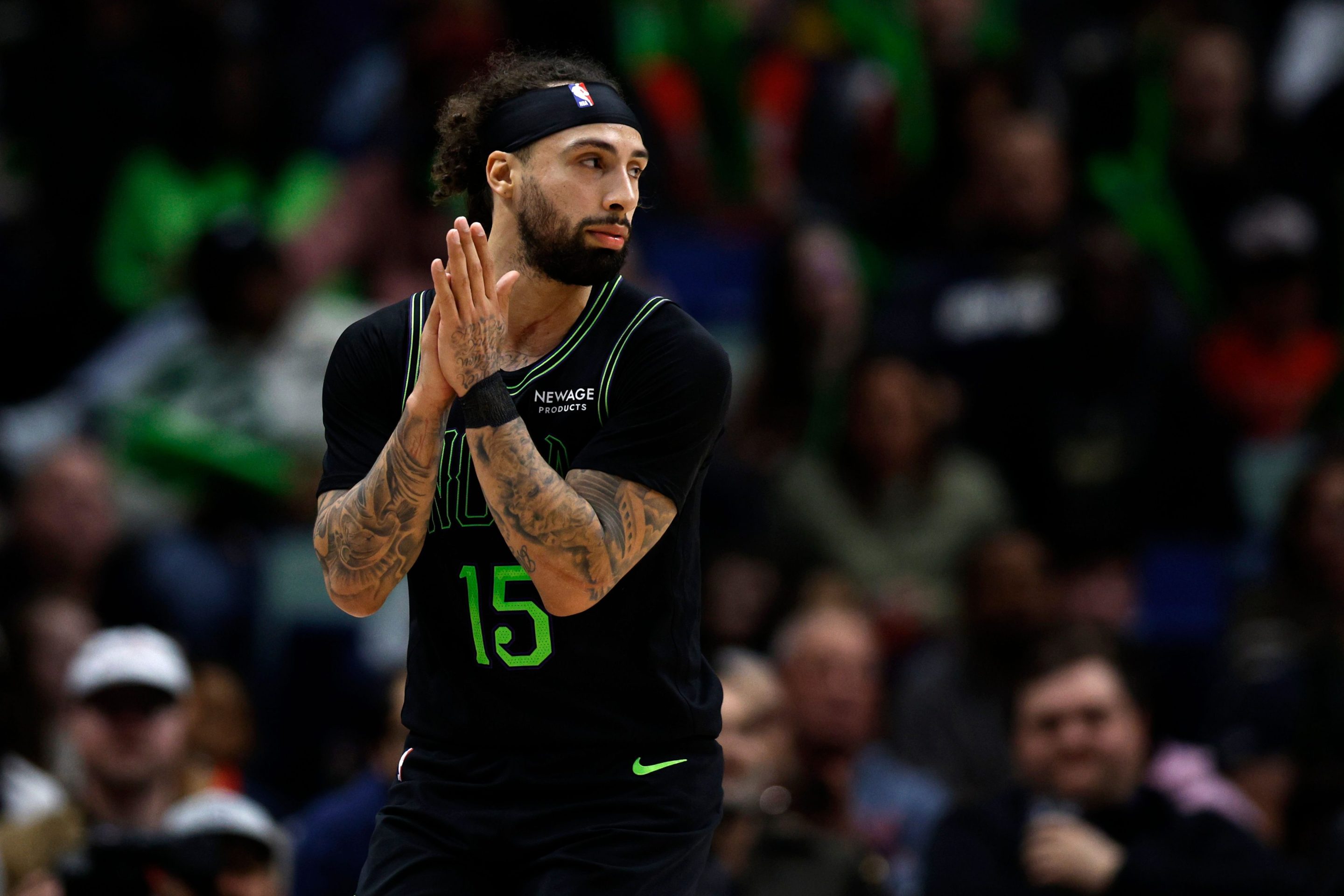
I knew then that Alvarado was headed for Georgia Tech; I had no idea he'd eventually carve out a role in the NBA as a point-of-attack dog. Watching him break out for the New Orleans Pelicans in the 2021-22 season was a delight. I often thought back to that raucous gym in Queens as Alvarado thrived in his pro career, needling opposing ball-handlers, talking prolific shit, answering real-time questions about his shooting ability, and even establishing his own signature steal—creeping around in the backcourt to ambush the inbounds pass. That whole Pelicans season was a rush. Head coach Willie Green came aboard and led a Zion Williamson-less squad through the play-in and into the postseason, where Alvarado got to torment Chris Paul on the national stage. He was one of many cool new faces on the team, alongside Herb Jones and Trey Murphy. The undersized scrappy guard had found his niche in the league, finessing his two-way deal into $6.5 million guaranteed.
This year's Pelicans were headed nowhere in particular, so Alvarado was rumored as a New York Knicks trade target for much of this season. Just a few hours before the Thursday deadline, this Queens kid was sent back home, in exchange for Dalen Terry, two second-round picks, and cash. Alvarado should bring an edge to a Knicks team that often coasts on a vague reputation of toughness, without consistently embodying it on the floor. The timing also could not be better, as guard Miles McBride has just been sidelined for a core muscle surgery that will likely keep him out until the playoffs. Alvarado will have some time to slide into McBride's minutes and give head coach Mike Brown an energetic demon in the backcourt. Judging by Alvarado's wholesome postgame interview after his Madison Square Garden debut in 2022, he'll be pretty keen on suiting up there as the home team.
To learn a little more about Alvarado's New York roots, I spoke with John Weir, who coached Alvarado for two years, both at Christ the King and on his New York Rens AAU team. Our conversation has been edited and condensed for clarity.
What was Alvarado's overall playing style like in high school?
It was very similar to what you see now, where he was a point-of-attack defender that was a nightmare for the other guards. Always. He's always been like that every level that I've seen him play. It's hard to not, like, repeat what everyone talks about—the New York toughness. But really he typifies that in a way. He's not gonna get out of your face, gonna talk to you a lot, and his personality is part of the whole thing. And it's so funny to see him doing all the same stuff to [Chris] Paul in the playoffs a couple years ago.
I saw he had a quadruple-double game with steals back in high school. Did he do the Grand Theft Alvarado trick back in the day?
Every level. He did it at AAU, at high school games. And I think I, like every coach is supposed to say, many times told him, "Hey, that's not a very good play." Like, you should just get back. But I really think that he is pushing the boundary of—if you feel like you're able to do that, you're able to take a play that "everybody knows" is not a good play, you're taught from a long time that this is not an efficient way to play, and he's just so good that he can do it. Because he picks his spots well, and got better at that. In AAU, he did it all the time, and I'd be like, "You'll be fine if you go steal it from him down the court, you don't have to do the trickery and then someone ends up having to cover you." But he picks his spots really well. He can read what's going on, and he knows when to step up.
In high school, he wasn't a tremendous shooter—I still don't think he's a great shooter—but I wanted him to take a shot every time. I can look at him and be like, He's not a great shooter, but when it's the time, he knows the situation, he can read the room, and OK, he'll take over. That's what he was like in high school.
He's still making those plays. It's just, the level being so much higher, he's finding ways to fit in. You talk about it as a coach: As a player, your job is to make it so that I have to play you, right? There's zero coaches in America that are gonna not play you if you're really making yourself completely indispensable, and that's what he's always done. You have to play him. Willie Green found out the same thing. You've just got to put him in, because good things happen.
What has it been like watching him develop since high school? Did you think he had a chance to make it to the league? Or were you also surprised?
I always knew that he was really, really, really good. But there was the question of physical development, he was much thinner in high school, and that was the only question. If he's gonna get bodied by bigger guards, then, as pesky as you are—he's so fast, but you have to be strong too. That was the biggest thing to me, watching how strong he got from high school, as the years go by in college, and then eventually when he's playing in the league. He's got a low center of gravity. Honestly, the physical tools that he has are similar to [Knicks guard Jalen] Brunson. You're not pushing him off anything. He's just too strong and low and so fast.
[Alvarado] learned at a high level in high school to be a volume scorer. Similar also to Brunson—you find ways to score against high talent. It doesn't really matter how much bigger they are, if you're used to doing what you got to do, and finding ways to create the angles. He's very good at using the tools to find a way, because he's been doing it for his whole life. People talk about [how] the league will be bereft of 6-foot guards. I don't think that's the case if they're these guys, learning at a high level from when they're young.
The thing I would also add to that point is that usually when they talk about the small guards going away, it's because they'll be a liability at the point of attack. And he's the exact opposite of that.
Yeah, and he does all the other stuff. He's in passing lanes, off the ball, he's really good. He's communicates, he's constantly talking, and some of it is talking shit, some of it is talking like you're supposed to do on defense.
I'm coaching my son's [third-grade] team now, and I'm trying to tell them, "Listen, it doesn't matter what you're saying. You just talk all the time, because at the very least, they can hear where you are on the floor." So when you have the motor that he does—there's a motor in his chest making him run, and a motor in his mouth making him talk—it's beneficial for everybody, because everybody knows, you hear him behind you, and you're at the point of attack, and he's behind you, and you hear him behind you.
Aside from those little steals he did, was there anything distinctive that he did on the court that was running against, maybe, the coach's wisdom?
I mean, other than the Grand Theft Alvarado, which was really the perfect example—it's so perfect—his shot selection was like that too. Sometimes I'd be like, Oh shit. He's a fucking gamer, so in time, being perfect-coach brain like, "Well, I'd like to get a better look," it doesn't matter, because for him, that's the same as a layup.
That was in high school. I don't think he's in that really anymore, but he's never been afraid to—no one is more Jose than Jose. He's never been afraid to do things exactly the way that he wants to do them. He's very confident in himself. Not everyone can get that and keep that going when you're playing in the NBA at that level.
His mental, you know, is the most impressive of all of it. Just, I'm coming in, this is what it is, everyone's gonna have to adjust themselves to me. The backup point guard, but you have to. The opposing coaches have to spend three minutes talking about, Be careful for Jose Alvarado, he'll get up, he'll steal a play because he is doing his thing. You find a way to affect the game just by being on the court because of the thing that you do, that everyone knows that you do, and you still are successful at it? That's crazy.