

Michael is a bad movie. Let’s just get that out of the way now. It is a movie designed less to tell a story than to recreate moments, ones you are probably already familiar with. It is a movie designed to give you a karaoke experience in a theater setting with other like-minded Michael Jackson fans. It is a movie designed to make the estate of a dead pop star a great deal of money, in line with other milquetoast biopics about other stars, like Bohemian Rhapsody or Springsteen: Deliver Me From Nowhere (more like deliver me from this theater). It is a movie not at all designed to tell a history, least of all the history of Michael Jackson.
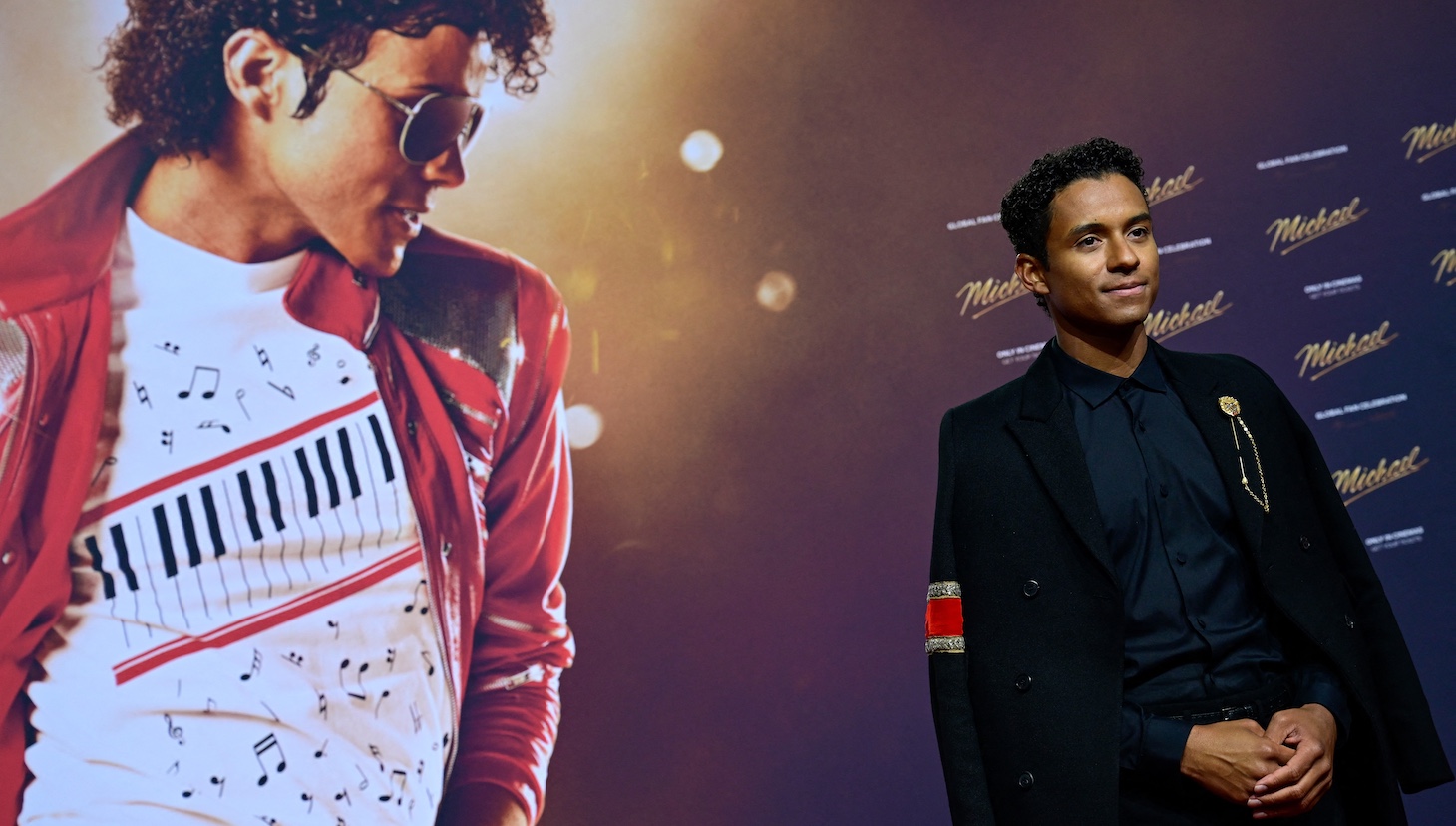
"Directed," in the scariest of scare quotes, by Antoine Fuqua, Michael tells a very abridged version of Jackson's ascendence, from child superstar (played by Juliano Valdi) to king of pop (played by Jackson's nephew, Jaafar Jackson). Much of the Motown and Jackson 5 era is told in montage, only stopping intermittently to highlight how sensitive of a person Michael is and how disconnected he is from other people due to his demanding father and being in a big pop group with his brothers. Later, as Jackson moves into adulthood, the movie aims to recreate the magic behind the making of the albums Off The Wall and Thriller, while stopping intermittently to highlight how sensitive of a person Michael is and how disconnected he is from other people: watching cartoons with his mom, wanting to play Twister with his big brothers, adopting a monkey named Bubbles, who shows up in this movie like he was one of the Avengers.
There are many moral problems with this movie, which we will get into, but just from a filmmaking perspective, so much of this is unbelievably cynical. It's one thing to watch a superhero movie and know that its primary job is to sell toys and merchandise; it's quite another to watch a biopic with more or less the same objective. The movie treats Jackson as if he were some sort of Marvel character, with subtle references to his many cosmetic surgeries, his addiction to painkillers, and his fixation with Peter Pan sprinkled in like Easter eggs for his biggest fans to go seek out. Even if a movie produced in collaboration with Jackson's infamously protective estate was never going to seriously confront Jackson's child sexual abuse cases, there is presumably a lot that could be said about even a sanitized version of one of the greatest, most fascinating artists of all time. And yet, Jackson is barely a person in his own movie. He is at best an idea, one vaguely though carefully sketched to undermine the bad things you know about him.
A big part of the problem lies in Michael's depiction of Joe Jackson, the Jackson family's domineering patriarch, played by Colman Domingo. Though essentially framed as the movie's villain, Joe's violent and controlling ways are nevertheless given the soft-focus treatment. This depiction differs greatly from other representations of the man. For instance, the 1992 miniseries The Jacksons: An American Dream made palpable Joe's abuse of his children. Every credible account of Joe to have emerged over the past several decades paints him as a man who more or less terrorized his family, handing out physical punishment and abuse, having extramarital affairs, and separating his sons from any sort of life outside of the boy band he had enlisted them into. And that doesn't even touch on later allegations that Joe himself sexually abused his children. In the movie, much of Joe's repugnant behavior is either underplayed or merely hinted at, as though Michael's fear and discomfort around his father was more about his own oversensitivity than anything Joe actually did. The movie's reluctance to depict Joe's brutishness, which is at this point well established in the historical record, is blatantly dishonest, and sets the stage for the rest of the film's dishonesty.
Many movies are bad. Sometimes badness is fun, but oftentimes it's pretty boring. I could in theory deal with simple badness of Michael the same way I dealt with the badness of so many biopics that have come out the post-Bohemian Rhapsody music IP gold rush—laughing at the sorry attempts to sand the edges off of famously jagged stars, enjoying the singalong bits, and mostly just not really caring about these movies one way or the other. But significant portions of Michael are dedicated to Jackson's love for his child fans, at which point the movie goes from not just bad but actively evil.
Much has been made of the fact that this movie has been conveniently constructed to leave out the many accusations of sexual abuse of young children by Jackson—a list of accusations that continues to grow to this day—with filmmakers and cast members trying to cover their asses by disingenuously teasing a sequel that "could" maybe deal with it. But any notion that Jackson's legacy of sexual abuse was simply outside the movie's narrow scope is undermined by the scenes where Michael innocently spends time with sick and injured children at a hospital. The straightforwardly admiring presentation of those scenes is ugly, and reeks of his estate trying once again to take back the narrative that had long stained Jackson's image.
Jackson's estate has worked incredibly hard in this regard even after his death, most prominently in their successful bid to get HBO to memoryhole Leaving Neverland, the documentary that recounted the stories of multiple people who said Jackson sexually abused them as children. The director of that documentary, Dan Reed, has his own feelings about Michael that are worth reading. Supporting the estate's whitewashing campaign is the army of Jackson diehards, who previously flooded the internet with conspiracy theories aimed at sullying the credibility of Jackson's accusers after Leaving Neverland came out, and who now have helped Michael become a global smash hit at the box office, in spite (or maybe even because) of the almost uniformly negative critical response. Even at the screening I attended, the audience seemed less critically or skeptically minded and more motivated to bask all over again in the uncomplicated glory of the man's undeniable music and dance moves.
This is the part where we're supposed to get into separating the art from the artist, and people's personal histories with and feelings about certain music, and how we are to deal with thorny questions about what people make and what they do outside of that, and blah blah blah. Frankly, I'm burned out. Maybe you've noticed, but we are living in an age of nihilism. We're in an upside-down world, one where someone can be obsessed with uncovering Jeffrey Epstein and his pedophile cabal, then vote a member of the Epstein cabal into the highest office in the land, and then happily go see a new Michael Jackson hagiography. No one knows the line anymore between enjoyment and endorsement, and no one wants to think critically about their choices; they simply want satisfaction at all costs.
The idea that we're all supposed to dutifully separate the art from the artist is complicated by the fact that our experience of art, particularly the popular, contemporary sort, is almost always mediated by our parasocial attachment to the artists who've made it. It's not enough to like Star Wars as a film—people want to be those characters, to dress like them, to speak in their quotes, to make their world like the movie, and to revere the mind that came up with it all. When Britney Spears or Rihanna changed their hair or adopted a new style, every middle-school girl followed in quick succession, not just because they liked the music and the look, but because they loved the person behind it. No one crafted a more intense parasocial relationship with fans than Michael Jackson, who coveted it not just as a lonely person, who grew up in isolation and was incapable of forming connections like a regular person, but also as a predator who cultivated deep personal relationships with young boys and their families for his own warped ends.
In On Michael Jackson, Margo Jefferson writes about the "short masterpiece" that is the 1983 music video for "Thriller" and thinks about what it might reveal about Jackson's psyche:
It is the tale of the double, the man with two selves and two souls, like Dr. Jekyll and Mr. Hyde, like Poe's William Wilson or Dorian Gray and his portrait. The everyday man and his uncanny double.
Which is his true self? "Everything which ought to have remained secret and hidden, but which has come to light." The everyday man broods and agonizes. Why does he feel a connection to this dreadful menacing other? Why is he drawn to an alien, even criminal life?
How does he keep this second self concealed? Does he really want to conceal it, especially from the woman whose love he has sought and won?
In her reading, the video becomes a metaphor for the man and his dueling natures: the child vs. the child star, the superstar vs. the introvert, the legend vs. the predator. An even more explicit artistic channeling of this same dynamic can be seen in Jackson's short film, Ghosts. The old cover story that Jackson and his sycophants always trotted out to explain away his out-in-the-open grooming of children is that, in a real sense, the adult man was still that 10-year-old child never allowed a childhood, and was desperate to recreate one. But as a friend of mine helpfully pointed out, his conception of childhood is a complete fantasy. Jackson idealized childhood as this magical time where you spend all day watching cartoons and eating ice cream and going to petting zoos and riding roller coasters. But real childhood, especially for the kinds of poor black kids in places like Gary, Ind., that he himself would've been in those years, isn't all sunshine and rainbows. Children are also interacting with a real and adult world that is shaping them. They are in constant discovery, and that means moving out of some burrowed Oz-like fantasia to hide yourself in. The magic and wonder and innocence of a healthy childhood is of course something to cherish, but it is also something to grow out of, and is especially to protect from predatory adults whose own twisted conceptions of it can lead down dangerous paths. Neverland is not real, and even on the story's own terms, Peter Pan is a cautionary figure, not some uncomplicated hero to emulate.
Just laying out the scenario in plain English makes clear how bizarre the argument really is. Here we have a world-historically rich, famous, and beloved man who himself said he was robbed of a childhood at the hands of a violently abusive father, who never got over that fact, and who tried to compensate for it by surrounding himself, often without any other adult supervision, with legions of small children with whom he could recreate his fetishized idea of the thing he had lost. And that self-evidently damaged psychology is precisely why we're supposed to believe that a person like that didn't actually commit the child sexual abuse he was accused of several times over.
Nevertheless, there is no shortage of people out there who have convinced themselves of that confounding narrative, using it to justify their choice to disregard the pain of children so that they might better enjoy the pleasure of music, even in the form of a poorly made, immorally bowdlerized biopic. It turns out that the only thing more powerful than Jackson's own ability to torture narratives into a shape that might hide his own demons is society's willingness to accept anything that makes it easier to ignore reality and believe in a comforting illusion.