

It's nearly impossible to relay a single fact about former Cincinnati Reds owner Marge Schott that does not stop an unfamiliar recipient dead in their tracks. For example:
- She was suspended from baseball in 1993 for the repeated use of racial slurs, which included referring to Reds stars Eric Davis and Dave Parker as her "million-dollar niggers."
- A few years after her suspension, MLB forced her into selling the team, in part because she said, of Adolf Hitler, "Everything you read, when he came in he was good. They built tremendous highways and got all the factories going."
- She kept a Nazi armband in a desk drawer in her house.
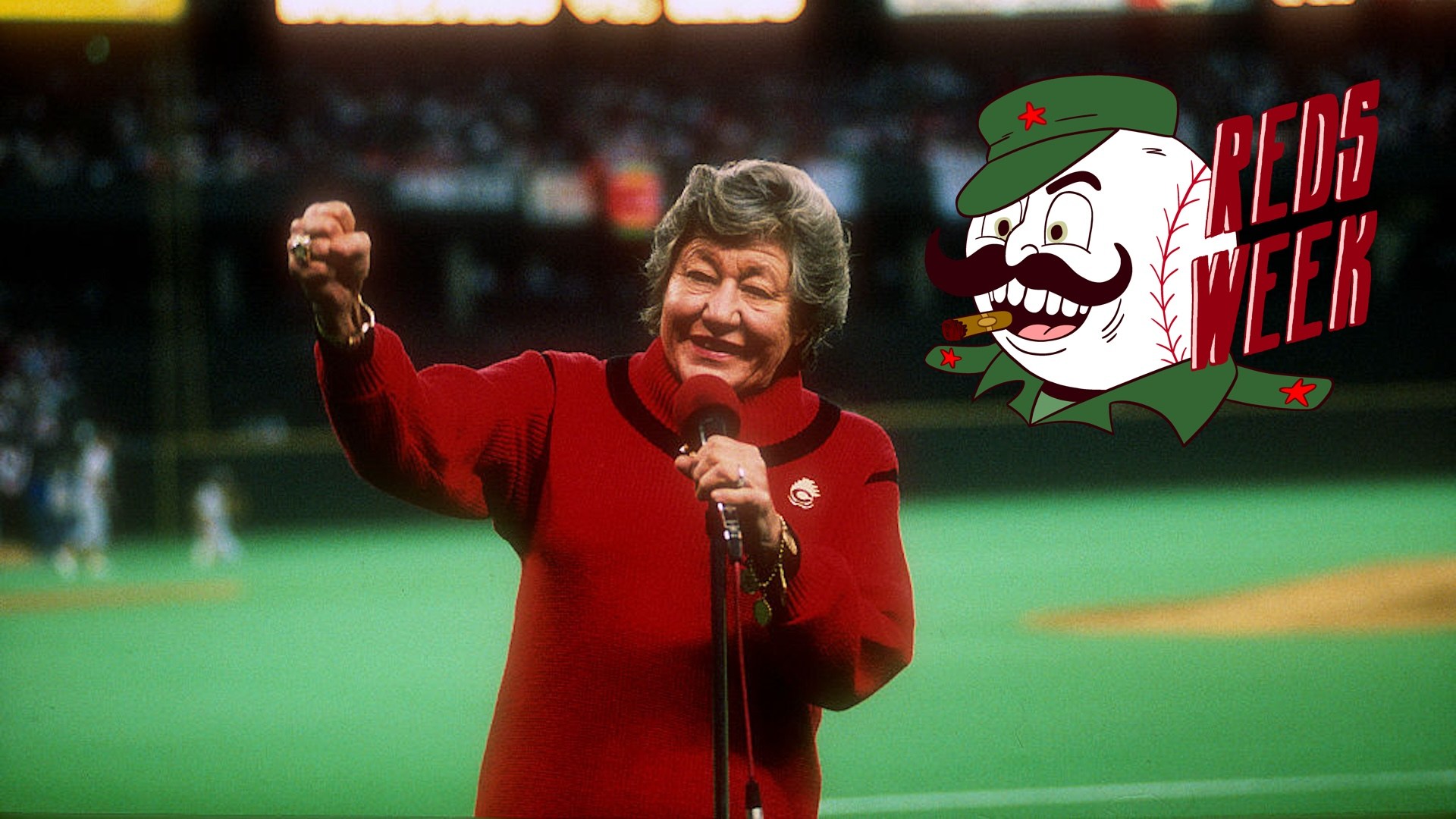
- She was an alcoholic, and was probably drunk when she took the field before Game 1 of the 1990 World Series and told the assembled crowd that she was dedicating the Series to American troops "in the Middle West." Thirty minutes later, she was on the field once again, this time with television cameras rolling, reiterating that the Series was being played in honor of "our wonderful men and women over in the Far East."
- She was enraged when the Reds won the 1990 World Series in a 4-0 sweep, because the shortened series robbed her of lucrative gate receipts.
- She used to let her dog, a big St. Bernard named Schottzie, piss and shit on the Reds' field.
This is just a small sampling of facts about Schott that can be found in Marge Schott: Unleashed, by former Cincinnati Post sportswriter Mike Bass. Aside from being a juicy, well-reported investigation into Schott's scandalous tenure as owner of the Reds, it is also a fascinating artifact of a time when access and resources were more readily available to sports reporters. The book was released in 1993, the same year that Schott was suspended, and features dozens of on-the-record testimonies from people who worked closely with her. News of Schott's racist behavior was slow to escape Cincinnati, and when it did, the national media often provided surface-level coverage. The situation cried out for a more complete portrait of Schott and her place in the game, and Bass provided one nearly simultaneous to the scandal's unfolding.
The story that Bass tells about Schott is not a flattering one. It may be hard to imagine such a book doing more damage to the reputation of a woman who was already best known for being racist, but Bass's book does just that. For someone like me, whose awareness of Schott is owed mostly to her Wikipedia page, some obituaries I read when she died in 2004, and a classic Sports Illustrated feature by Rick Reilly, it was bracing to be confronted with the full breadth of her behavior. Just as bracing is the book's inescapable conclusion: For all her horrible public and private behavior, Schott was never really out of place.
Like all good villains, Marge Schott's story begins in tragedy. Well, I guess that depends on how tragic you find being born into a stern immigrant family, going to college, marrying into a wealthy Cincinnati family, and then being widowed at the age of 39 after your philandering husband has a heart attack and dies, possibly at his girlfriend's house. These are the circumstances under which Marge Schott inherited a small empire of car dealerships, real estate holdings, and other businesses that provided her with the money and influence necessary to eventually become general partner of the Cincinnati Reds.
Schott already owned a small slice of the franchise when its majority owners, local insurance magnates James and Bill Williams, put their stake up for sale. Schott didn't have enough money to buy the team outright, which at the time was split into 15 shares, one of which belonged to her at a valuation of $1.6 million. She managed to convince enough of the other limited partners to maintain their investments that she only needed $9 million to buy out the Williams brothers. Thanks to a sizable loan from Fifth Third Bank, she did just that in 1985.
Schott knew the value of a good story, which is why when her purchase was made official, she portrayed herself as a lifelong Cincinnatian who felt compelled to make a bid in order to prevent the Reds from being bought by out-of-towners who were scheming to move the team to a different city. She called the purchase her "Christmas present to the city," and made it clear that if she hadn't stepped up, the Williams brothers would have let the team be stolen out from under Reds fans. In Bass's telling, that was all a lie—nothing more than a foundational myth that Schott used to raise her local profile. Bill Williams told Bass that he had "no idea where [Schott] gets this impression," and insisted that he and his brother would have never sold the team to someone who didn't plan to keep it in Cincinnati. Carl Kroch, a minority owner of the team at the time, also told Bass that Schott's version of events was "an absolute lie."
It was an extremely useful lie, though, and goes some way toward explaining how Schott was able to avoid scrutiny for so long despite her awful behavior. Locally, it made Schott something of a folk hero. Not only was she the woman who saved baseball in Cincinnati; she also kept ticket prices low, priced hot dogs at $1, and liked to watch games from behind the first-base dugout, where she signed autographs and patted kids on the head. Just as Elon Musk was once a climate-conscious electric car maker, Aaron Rodgers was once a talented quarterback with a wry sense of humor, and Donald Trump was once a celebrity real-estate tycoon, Schott was an eccentric local businesswoman who loved baseball.
To those who actually had the displeasure of working with her, she was a tyrant. Unleashed piles up examples of her belittling, harassing, undermining, and scheming against her employees. At her dealerships, she ridiculed her salesmen in front of customers, refused to pay them the salaries and commissions they were owed, and once told a top-performing employee who had badly injured his back that he would be fired if he didn't return to work within 24 hours. As managing partner of the Reds, her self-absorption and all-consuming pettiness led her into feuds with just about every team executive and employee she hired, and ultimately fired, during her tenure.
And she hated spending money. She used to turn the thermostat in the front office to frigid temperatures in order to save on heating costs; she denied every travel expenditure she could and routinely tried to stiff employees on the terms of their contracts; she froze salaries and fired part-time workers; she fired the organ player because he was costing her $25 per week; during one holiday season she cut off health insurance payments for 16 retired employees, saving herself approximately $28,000. When Davis tore his kidney while attempting to make a diving catch in Game 4 of the 1990 World Series, doctors told him that he couldn’t take a commercial flight back to Cincinnati because he needed to stay lying down. Davis was forced to charter a plane and staff it with medical personnel himself, and Schott at first refused to reimburse him for the cost.
Perhaps more than anything else, Schott liked using slurs in polite company. Any reader of Unleashed will eventually lose track of the number of pages on which a named source tells Bass about a time they heard Schott use racist or antisemitic language. She made routine use of her chosen slur for Parker and Davis, regularly complained about "Jew bastards," and seems to have exclusively referred to Japanese people as "Japs." It's important to note the timeline here: Schott's racism didn't become news until 1992, but Bass dates her use of slurs back to the very beginning of her tenure as Reds general partner. Dozens of Schott's colleagues could have come forward about her behavior at any point during those years, but chose not to. Roger Blaemire, who was the Reds' vice president of business operations, told reporters at The Cincinnati Enquirer about Schott's drinking and racist behavior in 1986, but the paper didn't pursue the story because he wanted to be an unnamed source.
That same year, Cincinnati Post sportswriter Jay Mariotti—decades away from his own journey into disgrace—had a phone call with Schott after she had made an appearance on Late Night with David Letterman. She (while probably drunk) raged at Mariotti about Letterman and how badly the recording had gone, and complained about "the Jew director" who had made her look bad. Mariotti didn't print any of it. "I bailed her out," Mariotti told Bass. "I wish I would have run it. I would have been the first to suggest Marge Schott was racist."
Throughout the book, the people who were around Schott fall prey to a familiar impulse. Over and over again, in their comments to Bass, they attempt to abstract Schott's racist language from her character. Several of Bass's sources attempt to explain that despite hearing Schott use slurs, they weren't convinced that she was racist or a bad person. Some of them point out how kind she could be to her employees' families. Others describe her as a kind of Archie Bunker character, chalking up her use of racist language to a generational divide or personality quirk rather than a moral failing. "Marge Schott is Rip Van Winkle—a churlish curmudgeon Rip Van Winkle," said Don Breen, a Reds executive. "She fell asleep in the '50s and woke up in the '80s."
The amount of time it took for Schott's bill to come due suggests it wasn't particularly all that out of place in the '80s. Unleashed drops a few hints indicating that while others may have found her language distasteful, they didn't have too much trouble living with her sentiment. In one scene, Reds marketing director Chip Baker hangs up on a candidate for a secretary position because "she sounded black." The implication is that he was acting according to Schott's wishes, but there's no indication that he had misgivings about it. When Howie Bedell, the Reds’ minor league director from 1990–91, tried to hire Moe Hill, a black former player, to a minor-league coaching position in West Virginia, he was told by GM Bob Quinn that “the thing with Moe Hill wasn’t going to fly at all,” because he would have been working in a Southern town.
In another scene, Bass talks to Joe Pfaffl, who was the finance chairman for the Butler County Republican Party in 1987, and revealed that he heard Schott refer to Parker as her "million-dollar nigger" in an airport. Pfaffl was subsequently dismissed from his position by the Butler County GOP, not because of his association with Schott, but because he came forward against her.
As for her place in MLB, Schott's worldview had long suffused the game in countless subtle and overt ways. Just as Schott's tenure running the Reds was beginning, the rest of the owners were engaged in a collusion scheme that froze the free-agent market and forced Andre Dawson, one of the league's best and most popular black players who was the prize of the 1987 free agent class, to take a pay cut. Schott gained control of the Reds less than a decade after former Washington Senators owner Calvin Griffith gave a public speech in which he said that the reason he had moved the team to Minnesota in the 1960s was that “[Minnesota] only had 15,000 blacks here.” She was two years into her tenure when Dodgers executive Al Campanis, who had played alongside Jackie Robinson, went on Nightline and said that the lack of black GMs and managers in MLB was owed to the fact that black people “may not have some of the necessities” to perform those jobs. When pressed to explain himself, he said that black Americans “are certainly short” on strong decision-making capabilities.
In one of Unleashed’s more ironic scenes, former Reds GM Murray Cook takes Schott to task for going over his head to sign Davis to a new contract before the 1989 season, even though Davis was planning to boycott spring training while his agent was criticizing Cook in the press for lowballing one of the Reds’ best players. When it came time to treat Davis as an asset that needed to be squeezed, to dehumanize him for the good of the franchise’s balance sheet, it wasn’t Schott’s slurs that left Cook disappointed.
Schott may have been too cavalier and reckless to uphold the principles of the ownership class in a way that was deemed socially acceptable, but she enjoyed their solidarity nonetheless. The most meaningful accusation that was made against her just so happened to be the one that never stuck.
Schott’s racist language first made it into the public record thanks to Tim Sabo, a Reds team controller who was fired by Schott in 1991. Sabo sued Schott, claiming he was fired not only because he had testified against Schott in a previous lawsuit that her own limited partners had filed against her, but because he opposed her blanket policy of not hiring black people. Schott countersued Sabo and attempted to dismiss his accusations as lies being peddled by a bitter former employee, but Sharon Jones didn’t provide such an easy out. Jones was a front-office staffer for the Oakland Athletics, and she told The New York Times that she was on a conference call with team owners in the late 1980s when Schott spoke up to say she hoped that the call hadn’t been organized by the commissioner in order to discuss “the race thing.” According to Jones, Schott went on to say, “I’d never hire another nigger. I’d rather have a trained monkey working for me than a nigger.”
As Jones and Sabo’s stories became national news, MLB began an investigation into Schott. Because the owners had just voted to fire commissioner Fay Vincent for acting too independently, an Executive Council of MLB executives had to be put together to carry out the investigation into Schott’s behavior and decide her punishment. The council gave minimal attention to the question of whether Schott had a policy of not hiring black people, because it feared inviting scrutiny of the rest of the owners’ hiring practices. The council was also mysteriously never able to corroborate Jones’s story about what Schott said on the conference call, which meant that none of Schott’s fellow owners who would have been on that call ever had to answer for their silence. This left the council with a straightforward and relatively meaningless task: determine if Schott had ever used racist language. There was no disagreeing on that front, and after a lengthy negotiation with Schott’s lawyer, the council announced its punishment: A $25,000 fine and eight-month suspension that was mostly symbolic. Schott was still allowed to attend games and watch from her executive suite. It would take another handful of years and public acts of bigotry before MLB decided enough was enough, forcing Schott to give up day-to-day operations of the team before ultimately selling her ownership stake.
Just as it was impossible for Schott’s contemporaries to write off her behavior as nothing more than a vestige of the past, it is unwise for any modern observer to conclude that Schott’s spirit was ever banished from the ownership ranks. Schott was part of a tradition that began long before her purchase of the Reds and has been carried forward many times since her ouster. Schott may have been louder and more unvarnished than many of the executives that have come after her, but you can hear her echoes in Donald Sterling declaring, “I support them and give them food, and clothes, and cars, and houses,” in Bob McNair warning against “the inmates running the prison,” in Tom Dundon cutting the Blazers to the bone while one of his deputies complains about Portland’s “divisive political environment,” in James Dolan banning Charles Oakley from the Garden, in the NFL’s disregard of the Rooney Rule and its desperation to keep Brian Flores’s discrimination suit from going to trial, in the blackballing of Colin Kaepernick, in every defiant tomahawk chop that happens in the Braves’ stadium, and on and on.
In fact, reading about Schott in the dreary light of 2026, it’s hard to imagine anyone who would have been better suited to wield influence in the 21st century. Bass gives such a vivid account of Schott’s personality that it’s impossible not to feel the sting of familiarity. She was an impulsive, self-absorbed, cruel person whose every action was dictated by her total inability to consider anyone’s feelings but her own. She was buffoonish, vindictive, and overflowing with grievance. Everything she touched was made cheaper and less dignified for her having done so. Sound like anyone you know?
Schott was the kind of person who, when asked during a deposition if she had a policy against hiring black people, responded by saying, “Definitely not. Best mechanic I have for 30-some years is Richard; he’s a black mechanic; get a hug every time I go in.” After her scandal broke, she agreed to meet with Michael Rapp, a member of the local NAACP chapter and Jewish Community Relations Committee. When Rapp arrived at her office, she showed him a wind-up St. Bernard that she had brought back from Japan. “How do you like my Jap toy?” she asked him. During an interview with Diane Sawyer in the aftermath of her suspension, Schott claimed she was the victim of a “witch hunt,” insisted that Sawyer must have also used the n-word at some point in her life, said the swastika was “not a symbol of evil,” and argued that the concept of racism is sometimes “created by the press, that it really isn’t there.”
One gets the sense that Bass includes all of these anecdotes not only to flesh out Schott’s character, but to highlight the singular nature of her thoughtlessness and self-destructive impulse. But as I read through the book and absorbed these moments, all I could think about was how much Schott might have been able to accomplish had she been born 30 years later, and flourished instead in a post-shame age featuring the total dissolution of a shared reality. She might have skipped baseball entirely in favor of becoming a multi-term senator from the state of Ohio, and who knows where she might have gone from there.