

Donald Trump has a hang-up about Pluto. As far back as 2019, his appointed NASA administrator was making noise about reclassifying it as a planet, a status it lost when in 2006 the International Astronomical Union created a new system of nomenclature for all those weird and wacky bodies hurtling around the sun. Pluto, long a staple of the Big Nine and a famous childhood acrostic, was now a "mere" dwarf planet.
Trump's back on his weird horse again, making noise about declaring Pluto a full-blown planet via executive order. This is not a thing that an executive order can do. This week, though, NASA administrator Jared Isaacman told a Senate committee hearing that he is “very much in the camp of 'make Pluto a planet again.'" This is also not a thing NASA can do. The IAU does it.
Isaacman knows this, and reached for a barely plausible mechanism: He referenced research papers that NASA is currently working on, and said "we would love to escalate through the scientific community to revisit this discussion." I do not think Isaacman actually cares about Pluto's status. I think he is remarkably shameless about kissing Trump's ass in order to let NASA receive sufficient funding to get on with its actual work. He's very good at that particular bit of key-jangling.
The thing is, there is some amount of genuine popular support out there for a reclassification of Pluto. The current system can be confusing and unsatisfying. But it's also a necessary kludge when trying to reduce the complexity of the formation and evolution of the solar system to something that can be expressed in a few column headers.
The solar system started as a huge cloud of dust, a small piece of a massive molecular cloud of matter that got dense enough for gravity to get to work. The biggest clump got big and dense enough to start undergoing nuclear fusion; that made it a star, our Sun. The rest of the dust remained in a flattened, swirling disk. The dust in the disk formed its own clumps, some bigger, some smaller, some paired off, some solo, some never quite dense enough to coalesce into anything mentioning.
That process is still going on today, but over billions of years some of those clumps got big enough for their own gravity to turn them into balls, and to clear out their own orbits around the Sun. We grew up on one of those clumps, and called it a planet. We also noticed that some of the lights in the sky moved in ways that proved that they too were big and round, and orbited the Sun, so we called those planets too.
In 1930, we discovered another light in the sky that seemed similar to the others we had found, so we called that a planet too, and named it Pluto. Then we noticed Pluto orbited the Sun in kind of a strange shape—more elongated than we were used to seeing, and tilted at an angle from the orbital plane. This was weird, but we thought, Hey, maybe Pluto's just a little weird, and kept calling it a planet.
At the time, we had no idea how much weird shit there was out there. That huge dusty disk still basically surrounds our sun. There are big things like Jupiter but also Australia-sized things like Pluto, but also, once you get out far enough, billions upon billions or maybe even trillions of things a few meters or a few kilometers across—that's the Kuiper Belt and the Oort cloud. There are still uncountable numbers of tiny grains of dust.
There were also, it turned out, a bunch of vaguely Pluto-sized things, at vaguely Pluto-distance distances from the Sun. It wasn't until 2005, when we discovered and plotted Eris, even more massive than Pluto, that the astronomy community stopped to formally reconsider things. What if Pluto weren't just a weird, little planet, but a perfectly regular specimen of a different class of planet, a class where being weird and little is normal?
The IAU's new regulations created the category of dwarf planet, which are just like regular planets in two ways but unlike in one major one. Dwarf planets too orbit the Sun and are large enough to be round, but crucially they are not big enough to have gravitationally "cleared their orbits"—consolidated or ejected all those even smaller chunks of rock in their neighborhood.
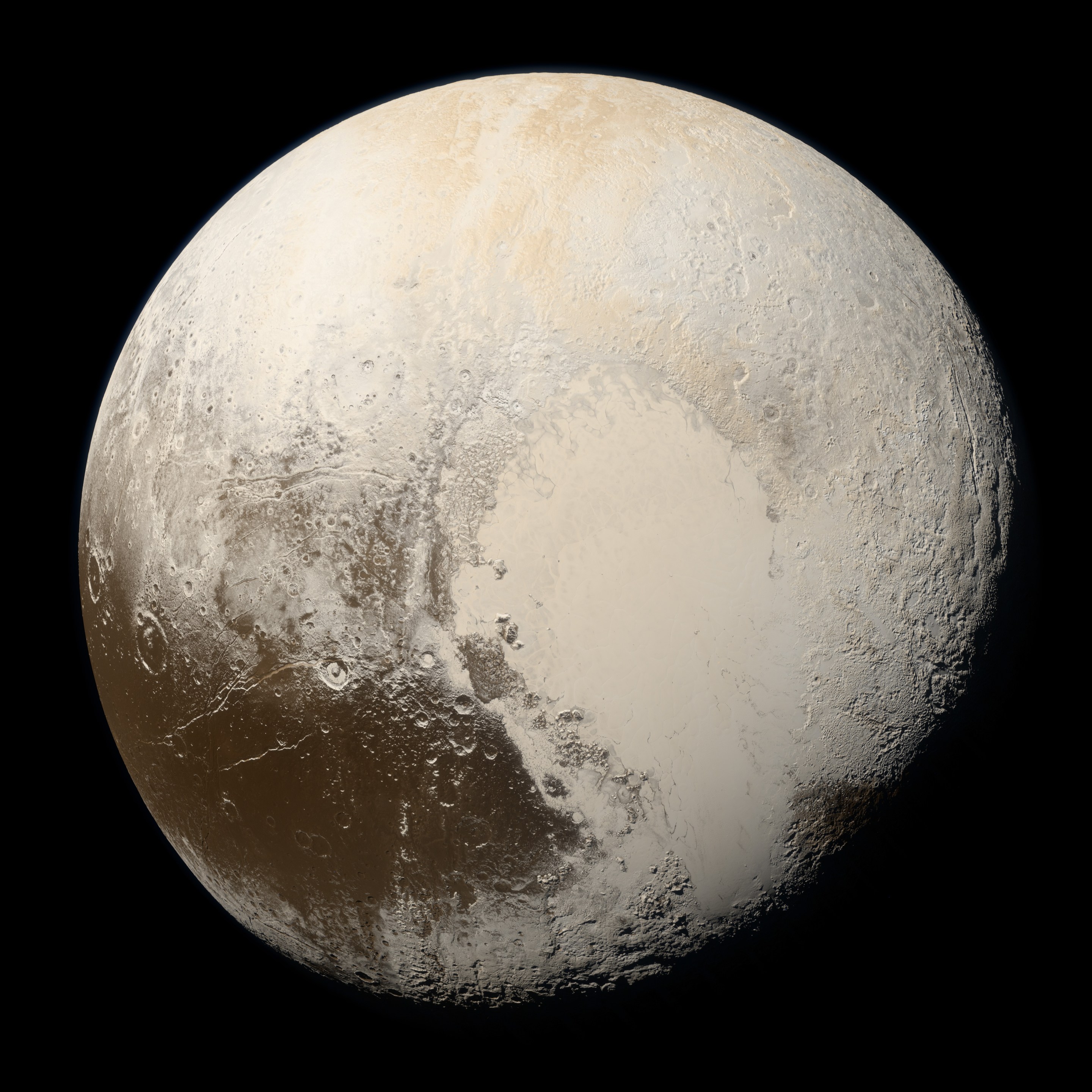
These dwarf planets don't have everything in common. Some are geologically active. Some have their own moons. (Pluto boasts both ... maybe.) Some have truly wild orbits. The IAU's definition was arbitrary, but any definition was going to be. Astrophysics doesn't care about fitting into a grade-school textbook. The IAU's new classification system was better in explaining the origin of these bodies, and describing the solar system as it actually appears. which is the important thing. But it made Pluto, which a lot of people have warm, nostalgic feelings for, and which we only first got a good look at a decade ago when New Horizons flew past, feel a little less ... special. We know for sure of nine, possibly 10 dwarf planets by this definition; we've found candidates for hundreds more; certainly there are thousands more in our solar system waiting to be discovered.
Does this make you think less of Pluto? Not me! I still think Pluto is cool and beautiful and mysterious. If I were going to tell a kid about a dwarf planet, you know I'm showing them Pluto's gorgeous face instead of Sedna's hideous ass. Pluto is just chilling. It doesn't matter what Donald Trump wants to call it. Hell, it doesn't matter what the IAU wants to call it. Pluto is Pluto, and it's doing fine.