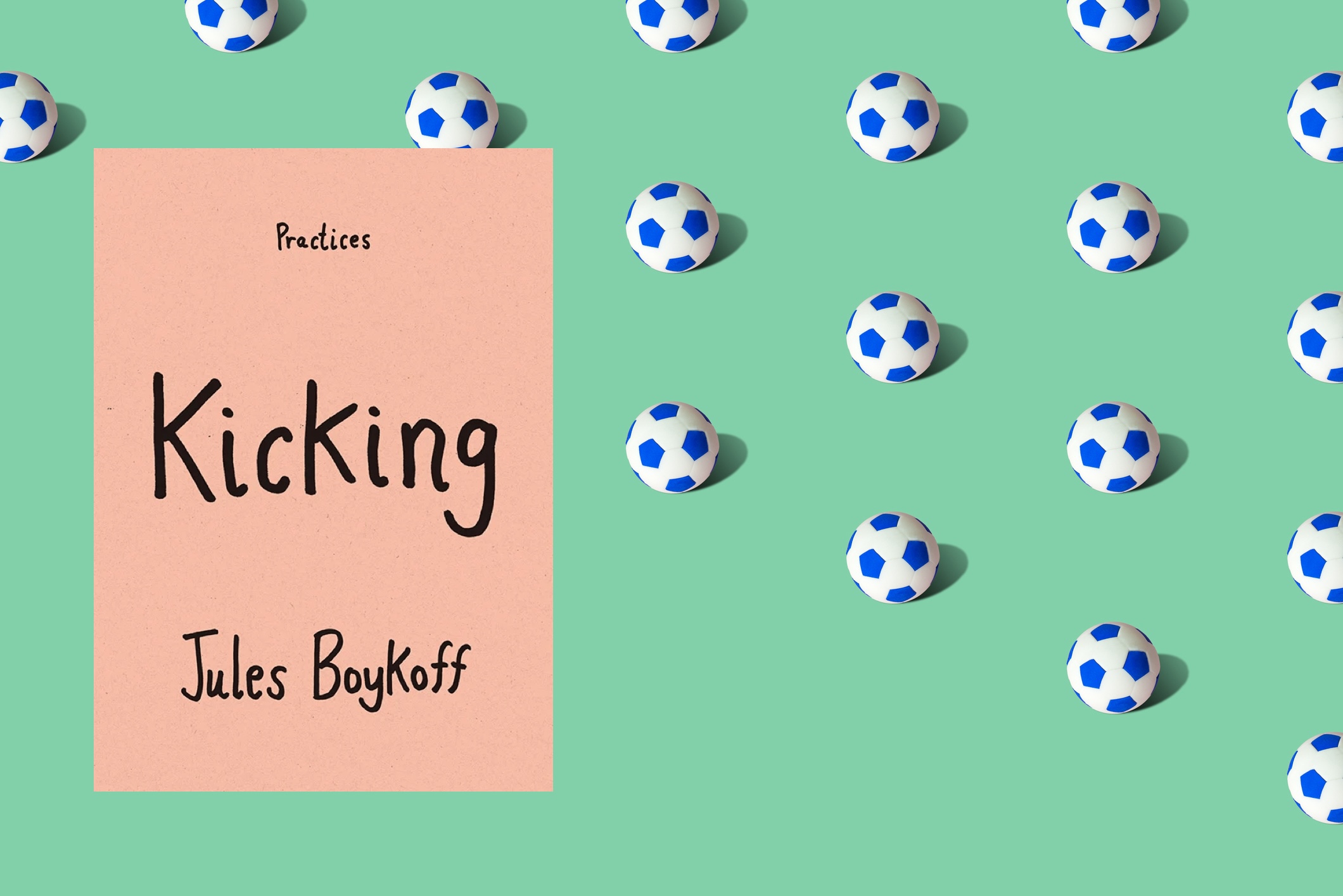
Jules Boykoff loves soccer. He loves the feeling of the ball at his feet, he loves the rush of cheering on the Portland Timbers at the fortress that is Providence Park, and he loves the knowing hum that goes around a stadium when a player delivers a little moment of sublimity that isn't flashy enough to make the highlight reel. "It's a collective recognition of the tiny acts of soccer intelligence that make the game glow," he writes in his new book, Kicking. "If you know, you know."
In the same breath as Boykoff loves soccer, he is honest about its flaws. It's no surprise that the poet and political scientist has focused a huge chunk of his academic and journalistic career on the sport. He writes that it was his experience receiving a "frosty reception" while playing for the U.S. under-23 national team in France in 1990 that led him to enroll in political science courses.
Kicking is a culmination of Boykoff's life and work thus far, a memoir that is as much about his own life—which has touched and been touched by soccer in many ways—as it is about soccer as a sociopolitical force in the world.
Boykoff scales soccer up and down. For his mom, whose body was warped by polio, her superactive son's love for soccer allowed her time for rest. "Soccer helped my mom survive," Boykoff writes. When he grew into a collegiate athlete, "friendship verging on kinship was the pulse of soccer's deeper meaning." Then, being a professional player was central to his social status. "Somehow kicking a ball held cachet," he writes. And soccer, too, "led to bad habits I work hard to kick," Boykoff writes, referring to alcohol addiction. Soccer, Boykoff seems to say, is never nothing, even at the smallest scale.
Boykoff has a gift for distilling a common experience in a way that makes it feel fresh and familiar all at once. I was especially struck by his description of flow, the psychological state which he describes as "stretching fully into the contours of the present."
"Sometimes, as I began the scoring sequence, time would thicken, decelerating into slow motion," he writes. "…Mind and body clicking in rhythm. The inverse of alienation." This was far from my first encounter with the concept of flow, and I've experienced it many times in my life (playing soccer, cooking, writing, crafting). But it is something to read about the experience from the perspective of a former elite athlete whose life was once dedicated to reaching the extremes of what bodies can do, his mind trained inward, attuned to both the aches and the ecstasy.
Boykoff also has insights into the totally unrelatable—to me, at least—parts of being a professional athlete. His self-conscious descriptions of the helpless, ruthless desire that fuels elite athletes beyond their literal physical breaking points evoke Georgia Cloepfil's The Striker and the Clock and Mac Crane's A Sharp Endless Need. The competitiveness required for the job feels of another species, and the confidence does too. "In soccer, self-doubt is corrosive. It precludes the possible," he writes, going on to say that now, as an academic, "I wrap everything around the axle of doubt."
That doubt sits alongside the certainty of love as the dual pulse of Kicking. In the memoir-manifesto, he tackles greenwashing, a particularly pervasive kind of "ersatz moral hygiene" that the most commercialized parts of the game invoke all too often to sell themselves to soccer fans who care about being good to the planet, and to each other. FIFA, for example, claimed that the 2022 World Cup in Qatar—an event that involved building eight new air-conditioned stadiums—would be carbon-neutral. A group called Carbon Market Watch found that in making those calculations, it "ignored enormous sources of carbon, underestimating emissions by a factor of eight." Plus, Boykoff writes, "FIFA’s sustainability claims are highly reliant on superdubious carbon offset schemes." He also digs into sportswashing, the Olympics' habit of regularly displacing communities, and plenty of other related evils.
And he does it ruthlessly. A sentence in his greenwashing chapter, after explaining how soccer's global governing body's claims of sustainability are hogwash, is memorable for both the image it conjures and the point it makes: "Verifying FIFA-style sustainability is a bit like trying to buy Bigfoot with a bucket of Bitcoin: Insisting the transaction is real does not make it so."
Boykoff's "ethic of optimism," which rhymes with Rebecca Solnit's Hope in the Dark, is woven throughout Kicking. It is because of his critique, of his honest evaluation of soccer's monied interests, that I believe him when he writes grandiosely hopeful things like, "The sporting depredations of the millionaire and billionaire classes will one day come to an end."
However, as each new insane headline reminds us, that day is far away. Kicking discusses the match made in hell that is Gianni Infantino and Donald Trump, but because of how long the academic publishing process takes—the book is published by Duke University Press, as part of a series called "Practices"—doesn’t mention FIFA's latest machinations like awarding Trump the FIFA Peace Prize and gouging fans on 2026 World Cup match tickets. Not to worry: Boykoff has another book coming out this month focused on the disaster that this year's World Cup already is. There is nary a sports critic who has earned the descriptor “prolific” more than Boykoff.
And Boykoff's portfolio is impressively consistent. He is a fantastic example of how not to succumb to one of the most seductive pitfalls journalists and academics fall into: the veneer of objectivity, the terribly presumptuous assertion that it is possible to set aside one's own experiences and circumstances and evaluate the world with a god-like indifference. Boykoff's writing is deeply honest about his own positionality, and always in service of the betterment of the world, unwilling to accept it as it is.
This extends beyond his writing. In Kicking, Boykoff describes his participation in the Timbers Army's Iron Front protest against fascism in 2019. He writes about when he was "tear-gassed and hit with pepper balls" in 2020, after the murder of George Floyd. During his soccer career, he worked for a nonprofit that served people experiencing homelessness.
Eventually, new tidbits sprinkled throughout the book—"Robin Hahnel, the eighty-year-old anticapitalist economist with whom I have regularly been attending Timbers matches since 2011," for example—stopped coming as a surprise. When I read that line, I let out a chuckle: Of course this guy goes to soccer games with an octogenarian anticapitalist economist. Who else? And then Boykoff ends that paragraph about Hahnel with a sentence that, in few words, describes what it is to share attention and care for a common cause with a friend: "We have been—and something tells me we forever will be—facing in the same direction."
He is at his best in these moments of poetic concision. "There’s a hummingbird in her heart and it flies with mine," he says of his wife Kaia Sand, who is also a writer and activist. Kicking is many things, a love letter to his family and to football perhaps most of all.
Where the book does occasionally suffer is when Boykoff defaults to a more academic register. "Soccer gifted us with voluptuous parcels of free time, space where we could forge an incipient politics," he writes of his playing days. "Life’s perils, pratfalls, and faux pas melt from consciousness," is one of his descriptions of the aforementioned flow state.
But as much as indulgent sentences like these irked me, I grew to appreciate them insofar as they are symptoms of Boykoff's seeming total freedom in writing this memoir. Kicking is about his deepest expertise and passions, and it is deeply pleasurable to read a skillful writer and thinker in his element, who is committed to making his love for soccer accessible to all.
Another fantastic effect of this freedom is the inclusion of countless quotes in the memoir. Boykoff is clearly well-read and the fun he was having while writing Kicking—his own intellectual playground—comes through.
Sometimes, he explains soccer with other people's words, whether or not that was their original speaker's intention. "There are a lot of things that don’t matter, and they add up," wrote poet Robert Fitterman, and Boykoff applies it to the thousands of microfactors that determine the outcome of a soccer match.
Particularly memorable are the quotes from poets, activists, and writers about how true social change is made. Emily Dickinson's "Tell all the Truth but tell it slant" sets the stage for his recounting of how FC Barcelona was a vessel for transgressive political expression under a repressive regime—a particularly great chapter that exemplifies sportswriting's power to teach about the world. Boykoff uses economist Milton Friedman's theory that in the wake of a crisis, "the actions that are taken depend on the ideas that are lying around" to declare his hope that public ownership of sports stadiums will one day take hold. For good measure, Boykoff also cites Zendaya, Taylor Swift, and Bob Marley—he is unpretentious in his excitement to share other people's ideas.
As soccer accompanies us along the widening cracks of our human-made disasters, it is imminently useful to have a figure like Boykoff in the public discourse. He writes, "Soccer has helped me forge the sometimes capacious delta between me and we. It has helped me metabolize the mayhem. It has helped me breathe." For those of us wondering if the world's monied powers will ever loosen their claws on our beloved sport, I think Kicking can do the same.