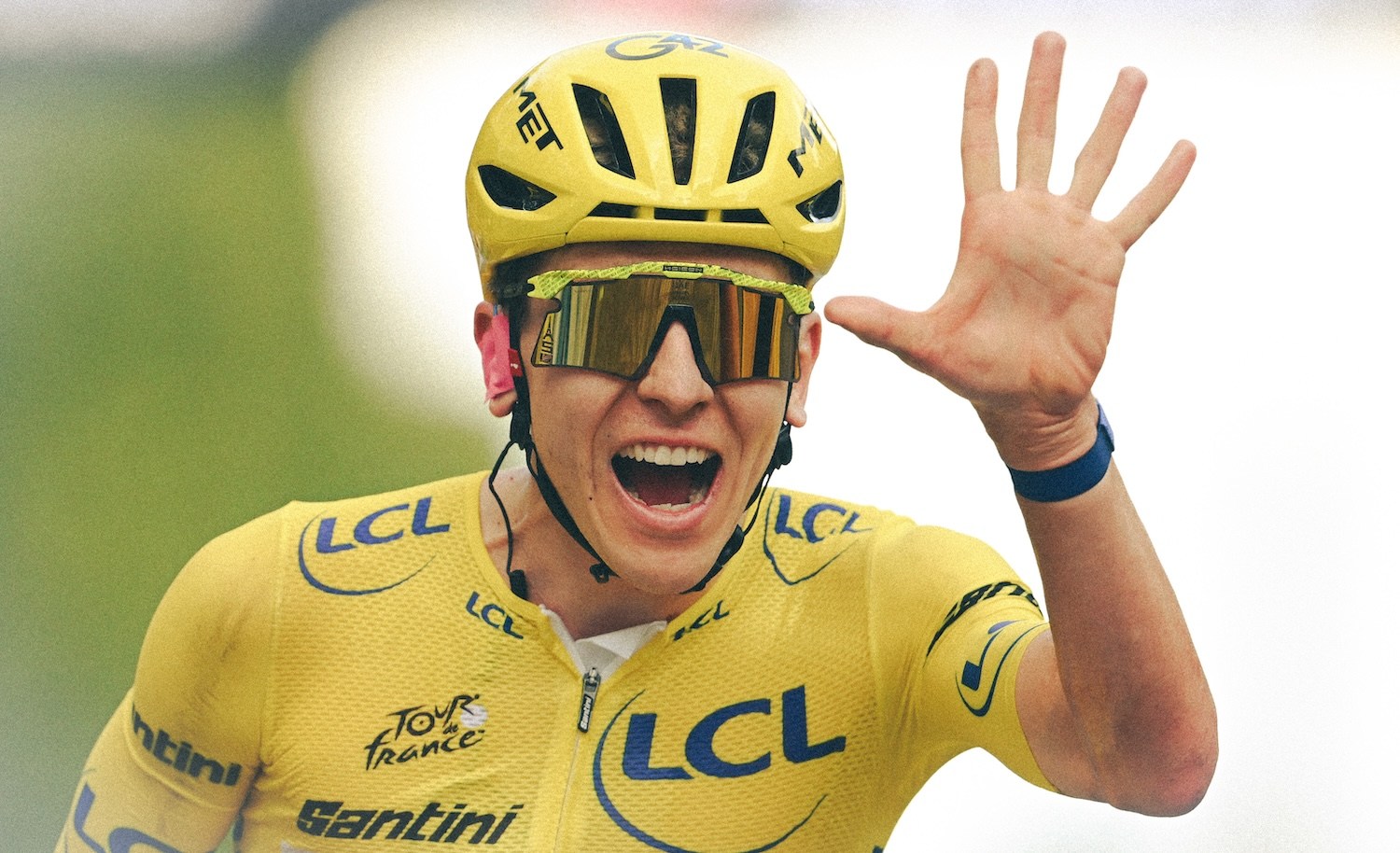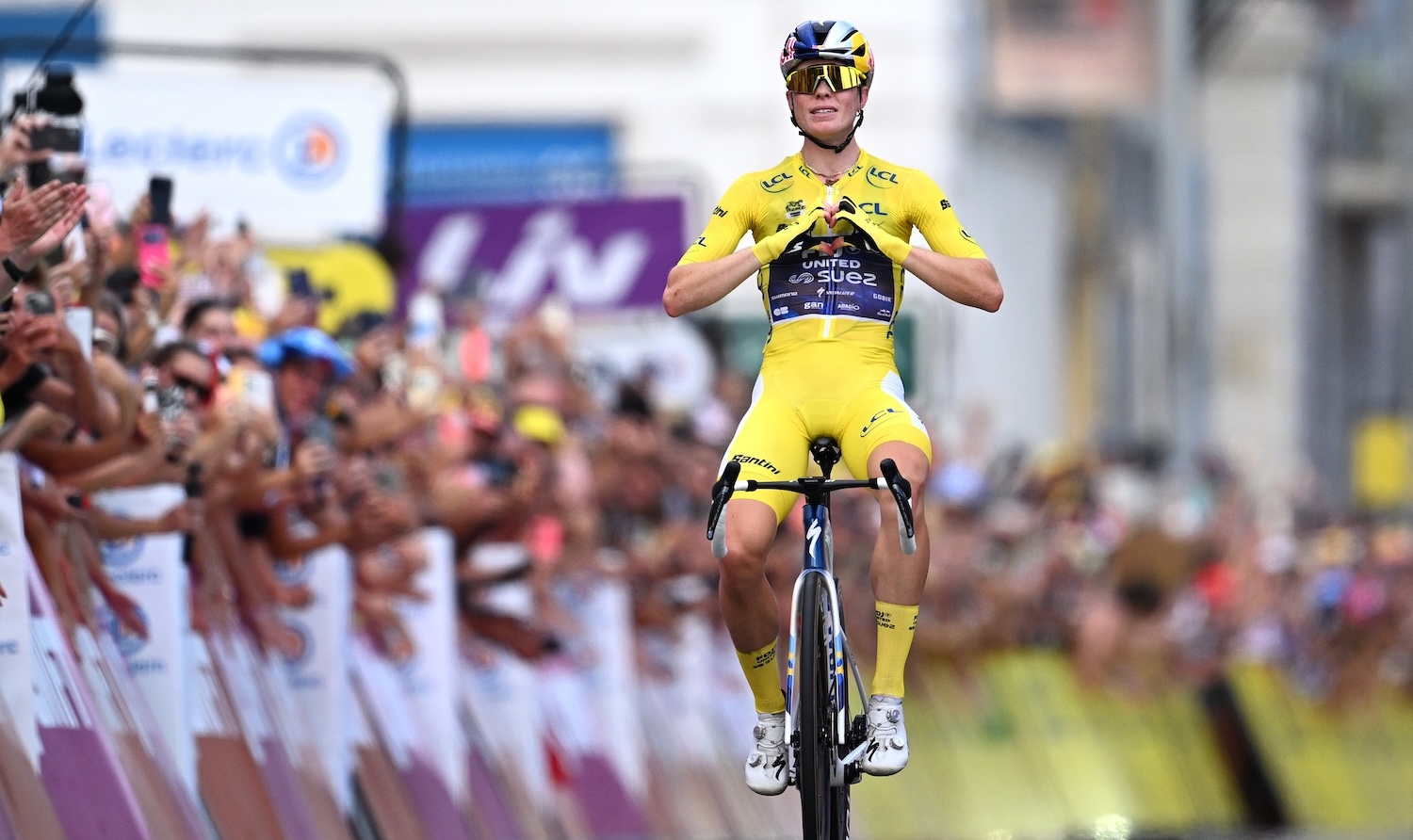

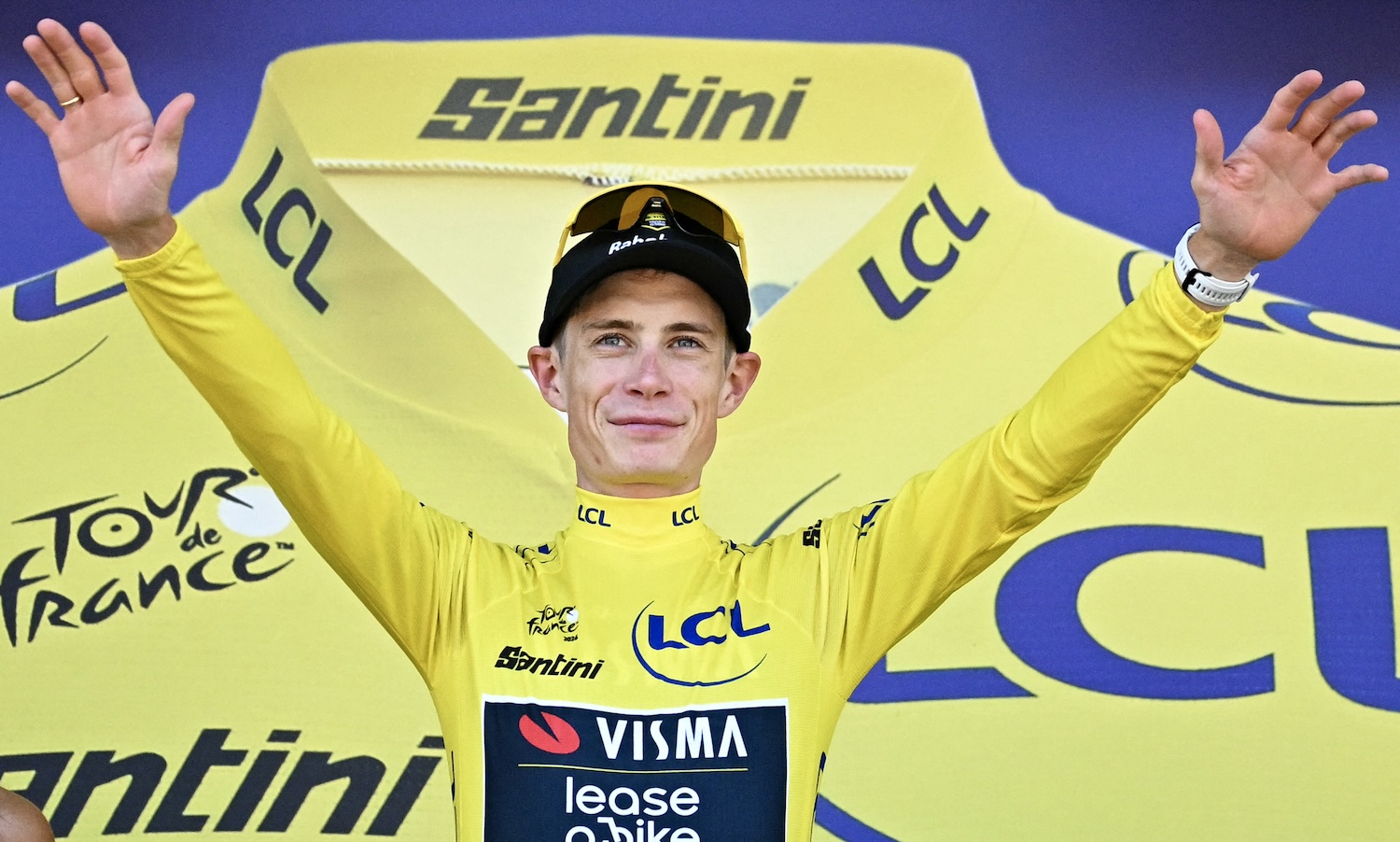
BARCELONA — "Every swarm needs a face," declares the post announcing Visma-Lease a Bike's new bee mascot, "and every face needs a name." Confusing proclamations aside—the defining characteristic of a swarm is its facelessness—the opening stage of the 2026 Tour de France was one for the insects. As if to bless Visma for their honeycomb jerseys out of an oblique entomic solidarity, the swarm of cicadas nestled in the scrubby pines atop Montjuïc thrummed Jonas Vingegaard to victory on Saturday's Stage 1. The lanky Dane smashed the Côte du Stade Olympique to win a team time trial somewhat worthy of the name and don the yellow jersey for the first time in three years. The Tour is here, and it's off to the most fascinating possible start.
The strangest thing about the Tour starting in Barcelona has nothing to do with the city's Spanishness but rather its size. The Tour is the biggest deal in almost every town, village, and city it graces, but Barcelona, like Paris, is big enough to have a city's worth of people with other stuff going on. You'd have little idea the world's biggest bike race was about to come to town for three days if you'd walked around and checked the vibes in Eixample, Ciutat Vella, or any of the other touristy parts of town on Friday. If pressed to say what major world sporting event was about to happen, and you'd done the necessary walking around, you might say an Argentina World Cup watch party. Anyone stepping foot into the KFC whose doors open up as if in enfilade out onto the Sagrada Familia is not going be bothered to put down a drumstick and walk up Montjuïc in the heat of the day. The toasted gaggles I saw out still flickering past 7 a.m. the next day aren't concerning themselves with such a morning sport.
But the cicadas know. The Tour opened with a fascinating experiment, and an equally swarming Barcelona crowd greeted the race with enthusiasm, bravado, and bright pink faces, thanks to event security's confounding decision to take people's bottles of sunscreen at the start zone. I spent a chunk of the sweltering afternoon positioned about halfway up the final climb, thronged by fans, including, rather puzzlingly, a venerable old Dutch guy wearing an orange (?) Red Sox hat (??) sitting regally in a full-cushion armchair (???). Did he haul it up the mountain? Repurpose it from some local scrap heap? A nearby man helpfully pointed out that he was a big-shot sponsor, before proudly telling us that his son Tim Marsman was riding his first Tour in support of Mathieu van der Poel. Exclusionary VIP experiences are an inextricable part of the Tour, so I appreciate that even while this man was perched in a cushy, well-upholstered chair, he was doing so among the people.
He got treated to some great racing, which is not something I ever thought I'd write about a team time trial. Most time trials, team or individual, are unwatchable. A guy rides faster than another guy, separately, without truly ever racing them. Its usefulness as a force of competitive differentiation is only surpassed by its anti-theatricality. This year's team time trial was conducted under new rules that invert a classic form. Instead of the whole team getting the same time when the fourth rider crosses the line, the team starts together, but every rider gets their own time. This sets up a novel strategic paradigm, one where victory is determined by the degree of a team's strength, rather than the severity of their weaknesses. Teams had seven riders to burn in service of their leaders. They had to be selective about the circumstances of their incineration, with a technical, flat section through 14 kilometers of Barcelona streets serving as prelude to two hard climbs at the end.
Vingegaard was slightly slower than Tadej Pogacar on the final climb, but 12 seconds faster through the course, thrilling the crowd and raising the tantalizing possibility that Visma could take the fight to UAE over the next three weeks. Elsewhere, Trek and Red Bull had their leadership situations clarified, Paul Seixas crushed it, and the minnows of the Tour failed to swim in sync. The packed press room was thrilled about Vingegaard's win—that is, when we weren't being delighted by a France TV special where a reporter went to the beach to ask people about Seixas but got diverted by some horrifyingly sunburnt Brits.
The notion that Pogacar could seize the yellow jersey on Stage 1 and potentially wear it all the way to Paris was a depressing one for the cycling world. His last two Tours de France have been imperial. Stage 1 was suited for him, provided his sneakily dysfunctional team could get its act together enough to deliver him to a climb he was sure to fly up. But no, Visma was better. There was Vingegaard, racing past his teammates as they peeled off with their faces twisted in rictuses, settling in behind Matteo Jorgenson as he led him through the penultimate climb, then Davide Piganzoli as he set up the finale for his leader.
Vingegaard hasn't worn yellow in three years, since he won the 2023 Tour, though perhaps a more relevant way to restate that is that he hasn't worn yellow since his horror crash at the Tour of the Basque Country in 2024. That day, he was broken, twisted into a man-shaped pile of limbs with his collarbone shattered along with several ribs and his sternum, and each of his lungs punctured. That he finished second in the 2024 Tour is both a medical miracle and a testament to the size of fight in that particular dog. That he finished second again in 2025 shows his talent, but also the size of the task he has in front of him. That he won today means that the best cycling rivalry in decades is worth taking seriously again.
This is what makes Vingegaard special, and worth cheering for. Pogacar's two-and-a-half-year reign of terror has cast those two Vingegaard Tour wins in increasingly warm light. Beating Tadej Pogacar seems impossible, only it's already been done. For Vingegaard to do so for a third time would take both the decapitation of this new, ruthless version of Pogacar, and a full recovery from an impossible crash. "It's been a few hard years for me. For obvious reasons, I've been at times struggling in the last few years," he said. "Now I feel like I can close this chapter in the book. It will always be a part of my book, laying there on the ground believing that I'm going to die. And coming to this point is a bit emotional. When you're there on the ground you don't think about cycling, I just thought about trying to survive. To get the yellow jersey again is a dream coming true for sure."
The question is how long can he keep dreaming. What comes next will feel like a nightmare, with a heat wave bearing down on southern France. The race will leave Barcelona and head straight into hell, as temperatures are expected to eclipse 104 degrees Fahrenheit by Tuesday. Paris feels 1 million miles away, even if it's the only other city besides Barcelona where the Tour isn't everything. After a perfect opening stage, all we can do is settle down into various upholstered armchairs and watch.