

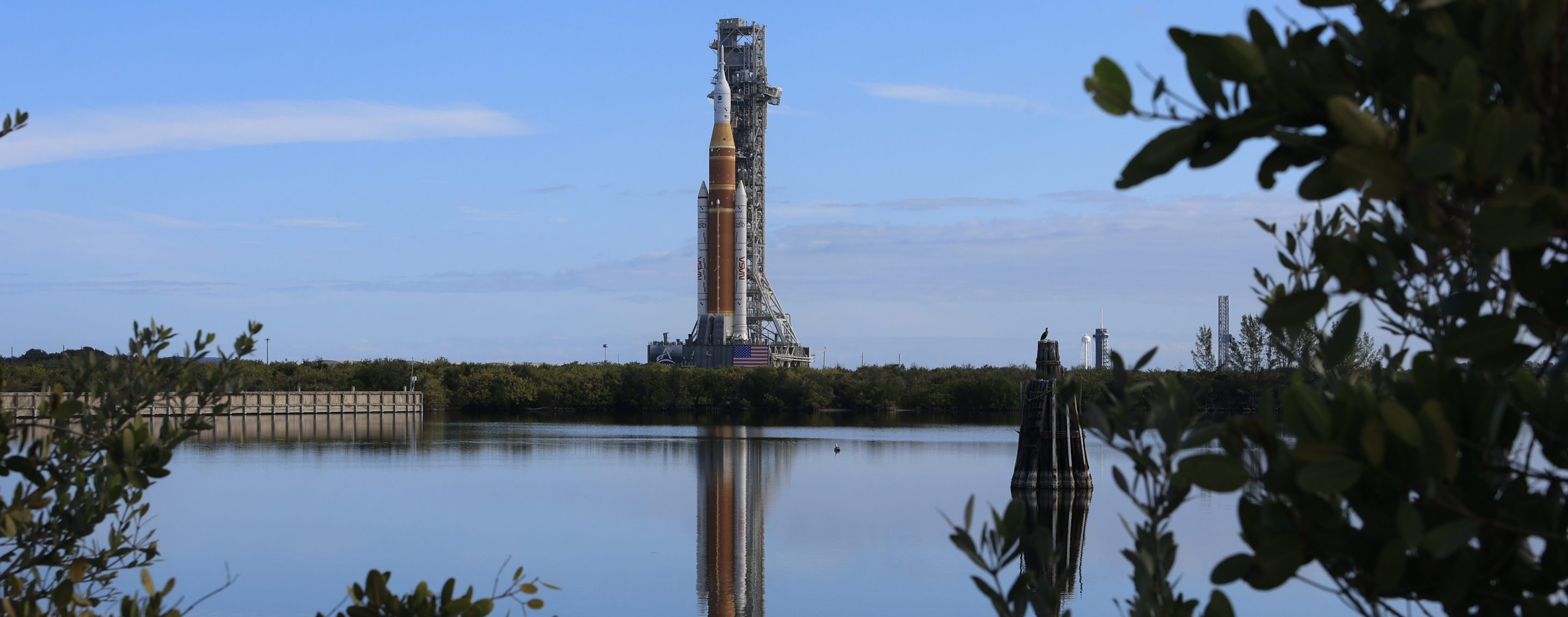

I am occasionally high-minded about space exploration. The quest for knowledge, the nobility of the human spirit, the inexorable call of the great void, blah blah blah. But then there are other times when I admit to myself that a sizable part of my interest is a simple, primal enthrallment at finding out just how big we can make a huge rocket before setting it on fire.
On Saturday in Florida, NASA wheeled out the assembled components of the Artemis II mission, which as soon as early February will take humans around the Moon—farther from Earth than humans have ever been. It was quite literally wheeled out, on a massive and purpose-built crawler, carrying the Space Launch System vehicle and the Orion spacecraft the four miles from the assembly building to the launchpad. It was a slow roll—about 1 mph—because that is one big honking rocket. Including the launch tower, that's about 14 million pounds being moved.
Just how big is this sucker? The SLS alone (the big orange rocket thingy) is longer than a football field. With its external boosters, it can provide nearly nine million pounds of thrust. It is the second-largest rocket to ever enter service, following Saturn V (Starship will be even bigger). It needs all this juice because it is going to put nearly 105 tons of mass into low-Earth orbit—and that's the easy part.
Artemis II will be the first crewed spacecraft since Apollo 17 in 1972 to visit the Moon. It will not land (that's planned for Artemis III, as soon as next year), but will instead have Orion orbit the Moon before returning its four-person crew safely to Earth. If you don't spend much time thinking about the scale of space travel, I do want to emphasize just how imposing a journey this is. Ninety-nine percent of launches limit themselves to low-Earth orbit, the first couple hundred miles of altitude above the planet. The International Space Station is 250 miles up. Most satellites orbit at about 500 miles. It takes a lot of rocket to put something up there. Now think about how much rocket it takes to get something from there to the Moon. Here's an actual, to-scale visualization. The grayish circle, tight on the planet, is low-Earth orbit. The red is where Artemis is going:
In the grand scheme of space, of course, the Moon is nothing. It's right there. It's a quick jaunt down the block to pick up some smokes. On the scale of humanity, it's a fairly mind-blowing trip. Artemis II will take 10 days from launch, to LEO, to lunar orbit, and back.
If all prelaunch activities go according to plan, and the weather is good, NASA's launch window opens up on Feb. 6, and dates have been selected through April—though only a few hours on each date will be possible. The specificity is necessary because Artemis needs a certain alignment of the Moon and Earth in order to complete the journey, which requires one highly eccentric perambulation of the Earth before using it as a gravity boost to head off into the blackness.
After one fly-by of the far side of the Moon within about 4,000 miles—which will put the astronauts farther from Earth than any of the Apollo crews ever went—they'll use the Moon's own gravity to slingshot back home at tremendous speed. So fast, in fact, that they'll utilize a "skip" reentry, initially skimming off the top of Earth's atmosphere to burn off speed, like a stone skipping on water, before ultimately splashing down in the Pacific.
This is a major mission, but to my casual-enthusiast eye, it feels like almost no one is talking about it. I can understand that. There's kind of a lot going on in the world right now. We're probably a little jaded by spaceflight, which is a victim of its own safety—it's coming up on 23 years without a catastrophe. And Artemis II will not land people on the Moon, which is probably the biggest drag of all to its being a bigger deal. We think in human terms, about humans. That's natural.
So perhaps I can do my part in drumming up some hype. Can I interest you in a really, really, really big Moon rocket?