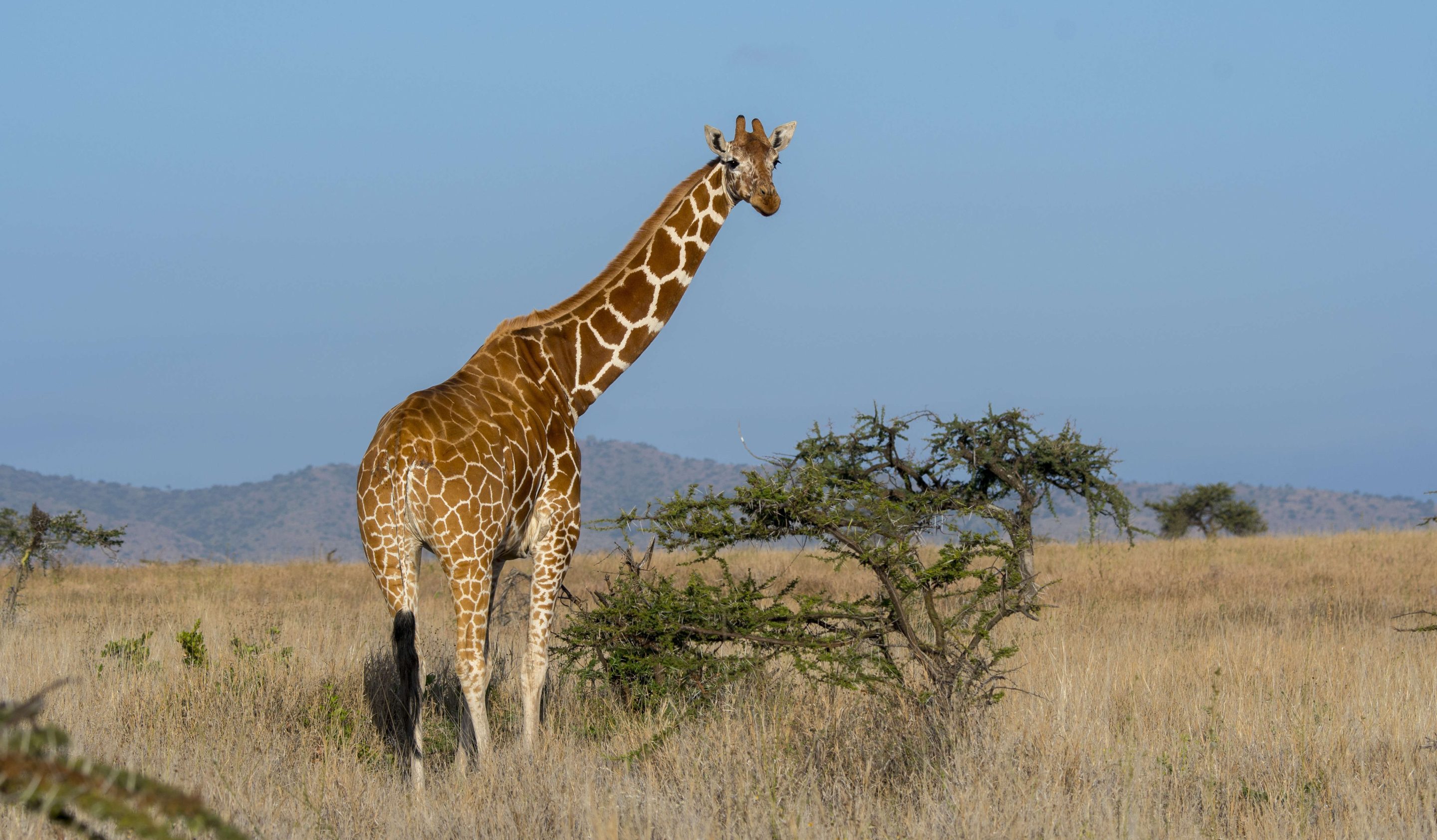
You may have heard that a giraffe named Gracie skipped town—"town" being the Cedar Hollow Ranch in Leakey, Texas. Gracie, who is estimated to be around 3 or 4 years old, had been living there since May. Gracie is a reticulated giraffe, a species known for their clean and geometric pattern of brown spots. The owner of the ranch, Vick Jones, told The New York Times that Gracie had wandered to a fenced corner of the ranch, which is nestled in a canyon, climbed a slab of rock to nibble on some trees, and then descended on the other side of the fence. From there she wandered in the Texas outback, oblivious that she had made headlines as a "runaway" and a "fugitive"—a giraffe "on the loose."
Although she occasionally popped up on game cameras from private properties in the area, Gracie dodged the authorities for nearly two weeks, leading Sheriff Nathan Johnson to decree, "In almost 30 years of being a lawman, this is my first escapee giraffe," per USA Today. There was a rush of AI-generated memes of Gracie enjoying the local sights. The giraffe was found four miles from the ranch after an extensive helicopter search, and Jones organized efforts to capture Gracie and return her to the ranch. Sheriff Johnson, upon sharing the news, reported that Gracie was found "fat and happy" and that "she had a 'catch me if you can, sucker' attitude."
It is funny to think about a giraffe wandering through Texas, just as it is funny to think about the search for said giraffe—perhaps nature's most obvious animal—taking two weeks. Sheriff Johnson, to be sure, is having some fun in his press conferences, whether his jokes are landing or not. But, as Kenny Torrella smartly pointed out for Vox, the reasons a giraffe like Gracie was in Texas in the first place are not so funny.
Cedar Hollow Ranch is not a zoo but a private game ranch that breeds exotic animals such as giraffes, zebras, and less famous ungulates such as bongos and kudus. Even the native species held on these ranches, such as white-tailed deer, are artificially bred for enormous antlers—the ungulate equivalent of a hyperventilating pug. When Torrella asked Jones why the ranch breeds giraffes, Jones said vaguely that he sells them to people who "enjoy having wildlife," meaning that he breeds giraffes so that ranches, roadside zoos, and rich people who want a giraffe can have one. Breeding ranches like Cedar Hollow exist to supply the approximately 5,500 ranches in Texas that house exotic wildlife. Around half of these privately hunt exotic animals, and around 500 are commercial hunting ranches open to the public. Torrella writes:
When I asked Jones if the other animals at Cedar Hollow — the exotic antelopes, deer, and sheep — are raised for hunting, he said, “No, we don’t raise any for hunting. … If they go someplace, and they wind up in that situation, that’s not on us.” However, Cedar Hollow’s owner said, in 2018, that these animals are bred for collectors and for hunting ranches.
This trophy-hunting industry emerged in the late 1920s, when a ranch called King Ranch obtained stock of an Asian antelope called nilgai from the San Diego Zoological Garden. "Nilgai are challenging to hunt, given their impressive eyesight, hearing, and sense of smell," the King Ranch website reads. "Depending on what the conditions dictate, nilgai hunts can be customized for still hunting, stalking, or safari style hunts." These hunts are, of course, designed to mimic the experience of hunting a nilgai in its natural habitat. But while the arid Texas terrain might serve as an acceptable substitute for the African savanna, the hunts are a pale imitation of the wild. At a trophy ranch, you are shooting an animal that is essentially in a cage, albeit a very big one.
Hunting advocates defend trophy hunting for its role in conservation: The billion-dollar business of breeding and hunting exotics can help ensure the species' survival in the wild, the argument goes. The ranches are permitted by the Fish and Wildlife Service to offer certain threatened or endangered animals to be hunted if they donate some percent of their proceeds to conservation programs. Animal advocates resist this framing, arguing that the real benefactors of the trophy hunting business are the private ranch owners who stand to profit from the hunts. In this business, you can't kill if you can't pay. At the Ox Ranch in Uvalde, which has a whole catalogue of exotics you can kill, it's $7,500 per nilgai, $28,000 per kudu, and $50,000 per bongo. Ox Ranch also has giraffes, but they are off-limits to hunters (as are the ranch's kangaroos). They even get names, like Buttercup. Instead, Ox Ranch's giraffe encounters are listed under a baffling trio of "Activities" options: "tank driving & shooting," "machine gun shooting," and "hand-feed giraffes."
Although it seems there is currently no commercial hunting ranch in Texas that offers up giraffes for the public to shoot and kill, it is totally legal to buy your own giraffe and shoot it privately, provided you have the right permits. The biggest barrier is the cost. The decisions these ranches make about which animals are pets and which are prey are totally arbitrary; kangaroos are not even endangered. But animal advocates, or even the general public, would likely be more outraged to see a father-son duo posing over the carcass of such an iconic or familiar animal rather than something less cute and recognizable, such as a nilgai. Of course the animals we decide to protect are the ones we like most.
The fact that Gracie was able to escape at all seems indicative of conditions of captivity that would not pass muster if these ranches were to be assessed are rigorously as zoos are. Ranch owner Jones told the Times that this is not his first giraffe jailbreak: Several young male giraffes once fled during a storm, only to return. Escaped exotics have become a fact of life for Texas authorities. "I’ve had wildebeests, I’ve had water buffalo, I’ve had monkeys, I’ve had zebras all go missing," Sheriff Johnson told The Dallas Express. "Sometimes we recover them, and sometimes we don’t."
This week, veterinarians in a helicopter shot tranquilizer darts into Gracie and waited a few minutes until she collapsed, sedated. "She fell gently on a safe, good spot," Pat O'Neil, a local veterinarian, told a local ABC affiliate. A crew of people then blindfolded and harnessed the giraffe, reversed the sedation, and led her into a trailer. The happy-go-lucky headlines recommenced, with CBS News declaring "Gracie the giraffe is finally home." Gracie, a giraffe whose historic range across Northeast Africa has been reduced to fragments of Kenya, is certainly not home. She is simply back at the ranch, where she will remain, probably, until somebody buys her. And what happens after, in the eyes of Cedar Hollow Ranch, is no longer their business.