
Like the universe itself, the United States tax code is ever-expanding, and no one can claim to know its exact size. There are statutes enacted by Congress; implementing regulations issued by the Treasury Department; rules from the Internal Revenue Service explaining how other rules apply to specific circumstances; and a patchwork of court decisions that may or may not supersede everything else, depending on who you ask. All told, these impenetrable documents could total 40 million words. Imagine 700 copies of Masters of Atlantis, stacked six stories tall.
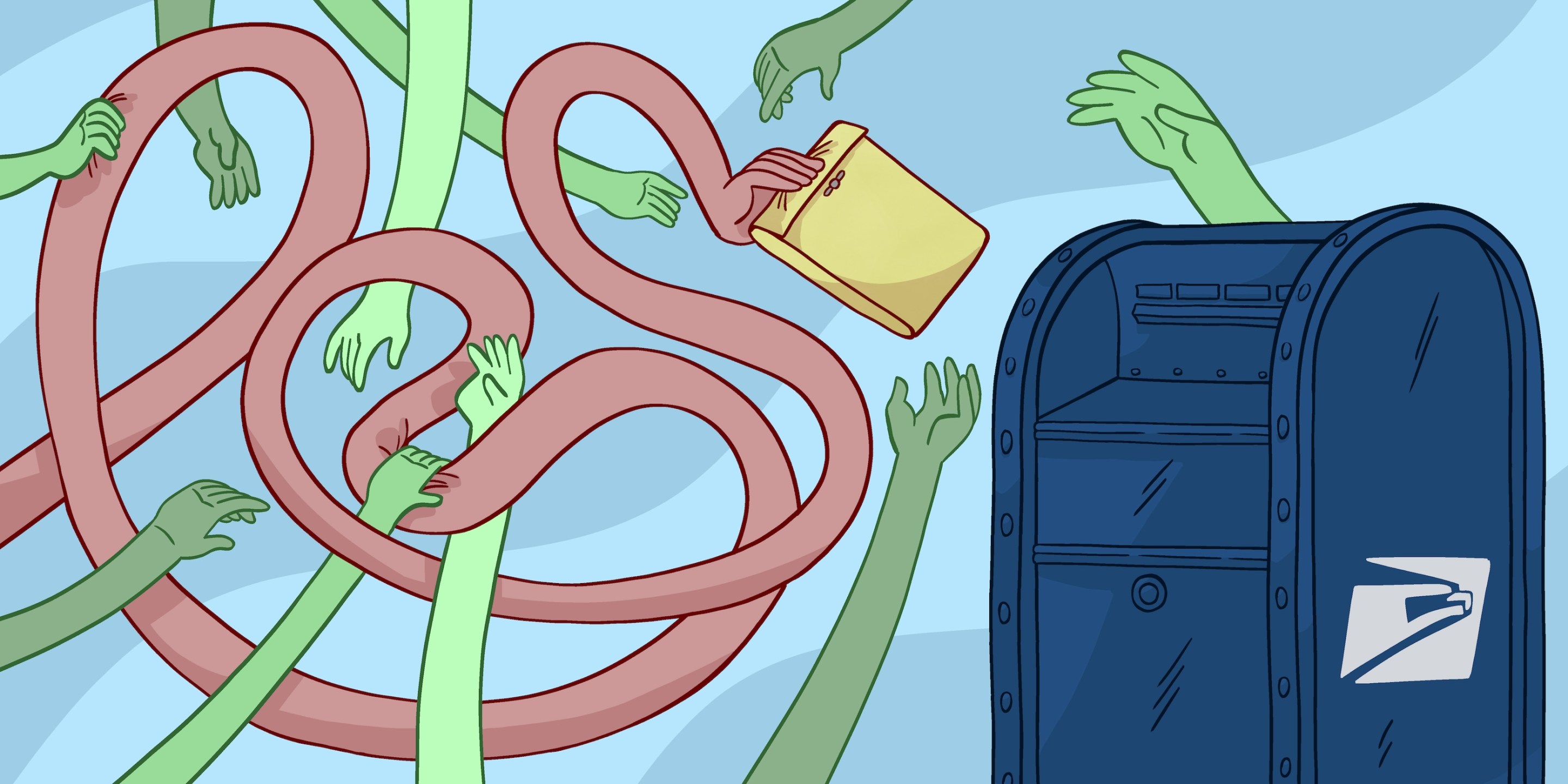
In dozens of other countries, governments make it easy for people to navigate labyrinthine tax laws. Ordinary wage-earners receive a pre-filled return from the state, and they can either sign or dispute it. Americans have different, decidedly worse options. We can white-knuckle our way through a mess of hard-copy paperwork, pray we didn't make any errors, and file via mail. Or, if we want the convenience of calculating and submitting our returns electronically, we can pay a tax-prep monopolist to do it for us.
This is lunacy. Find the nearest third-grader. Tell them they have homework, and they will be sent to prison if they don't complete it. Then explain that the best way to do so requires spending money, perhaps several hundred dollars, on homework-submission software. They would, quite justifiably, lose their mind. Adults, on the other hand, have grown numb to this kind of petty extortion, spending an average of 13 hours and $290 on filing their taxes, each and every year.
From 2022 to 2024, a small team of misfit technologists inside the federal government tried to create an alternative. Overcoming political opposition, industry lobbying, and a civil service still traumatized by the calamitous rollout of healthcare.gov, they built a first-of-its-kind platform called Direct File that helped Americans file their taxes from a phone or computer. The software was free and easy to use. Some 98 percent of filers walked away "satisfied" or "very satisfied." The government built something that actually worked—and the following year, the Trump administration killed it. Direct File was not brought down by runaway costs or technical fiascoes. It was murdered for no good reason at all, a victim of reactionary ideology and corporate self-interest.
This is a story about why we can't have nice things.
Merici Vinton was raised in the Sand Hills of Nebraska, where she rode a horse to a one-room schoolhouse every morning and wrote letters to Ronald Reagan urging him not to start a nuclear war with the Soviet Union. After studying Russian in college, she worked in the U.S. Embassy in Moscow, tasked with delivering sensitive diplomatic missives to Vladimir Putin's deputies by hand.
The experience inspired Vinton to make a career out of modernizing stodgy institutions—raging against the machine, and then figuring out how to reinvent the machine. In 2021, she returned home after a decade in the United Kingdom and joined the United States Digital Service (USDS), a small team of outside technical experts enlisted to fix and improve the government's online tools. Moving to Washington, she was astonished by how many agencies were still working with the digital equivalent of prehistoric hammerstones, including the IRS.
"I had no idea it still wasn't possible to file your taxes electronically with the government," Vinton said. "Right away, I was thinking about Direct File."
Electronic tax filing has long been considered the white whale of civic tech. In the early days of his presidency, George W. Bush proposed an "easy, no-cost option" for online filing. Pitched as a commonsense idea with huge political upside, it instead stirred up a minor congressional insurrection. A group of eight conservative House members, whipped into a frenzy by lobbyists for the nascent tax-software industry, penned a menacing letter warning the administration that any such program would be illegal and ill-advised. The lead signatory was California Republican Randy "Duke" Cunningham, whose district was home to Intuit, the company behind TurboTax. (Cunningham was later imprisoned for accepting millions in bribes from defense contractors.)
Chronically underfunded and fearing retaliation from Republicans, IRS leadership blinked. They agreed to negotiate with the biggest players in the tax-prep industry, reaching a compromise in 2002. A consortium of companies, known as the Free File Alliance, would provide free-filing services to at least 60 percent of taxpayers, and in exchange the feds would be barred from pursuing their own e-filing platform.
Hailed by some as a model public-private partnership, the arrangement was in fact doomed from the start. The free software was riddled with bugs, and users struggled to save their progress. It was also difficult for people to qualify. Each company was only required to serve a small fraction of the 60-percent target, allowing them to exclude groups most likely to use the product, like retirees, active military, and workers earning less than $10,000. The companies weren't obligated to advertise Free File, and they also could use it to hawk paid "upgrades." Participation peaked at 5 million filers in 2005; only three percent of eligible people ever participated.
Despite these shortcomings, Free File shambled along, and the tax prep industry maintained its stranglehold over policymakers on Capitol Hill. In 2019, Democratic Massachusetts Rep. Richard Neal advanced an amendment to enshrine this shambolic arrangement into law, permanently barring the federal government from developing its own free-filing system. Two weeks later, ProPublica reported that the largest tax-prep companies were deliberately hiding their Free File webpages from search engines.
Among those companies was Intuit. For years, it had spent many millions advertising a different service called "TurboTax: Free Edition." This version of the company's software was unregulated, and seemingly designed to maximize confusion and rage. The goal was to trick users into upgrading to a paid offering; almost without fail, if users didn't select a free option directly from the IRS website, they would be asked to pay at the end of their filing process, with no way to downgrade without losing hours of work.
Ultimately, the Treasury Inspector General for Tax Administration would find that 14 million taxpayers—in a single year—were bamboozled into paying for these "free" services, resulting in a $1 billion windfall for the software companies. (In 2022, Intuit agreed to a $141 million settlement with low-income taxpayers who were unfairly charged; three years later, H&R Block settled a complaint with the Federal Trade Commission for $7 million.)
Neal's amendment died in the Senate. In late 2019, ProPublica's reporting, coupled with pressure from lawmakers, led the IRS to revise its agreement with the Free File Alliance. Under new terms, there could be no more deceptive advertising, and no more hiding free products from public view. To keep the companies in line, the government also reserved the right to produce its own e-file system. In July 2021, Intuit pulled out of the alliance completely, citing "limitations" and "conflicting demands." This left a million low-income filers in need of a new option, and created an opening for the government to build something of its own.
When USDS engineer Chris Given first heard the news about Intuit, he couldn't sleep. "I was vibrating for a week," he said. During the pandemic, he'd worked with Vinton to solve a thorny tax problem. Congress had expanded the child tax credit, authorizing monthly checks for low-income families. But millions of people couldn't receive those checks: The IRS didn't have their tax status on file, because individuals earning less than $16,000 aren't legally required to file anything.
Given and Vinton helped build a new portal for non-filers to claim their cash. Along the way, they came to see that America's social safety net has been absorbed into the tax system—and that every year, the neediest families were unknowingly leaving billions of dollars in credit and deductions on the table. For Vinton, building something like Direct File was a moral and practical necessity.
Given didn't disagree. But working at more than a dozen government agencies had chastened him. Given considered Reinhold Niebuhr's "Serenity Prayer" to be essential reading for any civic technologist: Grant me the serenity to accept the things I cannot change; courage to change the things I can change; and the wisdom to know the difference between the two. The tax-prep lobby was too powerful, and no one in Washington was willing to expend the necessary political capital. "Chris told me I was crazy and wrong, and that it was impossible," Vinton said.
"But when Intuit left the Alliance, I realized maybe Merici was right," Given said.
That November, high-ranking officials in the Biden administration reached the same conclusion. They convened an interagency policy council, which is fed-speak for "a series of meetings held around a very big table." Some of the president's allies strongly supported an e-filing option, but others were paranoid. "We were shadowboxing with healthcare.gov," said Julie Brinn Siegel, deputy chief of staff at the Treasury Department. The botched rollout of the federal health insurance marketplace in 2013 still haunted a generation of technocrats. "The IRS has a zillion customers," Siegel said. "If you failed, it was a big failure. We had to get leaders ready to take a big risk."
While officials wavered for months, Vinton and Given quietly assembled a team inside USDS. They needed mavericks—engineers and designers delusional enough to believe that Direct File was not only doable, but doable within an ever-shrinking window of time. They needed people like Paul Eriksen, a loose-cannon engineer only a few months into his tenure at USDS.
Eriksen had either quit or been fired from every government assignment to date, because he deemed them either too boring or too fascist. "I don't like being told what to do," he said. Before entering government, he'd bounced between jobs, following passing fascinations. He built software for state courts, fire departments, accounting firms, and a short-lived cryptocurrency startup. ("Crypto is a fucking scam," he now admits. "It's all degenerates.")
Given tossed Eriksen's résumé in the trash, but Vinton urged him to reconsider. Eriksen was a character fit. He grew up poor in Toledo. When he was young, his family bought a computer with their tax refund, and it made him into an engineer. "My mom sacrificed repairing the roof, insulating the windows, fixing the walls, all in hopes that one of her weird-ass sons could be something other than a factory worker," he said. "I wanted to build a tax system that works for people, that doesn't make them hate themselves. I wanted to get people their money.”
Eriksen, three other engineers, and four product designers built a working prototype of Direct File in just eight weeks. Treasury officials were astounded. They were conditioned to expect memos, not demos. But they were also preoccupied with other things. Republicans in Congress went to war over the debt ceiling, and then–Treasury Secretary Janet Yellen had to consider whether to mint a trillion-dollar coin to avoid a national default. Russia invaded Ukraine, and the Treasury Department was suddenly tasked with freezing foreign bank accounts and seizing oligarchs' mega-yachts. The Biden administration was also struggling to advance its flagship spending bill through a deadlocked Senate, and they worried about drawing fire from influential tax-prep lobbyists. Direct File, they decided, was no longer worth the trouble. The team was disbanded and shipped off to far-flung corners of the federal bureaucracy.
But in August 2022, the ground shifted again. Senators Chuck Schumer and Joe Manchin signed a back-of-the-napkin agreement to advance a $750 billion tax, energy, and healthcare package; three weeks later, the Inflation Reduction Act was signed into law. Buried inside the 800-page spending bill was an unexpected line item: $15 million to study the feasibility of Direct File. There was also a catch: The team would need to be reconstituted inside the IRS.
It was May 2023—eight months until tax season—and the Direct Filers had been summoned to an all-day kickoff meeting with no agenda. Around 8:30 a.m., their minivan pulled up to the IRS Enterprise Computing Center, a 379,000-square-foot data complex hidden among the apple orchards and hospice houses of Martinsburg, W. Va. The sprawling facility is home to every taxpayer's financial data, as well as the cabal of information-technology executives who could each singlehandedly make or break Direct File.
The team was apprehensive about moving to the IRS, which is a famously difficult place to build things. Its technology is dated and maintained by a tangle of Beltway contractors, the protocols are strict and onerous, and the leaders are stuck in a "permanent defensive crouch," according to Given, who talks about the agency like an anthropologist. "Everything the IRS does is a potential source of criticism, founded or unfounded," he said. "So there's a lot of risk-aversion. They don't move unless they all move together, because it is a culture that has experienced perpetual onslaught for decades."
The workshop began with a series of excruciating icebreaker exercises, immediately revealing a cultural divide. The insiders were hierarchical and formal, all seemingly dressed for a funeral. The outsiders were weird, brash, and overly familiar. "One half of the table was reciting their career journeys," Vinton said. "We were talking about dead parrots."
After 90 minutes of team-building, the IRS executives led a crash course in the agency's IT architecture, which resembled a corkboard in a conspiracy theorist's garage. "They had this big-ass printout that looked like a Waffle House placemat. It's covered in lines and boxes to represent all the systems. But they weren't able to explain any of them," Eriksen said. "Things went completely off the rails."
Given hoped to salvage the day and win over his counterparts with a dazzling presentation on his working principles. He had learned from the healthcare.gov disaster, and Direct File would be different. They would operate more like a private-sector company: start small, make gradual improvements every week, and test those features in real time with taxpayers. They would control every facet of the product, rather than relying on a web of overpaid, do-nothing contractors. Their code would be made public for anyone to scrutinize. And 99 percent of the important decisions would be made by one authority: Bridget Roberts, an IRS veteran who had spent the past 20 years solving problems and fighting to improve taxpayer services.
Almost nobody in the room took them seriously. "We were seen as zealots," Eriksen said. "The highest-level executives all thought that we would fail, that there was no way to understand everything and get this accomplished within our timeframe. It would take years to finish."
Their doubts were entirely reasonable. As an official IRS platform, Direct File needed to translate the full complexity of the tax code into computer code, and it couldn't make any errors, because it would become a source of legal truth. It needed to ask questions that no other software asked, and capture rare circumstances that private-industry providers never bothered to consider. There are, for example, at least two and possibly three legal definitions of what it means to be 65 years old. There are children who do not qualify as children, dependents who are not dependent enough, and married couples who are not permitted to file jointly. "The U.S. tax code covers literally every scenario," said Matt Bowen, one of the team's engineers. "There is a rule for when your child is kidnapped. The month they were kidnapped determines whether you can claim a certain deduction. Then, there's another rule for if the kidnapper kills them."
Each designer was responsible for a single element of the tax code, like the earned-income tax eligibility or head-of-household status. Over days or weeks, they would read through every relevant form, regulation, pamphlet, FAQ, and court ruling—hundreds, perhaps thousands of pages of legal arcana—then determine what information was required to make those judgments. Their work resulted in a bank of 800 possible screening questions, written in plain language, then approved by multiple lawyers, that could elicit any fact they could possibly need to know about a taxpayer. "Our designers got really good at it," Bowen said. "They started winning tax-law arguments with the IRS attorneys."
With those questions mapped, the engineering team built a program called FactGraph, masterminded by Given. Their goal was to ensure filers received every dollar they were owed, while asking them as few questions as possible. FactGraph made smart inferences. With a handful of basic facts about a user—things like age, marital status, income sources, and family members—it could create a list of potential filing statuses, credits, and deductions. If more information was required to make those final determinations, it would ask a few targeted follow-up questions. At the end, the software calculated the tax bill or refund, then double-checked that none of the questions it skipped could've changed the answer. The result was an accurate return, completed without any unnecessary interrogation.
While the engineering was elegant, that was never the biggest concern. "People enter the Digital Service bright-eyed, thinking they'll write some code and things will get better. But that's never the problem," Given said. "It's always about people or process."
Throughout the build phase, Given kept a running list of the "top five reasons that Direct File could die this week." There were usually more than five. The IRS human resources department was too slow to onboard outside talent. IT was reluctant to grant access to key systems. Another agency bigwig had deemed the effort a needless risk, or another congressional appropriator threatened to defund Direct File in the next budget package. But state participation usually held the top spot on the list.
The U.S. has a two-layered tax system. Nobody wants to use software that can't handle both federal and state returns. To succeed, the Direct File team would have to convince at least some of the country's state and territorial governments to connect their own tax-filing portals to a new federal platform.
That summer, a delegation attended the Federation of Tax Administrators conference in Providence, where they "cornered every tax administrator, from every state in the nation." Nobody wanted to make eye contact with them. Most states had already set their budgets and schedules for the following years. Officials were loath to be associated with an effort they expected to fail spectacularly. Given and Vinton could only convince three states with an income tax—California, Massachusetts, and New York—to participate in their experiment.
Autumn arrived, and morale was flagging. The team was running out of time to publicly announce its pilot. Members were pulling 80-hour weeks, but they still weren't meeting their benchmarks. Building new software for the IRS is like constructing an office building: There are dozens of cascading sign-offs and permits required before anyone can occupy the space. But every inspector seemed to be dragging their feet, disappearing from the job site for weeks at a time.
The entire team traveled to Washington for the first onsite in September. Eighty employees sat awkwardly in a conference room, some expecting to be cut loose. Eventually, Given rose from his chair to deliver a bizarre message: Their team had been stationed on a strange planet; they were running out of oxygen; and there was no guarantee they'd survive. He borrowed a monologue from The Martian, delivered by Matt Damon after a young astronaut asks what to do when it seems you will die in space. "You just begin," he explained. "You do the math. You solve one problem. Then, you solve the next one, and the next, and if you solve enough problems, you get to come home."
"It was a depressing way to motivate a team," Given admitted. "But they realized they weren't being led by a crazy person. We could all see the reality, and everyone had been afraid to talk about it, so we finally started talking about it." Their conclusion: It would be nearly impossible to launch.
The next morning, while the rank-and-file nursed hangovers, Given, Vinton, and Roberts met with then–IRS Commissioner Danny Werfel. Werfel expected a normal progress report. Instead, he was told that his legacy-defining initiative was falling apart, and it would not be able to go public by the end of the Biden administration's first term—at least, not at the present rate.
Werfel remained calm, but recognized it was time to break the glass. "I called in leaders from around the IRS and said this is a drop-everything moment," he recalled. "If you have a problem, we're going to address it. Find the solution, and get back to me in an hour."
"Things changed pretty immediately after that meeting," Given said.
Every morning, Given brought a list of must-complete tasks to the IRS chief information officer, who then pressured dozens of middle managers to read their emails, relinquish petty grudges, and make an effort, even a modest one, to solve the problems that were delaying the future of tax filing. The administrative backlog was cleared in eight days, dispelling any notion that the gridlock had been necessary or inevitable. All of that, Given realized, was a choice. Things really could change if people wanted them to change.
In January of 2024, against all odds, Direct File was ready to launch. Roberts emailed every IRS employee located in a state without income tax: They were seeking their first filers. Within a minute, she received a reply from Dixie Warden, a 37-year-old human resources clerk in Kyle, Texas. "She was our ideal user," Given said. "It was blind luck, divine providence."
Warden was a single mom and "not a numbers gal," in her own words. Her annual return was straightforward, but she feared she would lose her job if she made a mistake. She was barely making ends meet, but still paid somebody $400 every year to handle her paperwork. "Everyone has been convinced they're too stupid to file their own taxes, and they believe it," Vinton said.
On Feb. 1, Direct File embarked on its maiden voyage with Warden at the helm. Given sat beside Roberts, remotely monitoring Warden's screen while sweating profusely and clutching his bald head. An hour later, Given and Roberts embraced. Warden had submitted her return, on her own, for the very first time. She was crying on the other end of the videoconference. In the next room over, engineers hooted and high-fived like they'd landed a man on the moon. "As she signed and submitted her return, I realized that I had not let myself believe until that precise moment that we'd ever actually be allowed to file someone's taxes," Given said.
Fifteen minutes into the revelry, while champagne flowed, someone monitoring the system logs noticed something peculiar. The return had been completed, but not submitted. He found a typo in the most essential line of code, responsible for transmitting data to the IRS. It would only require a three-character edit, but it took all night to hit submit on the change—at the IRS, every technology executive at the agency must be summoned to discuss such things. "There were nearly 100 people on a call to push a hot-fix for an application with no users," Bowen said. But six agonizing hours later, Warden's return had been submitted and accepted. The thing worked.
The 2024 pilot was limited to "simple" tax situations, but it was a smashing success. More than 140,000 people across a dozen states submitted returns with Direct File. One in four users had been non-filers in the previous year. Fraud seemed to be a non-issue, due to burdensome ID verification processes; 94 percent of users preferred Direct File to their previous filing method, and 86 percent said it increased their trust in the IRS. For the first time in human history, tax administrators were receiving fan mail, rather than death threats. "We had retirees telling us they were going day-drinking to celebrate," Vinton said. "A guy in Texas completed his return in 24 minutes. We didn't even think that was possible."
Direct File was not only easy to use, it was also dirt cheap, built for $25 million—$90 million less than the IRS had originally budgeted for the project. (By contrast, the price of a single F-22 fighter jet is $350 million. The online health-insurance exchange responsible for the scar tissue that held up Direct File's development cost at least $2 billion.) The Government Accountability Office called it a success, and said it should be expanded. In 2025, Direct File would grow to cover 25 states, feature automatic W-2 importation, and reach many more filers. An internal IRS report would dub it "beloved by its users."
The team had bigger ambitions. In the future, they planned to support gig income, investment dividends, gambling earnings, and scholarships. At full scale, they calculated, Direct File could save taxpayers $11 billion every year—an average of $160 per filer—and unlock $12 billion in unclaimed benefits. Over time, the team hoped to build a one-stop shop for federal financial services, a platform that could simplify the process for applying for student aid, food stamps, or any other program that required tax information for enrollment.
"The unmet potential of Direct File was connecting people to other benefits on top of tax credits," said Suzanne Chapman, the project's lead user-experience designer. "Did you know you're eligible for SNAP benefits? If you don't already have them, go here to enroll today."
None of that came to be.
For a time, it seemed that Direct File would survive the Department of Government Efficiency (DOGE). Shortly after the election of Donald Trump in November 2024, Elon Musk and Vivek Ramaswamy were reportedly considering a government-sponsored mobile app for tax filing. (After that news broke, Intuit shares dropped five percent overnight, while H&R Block tumbled more than 10 percent). Their interest made some sense. Antiquated tax systems are responsible for nearly two-thirds of federal paperwork. Direct File could be held up as a win for government efficiency, even as DOGE went about its actual mission.
The earliest days of the Trump administration were also encouraging. Steve Davis, a Musk lieutenant, praised the program and the engineers who built it. Amy Gleason, the acting administrator of DOGE, told Vinton that Direct File "had the support of the administration." The Direct File team was thrilled. They'd happily allow their new overlords to claim credit for their success. They would even rename the platform "TrumpFile" if it meant they could survive a few more years and reach a few million more taxpayers.
Vinton and Eriksen had the ear of Sam Corcos, a healthcare founder deployed to the IRS by DOGE. He supported retaining Direct File, too, and even offered to promote Eriksen to chief information officer of the agency. But days after Corcos met with past and present members of the Free File Alliance, something changed. He began parroting industry talking points. "He said it wasn't cost-effective, it was too expensive, and we weren't growing fast enough," Eriksen said.
"He made it clear that Direct File would no longer have new investment, and they wanted to shut it down," Vinton said. "That's when I knew it was over." (Representatives of the Treasury Department and IRS declined to comment.)
It's impossible to say who shot Direct File, but singling out Corcos as a lone gunman strains credulity. After the election, the tax-preparation industry expanded its federal lobbying efforts. Conservative leaders rallied the opposition. A group of 30 House Republicans, led by Rep. Adrian Smith, urged President Trump to end the "unauthorized and wasteful" program, which "pose[d] a threat to taxpayers' freedom." Americans for Tax Reform, the influential group led by Grover Norquist, issued a foaming-at-the-mouth call for eliminating Direct File. The administration acquiesced, and in February, Musk posted (prematurely) that Direct File had been "deleted."
The One Big Beautiful Bill Act, signed into law in July 2025, ordered the Treasury Department to study the feasibility of various replacements. Later that month, Billy Long, an auctioneer and short-lived acting administrator of the IRS, claimed that "Big Beautiful Billy"—a reference to himself, apparently—"wiped out" the program. Republicans have long organized themselves around the principle that government sucks, and that public services inevitably, invariably suck, too. Confronted with evidence to the contrary, they had no choice but to bury the proof in the backyard.
Last October, the Treasury Department released a road map for replacing Direct File. The 28-page document is short on details, but the takeaway is clear. The federal government will try to breathe new life into the rotting corpse of the Free File Alliance, "enhancing" the same partnership that previously defrauded tens of millions of taxpayers. At some point, the Trump administration will convene a "modernization summit" with private industry, then write another report to follow this report, which will likely recommend another report for good measure.
Though Direct File shuttered last year, the dream of free and easy filing endures. Given, Vinton, and others have left the federal government, but continue laying the political and technical groundwork for a future comeback. In May, IRS engineers published the entire Direct File code library online for anyone to scrutinize and improve upon. "There are potential new entrants—I've met many of them—that are working on solutions and trying to figure out how to offer this free or at minimal cost to taxpayers," Werfel said. "Direct File may not manifest itself the way we originally envisioned, but it's knocking over dominoes and inspiring other people.”
Given remains a true believer. Once pessimistic about what Washington can accomplish, he now feels differently. "We took a pipe dream and made it a policy choice," he said. "It's no longer possible to say that Direct File can't be done." The government, he believes, can achieve more. It can attract world-class technical talent. It can build nice things for all to enjoy.
"You just have to decide," he said, "whether or not you want to do it."