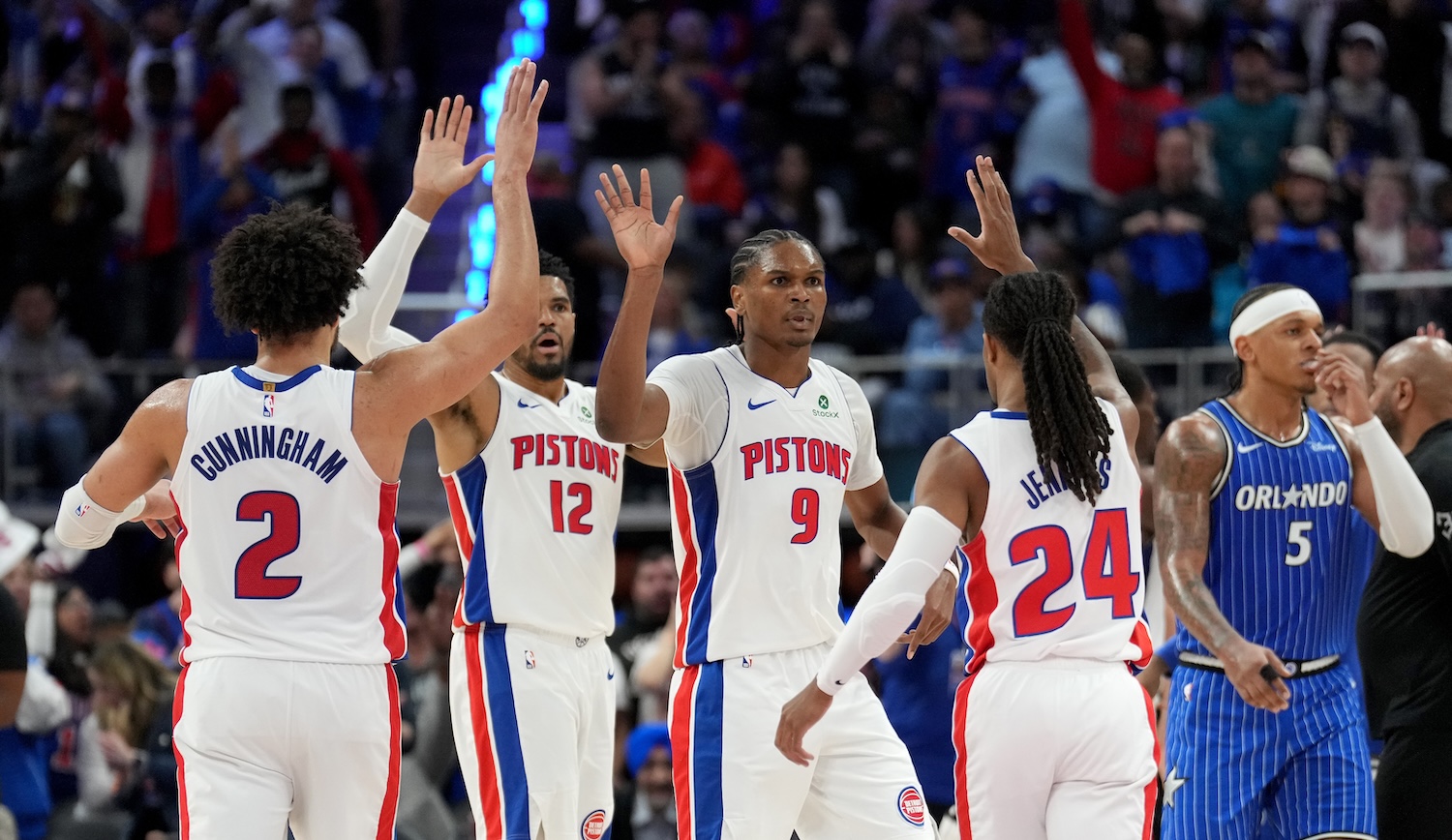
With a little under 10 minutes left in his team's Game 7 romp against the Orlando Magic, Cade Cunningham surveyed the floor. Like a wounded animal making a violent lurch, the exhausted Magic defense chose to attack, springing a double team. Cunningham calmly beckoned forth Javonte Green, who clanked a wide-open three. Detroit rebounded the miss, the ball came back to Cunningham, and the Magic sprung an even more desperate double team.
This time, Cunningham knew exactly where it was coming from, dribbled away from it, and, impervious to the pressure of two on-ball defenders and rotating help, eyed both the basket and the two far-side shooters that Tristan da Silva could not simultaneously cover. With his eyes, Cunningham manipulated the Brazilian-German into leaping out toward Duncan Robinson at the top of the key, then lasered a perfect pass to Daniss Jenkins in the far corner. Bucket.
The top-seeded Pistons took the long way to their first playoff series win in 16 years, digging themselves into and out of a 3-1 hole to win a triumphant, comfortable 116-94 Game 7 at home. The narrative arc of the series began with a collapse and ended on a graceful recovery. Detroit was awful through the first four games of the series, falling far behind a team whose players seemed only to have learned how to play together in the second play-in game, and looking like the worse team by a startling margin.
Plenty of groups take a game or two to get into the rhythm of a series, but having your All-NBA center exposed for the world to laugh at by Wendell Carter Jr. is not a rhythm thing; it's a full-blown crisis. Having your teamwide lack of shooting kneecap your offense from the tipoff of Game 1 is not the sort of thing that can be waved away as the product of something like chance or jitters. Simply put, after the first four games of the series, the Pistons looked like frauds. The buffet of slander options was generously stocked: regular-season demons, injury-luck merchants, so bereft of normal offensive firepower that a Kevin Huerter injury presented a legitimate worry.
The issue is that Detroit, despite winning 60 games and playing the Knicks super tough last year, did not profile as a playoff riser due to a concerning lack of two-way players (or, viewed another way, a bounty of one-way players) as well as a style that relied on outhustling opponents on defense and on the glass. In the playoffs everyone is trying hard, and suddenly that Daniss Jenkins second-side stuff stops working, Duncan Robinson's presence on defense starts to become a problem, and Ausar Thompson's lack of presence on offense also starts to become a problem. It's hard to win while covering gaps like that. If you can’t ride two horses at once, you shouldn’t be working at the circus.
Three big wins later, the question is: What changed? For one, Jalen Duren finally destroyed Carter Jr. The one thing that didn't go right for the Pistons in Game 7 was that they didn't get any production from their usually great backup center spot, but it didn't matter because Duren was such a force. His 15 points and 15 rebounds were both series-highs, and his offensive rebounding was especially troublesome for Orlando. Though Duren didn't record a block on Sunday, he walled off the rim, getting vertical anytime he was challenged. He helped his team hold the Magic to 14-for-32 shooting in the paint; Orlando made only three (which is crazy) of only seven (which is crazier) attempts at the rim.
As for the unfortuante Magic, Orlando's woes started where they always seem to: the bottom half of Franz Wagner's leg. A calf injury suffered late in their gritty Game 4 win kept Wagner out for the three subsequent losses, forcing Paolo Banchero to shoulder a larger burden of Orlando's offensive creation. Banchero was mostly great, scoring 45 points in a Game 5 duel with Cunningham, but a 4-for-20 stinker in Game 6 doomed the Magic in their lone home game in the back half of the series. Wagner's absence made the Magic play slower, more predictable offense, which thus allowed Detroit to dictate terms.
When the Pistons are operating at their best, scoring on them is a foreboding task. They are always flying into passing lanes and hawking the ball, and if you get to the rim, they have one of the game's most technically proficient shot-blockers in Isaiah Stewart and a reliably sproingy, huge verticality ace in Duren. Thompson's lurking omnipresence suffuses possessions with a sense of pressure. They will beat the shit out of you, making it increasingly difficult to score as the game goes on. Despite what I said about Robinson earlier, they make it onerous to try and isolate him with a high activity level behind the play, pre-switching or blowing up actions early. Cunningham, unlike many star ball-handlers, is a high-level defensive playmaker and needs no special accommodations at that end. He hunts drivers and would-be finishers. The Pistons are good at everything except not fouling, which is by design. Detroit held Orlando to an NBA anti-record 19 points in the second half of their Game 6 comeback.
In Game 7, the Pistons once again smothered Orlando. The Magic were so desperate to score that they ran off of a bunch of Detroit's makes and switched their rotation up so the more offensively inclined Moe Wagner got backup center minutes. None of it mattered. Sunday's only worrying stretch for Detroit came in the fourth, after the Pistons relaxed. Banchero scored an efficient 38 points, but he was clearly going to need to eclipse 50 for his exhausted team to have a chance: He had half of Orlando's points through three quarters. Tobias Harris made Banchero sweat for those points, playing him well enough one-on-one that the Pistons only briefly had to resort to double teams.
Speaking of Harris, he had his best game as a Piston, with 30 points, nine boards, and three steals, shooting well from three and capably running the show when Cunningham rested. Game 7 could be argued as the Tobias Harris Game, and I wouldn't object. If Duren isn't cleanly winning his matchup, the Pistons' offense can get pretty waterlogged unless Harris or Jenkins step up; when they hit shots, as they did on Sunday, everything gets unlocked.
By "everything," I of course mean Cunningham. For as great as Harris was, this was once again Cunningham's show. Cunningham scored 45 in the Detroit's Game 5 win, followed up that masterclass with a crisp 32-point, four-steal performance in Game 6, then capped the series off with 32 points (on just 18 shots) and 12 assists in Game 7.
Cunningham's back-to-back-to-back season-saving performances showed what makes him such a special player. There's no speeding him up in the half-court. Spring a double team, and he'll jag into the space without needing to breathe out of his mouth. Give him a runway and he'll attack, waiting to see which weak spots the defense exposes before striking them. One thing Orlando did well in the series was their combination of switching and going under screens, which ceded wide-open threes as a way to pay for covering the back end. Cunningham hit 11 of his 18 threes over the final three games.
What the first play shown in the story highlights is a disparity in temperament. The Magic are harried and frantic as they flail to get the ball out of Cunningham's hands, which never shake or sweat as Cunningham cuts through them to make the smart play. It's not effortless, though it may appear so. It's masterful.
Detroit's ambitions extend beyond winning a tough series against the eighth seed, and even having been forced to the brink by a team that spent much of 2026 in varyingly open stages of rebellion could be seen as a disappointment. That's fine. It's ultimately inconsequential. The Pistons got through, and that's all that matters. They might even be better off for it. They have had a playoff crisis already, and though they nearly collapsed, they wound up banding together and forcing their way to an ultimately impressive set of wins.
The Cleveland Cavaliers, who later Sunday night dispatched the Toronto Raptors in a Game 7 of their own, await. Duren will be further tested, as will Detroit's defense. But however that goes, whatever the Pistons turn into, they are not frauds.