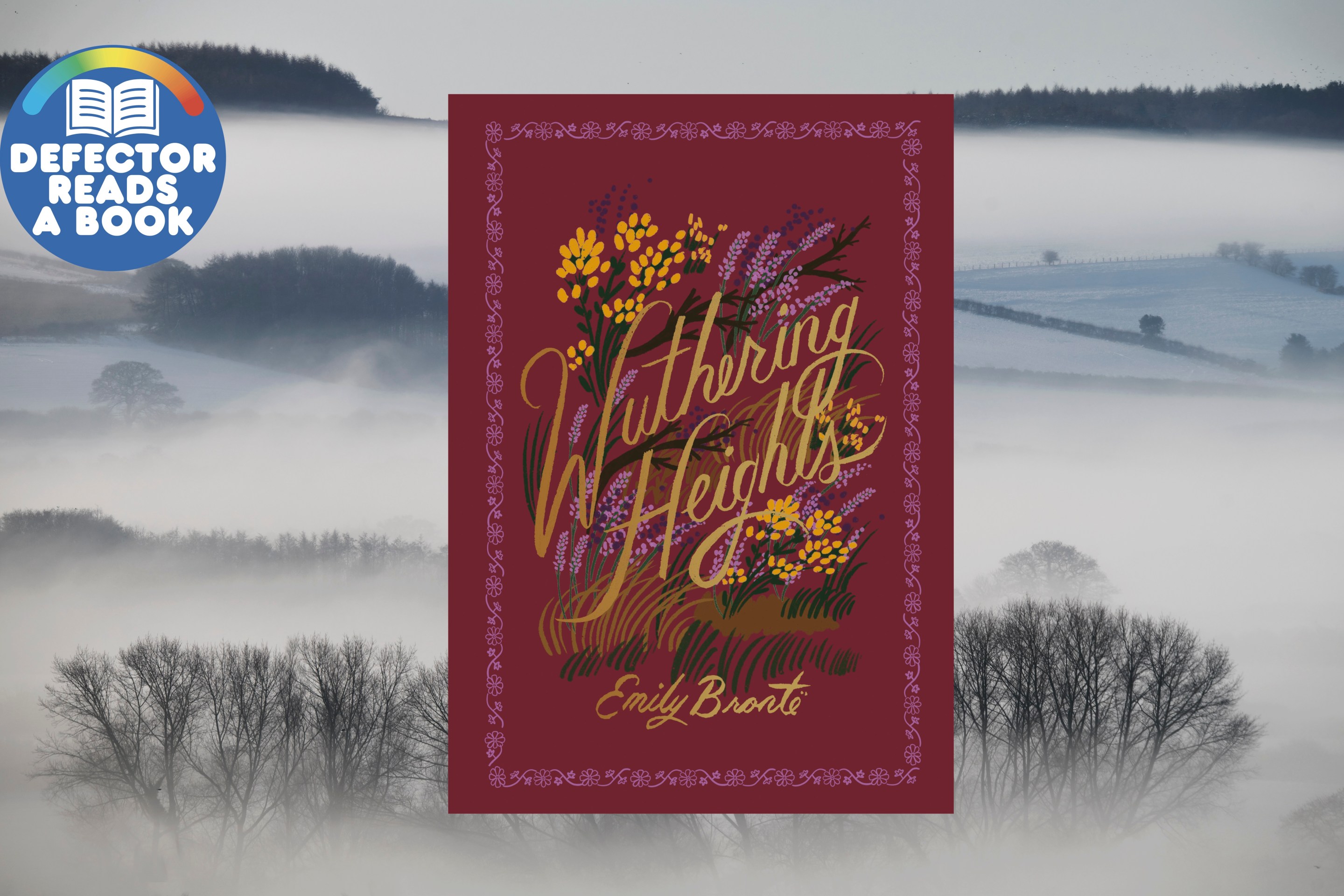


Wuthering Heights is always a stranger book than you remember. This holds true whether you last read it in high school, or a month ago. There is always some weird detail, some brutality, some incomprehensible human interaction that you overlooked. Everyone remembers the ghost of Catherine Linton at the window, pleading to be let in, but do you also recall how our gentleman narrator “pulled its wrist on to the broken pane, and rubbed it to and fro till the blood ran down and soaked the bed-clothes”? Catherine’s famous declaration about Heathcliff—“Whatever our souls are made of, his and mine are the same”—sticks in the mind, of course, though years and Instagram quotes have a habit of turning it into an expression of romantic sympathy, instead of what it actually is: a description of the total obliteration of sovereign selfhood. You might have held on to a vague sense that there are a lot of dogs in this book, but do you remember that one of the dogs is named Skulker? Or that Skulker the dog has a son, named Throttler?
One of the things I hadn’t remembered was how little we are told about the environment around Wuthering Heights and Thrushcross Grange. This is particularly strange, given that I always think of it as a novel deeply concerned with setting. If you had asked me a week ago how much of the book is dedicated to long and detailed descriptions of the West Yorkshire countryside I would have answered “quite a lot,” and I would have been wrong. We get a bit about Penistone Craggs (“bare masses of stone, with hardly enough earth in their clefts to nourish a stunted tree”), some river sounds, a lot of fog, but not a whole lot else. We think about Wuthering Heights as a novel about place, but it is better described as a novel about not knowing your place. Foundlings rise, sons are brought low, servants are hilariously emboldened, and the path between one house and the other is sometimes obstructed. Lockwood, our narrator, is out of place—you get the sense that he was meant to appear in a comedy of manners but got lost along the way. The reader is often equally confounded, between the multiple Catherines and Lintons and general sense that everyone in this book is stark raving mad.
Wuthering Heights is always a stranger book than you remember because it actively resists your comprehension. It is, in fundamental ways, a book about things we do not and cannot know. This goes back to the inciting event—we are never told why Mr. Earnshaw brings an unnamed orphan back from Liverpool. We are never given a clue as to Heathcliff’s origins, or how he makes his fortune during his three-year absence.
The moors remain mysterious and, crucially, we aren’t really ever shown or told how Catherine and Heathcliff fall so calamitously in love with each other while they are out there. That they run along the moors as children is meant to stand as explanation enough for the subsequent destruction of everyone and everything around them. Emily Brontë is not particularly interested in why things happen, she is writing about the consequences.
Which goes some way to explaining what Emerald Fennell failed to capture. I can’t top what Chris has already said about the film, but to my mind, the problem is that Fennell wanted to make a movie about motivation, about the motivation of desire in particular, but Wuthering Heights is a book about compulsion. Catherine and Heathcliff do not want each other any more than lightning wants a tree. They are not driven by the whims of the body. In the end, both of them stop eating and refuse having bodies at all.
And I too am compelled: to return to this strange book I barely understand, time and time again, always finding something I’ve overlooked. - Brandy Jensen
Brandy: Obviously this was not my first time reading Wuthering Heights. What about you guys?
Kelsey: It was not my first time reading it, either, but it had been a long time since I read it last. When I was younger, I spent a lot of my time rereading books that I liked, so I would guess this was my fourth time reading it, but my first time in maybe eight or nine years.
Brandy: Did you also find it a stranger book than you recalled?
Kelsey: Extremely. I had completely forgotten (for example) about Heathcliff digging up Cathy’s grave! I think also because I am a better reader than I was 10 years ago, I was much more captivated by the narration choices in the book, which are also incredibly strange. It’s such an untidy book—plenty of narrative strands never tie up, we don’t get the answers to some major questions, the actual ghost doesn’t return again—and I was riveted by this.
Maitreyi: It was not my first time reading Wuthering Heights—and I actually don’t think it was a stranger book than I recalled. My tastes were different as a high school junior, so I disliked it precisely for its strangeness! (I also stupidly felt the need to pick “teams” and was very Team Charlotte as a teen.) But I could appreciate the strangeness more this time around.
Brandy: It is an insane book to assign to teenagers, I think because the characters are largely driven by the kind of emotions children experience. They throw tantrums and imagine their feelings are the only thing in the world that matters. I think you need the distance of adulthood to find that interesting rather than irritating.
Maitreyi: The word “feral” came to mind a lot.
Kelsey: I remember, as a teen, really disliking many of the characters, and I think your read is exactly right. The characters of Wuthering Heights just do whatever they want, which is infantile and deranged and fascinating to read about. There are really so many tantrums! I cannot believe that Nelly managed to work for this insane family for so many damn years.
Brandy: I guess the biggest question about this book, and one we will have to address eventually so why not now, is: Do you find it romantic?
Kelsey: This is going to sound so dumb, but I found everyone’s relationship to the space (the moors, the houses, the path between the houses, the little rooms they lock themselves in to cry) incredibly romantic. Between the characters, I think it is mostly obsession, which I guess is a form of romance to some people. That said, I was pumping my fist when Heathcliff did his “Be with me always—take any form—drive me mad! Only do not leave me in this abyss, where I cannot find you” speech.
Maitreyi: Yes, Kelsey. There is that Virginia Woolf line about Wuthering Heights, that there is love in it but “not the love of men and women”—something more awesome and terrifying than that. I think there are some words used interchangeably with romance that might apply here—restlessness, longing—but no, I don’t think romance itself.
Israel: Hello, a handsome stranger has just arrived for this discussion, and the rumors are he has a wealth of knowledge.
Brandy: How thrilling and mysterious!
Maitreyi: You have to sing “let me in your windoooow.”
Kelsey: Wow! Mysterious! Exciting! Israel, was this your first time reading the book? How big of a Wuthering Heights sicko are you?
Israel: This was my first time reading, mostly as a challenge from my friend and roommate in anticipation of the movie (she is a WH sicko). My main takeaway is that this book is kind of insane? But complimentary. And actually very appropriate right now. I took part in a reading for Valentine’s Day and the poet Eileen Myles was there, and one thing she said was that the best poets right now are all losing their minds and so is the poetry. And I think that is very true of this novel.
Brandy: It is absolutely a book full of mad characters, which I think accounts for one of its most underrated qualities, which is the humor. It’s a very funny book at times! Lockwood in particular makes me laugh, as he keeps thinking he is dealing with normal people and then a dog bites him and nobody cares.
Kelsey: There was one scene, where Heathcliff sneaks in to be with Cathy when she is ailing and they are sobbing together and all wrapped up and saying, “Kiss me again; and don’t let me see your eyes!” and the next line after this pretty emotional scene is Nelly saying, “I grew very uncomfortable.” And I was just laughing for like five minutes thinking about how a lot of these scenes are two insane people stroking one another’s faces while Nelly just … stands there in the corner.
Israel: Nelly is surprisingly abrasive throughout, but it’s usually entertaining and I kinda get it, Cathy is like a human fainting couch. Another thing that caught me by surprise is how dense and knotty it is: so many characters, so much time passing. It’s gothically romantic but not actually romantic. Except maybe about the concept of home, and being kind of driven crazy by your environment and upbringing.
Maitreyi: The “human fainting couch” moments probably got the most laughs out of me—I cracked up when she was like, “Does Edgar know I’m DYING of HUNGER???” and Nelly was like, “No, you just ate.”
Brandy: So many characters and so few names. By the time we get to Linton Heathcliff, that also becomes very funny. Although the thing about its gothicness is interesting, since Brontë is inverting a lot of typically gothic characteristics. Usually, you have a woman being brought elsewhere (somewhere on the continent, somewhere Catholic), but here the Otherness is introduced into the home via Heathcliff.
Kelsey: So many people die in this book! By my count, I think it’s 10 humans and three animals that die in the course of this book, which is just a testament to how dense it is how many whole lives can be ended in 350 pages. The entire final generation of the book is born on the property and seems to never leave it.
Brandy: Quite a few dogs almost die as well, specifically via hanging. Plus a random pile of dead rabbits? I’m still not clear on if the rabbits were decorative or what. Patricia Lockwood said in an LRB podcast about Wuthering Heights that the entire novel takes place in the world of dogs, and I think there’s really something to that, which fits with your earlier point about everything seeming “feral,” Maitreyi. The one civilizing force seems to be literacy, which is I guess where we are finally left at the end.
Israel: One thing I do wonder, and I’m curious about you all’s take on it: What exactly is the difference between desire and compulsion? It’s sort of that thin line between infatuation and obsession or love and hate in general, I guess. On the one hand, intellectually, I understand that this book is less about love or romance than it is about attachment and fixation, but I read some of the passages between Heathcliff and Cathy and I think: “Oh yeah, been there.” Or truthfully, “Trying to get back to that.” Maybe that’s more about me, but I think it's a worthwhile conversation.
Kelsey: I’m really glad you asked this, because I think this is exactly the difference I was trying to articulate with the romance question. I think the characters have dozens of compulsions that they act on without thinking, but the only things they really desire are property. Catherine (old) marries for wealth and status. Heathcliff, now that I think about it, is maybe the only one in the novels with true, destroying desire. He wants Cathy. He wants to destroy his rivals. He wants property. It is his wanting that separates him from everyone else, maybe.
Israel: I don’t think that’s an accident, either. I think that’s a lot of class projection happening where Heathcliff is the only one still able to want and aspire to things that mean something beyond status and superficiality.
Brandy: I wouldn’t describe Heathcliff as desiring Cathy, or Cathy desiring Heathcliff. I read the relationship between the two of them as catastrophically stunted and stuck in the phase of early development where you cannot distinguish yourself from another. They are wild children, even as adults. Closer, in fact, to dogs than to rational creatures. If I had to put it somewhat succinctly, I would say that desire can be tamed, but compulsion can only be put down. Although I must confess that I often have the same response as Israel. Love that will ruin me? Sure, I’m in.
Kelsey: Oh. That’s interesting. In this reading, I feel that’s true between Heathcliff and Cathy, but as the book comes on I do think the longevity of his pursuit of revenge makes it more of a desire than a compulsion, but maybe that’s wrong. Maybe compulsion is more about the energy of the action than the meditation of it.
Maitreyi: For all the loud, active words that it feels right to use here—compulsion, desire, passion, feral—there is something to be said about how stagnant things are? Like none of the many miserable people in this book leave or try to proactively address problems? Everyone gets caught in these same cycles of misery.
Brandy: Imagine living in that town near them, Gimmerton, and just constantly hearing someone else has died up there. Now your rent is going up again.
Kelsey: Imagine being that weird milkman who just carries the love letters of these two cousins who have never met anyone else back and forth between their giant houses.
Israel: That’s probably what disappoints me most about the film. It’s soooo uninterested in the weirdness of this world, in favor of this silliness between Cathy and Heathcliff. I’m not trying to be all book vs. movie, but it’s very odd to me to read something so dense and mad and strange, and disregard all of it. But I guess that’s why you shouldn’t let a 10-year-old read Wuthering Heights.