

Covering WNBA games in person is a strange experience. Enriching, for sure: It's cool to hear directly from players and coaches, to be able to pepper them with whatever questions I'd like. Recently, I was able to cobble their insights into an Olivia Miles profile that received, I suspect, fewer comments than this post will. Sometimes you luck into great color: It was funny, at Wednesday night's Fire-Sky game, to hear Portland head coach Alex Sarama directing his players to hunt Rachel Banham on "every single possession." (She was mercifully benched before they could do this.)
The in-person experience is also disorienting. If my powers of observation feel heightened in some ways, they are certainly dulled in others. I've learned to appreciate all the work that goes into constructing the story of a game, work done for me by statisticians, broadcasters, beat writers, and online posters when I'm watching on TV. My eyes supply me no graphics, no tickers, no counters. If a player sits for an unusually long stretch, that doesn't always register to me. It might strike me that a team's offense has slowed down, but I might not clock that they haven't actually scored a field goal in six minutes. Turns out, I'm not very good at watching basketball on my own.
In the play-by-play data, the most controversial moment of the WNBA season, a play from Wednesday night's Mercury-Fever game, is dispassionately tagged as "MISS A. Boston 26' 3PT":
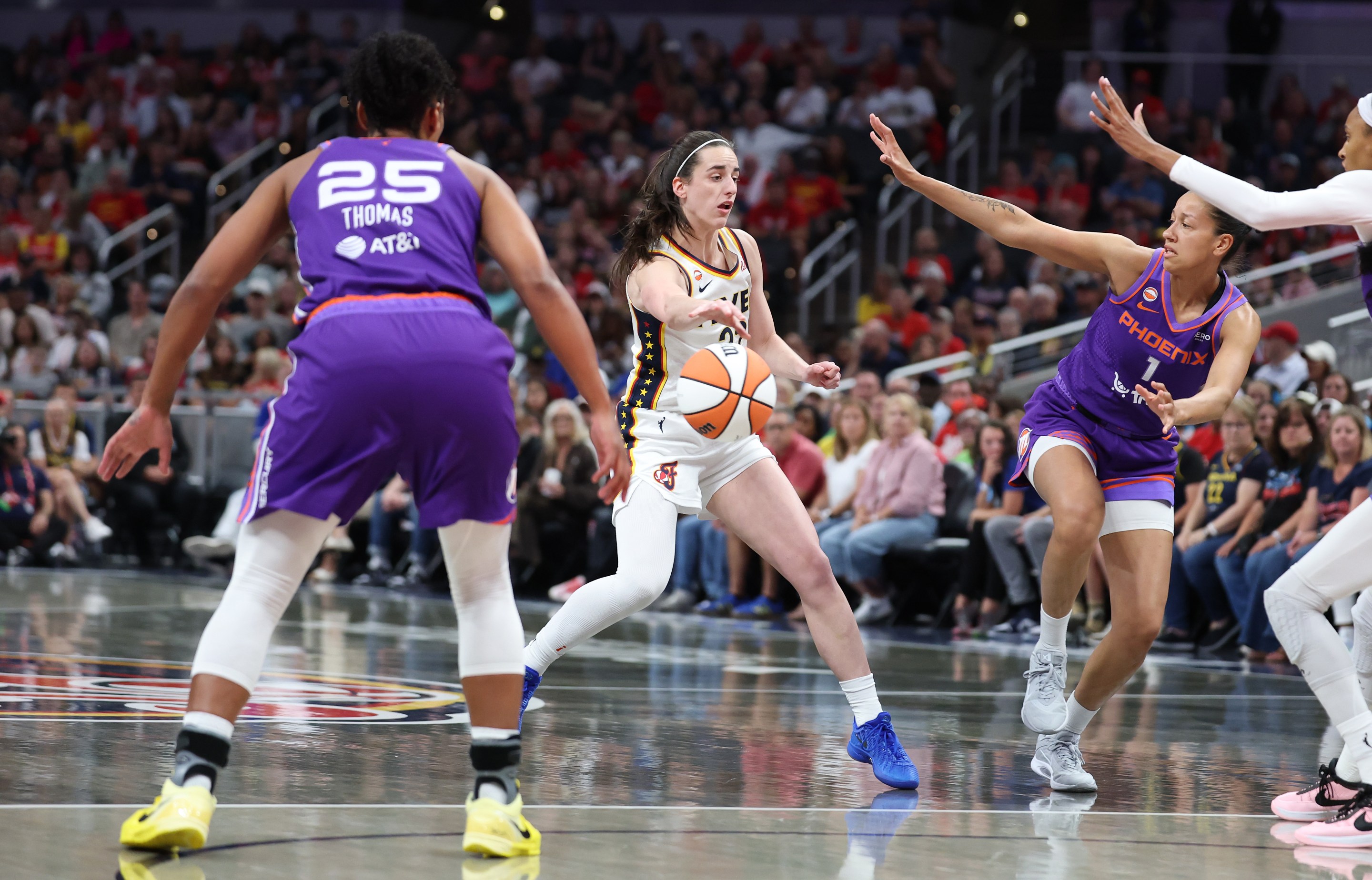
It's exactly the sort of play I would have paid no mind to, before opening my phone after the game and discovering it like Donald Glover walking in with his pizza boxes. Nothing much stands out about the sequence in real time. Caitlin Clark was definitely bothered by the contact Mercury forward Alyssa Thomas made with her in the scramble for a loose ball. The Fever guard took a second to get back up and said something to a ref when she got back to the other end of the floor. But play continued. No one on Indiana's bench moved, except for Lexie Hull, who was standing up for Boston's three-point attempt. Clark stayed in the game, but left in the third quarter with a back issue. Later in the second, she'd been fouled by Valeriane Ayayi on a three-point attempt; the officiating crew took a look at it during the game but didn't upgrade it to a flagrant for a reckless closeout.
Fever head coach Stephanie White told reporters Friday morning that Clark will miss Indiana's game Saturday against the (terrible!) Los Angeles Sparks because of the back injury, the same one that has given her trouble this season, and was at the center of a mini reporting controversy earlier this month. The clip from Wednesday, which followed a spicy game between these same teams on Monday, took on a much richer life online and in slow motion:
Caitlin Clark and every WNBA player should be protected from this targeted behavior.#WNBA #W #wnbabasketball #Basketball #Sports #caitlinclark #RG3 #RGIII #RobertGriffinIII
— RG3 (@robertgriffiniii.bsky.social) 2026-06-25T18:28:22.083Z
On Thursday, the WNBA announced it was assessing a retroactive Flagrant 2 foul to Thomas for "recklessly making contact with her fist to [Clark's] throat area," suspending her for a game, and fining her $1,000. I can understand why someone would not be inclined to give Thomas the benefit of the doubt. She shows as little regard for other players' bodies as she shows for her own. If the league wants to set a clear standard around contact to the head and neck, this response makes sense. The ever-zealous Clark booster Christine Brennan was less satisfied. At USA Today, she wrote:
The league’s paltry one-game suspension of Thomas, with a tiny $1,000 fine (she makes a base salary of $1.2 million a year) and no mention of punishment for the officials overseeing the incident, barely begins to address the problem. Ten games and a fine well into five figures would have sent a significant message. One game does not.
Clark is getting pummeled on a regular basis and WNBA commissioner Cathy Engelbert — who was given the greatest gift, in Clark, any women’s sports commissioner has ever received — has done precious little about it, until today, kind of, just a little. What an opportunity she had to throw the book at Thomas, who has a history of dirty play, including severely injuring Minnesota Lynx star Napheesa Collier’s ankle last year.
True: To suspend Thomas for almost a quarter of the 44-game WNBA season over this play would have sent a significant message. To publicly discipline officials for a non-call, another action with basically no precedent, would have also sent one. I don't know that either message would have been particularly reassuring or valuable.
If anything, the WNBA can be too guilty of taking its cues from erratic internet posters and reacting accordingly. Last year, after the Fever's season opener against the Sky, this press release turned up in my inbox:
NEW YORK, May 18, 2025 – The following is a statement from the WNBA regarding yesterday’s game in Indianapolis:
“The WNBA strongly condemns racism, hate, and discrimination in all forms — they have no place in our league or in society. We are aware of the allegations and are looking into the matter.”
I had no clue what it was about. What allegations? What matter? Later, the WNBA would close this investigation, one into a report of racist fan behavior, without finding anything. As Seerat Sohi points out at The Ringer, a WNBA whose fans trusted officials to call the game consistently might be able to project authority without having to send significant messages all the time.
One annoying thing about the WNBA season is that it coincides with precisely the time of year when college football and NFL commentators have their most free time. If Fever games constitute your only exposure to the WNBA, I can see why it might feel like the player who has the ball in her hand more often than anyone else in those games is subject to outsized defensive attention. If slow-motion Twitter clips of Clark being fouled constitute your only exposure to the WNBA, I can really see why it might seem like this stuff happens too often.
But between these episodes and the ongoing back issue, Clark is actually enjoying a very productive season, averaging 21.2 points, 4.0 rebounds, and 8.2 assists. The story of her on-court performance gets a bit warped, both by the annoying people obsessed with her and by the people annoyed by the annoying people obsessed with her. So cast that aside for a second. The officiating changes she's helped bring about are working for her. Clark's driving a ton, to great success. Her midrange game has come along nicely. No one generates more looks at the rim for teammates. She's unquestionably one of the best players in the league, and she should end up on an All-WNBA team this year. To me, the biggest issue with her defense, a real magnet for criticism this year, is that it gets her into foul trouble and takes her off the court on offense too much. If your point guard's defense is killing your team, that probably means there are some deeper issues with your roster, anyway.
Most of the questions reporters asked White in Wednesday's postgame press conference had to do with Clark and officiating. "I'm not sure if it had any impact on her health or not, but it was egregious, the fact that it was a no-call. I heard about it at halftime. I brought it to the attention of the officials at halftime," White said. Maybe she was glad for the distraction. I may not notice everything, but I did notice this: Wednesday marked a WNBA-record fourth time this season that the Fever have scored 100-plus points in a loss.