Several months ago, I received a text from my friend Giulia with news that every former musical theater nerd yearns to hear: she had an extra ticket to see a Broadway show. Namely, Chess: The Musical, starring Lea Michele, and did I want to go? Yes, I said, yes, I will, yes!
I knew very little about chess the game, and even less about Chess: The Musical, but the real draw was Lea Michele. Who wouldn't want to see the allegedly illiterate diva with indisputable pipes serenade you in the flesh? I knew Chess was scored by Benny Andersson and Björn Ulvaeus of ABBA, a group that knows how to write a certified banger. I'd heard some of these bangers in high school, like "I Know Him So Well" and "Heaven Help My Heart." And I knew the musical was, ostensibly, about chess. And yet nothing could have prepared me for just how much chess would be present, literally and metaphorically, in the musical Chess.
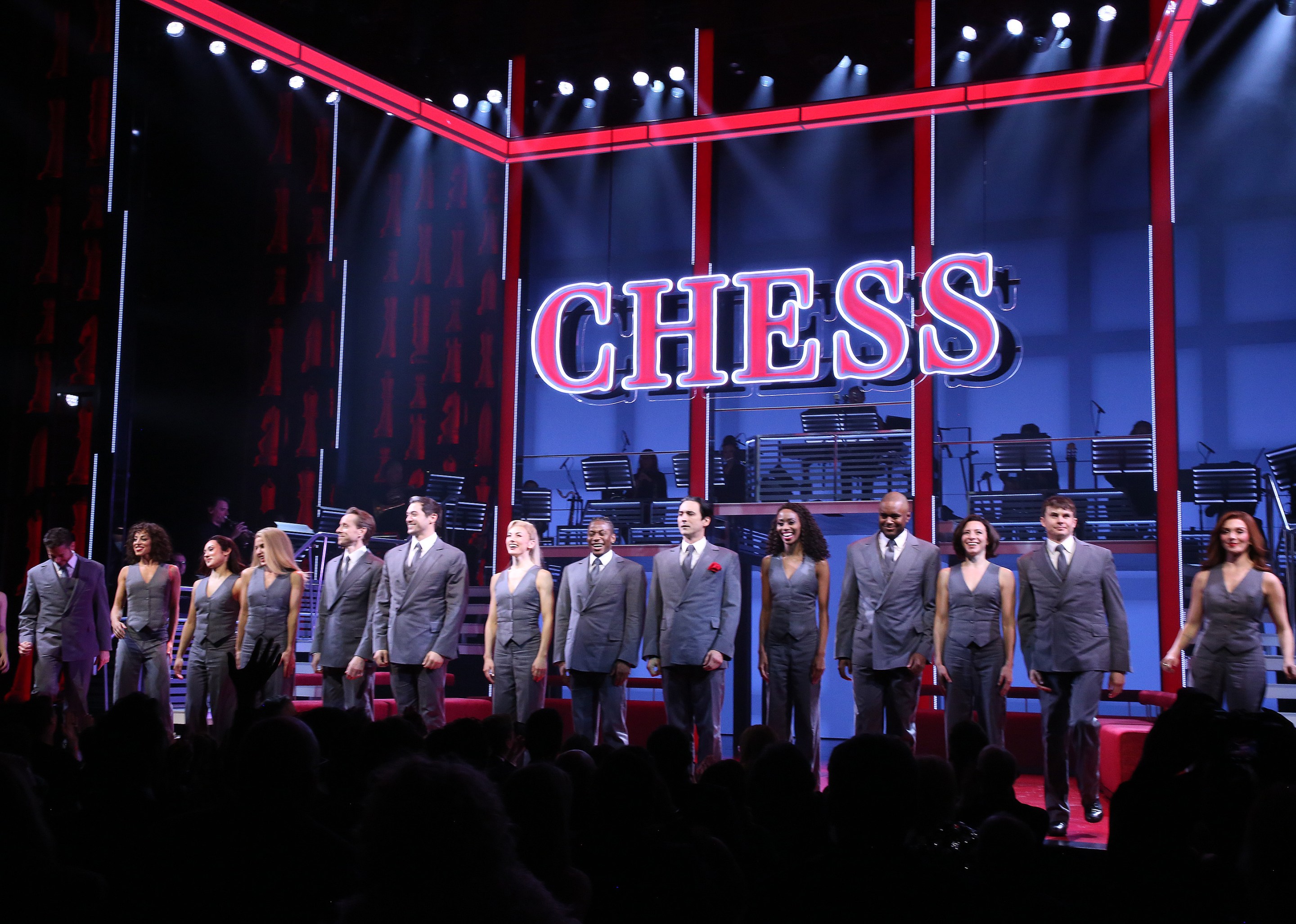
If you, for some reason, did not think Chess would be literally about chess, the set makes it clear. All the scenes take place in front of a series of repeating columns filled with chess pieces: knights, rooks, pawns, you get the picture. In case it is still unclear, there is also a big neon sign above the orchestra reading, you guessed it: CHESS. And then there is the opening song, called "The Story of Chess," wherein soloists explain, again, quite literally, the story of chess. As they introduce it: "Not much is known / Of early days of chess / Beyond a fairly vague report." Informative! Later on in the song: "The spirit and the speed of chess made swift advance / Through all of Europe's vital lands."
Once you, the audience member, are situated in your understanding of the hallowed origins of the great game, the show flings you into 1979, introducing the sexy bipolar American world champion Freddie Trumper (Aaron Tveit) and his sexy Soviet rival Anatoly Sergievsky (Nicholas Christopher). Freddie seems like an asshole, but it's only because his father walked out on his family when he was 12, a heartbreaking fact revealed mid-song in a way that I can imagine was written to garner pity, but unfortunately made me laugh. Anatoly, on the other hand, seems like a stand-up guy, the only ding against him the fact that the USSR will murder him if he loses the big chess match to the U.S. Oh, and he also abandons his wife and children for Lea Michele, but the musical seems to believe this to be a great strength, valorizing the American notion of choosing love and rejecting the conformity of your communist wife.
Between these two great men of chess is Florence Vassy (Michele), who once loved Anatoly, then pivots to become Freddie's girlfriend and "second," a term I understand to be a study-buddy–cum–coach, and then eventually returns to her entanglement with Anatoly in what might have been the most Russian-looking bed of all time. I swear there was a Fabergé egg on the headboard. The notion of a "second" was something that perhaps would have been more helpful for Chess to explain than the invention of the game, but there was simply no time, for there was more chess to be played.
I cannot begin to articulate how devastatingly underwhelming it was to watch Freddie and Anatoly play chess on stage. For one, there is no chessboard. There are no pieces, except for the ghostly ones illuminated in the set. Instead, Freddie and Anatoly stand in front of microphones like dueling comedians and recite their chess moves. "Knight to D5." "Bishop to A5." This is even less interesting than watching actual chess. And then, inevitably, one of our tortured chess boys would find himself transported into the throes of revelation and burst out into a song about how his father left him when he was a child.
In the musical's final chess match, an expensive-looking illuminated grid descends to enclose Freddie and Anatoly for half a song, presumably to make it look like they are chess pieces on a board, and then vanishes, never to be seen again. What was the point of that? Did it make the chess any more interesting? No. Did it make me nervous that it would hit one of the cartwheeling chorus members? Absolutely. There are 16 members of the chorus—the same number of a player's pieces in a game of chess, do you get it?—and as they pranced merrily around the grid, I found myself thinking, Oh, just like ... chess?
This is where I should mention that Chess was first released as a concept album in 1984 and then eventually expanded into a stage musical that debuted on the West End in 1986. Or perhaps I should call it a high-concept album, the concept being, of course, chess. The show opened to success in London, but floundered on Broadway and closed after two months. Many of the revivals attempt to fix what is thought of as the fundamental problem of Chess: the show's incoherent plot. In my viewing of Chess, however, I was not so much perturbed. Whenever I found myself confused—which was often enough—I just reminded myself that it's about chess, which I do not understand.
Frankly, the worst part of Chess are the parts that are not about chess, but about war, which the show argues is also a form of chess. What little energy exists in the show dissipates once the two non-chess characters walk on stage, who are essentially a CIA guy and a KGB guy. Despite the palpable erotic charge between them, they meet up merely to explain, in exhaustive detail, how these games of chess fit into the timeline of the Cold War. This is unsurprisingly more boring than watching two sexy men pretend to play chess. Whenever the CIA and KGB guy walked on, they launched into monologues about Cold War history to the audience that were delivered to us as if we were children. They explained the SALT II treaty, an agreement between the U.S. and USSR to limit nuclear weapons, and the Able Archer 83 exercise that heightened tensions between the two countries. And yet somehow the stakes of these conversations, despite concerning a potential nuclear apocalypse, felt far less thrilling than all the chess, which was not even that thrilling to begin with.
Something that Chess the musical loves to do is rhyme "chess" with "the U.S." Chess the musical also loves to make chess puns. "It's not just black and white," someone sings. Characters accuse each other of "gambits" and playing each other like "pawns." But Chess reaches the pinnacle of its singular conceit at the beginning of a song called "Endgame," in which the 16 chorus members sing the names of actual world chess champions as their faces appear on a Powerpoint presentation playing behind them. "Steinitz!" the chorus sings, as we watch a black-and-white photo of the bearded Bohemian-Austrian come into view. "Lasker!" they wail in front of the mustachioed German. "Capablanca!" they bleat in front of a photo of the dapper Cuban. And so on. This was, to me, the peak of chess in Chess, an interlude so uninterested in any fictitious plot or character or even tie-in to the Cold War, and therefore Chess at its besst.
I was lying earlier. The worst part of Chess is this character called the Arbiter, essentially a chess judge. This revival doubles his role, as both judge within the show and omniscient narrator, meant to help us understand the musical's plot through a sarcastic, present-day lens. To do this, he treats the audience like we are children, spoonfeeding us painfully unfunny jokes about the worm in RFK Jr.'s brain and Joe Biden. I did not enjoy this character, how he took stage time away from the sexy chess boys, and how some not insignificant part of the audience lapped up his non-jokes. Ha ha! they libbed out, hee hee! At one point, the Arbiter announced that Ronald Reagan had become president (not a joke, unfortunately), and a member of the audience unironically cheered.
This is when my experience of Chess transformed from a good bit of fun to an out-of-body experience. I had been doing my best to suppress my laughter throughout the show, out of respect for the performers and the audience members around me, who I assumed had paid hundreds of dollars to see this show. But I assumed none of us were taking the show seriously, because how could we? It was simply too much about chess.
But then, at the very end of the musical—sorry for the spoilers—Florence's long-lost father, who she believed was killed during the Hungarian Revolution of 1956, returns, against all reasonable doubts, alive! We learn this as a very old man wobbles on stage to embrace Florence. I turned to my side and saw the dazzling slick of tears on the cheek of a monied gay man and realized that some of us were genuinely moved by the musical. Rolling my eyes, I felt as isolated as a pawn. Let's get back to what matters, I remember thinking. Let's get back to the damn chess.
Should you pay to see Chess? Unless you are a millionaire, absolutely not. But should you luck into a ticket, if the spirit of camp is alive in your heart, make your way to the Imperial Theater before Chess closes, as it almost certainly will, in May, to witness what could be feasibly called the greatest musical ever to be made about chess. The vocals are brilliant, the vibes strange, and the chess omnipresent and inscrutable. What more could you want?