

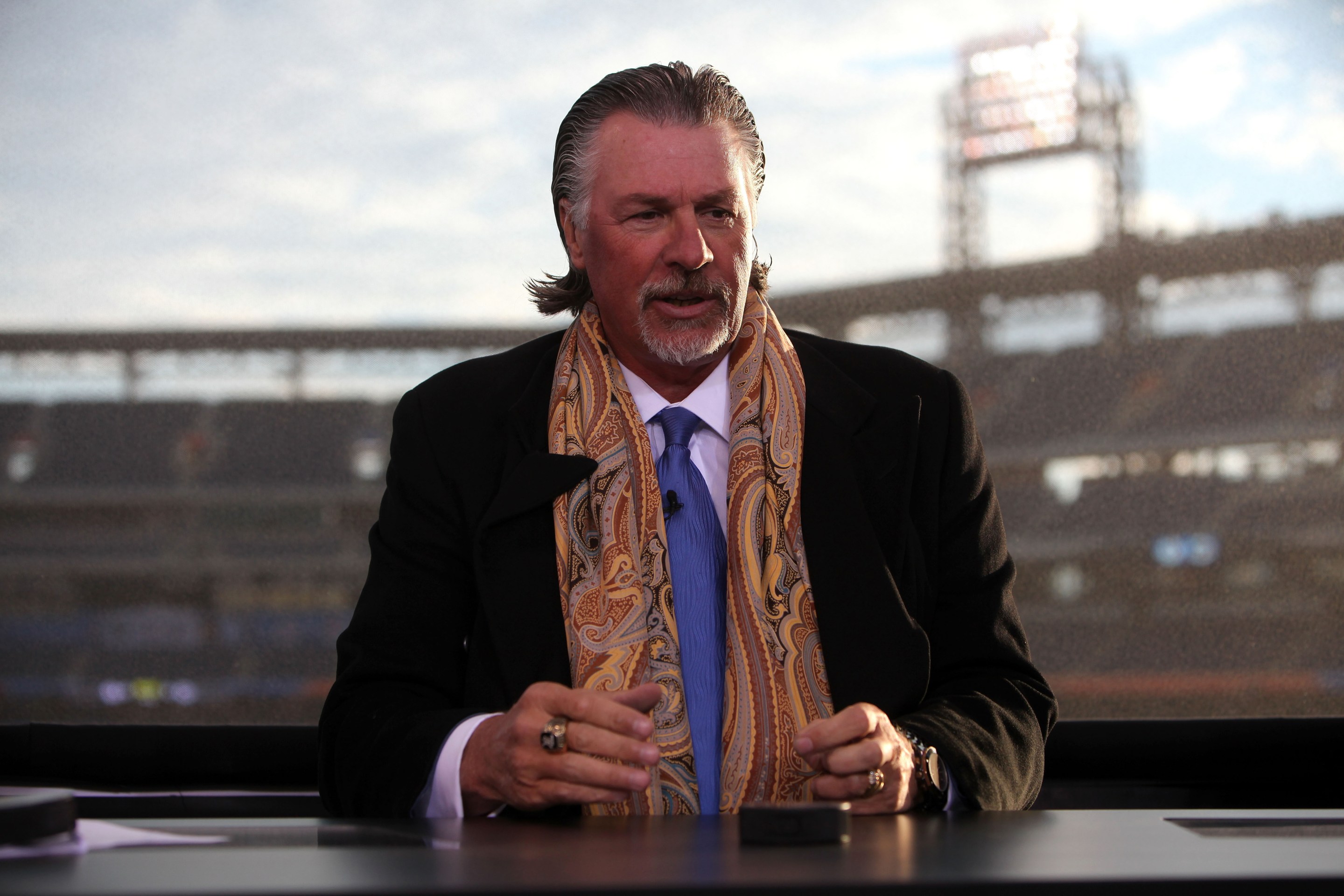
Go ahead and listen to this. (For the real perverts, use this one; you just know you're about to stay up until 1:00 a.m. for a particularly shitty Sharks–Mighty Ducks game.) What does it evoke? What do you think of? More specifically, who do you think of? You immediately know you're about to spend some time with Barry Melrose, the formative face—and hair—of an entire generation of American hockey fans.
Melrose died Wednesday at age 70, three years after he had been diagnosed with Parkinson's disease, which forced him to retire from ESPN, where he had spent more than three decades as the network's lead hockey analyst.
Paired with John Buccigross in the studio or Steve Levy in the booth, or sometimes Bill Pidto or John Saunders, Melrose was simultaneously a voice of reason and an outsized cartoon character. If a team was ass he'd say they were ass, in a way that few, more diplomatic broadcasters ever would. And he'd deliver his pronouncements from within an immaculately tailored suit and beneath one of the continent's finest and most immovable mullets. His style imparted a sort of hockey gravitas: You wouldn't trust a guy like that to sell you a used car, but you'd sure as hell trust him to tell you what's up with the Calgary Flames' power play.
A farm boy from Saskatchewan, Melrose was a relatively undistinguished defenseman who managed to hang around for nine seasons in the WHA and NHL, with Cincinnati, Winnipeg, Toronto, and Detroit. He immediately went into coaching upon hanging up the skates, and had some AHL success there, but it was still a shock when in 1992 the 35-year-old Melrose was named coach of the Los Angeles Kings. Those Kings had Wayne Gretzky but hadn't been able to get past the second round since the Great One had arrived.
Melrose's '92-'93 Kings were a nasty team to play, leading the Campbell Conference in shots on goal and leading the entire NHL in penalties taken. In the first round, down 2-1, Melrose made the bold move of benching veteran goaltender Kelly Hrudey for rookie Robb Stauber, who put up three straight wins to advance. In the third round, Melrose became public enemy No. 2 in Toronto, after Marty McSorley laid out Doug Gilmour in what some Leafs believed had been a hit ordered by the Kings' coaching staff. It would set the tone for the rest of the conference final, which L.A. won with a Game 7 hat trick from Gretzky. He'd later call it the greatest game he ever played.
That would be Melrose's high point behind the bench. The Kings would lose in the Final to Montreal, and after two more subpar seasons, Melrose was fired. Except for a very brief and unsuccessful stint in Tampa in 2008, Melrose was from then on a TV man.
Scott Van Pelt, Jeremy Schaap and the ESPN family remember Barry Melrose. pic.twitter.com/nX0HBMY8La
— ESPN (@espn) September 10, 2026
(I find it funny that Scott Van Pelt mentions Melrose's cologne early in this lovely remembrance by ESPN. I crossed paths with Melrose once—shared an elevator at a Winter Classic game; he was polite and affable—and the thing I remember most from the brief encounter is that he had cologne on, a lot of it, and it was strong.)
His playing and coaching careers finished, Melrose nevertheless managed to make himself a lifer in the sport he loved. He joined ESPN in 1995, when ESPN was about the only game in town for U.S. fans hungry for the sport. He was a fixture in the studio forever—even after the lockout and ESPN lost the broadcast rights to Versus. It said something about Melrose's stature that the network kept him on even if it seemingly otherwise pretended the sport no longer existed.
That was kind of a wilderness period for the league, too, but Melrose always offered a familiar face, a reassuring one that told viewers concerned about the future of the NHL that if you cared about hockey, you weren't alone. Multiple generations of fans grew up with Barry Melrose as their face and voice of the game. He's ingrained as deeply in the viewer's experience as any player ever was. I won't say it's hard to imagine watching the NHL without him—we've had a couple years to get used to that. But when ESPN drags out the old theme, a part of me still expects him to be there.