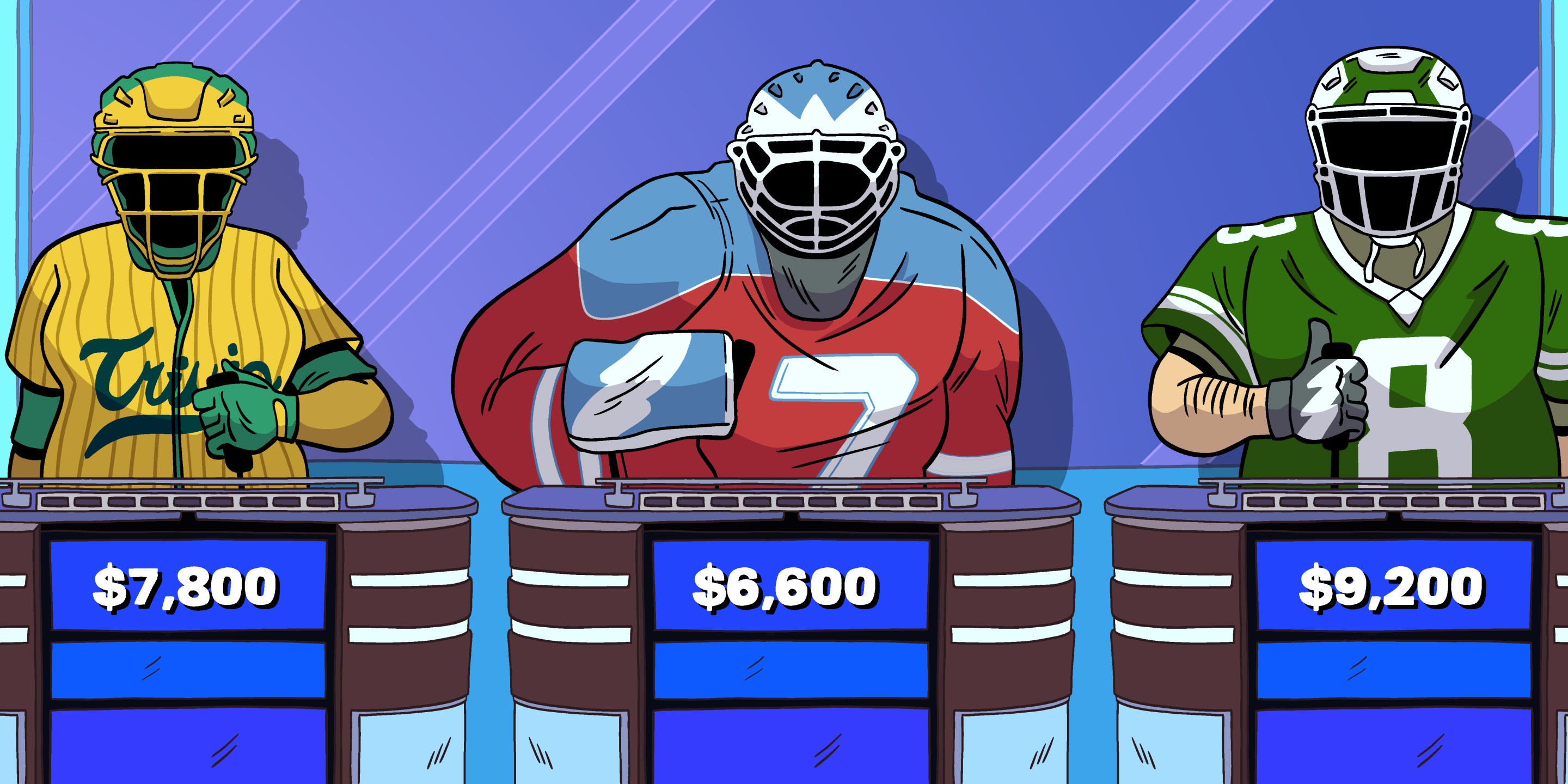

There’s a stereotype about Jeopardy! contestants: They can name the stars of 18th-century operas, but not the starting quarterback for the Buffalo Bills. It comes up again and again and again and again and again and again and again and again and again and again and again and again and again and again and again. Despite 40 years and nearly 10,000 episodes, this 2018 clip, one of the most viewed Jeopardy! videos out there, may have the largest cultural footprint:
A lot of the appeal in this clip is certainly in how the late Alex Trebek, a former sports correspondent, needled the three contestants for their collective inability to make even one guess. But I think people also love the War of the Worlds irony of it all: These geniuses weren’t stopped by our toughest geography questions, but they couldn’t survive a simple question about the Minnesota Vikings.
But are Jeopardy! contestants really that clueless about sports?
I’ve been obsessed with what Jeopardy! chooses to ask about for several years now, partially because I’m one of several former contestants who tried to hack their way to victory via some machine learning something-or-other. (I had mixed results, losing immediately on the main show in 2022 before being part of the team that won the first season of the streaming spinoff Pop Culture Jeopardy! last year.) But contestants’ collective lack of ball knowledge has never made sense to me. The most popular explanation I could find—that elite trivia snobs consider the topic beneath them—doesn’t square with my experiences in the world of hobbyist trivia, a world with a lot of people who are very eager to tell you that they’ve been on Jeopardy!. So I dug into the data I’d previously built for my own prep to find reasons why this knowledge gap seems to exist.
I found something you might not expect. While contestants are, in reality, pretty damn good at correctly answering sports questions, it appears that the game itself teaches its players that learning sports facts, if you don’t know them already, is not worth the effort. Jeopardy! often repeats itself, hitting many of the same beats over and over again with only slight variation. It’s unavoidable in some cases—Shakespeare hasn’t written anything new in quite a while now, and, give or take an occasional Basquiat clue, “notable painters” isn’t a list that’s changed much since Trebek began hosting the program in the mid-1980s. As long as Jeopardy! wants to ask about those topics, they’re only going to have so many possible answers. Someone who memorizes the periodic table one time is basically good forever. Meanwhile, if you’ve ever played a dive bar’s outdated copy of Trivial Pursuit and had to answer questions about, like, the Nash Ramblers or Eydie Gormé, you already know that pop culture content turns over at a much quicker clip.
The above table shows the frequency over the past decade that the correct answer to a Jeopardy! question had never been an answer before. (The full explanation of how I produced this data is available here.) Ignore “miscellaneous”—a label which includes a lot of oddball answers like “Mutiny on the Bounty Hunter S. Thompson”—and most of the top of this list is mass culture, including the “sports & games” group (which is, if you’re curious, 85 percent sports, 15 percent games). Topics with this higher churn create two problems for anyone trying to bone up on the subject: There’s both more to learn if you haven’t been keeping up, and it’s less obvious what, specifically, you’re supposed to catch up on.
For more static topics like history and geography, Jeopardy! viewers, who often eventually become contestants, can learn common answers by repetition. I know who Samuel Pepys is, because they ask about Samuel Pepys all the time. You know who they’ve never asked about? Christian Pulisic.
This isn’t unique to sports as a genre of question, and sports facts don’t even have the shortest shelf life. Pop culture topics are all slippery like this, as are some of the more “serious” topics like politics and current events. Where sports trivia really stands out is that, on Jeopardy!, being knowledgeable of it is less profitable than nearly every other category.
If you’re unfamiliar with Jeopardy! gameplay, the questions in the Double Jeopardy round are worth twice as much as the Jeopardy round, which makes what gets asked about in that round twice as important to winning the game. There are no official rules or publicly available guidelines about how the show’s writers pick what gets asked about, and they do not give anyone a study guide. But there are definitely patterns I’ve noticed as part of this analysis. There’s pretty much always one literature category per episode, for example, and you can expect to see one pop culture–centric category per round, but almost always just one. Sports topics appear to be part of this pop-topic timeshare; it’s one of what the writers consider an option to be the “fun” category of the round. That shakes out to, on average, a dedicated sports category being on the show a bit more than once per week. This isn’t especially rare as these things go; it’s actually twice as often as a lot of what people think of “Jeopardy! topics” like classical music and fine art. The problem is that they’re nearly never where the real money is:
Across the entire multi-decade run of the show, through different production companies, hosts, writers’ rooms, and executive producers, the sports categories are rarely in the Double Jeopardy round, meaning sports knowledge is consistently among the least rewarded trivia skills on Jeopardy!.
It’s even more noticeable in the past few years: Either to make the game more accessible or because the monoculture collapsed, expertise in television, movies, and pop music has been rewarded more generously since the turn of the century. But even as similar topics have gone up in value, the sports clues still remain decidedly low-equity. So far this decade, they’re worth less than ever.
So: Sports isn’t asked about particularly often, and it’s relatively unprofitable when it is. Again, I think players know this intuitively, because the show has been like this for many of their entire lives at this point. Maybe they picked up the trend by watching Jeopardy! for decades. Maybe they just know it by reputation, because Jeopardy! is a cultural institution. Either way, one day they get the call, and now they’ve got a month to cram for everything. Sports knowledge isn’t going to win or lose them the game. Why bother?
This all so far only explains why non–sports fans wouldn’t put in the time to study flashcards for the life and times of Dave Stieb, not why none of these geeks are ever geeks in the Howie Schwab mold. It’s especially odd if you’re someone who pays attention to those little pre-game introductions, which makes it clear that the show intentionally casts an extremely broad net across the country. These people, with their random-ass job titles and widely spread hometowns, seemingly have nothing in common except being know-it-alls about everything besides one of the most common interests in America. If the stereotype was true, it’d be proof of a nerd-jock binary: Jeopardy! contestants are nerds, sports fans are jocks, and you’re either one or the other. You cannot know ball and ballet at the same time.
Except of course you can. The shortest answer to why Jeopardy! contestants are bad at sports questions is: They're not.
Jeopardy! contestants are, both on aggregate and when accounting for question difficulty, totally fine at the sports questions. The above is the percent of the time the correct answer is provided by anyone on stage besides the host, but it holds up just the same when you look at the times people buzzed in and guessed wrong.
In some ways, I hope this data is reassuring: I’ve seen people worry that they could never hang on the show because they don’t know, say, Renaissance painters, and while you should probably brush up on those guys given the opportunity, that’s actually a pretty typical knowledge gap. Shoot for the stars. Take the Anytime Test.
Make no mistake, Jeopardy! contestants are definitely nerds. But they’re nerds who live in the same world as everyone else, and their familiarities and interests on the balance are not going to be that different. Some contestants will go home afterward and listen to their favorite Mahler symphony. More will watch the Giants game.
As ridiculous as nerd-jock essentialism is, people really do believe it, and I think it’s a big part of what created this meme in the first place. Dividing “hard” and “important” fine arts content from “easy” and "frivolous" mass media facts is a preexisting cultural attitude, not a construct that was invented by game shows. As much as Jeopardy! perpetuates it, the show isn’t to blame for this so much as it’s just far and away the biggest and best-known “trivia” thing in the United States and, probably, Canada. Imagine what people would think if they knew the slang term used for pop-culture content in Quiz Bowl circles, where the actual elite trivia snobs compete, is literally “trash.”
And that’s very silly! Nearly none of this information has practical value. It’s literally, y’know, trivial. Questions can be as hard or easy as you want them to be. Sports questions are not inherently easier or harder than any other topic, as if the roster of the ‘86 Mets fits more neatly into the human brain than the plot of Rigoletto. Just a few months ago, the popular trivia site LearnedLeague asked these two questions back to back:
- What former Prussian city had, in Leonhard Euler's time, seven bridges that crossed the Pregel (Pregolya) River, connecting the city's northern and southern portions with the Kneiphof (Immanuel Kant) and Lomse (Oktyabrsky) islands?
- What is the team name of Portland's National Women's Soccer League franchise, a pointed nod to the city's nickname dating back to the late 19th century?
The correct answer to the Euler question was provided by 30 percent of the site’s userbase. The NWSL question, asked to the same group, rife with game show contestants past and future, was also answered correctly by 30 percent.
(If you are a member, by the way, please check out my quiz about Defector on Feb. 10.)
There’s also a world of intentionally deep-cut sports trivia for the real heads, such as the Benchwarmers podcast and the especially brutal Apocalypse Sports Trivia, if you want the challenge of recognizing Markieff Morris by his game logs or naming the last seven Pitt Panthers to go in the NFL Draft’s first round. All this is to say that sports questions can be hard. The Jeopardy! production team definitely knows this: The show’s executive producer since 2021 has been Men in Blazers co-founder Michael Davies, who’s on the record about trying to bring back Sports Jeopardy! this year. Maybe the writing team is saving their fastballs for that, but they could throw a few of them into the mainline show if they wanted to. Nothing’s stopping them.
But more than any of that, the whole “don’t know sports” thing is probably just availability bias. Imagine you’re watching Jeopardy! and all three contestants miss a question about, say, the ancient Greek historian Xenophon. If you didn’t know it yourself, it doesn’t even register as something a normal human being could possibly know. But then the same three contestants miss a question about Bo Jackson, and that’s a lot more surprising, because you know about Bo Jackson. That’s an actual famous guy! What planet are they finding these dorks? And so along with probably a hundred thousand other people, you get your I-Beat-The-Smart-Kids moment. Then all the surprised people pass the clip around to the point that Bo Jackson feels compelled to forgive them. The sports misses are just what make headlines.
Anyway, a few months after the “Talkin’ Football” fiasco, there was another category titled “Uh-Oh, Talkin’ More Football.” That day, the contestants went right for it. They went four for five.