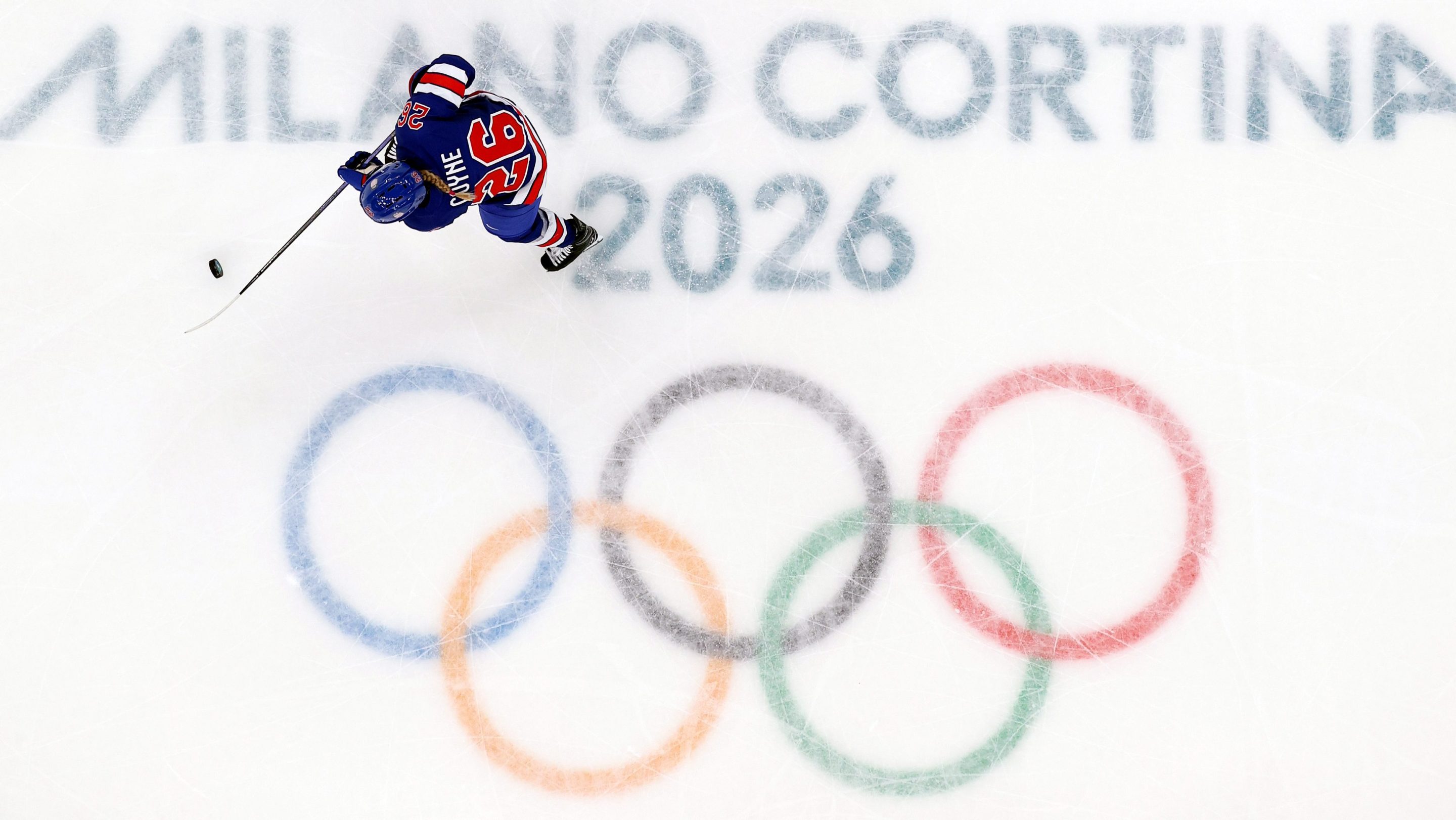
On Thursday, the U.S. women’s hockey team will take on Canada in a battle of the women’s hockey superpowers. Every single Olympic gold medal in the history of the sport has been won by one of these two countries. If you're rooting for the U.S., it means watching a team stacked with talented and innovative players. Team USA is undefeated and riding a record 331-minute shutout streak. Four-time Olympian and captain emeritus Kendall Coyne Schofield cuts an impressive figure across the sport: two-time PWHL champion, a leader of the labor movement that led to the league’s creation, and the first woman to compete in the NHL All-Star Game's skills challenge.
Would you know this from watching the NBC broadcast of Team USA’s games? Doubtful. You'd probably know more about Coyne Schofield’s baby.
Don’t get me wrong. Her toddler, Drew, is adorable. I’m a new aunt in my late 30s, and I could absolutely eat him up. But when that puck's on the ice, what I really want to hear about is why his mom is one of the best women’s hockey players in the world.
This isn’t a new problem for NBC Sports. In years past, the commentary would veer off track to talk about Amanda Kessel’s brother, or Hayley Scamurra’s father. Alex Carpenter has built a career in her own right, but her first touch of the puck still beckons the play-by-play person to bring up her father and his record. It’s a fun fact if you bring it up once, but at some point the repetition morphs from fun facts to a sense that these tidbits are viewed as more important than the players’ own accomplishments. And this has been a longstanding issue in women’s hockey.
For years, one of the worst offenders was the polarizing pundit Pierre McGuire. As an ice-level analyst, McGuire drew the ire of women’s and men’s hockey fans alike for his reliance on an impressive rolodex of player history and a lack of personal space in his interviews. When it came to his calls of women’s hockey games, his tendency to bring up an athlete’s spouse or family members inspired at least one drinking game. In 2019, McGuire reached a new level of notoriety when he was joined between the benches by Coyne Schofield in her broadcast debut. McGuire told the Olympic gold medalist, “We’re paying you to be an analyst, not to be a fan tonight!”
— CJ Fogler 🫡 (@cjzero) January 31, 2019
McGuire later apologized, and Coyne Schofield posted a statement saying she knew McGuire respected her “as a hockey player, a woman, and a friend,” but, after watching the video back, she could understand why people thought it was inappropriate. Later that year, McGuire was removed from the primary broadcast team, though he’s still a part of NBC's Olympics coverage online.
At least he isn’t calling the games live. This Olympics, the lineup for the medal rounds has been play-by-play commentator Kenny Albert and analyst and gold medalist A.J. Mleczko, with gold medalist Jen Botterill between the benches. Mlezcko and Botterill won a national championship at Harvard, and previously worked together on MSG Network’s coverage of the New York Islanders. It’s a stacked lineup that should easily crush this coverage.
Early on in Monday's coverage of the U.S. vs Sweden, they did. The broadcast of the semifinal began with a package designed to induce flashbacks to anyone who watched the U.S. lose to Sweden in a shootout in the 2006 semifinal. Then Albert and Mleczko set the table with all the relevant information you might need if this was your first chance at these Olympics to catch women’s hockey. Overall, the first period played out like any other hockey broadcast. But with under seven minutes to go in the first period, the broadcast started to get away from hockey.
At a break in the action, reporter Kathryn Tappen shared a quote from U.S. men’s player Matthew Tkachuk about the women’s team’s leading scorer Caroline Harvey, comparing her to Bobby Orr. The broadcast put up a graphic of the quote, and the camera panned to Tkachuk and his brother in the crowd. From then, the broadcast’s concerns for the game seemed to slowly melt away. Albert kept talking about the Tkachuk brothers and the men’s team, even as Sweden worked the puck around the U.S. zone and put a shot toward net. The talk finally moved back to the on-ice action when the U.S. offense started putting more shots on net, normalizing the broadcast as the speedy children went to work on padding their lead.
Then came a cute clip of Coyne Schofield’s son giving her a good-luck fist bump. The adorable, heart-warming moment that does serve as a part of Coyne Schofield’s gameday routine then turned into an extended conversation about her husband Michael and her son while her team kept playing. When a stoppage came, the production rolled a clip from the USA-Canada game a week before, when an errant puck fell at Michael Schofield’s feet in the stands. He gave the puck to Drew and held him high, Simba style, as surrounding fans applauded. It’s a great clip for social media, but, having already seen it when it was fresh from the truck last week, and again when the U.S. played Italy in the quarterfinals, I was about done with hearing about Baby Drew Simba while his mom was busy making history.
The USA Hockey moms club is incredibly exclusive. Coyne Schofield is the first mom to be on the U.S. Olympic hockey team since Jenny Potter retired after the 2010 games. There are no others. There will be in the future, thanks to Coyne Schofield: She took part in the 2017 Team USA boycott that secured maternity leave protections for new mothers. As a leader in the PWHPA movement that gave way to the PWHL, she was part of negotiations for the players’ collective bargaining agreement, securing child care and maternity leave at the professional level. While a mention of Potter made the broadcast, I have yet to hear the story of Coyne Schofield’s many contributions.
So, sure, roll the baby clip again.
The U.S. went into the first intermission with a 1-0 lead, by the way. It was a tight margin for an anxious fan, but not unusual for this team. At these Olympics, they’ve tended to whale on their opponents late in the second period.
As the second period began, the broadcast reset. They talked about hockey again! Albert was sharp on the call, adorable baby anecdotes seemingly behind him. Sweden came out hard, hoping to draw level, prompting a welcome conversation about all they had endured to get back to the semifinals for the first time since 2014. Botterill brought up the team boycott of their federation to get better treatment. These are the kind of things someone on the beginning of their hockey-loving journey might want to know, and the broadcast meets a moment in the way that it should.
But, once again, the broadcast shifted after Hannah Bilka and Taylor Heise connected on a bang-bang play to stretch the Americans' lead to 2-0. They showed the Tkachuk brothers cheering on the moment. A couple of minutes later, in a stoppage of play, the broadcast again went to the Tkachuks. This time, viewers got Brady Tkachuk with an earpiece. He could only somewhat hear the broadcast, and viewers could somewhat hear him. Play resumed on the ice, but the broadcast split the screen, and the sound stayed with Brady Tkachuk, who answered questions like "How’d you decide who would talk to us?" while the U.S. went on the rush in the Swedish zone.
When the interview finally ended, Botterill and Mlezcko broke down a play by Joy Dunne that got missed during the Tkachuk interview. Albert wrapped up the segment not by mentioning Dunne’s two goals and five points in the Olympics, or her older sister Jincy, who played for the U.S. in 2022. He instead landed on the most salient fact being her hometown of St. Louis—because she shares it with the Tkachuks.
I’m no newbie to watching the Olympics, and every fan knows that certain unwritten rules apply to these quadrennial events. If Snoop Dogg is in the crowd, the camera is going to cut to him. If Martha Stewart is there, we’re cutting to her, too. Celebrities must be shown, cross-promotions must happen, and sponsors must be appeased. I get it. But at some point, we are here for the sports, too. At the highest level of sport, the story of the broadcast shouldn’t be about the famous people in the audience. By all means, cut to Jason Kelce holding a tiny beer bottle in his giant hands, but let him be a spectator.
A few hours after the U.S. clinched their spot in the gold medal game, the same commentary team took to the booth and the bench to find out whether Switzerland or Canada would join them. The broadcast for that game was, overall, shockingly normal. They mostly talked about the players and the action on the ice, a thrilling win for Canada. The U.S.-Canada rematch for gold was official.
The U.S. is favored to win gold today, but the lore of this matchup demands respect for Canada defending their title. This intense and storied rivalry provides a bountiful spread of stories that can be told on the broadcast. Or maybe I’ll just see, for the 10,000th time, that clip of Michael Schofield holding a baby.